Skills-Based Hiring Frameworks Reshaping Engineering Talent Acquisition
Most companies claim skills-based hiring; only one in ten actually do it well.

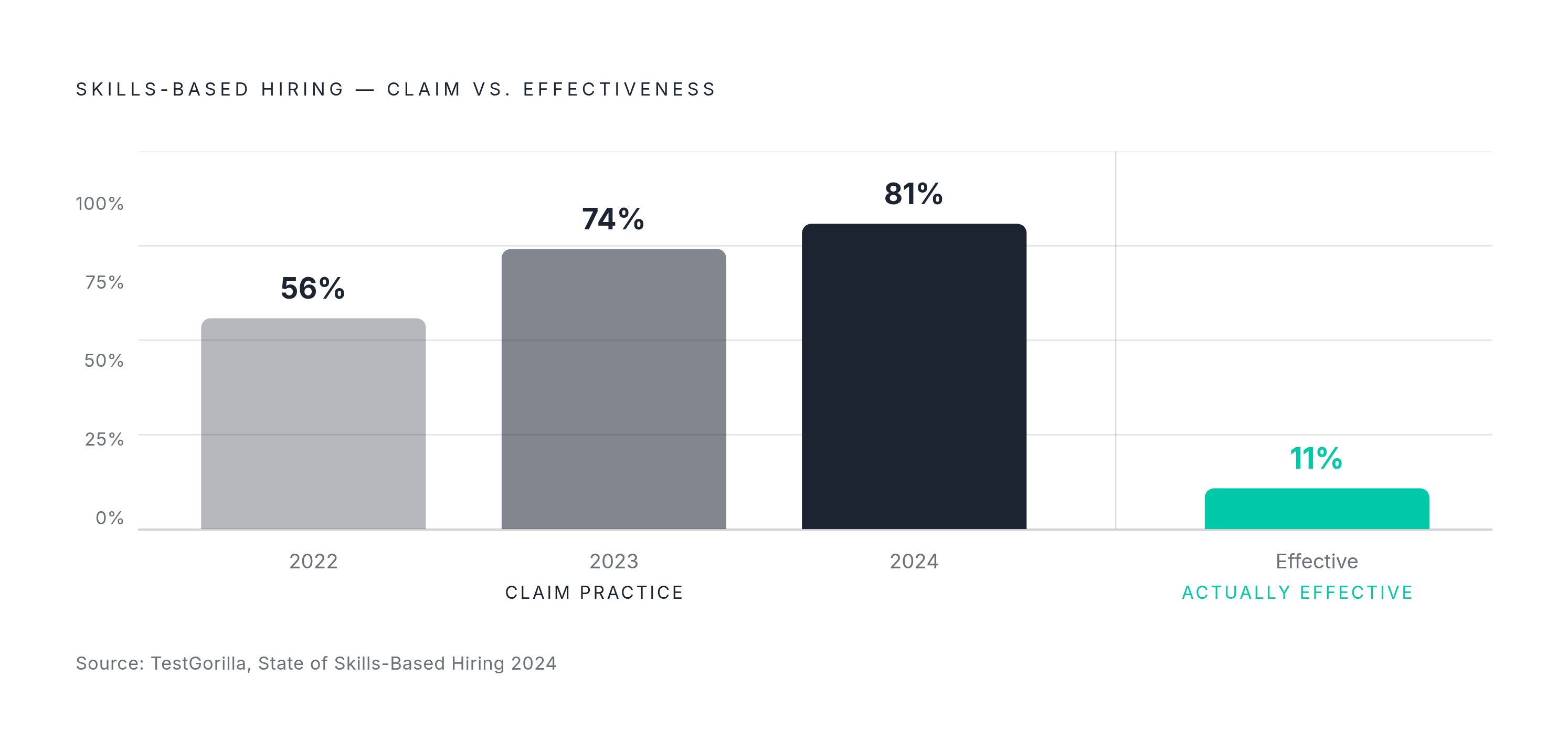
Skills-based hiring in engineering went from niche experiment to default policy in about three years. Data from wilsonhr.com tracked adoption climbing from 56% of organizations in 2022 to 74% in 2023 and 81% in 2024. Saying you do something and doing it well are two different things, and right now, most of engineering hiring lives in the space between those two claims.
Gartner surveyed recruiters in November 2024 and found only 11% believed their organization was actually effective at skills-based hiring. Eight in ten companies claim to be doing this. Fewer than one in ten think they're doing it well, and I've sat in enough hiring retros to know which number to trust. A mis-hire in a senior backend role, or a wrong read on how deep an AI/ML candidate's expertise really runs, doesn't cost the same as a bad resume screen for an entry-level generalist. It costs a quarter of missed sprints and a rewrite six months later.
What "skills-based" actually means in an engineering hiring context, and where most programs stop short
The idea is easy enough to state: care less about where someone went to school, more about what they can actually build. It has become the defining move of the current market. Building it is a separate problem, and a much harder one.
A real program needs three things running at once, not stacked in sequence. The skill has to be defined precisely enough to test, something closer to "can design and debug an async data pipeline under production constraints" than "knows Python." Someone then has to build or find an assessment that surfaces that actual capability rather than a proxy for it, the way a LeetCode puzzle rewards pattern memorization over engineering judgment. And hiring managers need training to read the output of that assessment instead of grabbing the resume the moment the conversation turns ambiguous. It always does, somewhere around the twenty-minute mark.
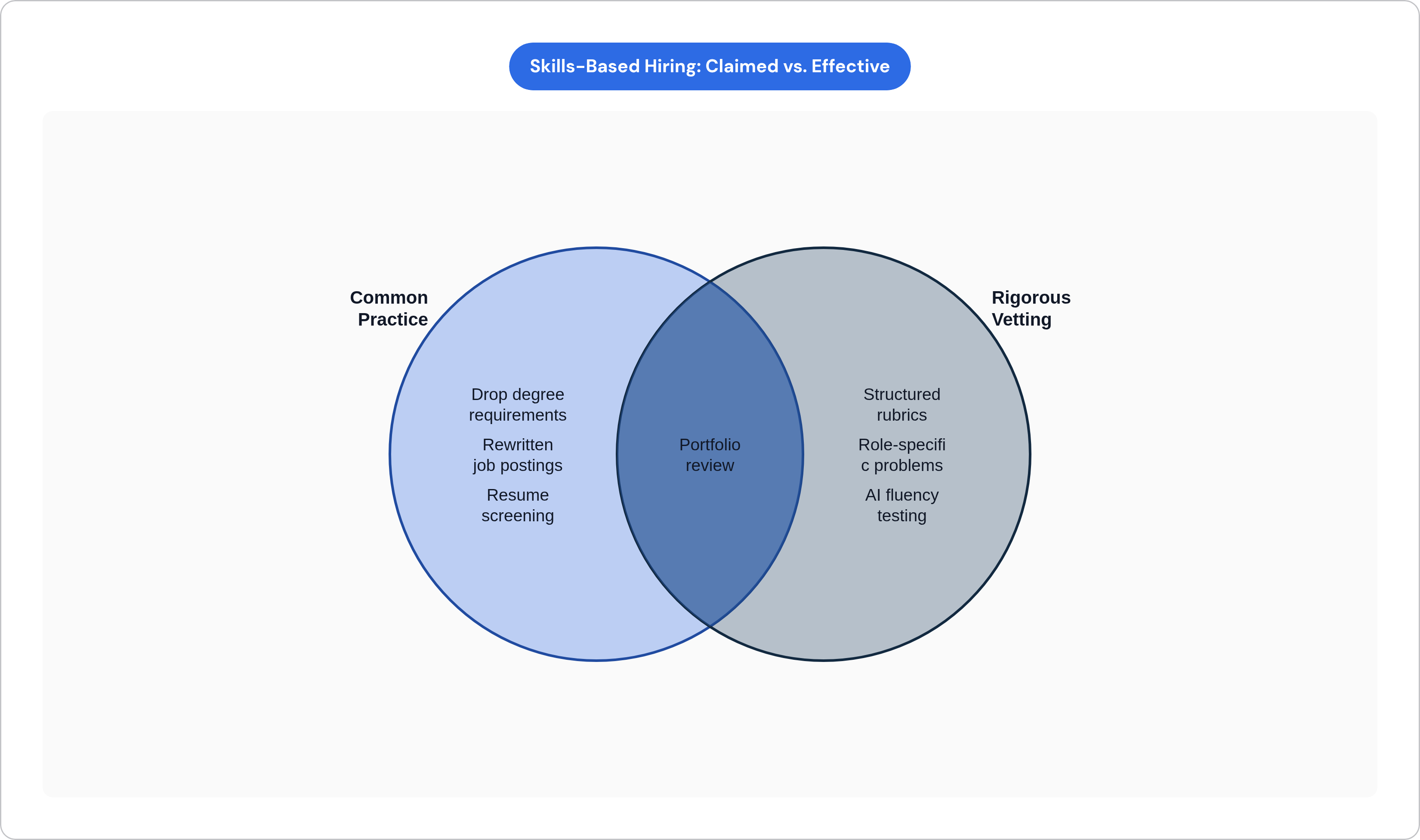
Most programs nail the first move and stop there. Drop the degree requirement from the posting, call it a day. Meanwhile the interview loop behind it never changes: heavy on resume screening, heavy on "tell me about a time" questions that go nowhere specific, light on anything that would surface real capability. Practical problem-solving tests, portfolio review, and hands-on builds are the actual mechanics here, and none of that appears just because a job posting got rewritten.
What you get, more often than not, is a credentials-based process wearing skills-based language. Non-traditional candidates get let into the funnel and then filtered out anyway, the moment evaluation leans back on university pedigree or a past employer's logo instead of evidence of what someone actually built. Ask a hiring manager how they'd tell a bootcamp grad apart from a four-year CS grad, or how they'd distinguish someone who sounds fluent from someone who's built the thing under real constraints. Nine times out of ten, you get a shrug.
Why measuring whether skills-based hiring is working remains the exception
Only 28% of organizations measure quality of hire at all, per Gartner. That single number explains most of what's wrong here. Without it, nobody can tell a skills-based process that actually works apart from one that just reads well on a careers page.
The wider picture backs this up. Just 5% of organizations call their talent acquisition strategy world-class, and 51% are still running reactive hiring, according to the 2025 Future of Talent Acquisition Report from rival-hr.com. Reactive hiring and rigorous technical assessment sit in tension. Building a meaningful evaluation takes time, and filling a seat under pressure doesn't leave room for it. Give a hiring manager six weeks to close a role, and the rubric loses to a gut read on the resume almost every time.
No data on which assessments actually predicted on-the-job performance means the same flawed loop runs again, gets relabeled "iteration," and nothing underneath it changes. Meanwhile the pressure keeps building from the other direction: business transformation is driving demand for engineers with AI and ML skills right as most TA teams realize they can't validate those skills at all, a tension that ere.net lays out without much softening. Recruiting and retaining skilled technical staff comes up as the top business challenge for 2026, named by roughly half of organizations in software.iquasar.com's software development industry challenges report. None of that is a coincidence.
What rigorous technical vetting actually looks like — and why it is rare
Strip away the policy language, and rigorous vetting comes down to a handful of concrete moves. Structured technical screens with a defined rubric rather than a freeform "walk me through a hard problem." Role-specific problem sets calibrated to what the job will actually throw at someone: latency budgets, a legacy codebase nobody wants to touch, requirements left half-written on purpose. Portfolio or code review that asks why a decision got made, not just what shipped. A look at how someone debugs alongside how they build, because debugging is exactly where surface familiarity runs dry and real understanding either shows up or doesn't.
Add one more line item now: a separate check on AI fluency. Can the candidate direct, verify, and correct AI-generated code, or do they just take whatever the model hands back and ship it?
None of this is common, and the reasons are structural, not a failure of will. Building a valid technical assessment eats senior engineering time, and that time belongs to the engineering org, not to talent acquisition, which usually can't requisition it on demand. Calibrating a rubric against real downstream performance needs longitudinal data that, per that 28% figure, most companies simply don't have. Interview loops built to surface real skill take longer, and that creates friction with hiring managers optimizing for speed, which is understandable given what their bosses actually measure them on.
The organizations getting this right treat vetting the way a product team treats QA: a core function with its own budget and its own headcount, folded into a recruiter's already full week only as a last resort elsewhere. Companies clearly believe in skills-based hiring at this point. What most of them lack is the machinery to run it.
How AI fluency has complicated skills definition just as organizations were beginning to agree on frameworks
AI adoption inside engineering teams stopped being a fringe statistic a while back. According to uvik.net, 90% of software development teams now use AI at work daily. Further data from Q1 2025, per uvik.net, found 82% of developers using AI tools weekly, with 59% running three or more tools at once. AI fluency moved from specialization to baseline fast, and any skills framework that hasn't caught up is stale on arrival.
Testing for it doesn't look like testing SQL proficiency. Part of it is judgment: knowing when an AI's output is wrong, incomplete, or confidently making something up. Part of it is workflow, and whether a candidate has actually built a setup that multiplies their output, or is simply performing AI use because that's what they think the interviewer wants to see. The research on this is blunt about how much results vary; The research on this is clear that results vary considerably from one engineer to the next, even when the tools are identical. Team-level productivity gains stay lumpy even across teams that look equally "AI-enabled" on paper, for exactly that reason.
Most skills-based frameworks in use today were built for static competencies, Python, SQL, systems design, things that don't shift much year to year. AI fluency moves every time a model ships, and that mismatch bites hardest exactly where the stakes are highest. hirecruiting.com ranks AI and ML engineers as the most sought-after specialization of 2025, meaning demand peaks precisely where the industry's shared definition of the skill is least settled. Leading organizations have trended toward continuous upskilling in AI and adjacent technologies, which is really just an admission that nobody walks in the door already finished learning this stuff.
Why the talent pool expansion that skills-based hiring promises depends on vetting quality, not just access
The pitch for skills-based hiring always came bundled with a promise about access. Drop the degree requirement and the credential filter, and the pool opens up to bootcamp grads, self-taught engineers with strong open-source histories, and talent markets that never fed into the usual university pipeline to begin with.
There's real substance behind that promise. Full-time independent freelancers roughly doubled between 2020 and 2024, and a meaningful chunk of that growth sits in engineering, capable people who never picked up the institutional résumé lines that old screening rewarded. Latin America makes the case well. The region built a deep, technically strong engineering base over the past decade, much of it without the U.S. university credentials a credential-first process defaults to favoring. A company that verifies skill directly, instead of leaning on resume signals, can bring on a senior engineer out of Medellín, Buenos Aires, or Mexico City in weeks, against the six-plus months a comparable San Francisco search often takes. Nearshore hiring also buys distributed teams overlapping working hours, which research on distributed team output keeps flagging as a real precondition for shipping on time.
None of that access matters if the vetting underneath it is weak. If "skills-based" only shows up in the job posting while the evaluation loop still filters on the old signals, the pool grows on paper and the same candidates get screened out for the same old reasons, just with different language attached to the process. The companies that built real vetting infrastructure, or partnered with a firm that already has one, are the ones turning a bigger applicant pool into actual hires. Everyone else just gets the vocabulary.
Staff augmentation as an alternative path through the execution gap
Given how hard internal vetting infrastructure is to build, a lot of companies just route around the problem entirely. Research cited in reco-vn.com's engineering staff augmentation analysis puts the number close to 62% of enterprises using engineering staff augmentation to absorb workload swings, with 64% of large organizations leaning on it to support transformation programs.
The appeal is straightforward. The vetting already happened on the augmentation partner's side, and that partner's business depends on the assessment being real rather than for show; a bad placement is their cost, not just the client's. Augmented engineers also step into the client's actual process on day one, same standups, same repo, same code review, so skill shows up in practice rather than on paper. If there's a mismatch, it gets caught and fixed fast, without the legal and financial weight of unwinding a full-time hire.
The market size says how structural this has become. Mismo.team's industry analysis values the IT staff augmentation market at roughly $150.5 billion in 2024, with substantial growth projected through 2032. AI adoption pressure and cost pressure are widely cited as the two forces pushing companies toward flexible staffing fastest. A related, fast-growing variant is fractional engineering leadership: fractional CTOs and fractional architects brought on for a fixed set of hours a week, common at Series A and B startups that need senior judgment before they can justify a full-time executive, and at larger enterprises running a transformation program that needs architecture leadership faster than a search would ever deliver it.
Augmentation works around the internal vetting gap more than it closes it. Used well, it buys a company time to keep shipping while it slowly builds the muscle to hire differently on its own clock.
What closing the execution gap requires in practice
The 11% of organizations Gartner flags as actually effective at skills-based hiring share one trait: they treat assessment as ongoing operational work, maintained and revisited and argued over, rather than a step bolted onto each hiring cycle and forgotten the moment the req closes.
A few conditions separate that 11% from everyone else. Quality-of-hire measurement has to exist, because without it there's no feedback loop telling you whether your assessment predicts anything real, and right now only 28% of organizations have that in place. Senior engineers need to be in the room designing the technical assessment itself, alongside recruiters, rather than leaving the work to a job description someone wrote eighteen months ago and never touched again. AI fluency needs to be scoped and tested on purpose, not assumed, since it now shapes how much every other engineering skill is actually worth on the job. And the definition of "skill" needs a real review cadence, because the fastest-moving specializations, AI and ML chief among them, will make a static framework obsolete inside a year, maybe less.
Most companies can't build all of this alone, and with 51% still running reactive hiring, that's just where the industry stands right now. The path forward is either a deliberate, multi-year investment in internal infrastructure or a partnership with an outside vetting operation that's already built one. As the talent pool keeps widening globally, and AI tools make more candidates sound competent on a call than they actually are, telling real depth from surface fluency is worth more than it was two years ago, and it'll be worth more still in two more.
Eighty-one percent adoption against eleven percent effectiveness is not a rounding error. It's a market that reached for the label before it built the machine underneath it. Run properly, the framework matches engineering talent to what the job actually requires, rather than to what a resume happens to say about them.