Employee Engagement Impact on DORA Metrics and Sprint Velocity
Engaged engineers move DORA metrics through psychological safety, not tooling.
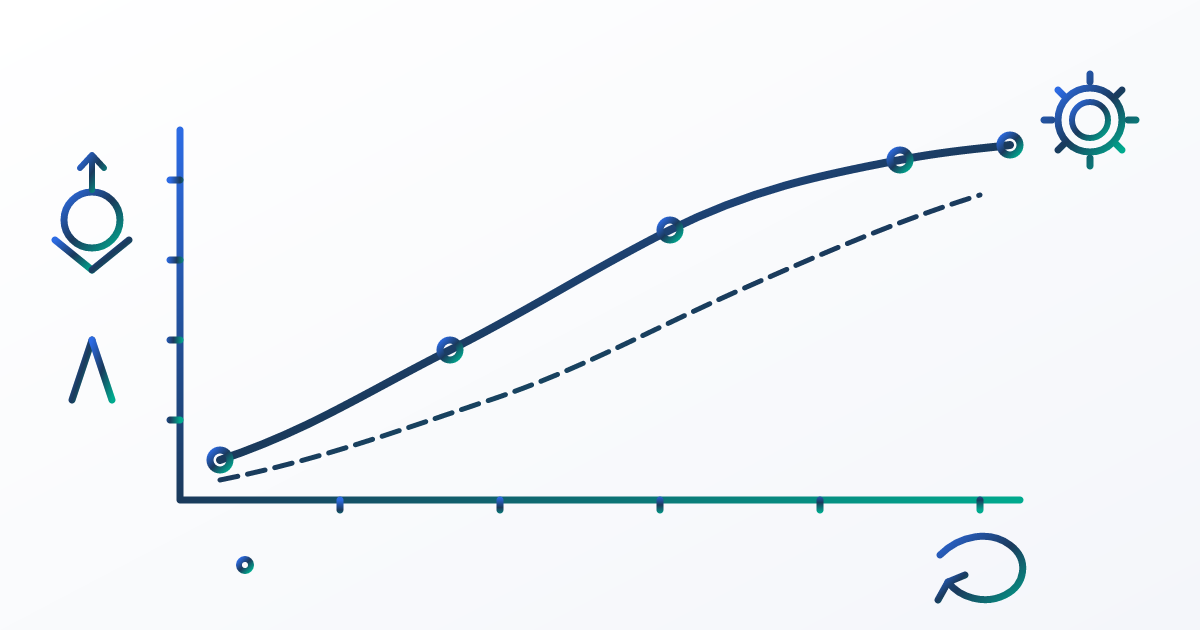
Employee engagement is not a soft HR metric sitting off to the side of DORA metrics and sprint velocity; it is the upstream condition that produces them, because the behaviors that drive deployment frequency, lead time, change failure rate, and recovery speed are the same behaviors that engaged or disengaged engineers exhibit every single day. Once you see that link, engagement stops being a culture initiative and becomes an engineering performance lever.
The DORA research program started in 2014 under Dr. Nicole Forsgren, Jez Humble, and Gene Kim, and it has run annual surveys of engineering organizations worldwide ever since. It produced four core metrics: Deployment Frequency, Lead Time for Changes, Change Failure Rate, and Mean Time to Recovery, with Deployment Rework Rate added in 2024. The methodology mattered as much as the metrics themselves: DORA identified causal relationships between practices and outcomes, distinct from mere correlations sitting next to each other in a spreadsheet. Skipping past that distinction is easy, but it is the reason these numbers deserve to be treated as real levers rather than vanity dashboards.
Sprint velocity predates all of this. Story points and velocity charts have circulated in agile teams for two decades with no empirical basis for predicting performance across organizations; they only ever meant much within a single team, tracked over time, against its own history. DORA gave engineering leaders something velocity charts never could: a cross-organizational, research-backed benchmark. And that raises the real question underneath both frameworks. Every metric in DORA and every velocity chart is a downstream record of decisions engineers made, conversations they had or avoided, reviews they prioritized or rushed, and problems they surfaced or stayed quiet about. So if these numbers trace back to human behavior, the obvious next question is what determines that behavior on an ordinary Tuesday.
What the four DORA metrics are actually measuring when you read them as a system
DORA was built on two axes, not four independent scores, with Deployment Frequency and Lead Time for Changes measuring velocity while Change Failure Rate and MTTR measure stability. The research insists these be read together, because a team can juice either axis in isolation and produce a number that looks good and means nothing.
Read Deployment Frequency alone, and a team can inflate it with trivial commits that touch a config file and call it a deploy. Read Change Failure Rate alone, and a team can flatten it by simply refusing to ship anything risky. Both moves are gaming behaviors, and both are, not incidentally, disengagement signals: they describe engineers optimizing for the number on the dashboard instead of the outcome the number was built to represent.
Elite performers in the DORA research deploy multiple times a day with change failure rates that are vanishingly low, and they are twice as likely to exceed their organization's goals on profitability, productivity, and customer satisfaction. What separates those teams from the pack has less to do with toolchain sophistication and more to do with how fast problems surface and how confidently the team acts once they do.
Deployment Rework Rate, the 2024 addition, measures the percentage of deployments triggered by a production incident rather than planned work, serving as a direct proxy for how well a team catches problems before they reach users. That capacity depends on review culture and psychological safety more than it depends on any static analysis tool. Sprint velocity plays a companion role here: unreliable across teams, still useful within one team over time, and its real connection to DORA is that both degrade under the identical conditions: unclear ownership, slow feedback, and a fear of raising blockers out loud.
The engagement deficit sitting behind most delivery problems
Start with the number. Per Insight Global's 2025 Employee Sentiment Report, only 35% of workers feel essential and engaged at work, which means the modal engineer, the person doing the median amount of work on a median team, is not operating in the psychological state that produces elite delivery behavior.
Disengagement in an engineering context has a specific shape. Engineers who feel disengaged are slower to raise a blocker or flag a bad design decision before it calcifies into the codebase, and they invest less in code review, treating it as a checkbox rather than a chance to catch a real problem. They do the minimum required to close the sprint ticket in front of them, not the work the surrounding system actually needs. They are also far less motivated to write the documentation or test coverage that quietly reduces MTTR six months later, when nobody remembers who touched that service last.
None of this reflects a character flaw. These are rational responses to environments with low psychological safety, unclear purpose, or feedback loops that never close. An engineer who raises a concern and watches it disappear into silence learns, correctly, that raising concerns is a waste of energy.
The arithmetic here is not subtle. If a large majority of engineers are operating in a disengaged state, it is close to impossible for a team's DORA scores to reflect what those engineers are technically capable of doing. The gap between capability and output is sitting in that 65%, not in the toolchain.
Distributed and augmented teams inherit a compounded version of the same problem, since trust and clarity, the two foundations engagement is built on, are already harder to establish across geography and employment models. Left unmanaged, the engagement gap on those teams tends to run wider, not narrower, than on a team sitting in one office.
How engaged engineers produce the specific behaviors that move DORA metrics
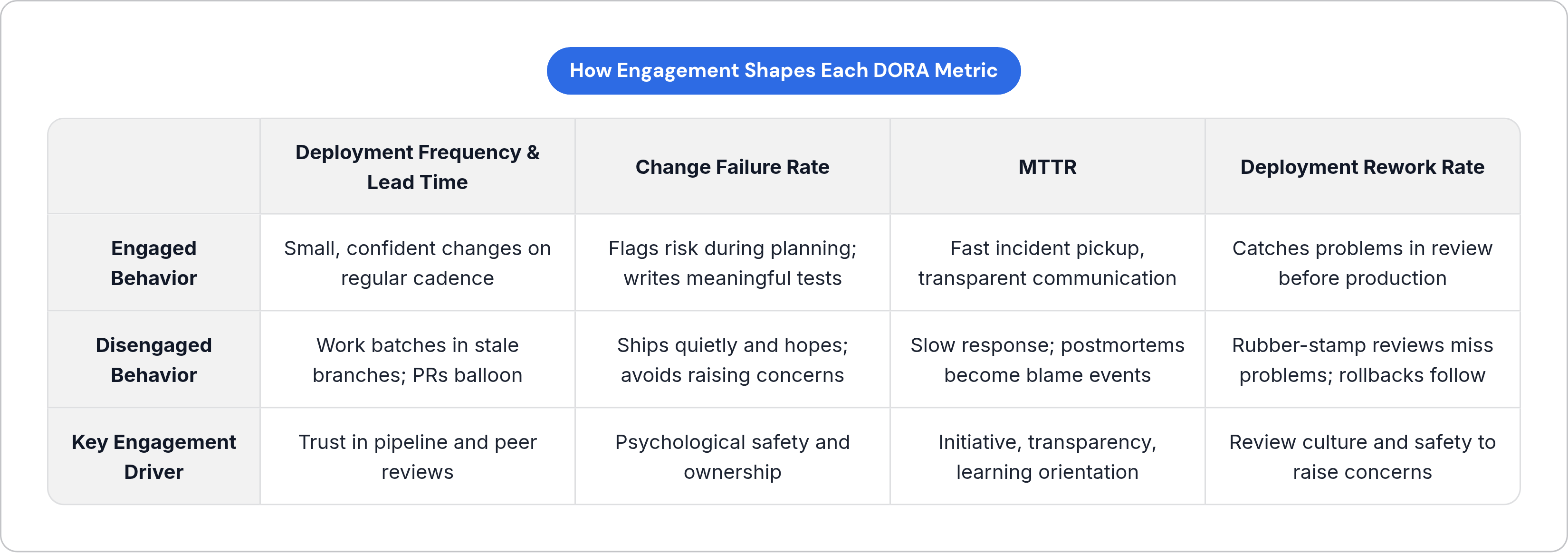
Deployment Frequency and Lead Time move when engineers push smaller, more confident changes on a regular cadence. Engaged engineers don't batch work into long-lived branches to avoid scrutiny; they trust the pipeline, and they trust that their teammates' reviews are worth something. Disengaged behavior produces the mirror image: work sits in stale branches, pull requests balloon to the point where nobody can review them properly, and reviews that do happen go stale before anyone acts on them.
Change Failure Rate tracks something closer to ownership. Engineers who feel responsible for outcomes, not just tickets, write tests that actually mean something, flag concerns during planning instead of after the fact, and speak up when a deadline is pushing a risky deploy out the door. Psychological safety is the specific dimension of engagement doing the work here, and without it, engineers ship quietly and hope, rather than flag loudly and delay.
MTTR depends on who picks up an incident, how fast they communicate what they're seeing, and whether the postmortem afterward functions as a learning event or a blame event. All three of those are engagement-dependent behaviors: initiative, transparency, and a learning orientation all run higher on engaged teams, and lower on teams where people are protecting themselves.
Deployment Rework Rate might be the most sensitive of the five to team culture, since unplanned rollbacks trace directly back to problems that weren't caught in review, which traces back further to whether anyone felt safe raising them. Sprint velocity, for all its limits as a cross-team benchmark, still responds to engagement within a team: engaged engineers give more honest estimates, surface blockers earlier instead of quietly working around them, and finish reviews fast enough to unblock a teammate instead of leaving them waiting.
What unified measurement frameworks reveal about the engagement–performance connection
DX Core 4, developed by Laura Tacho and Abi Noda in 2024, tries to fold all of this into a single scorecard. It combines Speed, measured as diffs per engineer; Effectiveness, measured through a 14-question survey; Quality, measured as change failure rate; and Impact, measured as the percentage of time spent on new capabilities versus maintenance. The detail worth sitting with is that Effectiveness, the survey dimension, is baked directly into the official score, with team perception and engagement carrying equal standing alongside the "harder" metrics as one of the four pillars.
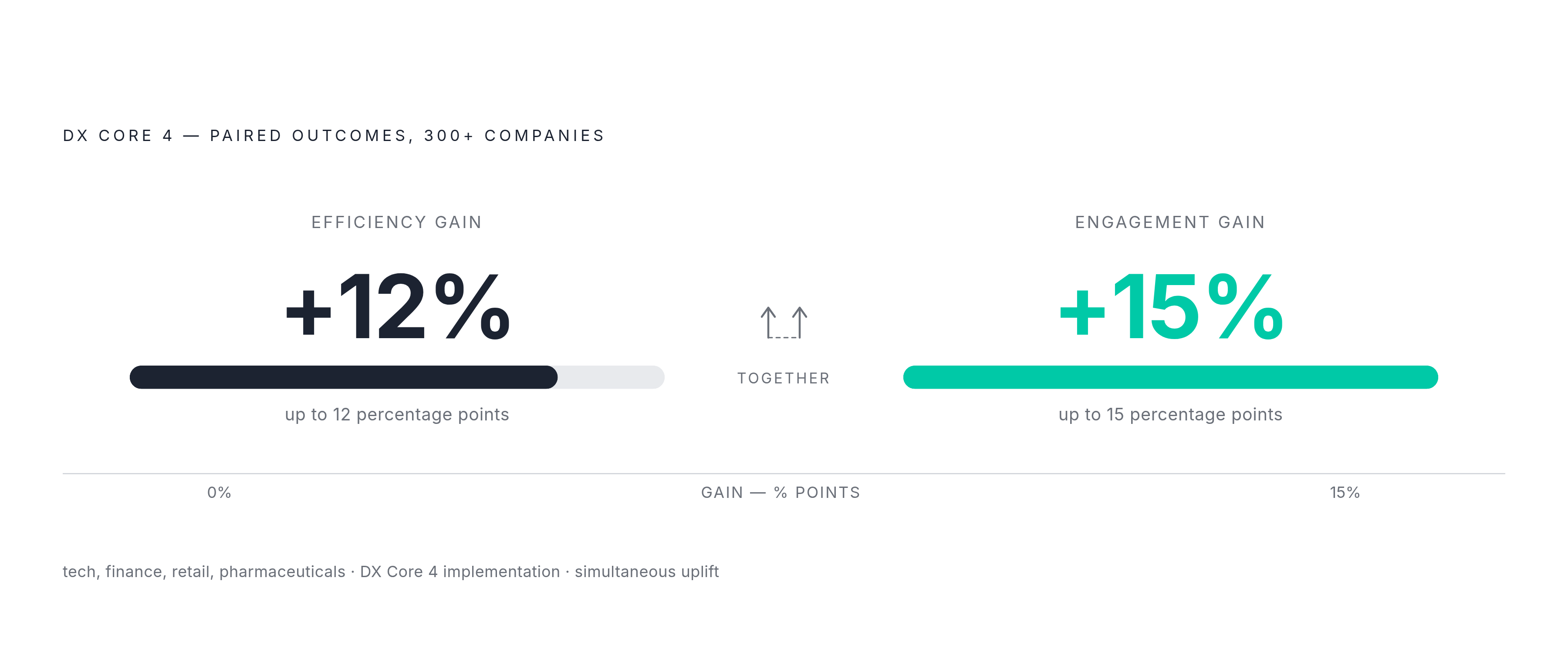
Organizations that implemented DX Core 4 saw efficiency gains up to 12% and engagement improvements up to 15%, across more than 300 companies spanning tech, finance, retail, and pharmaceuticals. Read those two numbers side by side and the directional story is hard to miss: efficiency and engagement moved together, which is exactly what a causal relationship should look like, rather than a coincidence of measurement.
The industry has already registered the significance. Atlassian acquired DX, the company behind getdx.com, in September 2025, in a deal valued in the billions, and that price tag says something about how seriously engineering leadership now treats delivery measurement as a strategic asset rather than a reporting exercise.
What DX Core 4 does that DORA alone can't is surface a team's self-reported sense of its own productivity, ahead of the fact. DORA metrics are lagging indicators; they tell you what already happened. A team's Effectiveness score tells you what's about to happen, while there's still time to do something about it.
How AI tooling is changing the engagement–velocity relationship
AI adoption among developers is no longer an early-adopter story: 84% of developers now use or plan to use AI tools, 51% use them daily, and developers report saving an average of 3.6 hours a week. Those are adoption numbers, though, not the interesting finding.
The interesting finding sits in research showing that developers using AI tools report feeling happier, more fulfilled, and more regularly entering a flow state. Flow state is the experiential signature of high engagement, and that connection ties tool adoption directly to the psychological condition that drives elite DORA performance in the first place.
AI's real effect on the pipeline is volume, with more diffs and more pull requests moving through the same review and deployment process that existed before. That shifts the binding constraint away from writing speed and onto review quality, CI discipline, and deployment judgment, none of which an agent performs on your behalf. This is precisely why DORA metrics matter more, not less, in an era of AI-assisted coding: agents change who writes the code, but they don't change the path that code has to travel before it reaches a user.
The risk case is straightforward to picture. A high-velocity, low-engagement team generates more code, faster, and pushes it through a review process staffed by engineers who aren't invested in catching what's wrong with it. That is a formula for a higher change failure rate and more deployment rework, regardless of how good the model writing the code is. The opportunity case runs the other direction: teams where AI absorbs the rote work, freeing engaged engineers to spend their attention on design, review, and judgment, are the teams whose DORA metrics should actually improve. The tool amplifies whatever behavior was already there.
The distributed team variable and why engagement requires deliberate design at a distance
Trust and clarity degrade with distance. That's not a controversial claim; it's the reason distributed teams have to work at things that co-located teams get for free, and engagement is one of them.
An offshore arrangement with a 10 to 12 hour time difference turns a simple question into a next-day bottleneck. When a blocker can't surface in real time, every behavior that produces good DORA scores, fast feedback, confident deploys, early problem-flagging, slows down with it, not because the engineers are less capable but because the loop that lets them act on what they know has gotten longer.
Teams that shift from offshore to nearshore arrangements often see a measurable drop in ticket rework, and the reason isn't that the engineers changed. Same-day communication replaced an overnight wait cycle, and that alone restores the feedback loop engaged engineers rely on to feel like their work connects to an outcome in real time.
Augmented team integration raises a related but distinct challenge. Even a genuinely experienced engineer needs context on tools, workflows, culture, and expectations, and weak onboarding erodes the speed advantage that augmentation was supposed to deliver in the first place. Worse, augmented engineers who feel like contractors rather than teammates tend to exhibit the exact disengaged behaviors that degrade DORA metrics: minimum-viable contributions, reluctance to flag a blocker, limited investment in quality beyond the literal ticket in front of them. Pairing new augmented engineers with a team lead, running structured check-ins, and genuinely including them in planning rituals are the operational levers that close that gap. Documentation discipline matters more than it gets credit for, too: when an augmented engagement ends without a real handoff, the knowledge that engineer built up leaves with them, and that's a latent MTTR problem waiting for the next incident to expose it.
Turning engagement into an engineering performance lever in practice
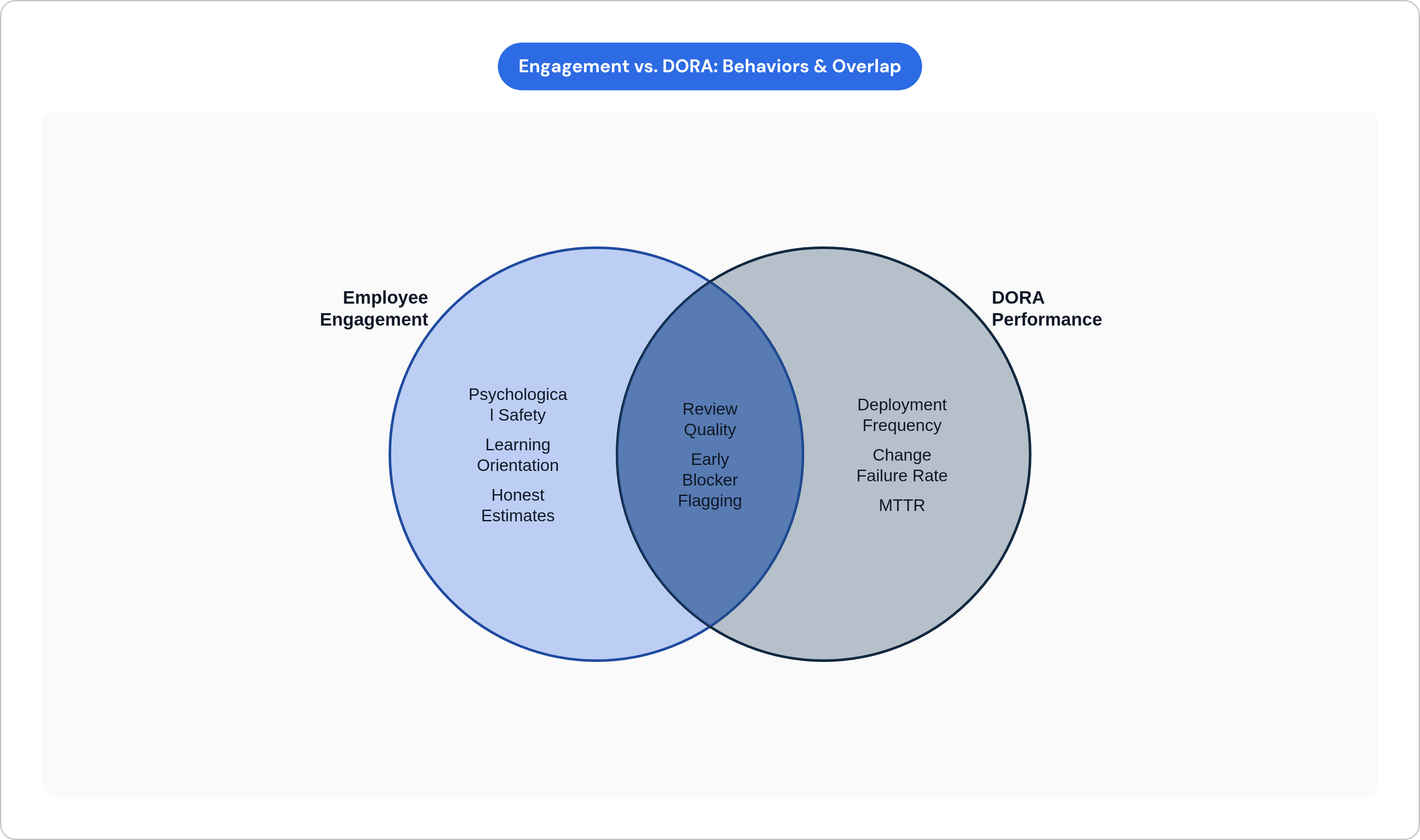
Treat a degrading DORA metric as an invitation to investigate upstream conditions, alongside any prompt to buy new tooling. A rising change failure rate might mean the deploy pipeline genuinely needs hardening, or it might mean engineers have stopped flagging risk because raising a concern doesn't feel safe on that team anymore. Stalled sprint velocity might mean the stories are poorly sized, or it might mean reviews are slow because the reviewers have checked out.
This is where the Effectiveness dimension of a framework like DX Core 4 earns its place. It gives engineering leaders a leading indicator, the team's own sense of its productivity, well before the lagging DORA numbers move enough to raise alarms. That gap between the two is the window where an engagement problem is still correctable rather than already baked into a quarter's worth of missed deploys.
A handful of specific levers carry known DORA surface area. Psychological safety in retrospectives tends to show up later as a lower change failure rate and lower deployment rework rate, while clear ownership of services and domains speeds MTTR, because the right person engages the moment something breaks instead of three people figuring out whose problem it is. A code review culture built on real scrutiny, rather than rubber-stamp approval, lowers failure rate and raises developer satisfaction at the same time, which is a rare pairing worth protecting once you have it. Sprint planning that rewards honest estimates over optimistic ones produces more accurate velocity and fewer blockers that surface too late in the sprint to fix.
For distributed and augmented teams, this design work has to be deliberate from day one. Onboarding, timezone overlap, inclusion in planning, and documentation norms function as DORA inputs in their own right, as concrete as a CI pipeline or a rollback script, rather than HR line items sitting off to the side of engineering strategy.
The honest test of whether engagement investment is working is whether DORA metrics and Effectiveness scores move together. If delivery speed climbs while the survey scores sit flat, the gains are fragile and probably temporary, resting on a team pushing harder rather than working from a genuinely stronger position. Engagement and performance rise together or they don't rise at all, and by now, the research has made that relationship hard to argue with.