Contingent Workforce Growth in Software Engineering Teams
Organizations must treat contingent engineering as permanent strategy, not emergency hiring.
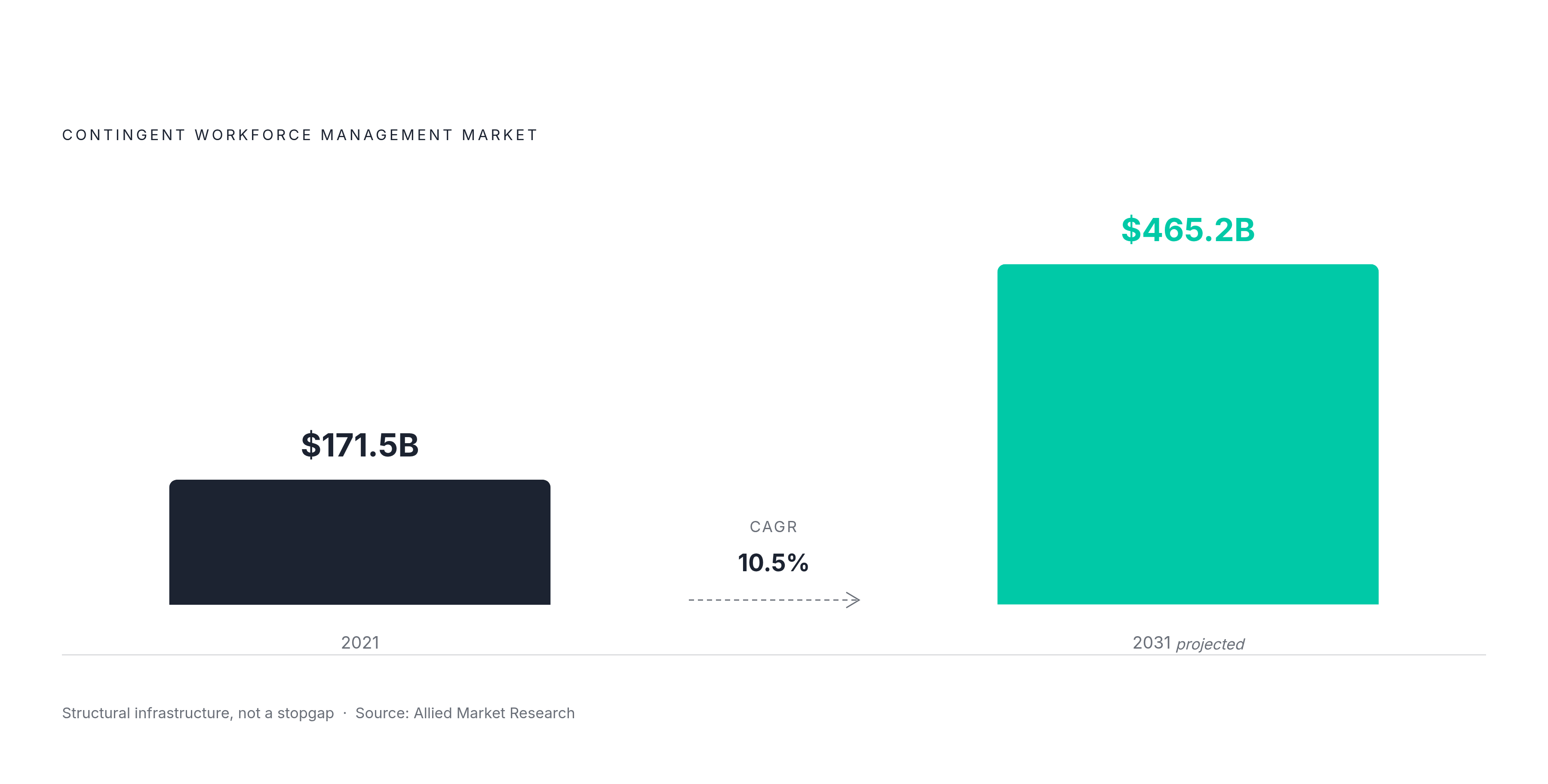
Contingent workforce growth in software engineering is not a temporary reaction to a tight labor market. It is a permanent shift in how engineering capacity gets planned, sourced, and scaled, and most organizations are still managing it like an emergency patch rather than the structural layer it has become. Allied Market Research put the global contingent workforce management market at $171.5 billion in 2021, and projects it will hit $465.2 billion by 2031, a 10.5% compound annual growth rate. That kind of trajectory doesn't describe a stopgap.
This piece is for engineering leaders who already use contingent engineers, or are close to it, and want to move past reactive hiring into something deliberate. The old model treated external engineers as a fallback: a permanent hire falls through, a deadline slips, someone calls a staffing firm. That model is now a liability. Organizations that treat contingent engineering as a fallback never build the governance habits or the integration habits that make contingent talent actually productive. They end up building a permanent stopgap, which is a contradiction in terms, and an expensive one.
The talent market conditions that made contingent engineering a structural necessity
Software engineering sits in a strange spot right now: a high-growth field in chronic shortage. CompTIA's 2025 State of the Tech Workforce report projects tech jobs growing from 6.09 million in 2025 to 7.03 million by 2035, with software developers and engineers specifically growing 297% over that window. Yet the market feels tight from both directions at once. Engineers send out applications and hear nothing back. Hiring managers post roles and can't fill them. Both things are true simultaneously, and the reason is a mismatch between where the growth concentrates and where the supply actually sits.
The AI and machine learning skills gap is the sharpest edge of that mismatch. Robert Half's 2025 hiring data puts AI analysts among the most in-demand roles anywhere in tech, and AI/ML engineering skills have remained similarly sought-after heading into 2026. The demand isn't confined to specialist teams anymore, either. The AI Workforce Consortium, led by Cisco, found that AI technical skills now show up in roughly 78% of ICT roles. That number matters because the skills gap is a broad problem spanning far beyond a handful of specialist hires. It's diffusing across nearly every engineering job on the org chart.
Then there's the mismatch between hiring speed and project timing. Senior engineers who clear a technical bar move fast once they're in the market, often within days, while a permanent hiring pipeline, with its rounds of interviews and approvals, stretches across weeks or months. By the time an offer goes out, the project window that justified the hire may already have closed. Skills don't hold still while that pipeline grinds along, either: Technology skills can go stale in as little as two and a half years, a pattern widely observed across the industry. Permanent headcount alone can't keep pace with how fast the required skill set rotates.
None of this argues for replacing permanent engineers with contingent ones. It argues that permanent hiring, on its own, moves too slowly for how fast skill demand shifts now, and the contingent layer is the mechanism that lets an org match speed to specialization when a supplement alone can't do that job.
What contingent means in a software engineering context
"Contingent" gets used as a catch-all, and that's part of why so many programs mismanage it. The term actually covers a few distinct engagement types, each with its own mechanics.
Staff augmentation puts external engineers inside the client's own team. They report to the client's engineering managers, sit in the client's standups, work in the client's tools and repos. For the length of the engagement, they're team members, full stop.
Project outsourcing, usually structured as a statement of work (SOW), works differently. A vendor takes a defined scope, manages its own people, and delivers an agreed outcome. The client manages the contract and the deliverable, not the individual engineers doing the work.
Independent contractors and freelancers sit apart from both: engaged directly, usually for a specific skill or a short, bounded contribution rather than an ongoing team role.
The distinction is not academic, and getting it wrong is where most of the damage happens. Staff augmentation demands integration discipline: onboarding, standups, code review norms, access provisioning. Outsourcing demands specification discipline: a scope tight enough that a separate team can deliver against it without daily hand-holding. Blur the two and you tend to get the worst of both outcomes. A vendor team managed like they need daily direction erodes their margin and slows them down. An embedded engineer treated like a black-box vendor means nobody bothers to onboard them properly, and the work suffers for it. Reporting on program management heading into 2026 has noted that the boundary between staff aug and SOW work is blurring in mature organizations, with contingent workforce leaders folding both under one governance structure instead of running them as separate tracks with separate rules.
Nearshore staff augmentation is a geographic variant of the same integration model, not a separate category. It combines the embedded, team-member structure of staff aug with timezone and cultural proximity, so engineers work in the same real-time windows as the internal team instead of a shifted-hours setup where a question asked at 4pm gets answered the next morning.
Staff augmentation gets the most attention in the rest of this piece, because that's where the integration choices an engineering leader makes have the most direct bearing on the actual quality of the work.
How geography shapes the collaboration reality of contingent engineering
Geography is a collaboration variable. It's a collaboration variable, and treating it purely as the former is where a lot of engagements go wrong.
Onshore engagement gets the most real-time overlap and the tightest talent pool, at the highest price. It's the right call when regulatory requirements, security clearances, or the need for direct executive access aren't negotiable.
Offshore engagement opens up the widest talent pool at the lowest hourly rate, but the collaboration friction compounds in ways the rate card never shows. Feedback loops stretch out. A misunderstanding that would take five minutes to clear up over a shared desk takes a full day to surface and fix across a 10 or 12 hour timezone gap, and ambiguity in requirements gets amplified in both directions as a result. Once you count the rework and the extra management overhead that ambiguity generates, the "cheap" rate advantage narrows fast. For anything that needs constant back-and-forth, the effective cost can land close to what nearshore would have cost from the start, which makes offshore, in that scenario, a false economy.
Nearshore engagement trades some of that talent-pool breadth for timezone-aligned, real-time collaboration at a meaningful discount against home-market rates. For companies based in a home market like North America, Latin America is the primary nearshore region. For Western European companies, it's Eastern Europe.
Offshore is the right tool for a specific kind of job: stable specifications that aren't going to shift mid-engagement, or large modernization efforts with well-defined outputs. It's the wrong tool when requirements are genuinely still being worked out, when the job needs unscripted, real-time contact with executives or customers, or when data residency and personnel vetting rules can't be satisfied by the arrangement.
Hybrid sourcing looks to be where the market is heading. Industry reporting heading into 2026 points toward a broad shift, with a growing share of companies moving toward hybrid sourcing models that include nearshoring. Latin America's role in that shift keeps growing, too: the Inter-American Development Bank projects nearshore outsourcing will add tens of billions of dollars in export value to Latin American and Caribbean economies, which says something about both the maturity and the scale of the talent base building up in the region.
There's a plain reason nearshore fits modern software delivery so well. Agile development runs on continuous integration, daily standups, and iterative sprints, all of which depend on tight feedback loops. Timezone alignment is close to a prerequisite for that rhythm to hold together.
The effect of AI tools on contingent engineering team composition
AI tool adoption among developers is close to universal in a lot of engineering orgs now. Adoption and productivity gain are two different numbers, though, and conflating them is a real risk.
Developers using AI coding tools often report feeling faster. At least one randomized controlled trial, run by METR, found the opposite under some conditions: developers using AI assistance were actually slower, despite believing they'd sped up. That gap between perceived speed and measured speed matters a lot for any team optimizing its contingent engineers around AI-assisted output. Chase the wrong metric and you get more code shipped, not more value delivered.
Code quality carries its own risk in contingent contexts specifically. AI-generated code has been shown to carry elevated vulnerability rates, and that risk gets sharper when the people accepting AI suggestions are external engineers who haven't yet built deep context on a codebase's security posture. Review discipline has to be set explicitly rather than assumed: if only 48% of developers say they always review AI-generated code before committing it, that norm belongs in the engagement terms, not left to habit.
Regulation is entering the picture too. Under the Digital Omnibus (Regulation EU 2026/1744), the European Commission's timeline has transparency obligations under the EU AI Act taking effect August 2, 2026, while the high-risk system rules under Annex III have been pushed to December 2, 2027. Any team building something that touches the EU market needs contingent engineers who understand those obligations as well as the tools.
Vetting has to change to match. The skills that matter now include prompt engineering judgment, system design sense, and the ability to spot a subtle bug hiding inside otherwise plausible-looking AI-generated code. A traditional coding assessment, built around solving an isolated algorithm problem, misses most of that. AI fluency itself is now a baseline expectation, contingent or permanent. An org that lets two or three specialists carry all the AI literacy while everyone else ignores it is quietly building a capability gap that ignoring baseline AI literacy across the team causes, and it becomes visible later, usually at the worst possible time.
The governance gap that stops most organizations from getting value from contingent engineers
Most enterprises grew their use of contingent engineers faster than they grew their ability to manage them. Procurement, legal, finance, and the hiring managers actually doing the work all draw from the same external talent pool, but they run on separate systems with priorities that don't naturally line up.
Contingent workforce program leaders want visibility across every worker type in use. Procurement wants cost control and rate discipline. Hiring managers want speed, and will route around any process that slows them down even when that process exists for a good reason. Legal wants to avoid worker misclassification, which GlobeNewswire has flagged as the single biggest risk factor in contingent workforce management today. Four groups, four different success metrics, and no shared system by default.
Missing governance causes fragmentation that is visible in predictable places. Independent contractor agreements, global engagements, and project work tied to a fixed-scope agreement often sit entirely outside formal governance. Spend goes untracked. Classification gets applied inconsistently from one engagement to the next. Performance data on a given engineer or vendor never accumulates anywhere useful, so every new engagement starts from zero.
That "starting from zero" is the real cost of skipping governance. Without a unified view of total talent, an organization can't forecast demand, can't benchmark rates against what it paid last time, and can't build long-term supplier relationships that improve with repetition. It just repeats the full sourcing and onboarding cost on every engagement, indefinitely.
Compliance, not cost, is now what drives how mature programs get designed. Trend reporting on contingent workforce management heading into 2026 shows compliance has overtaken cost optimization as the top design factor, pushed by tighter regulation and the spread of cross-border remote work. Governance-by-design has stopped being optional. Contingent workforce management is infrastructure, and treating it as an administrative afterthought is what makes a program scale badly, in ways that get expensive to unwind later.
How to integrate contingent engineers so they function as part of the team
Staff augmentation only works when the external engineer is treated as a team member with real, embedded responsibility. Every integration decision either reinforces that or quietly undermines it.
Readiness on day one is a precondition, not a nice-to-have. Access, tooling, and CI/CD pipeline permissions need to be set up and automated before the engineer's first day, not assembled while they wait around. Every day spent on setup at a senior engineer's rate is waste, and it's waste that compounds across a whole contingent bench if it repeats on every engagement. A useful early signal: whether the engineer gets a real pull request submitted within the first few days. That forces genuine contact with the codebase and makes blockers visible while they're still cheap to fix.
Sprint integration is where the daily mechanics live. External engineers should be in standups, in retrospectives, and accountable to the sprint's actual goals, not parked at the edge of ceremonies as silent observers. Performance should get measured by cycle time and delivery outcomes, not by proxies like lines of code written or hours logged, which reward activity instead of progress.
Distributed teams need a defined communication structure before problems occur, not after. Set "golden hours," the real-time overlap window between internal and external team members, and protect that time for synchronous decisions and unblocking rather than letting it get eaten by unrelated meetings. Escalation paths and reporting cadences should be written down before work starts, not improvised once something breaks.
Pairing internal engineers with new external ones during the first sprint is one of the fastest ways to transfer context. Left to async communication alone, that same transfer can stretch across weeks of half-answered messages in a chat tool.
None of this works well if the engineers arriving aren't genuinely senior to begin with. A rigorous pre-engagement vetting process, real technical assessment, cultural fit, skills demonstrated rather than credentials listed on a resume, shortens the ramp that all this integration work is trying to compress. Any agency charging a meaningful cut of a first-year salary should already have done that vetting before the engineer ever shows up on a call.
When permanent hiring is the right answer
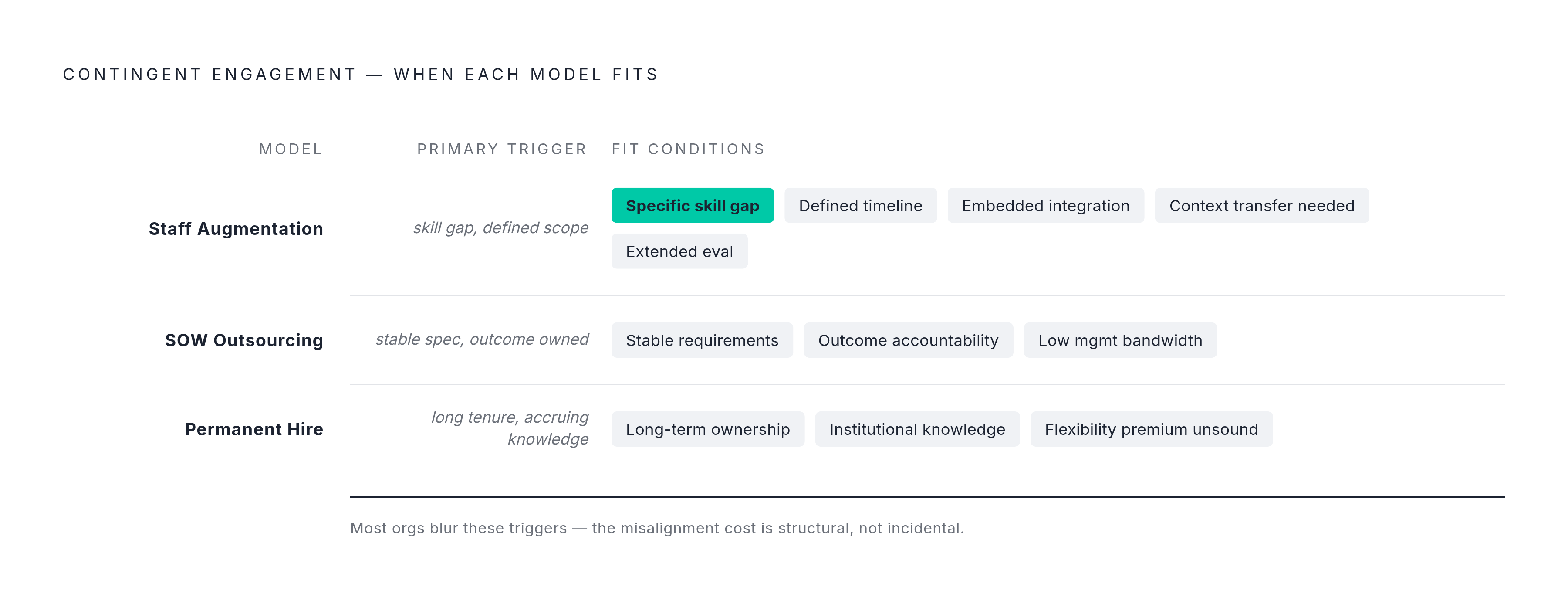
Staff augmentation earns its place when there's a defined timeline, a specific skill gap, and an internal team the engineer needs to plug into: work that depends on institutional context the engineer has to absorb and carry forward. It's the right call to accelerate a product cycle or push through a legacy migration without pulling permanent engineers off the work that actually needs them. It also functions well as an extended, real-output technical interview when an org wants to evaluate someone before offering a permanent seat.
Outsourcing under a statement of work earns its place when specifications are solid, stable, and unlikely to shift mid-project, so the vendor can be held accountable for an outcome rather than a headcount slot. It also fits when an organization genuinely doesn't have the bandwidth to manage embedded engineers day to day. Outsourcing hands off management responsibility, not just labor, so be honest about that before signing anything.
Permanent hiring is the right answer when a role sits at the center of long-term product ownership, where institutional knowledge needs to build up in one person over years rather than get handed off at the end of an engagement. It's also the right call once an engagement would need to run long enough that the premium paid for external flexibility stops making structural sense.
Most engineering organizations operating at real scale end up using all three models at once. What separates the ones getting value from the ones treating this as a shell game is knowing which work belongs where, backed by governance that can manage all three without letting any of them fragment off into their own ungoverned corner. The organizations getting the most out of contingent engineering tend to treat it as a long-term relationship rather than a series of disconnected transactions, letting a vendor or a nearshore partner build up real knowledge of the codebase, the team's norms, and where the product is headed. That accumulated context is a delivery asset in its own right. It doesn't reset to zero with every new statement of work, and organizations that manage it well stop paying to relearn the same lessons every time someone new comes on board.
Sources
- 2026 tech job market statistics and outlook
- 50 Contingent Workforce Statistics You Need to Know in 2026
- The 6 Trends Redefining Contingent Workforce Programs in 2026
- Engineering Workforce Trends 2026: What 2025 Revealed About Next Year’s Talent Challenges | Automation Alley
- Contingent Workforce Strategy for IT Software Teams Artech
- weareams.com