Visa and Work Authorization Trends Affecting Cross-Border Tech Talent Mobility
New fees and stricter rules are pushing tech talent toward remote work and other countries.

For decades, the H-1B visa was the dominant pipeline for cross-border tech talent relocation into the U.S., and its predictability made it the default hiring strategy for many companies. That predictability broke down on September 21, 2025, when a White House proclamation attached a $100,000 supplemental fee to every new H-1B petition filed from that date forward Stratagem Systems Deel. A USCIS final rule took effect on February 27, 2026, replacing the old lottery with a wage-based lottery starting with the FY2027 cap season, which increases approval probability for higher-paid applicants and restructures who can realistically use the visa. Then, in August 2026, a DHS rule tacked on a new biometric entry-exit fee to H-1B and L-1 petitions, and the pattern by that point was unmistakable: each new rule adds cost on top of the last one, rather than settling into some stable equilibrium.
None of this reads as routine enforcement housekeeping. Each change independently raises the cost, the uncertainty, or the paperwork load of moving one worker across a border, and the fee in particular does not scale with company size the way a tax bracket might White House Proclamation Stratagem Systems. The $100,000 fee applies equally to a funded startup or a Fortune 500 company, and its effect on smaller employers is disproportionate White House Proclamation Stratagem Systems. Julia Gelatt of the Migration Policy Institute said some of those jobs will simply relocate abroad, or companies will lean harder into recruiting domestic workers. That's not a prediction so much as an acknowledgment, coming from inside the policy conversation, that offshoring the job is now the rational move for a lot of employers who used to sponsor visas without a second thought.
The global talent competition's reshuffling around U.S. policy tightening
The $100,000 fee didn't land in a vacuum White House Proclamation Stratagem Systems Deel. It sharpened a contest for skilled labor that other countries were already running, and several of them moved fast to take advantage of the opening White House Proclamation Stratagem Systems. Canada was the most direct about it: its Budget 2025 response named the H-1B fee outright as the catalyst, committing $1.7 billion to attract global talent, building accelerated pathways for H-1B holders specifically, and opening a permanent residency route for 33,000 workers by 2027 Canada Budget 2025 / Deel. That's not a speculative bet on demand, either. A smaller pilot version of the program in 2023 filled 10,000 spots in 48 hours Deel.
Germany, already the dominant EU Blue Card issuer, shortened its path to permanent residency to 21 months for German speakers and launched an Opportunity Card that lets non-EU job seekers move without a job offer in hand Deel. China introduced its first sponsor-free work visa for STEM graduates in October 2025, with no job offer required and long-term residency, tax breaks, and housing support built in. The UK stood up a Global Talent Task Force and has proposals in motion to eliminate the £766 visa fee entirely for graduates of its top five universities Deel. Singapore's ONE Pass, launching in January 2027, will let stock options count toward the salary threshold, which is a small provision with a large signal: it acknowledges how startup engineers are actually paid, rather than pricing them out on cash salary alone. Dubai, meanwhile, saw Golden Visa approvals climb 34.7% year over year in the first quarter of 2026, driven largely by property investment pathways Northman & Sterling.
IMD's research frames the through-line here: U.S. attractiveness to global talent is declining, weighed down by expensive education, visa complexity, and a patchwork of state-level policy, while Canada and Singapore increasingly stand out as the places picking up the slack. Workers with in-demand skills now have real optionality about where they land. The U.S.-centric pipeline that used to be the default is no longer automatic. Companies still building global hiring plans around a single destination country are, at this point, already behind the curve.
Relocation as a strategy losing to remote cross-border employment on multiple dimensions
The case against relocation is structural, extending beyond one country's fee schedule. It's structural, and it appears across the numbers. Globally, 33% of companies name visa and immigration hurdles as a top barrier to hiring, one in three organizations losing ground not on salary or culture, but on paperwork and processing time Northman & Sterling. Layer on top of that the specific 2026 conditions: tighter quotas across H-1B and L-1, longer approval waits, new compliance requirements for sponsoring employers, more scrutiny of remote work arrangements, and fewer legal options for workers' dependents. Every one of those items adds friction to the same basic transaction: getting one qualified person legally working in one location.
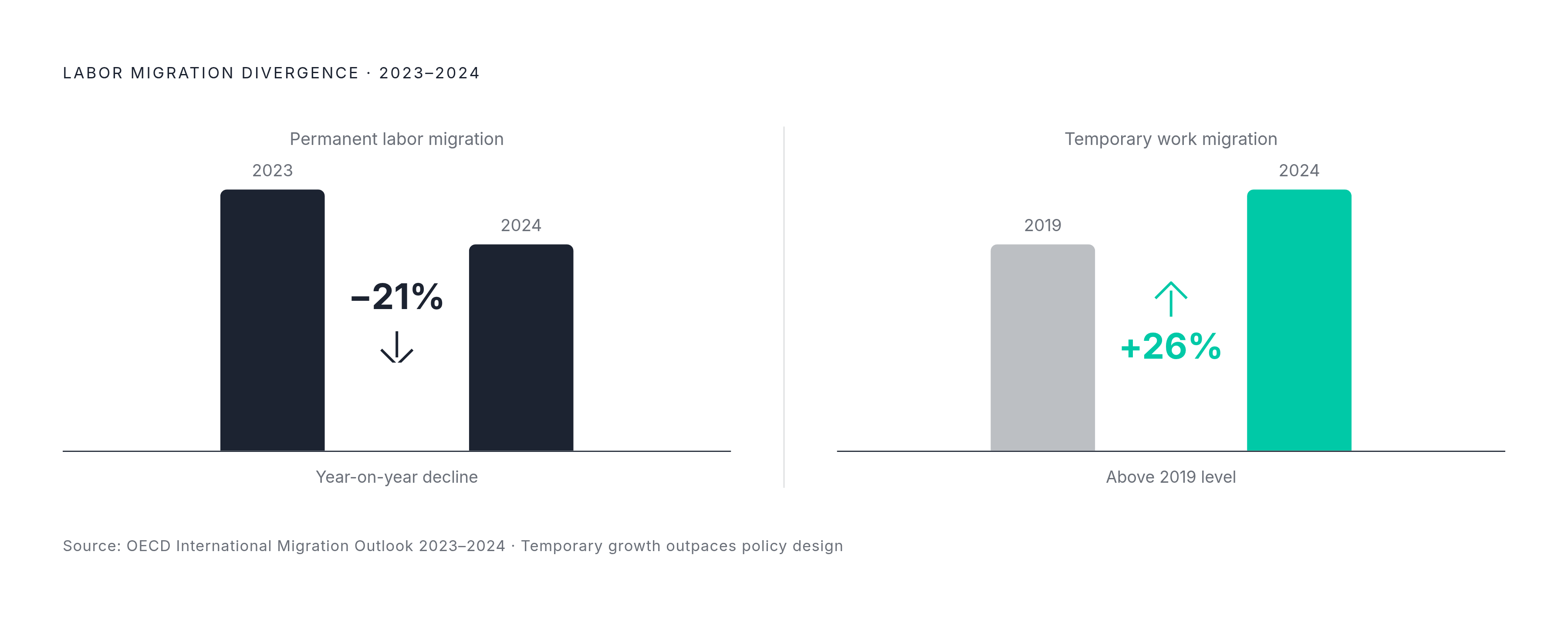
And yet international mobility itself hasn't shrunk, it's just changed shape. OECD data shows permanent labor migration fell 21% between 2023 and 2024 as governments tightened their skilled-worker programs, but temporary work migration stayed 26% above 2019 levels through the same period OECD / INS Global Deel. That gap is the whole story in miniature: people are still moving for work, just not in the permanent-relocation form visa policy is built to regulate. INS Global's analysis describes the mechanism directly, noting that global mobility now leans on remote cross-border employment and Employer of Record structures that bypass traditional visa pathways altogether, instead of waiting around for immigration policy to settle down. Digital nomad visa applications are one visible symptom of this, up more than 60% in 2025, and that's not a lifestyle fad so much as a structural signal that skilled professionals are separating where they live from where their employer happens to be incorporated Northman & Sterling Bayone Global Talent Mobility 2026: Key Trends, Data, and Employer Actions - EWS.
Even the pathways designed for exceptional cases have gotten shakier. If the elite pathway is this unpredictable, the ordinary ones aren't going to be more forgiving. And the cost of that unpredictability isn't abstract: a delayed work permit means a delayed start date, and in a competitive hiring market, that gap is often enough to lose the candidate entirely. As an EB-1A "extraordinary ability" high-skilled workaround, approval rates fell from 70.5% in FY2023 to 60.65% in FY2024, with a partial recovery to 67% by Q3 FY2025, while RFE rates now stand at 40–50% for self-petitioned cases, showing that even the elite pathway is unpredictable USCIS / EB-1A Experts Bayone Canada Immigration Levels Plan / INS Global.
The true cost of nearshore, offshore, and onshore models in 2026, beyond rate cards
Running the actual numbers shows the rate cards tell a clear story on paper.
Rate cards are not the whole picture, though, and treating them as such is where a lot of cost analysis goes wrong. Recruitment, retention, HR, payroll, and benefits administration add another 15% to 20% on top of the base rate when a company manages all of it independently Cloud Employee. And offshore engagements carry a cost that never appears on a rate card at all: the rework cycle. Rework generates review cycles, review cycles cross the timezone gap, the delay pushes the project timeline, and the extended timeline delays revenue, so a project that looks 60% cheaper on paper can run at or above onshore total cost once every one of those terms gets counted Northman & Sterling Bayone Global Talent Mobility 2026: Key Trends, Data, and Employer Actions - EWS.
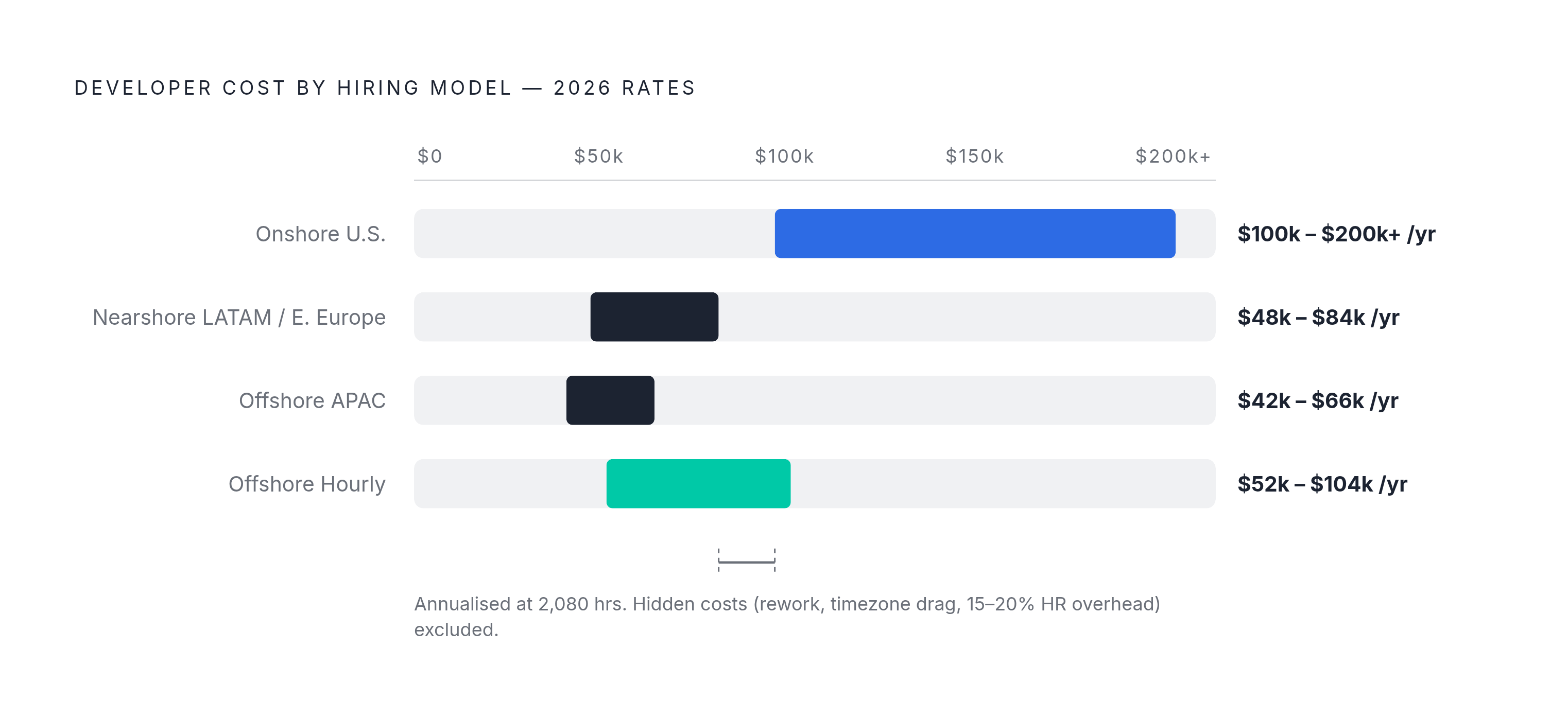
Cost has stopped being the primary reason companies outsource. Five years ago, 70% of U.S. companies cited cost as their main reason for outsourcing development work; in 2026, that figure has dropped to 34% Bayone Canada Immigration Levels Plan / INS Global. Deloitte's Global Outsourcing Survey puts access to specialized talent at the top now, cited by 42% of companies, with 35% pointing to the pressure of meeting rising customer expectations Bayone Canada Immigration Levels Plan / INS Global. The argument for nearshore, in other words, is about getting to talent that clears a high bar. It's about getting to talent that clears a high bar, in a working model that doesn't sacrifice how fast a team can actually move together. Rate cards by model reflect 2026 figures. Nearshore talent, in LATAM or Eastern Europe, costs $4,000–$7,000 per developer per month Cloud Employee. Offshore talent, in APAC markets such as the Philippines, costs $3,500–$5,500 per developer per month Cloud Employee. Offshore hourly rates in Eastern Europe and India range from $25–$50 per hour Stratagem Systems. Onshore U.S. hourly rates range from $100–$200 per hour, with a fully-loaded U.S. senior engineer exceeding $200,000 per year Stratagem Systems CodeBrand.
Timezone overlap as the determinant of distributed team function
Cost and quality both run through one variable that's easy to underweight: overlap hours. Offshore engagements don't get that overlap for free. Coordination has to be made explicit and written down because there's no live window to patch gaps in communication, and if engineering leadership doesn't have the bandwidth to write clear, complete scope documents, an offshore team will underperform no matter how good the rate looks. That collaboration debt is structural.
The savings math still favors distributed work broadly, just at different rates depending on the model. Nearshore delivers 40% to 60% savings against U.S.-based equivalents while keeping the collaboration speed that Agile teams actually depend on Northman & Sterling Bayone Global Talent Mobility 2026: Key Trends, Data, and Employer Actions - EWS. Offshore still has a clear place in the market: India's tech industry alone employs 5.8 million professionals, according to NASSCOM's Annual Strategic Review, and offshore work delivers 60% to 80% savings on a pure hourly basis NASSCOM / Bayone. That model works when the coordination overhead gets planned for upfront and the team is large enough to absorb the review-cycle drag rather than let it compound NASSCOM / Bayone.
The visa story closes the loop here in a way that's easy to miss if you're only looking at labor cost. The $100,000 H-1B fee, the wage-weighted lottery, the biometric entry-exit charge: none of it applies, because nobody is crossing the border in the first place White House Proclamation Stratagem Systems. A nearshore team in San Jose, Costa Rica shares 6–8 hours of working overlap with a San Francisco Bay Area headquarters every single business day, enough for daily standups, same-day pull request review, and real-time requirement clarification Bayone.
Rigorous talent vetting when access to the top of the pool is the competitive claim
Deel's 2026 analysis found that workers who clear visa bars tend to out-earn local peers across nearly every major market, and at younger median ages: the bar to clear is high, and the people who clear it are simply strong. The same logic carries over directly to nearshore vetting. The filter is the point, not an obstacle around it.
The pressure behind that filter is real and getting worse. IDC projects more than 90% of organizations worldwide will feel the IT skills crisis by 2026, with potential losses running to $5.5 trillion from project delays, quality problems, and lost revenue, and 69% of U.S. employers already report trouble finding skilled talent. Vetting that actually addresses a shortage at this scale can't stop at checking credentials. It needs technical depth assessment, practical problem-solving evaluation under real conditions, English-language communication testing, and an honest read on whether a candidate fits into a distributed Agile team's working rhythm.
"Top 1%" is a phrase that gets thrown around loosely, and it's only defensible when the funnel behind it is big enough to make the number mean something. A nearshore partner drawing from a pool of 4,000-plus engineers across 100-plus technologies rejects candidates at a meaningfully different rate than one working out of a shallow local bench. AI fluency belongs in that filter now too: generative AI roles are projected to grow at an 11.75% compound annual rate through 2031, and engineers who can't work alongside AI coding tools are already falling behind, which means vetting has to test for this specifically, not assume it CloudTech Canada Immigration Levels Plan / INS Global. Latin America's position in all this isn't as a fallback option when U.S. hiring gets expensive. It's a maturing talent source in its own right, producing engineers who compete on quality first.
Integrating staff augmentation without losing velocity
The scale of the staff augmentation market says something about how normal this has become. The global IT staffing market hit $123.30 billion in 2025, with software developers making up 37% of demand, and temporary or contract engagements now account for 63% of all IT staffing activity CloudTech. Zooming out further, the IT outsourcing market these engagements sit inside is projected at $634 billion in 2026, according to Statista Statista / UVIK. That's the mainstream delivery model, not a niche workaround for companies that couldn't hire properly. It's the mainstream delivery model.
Most engineering organizations by 2026 already run hybrid workforces, blending full-time staff, augmented talent, and contractors in the same org chart, so the live question for most teams is how to bring in augmented talent without creating friction.
Integration failures tend to come from a small set of repeatable mistakes. Treating augmented engineers as interchangeable capacity instead of team members creates real gaps in context, standards, and a sense of ownership over the work. Weak onboarding documentation costs more than usual when the new hire is remote and several time zones away, because there's no hallway conversation to fill in what the docs missed. And augmentation works best when project scope is genuinely clear and the internal team has the capacity to direct incoming talent, rather than expecting a new engineer to figure out priorities alone. Handled well, scaling an augmented team up or down as funding or market conditions shift isn't a compromise, it's the actual advantage. Visa policy matters here too, because augmented nearshore engineers stay employed in their home country, and the employer sidesteps H-1B sponsorship costs, EOR compliance overhead, and the processing uncertainty now baked into U.S. immigration, and the compliance burden sits with the partner instead of the client. In-house hiring takes 2–3 months on average, while staff augmentation providers can deliver qualified talent in 2–4 weeks, a lead time gap that is material in a market where Gartner identifies AI and cost pressure as the two forces reshaping talent acquisition.
Company talent strategies repositioned in response to these combined pressures
The convergence of tighter U.S. visa policy, a global talent competition spanning multiple destination countries, the proven TCO advantage of nearshore models, and the normalization of remote cross-border employment together add up to a structurally different talent strategy environment than existed three years ago.
The companies adjusting fastest are the ones treating timezone overlap, vetting rigor, and integration discipline as the real variables. They're the ones treating timezone overlap, vetting rigor, and integration discipline as the real variables: if these are managed well, distributed engineering work ships on schedule. Physical relocation still has a role for specific cases, particularly where a role demands onsite presence or a security clearance that no remote arrangement can satisfy. But as a default hiring strategy, relocation has become the expensive, slow, uncertain option, while nearshore engagement, done with real vetting and real timezone planning, has become the reliable one.
Sources
- Global Mobility Trends in 2026
- Beyond the H-1B: Where Global Talent Is Going in 2026
- How Visa Policies Are Reshaping Global Business Mobility in 2026 - Northman & Sterling
- Global Talent Mobility 2026: Key Trends, Data, and Employer Actions - EWS
- Global Talent Mobility in 2026 | Why Top Talent Chooses US
- presidentsalliance.org
- cloudemployee.io