Bootcamp Graduate Hiring Outcomes Versus Traditional CS Degree Engineers
Bootcamp grads break even faster, but CS degree holders earn more long-term.

A coding bootcamp runs $13,500 to $14,500 in tuition and takes 12 to 16 weeks full-time. A CS degree runs $40,000 to well over $163,000 across three to five years, and that figure doesn't even count the salary someone gives up while sitting in lecture halls instead of earning one.
The payback timelines split hard, and that split is the whole point. Bootcamp grads tend to hit breakeven relatively quickly, mostly because the jump from an average pre-bootcamp income of $46,974 to a first tech job averaging $70,698 amounts to a 51% raise. CS degree holders take three to five years to recover their investment, even though their starting salary, typically $80,000 or more, sits well above the bootcamp figure. Anyone who calls the degree the safer financial bet is skipping the significant detail that it takes three times as long to break even.
These are different wagers, not two versions of the same bet. A bootcamp is a sprint wager on getting employed fast. A degree is a slower, compounding bet on where someone's earning power lands ten or twenty years out. For a hiring manager, that difference matters beyond the resume: the person across the table already ran a financial calculation to get there, and the shape of that calculation says something about how urgently they need the job and what kind of climb they expect once they have it.
Where starting salaries diverge and what drives the gap
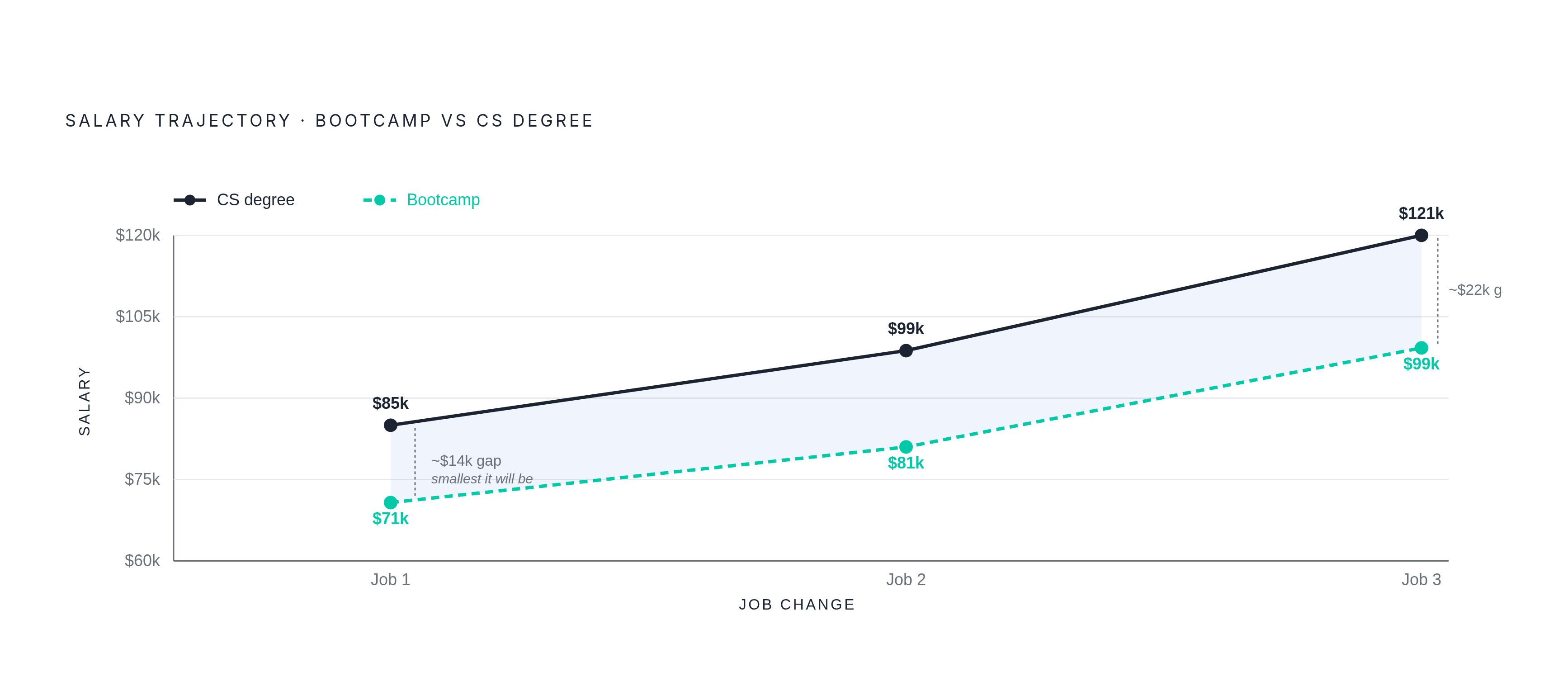
At the entry level, bootcamp grads land around $70,698 on average (Course Report, 2025), with most offers falling between $65,000 and $69,000. Traditionally trained grads start above $80,000. The gap at the starting line, somewhere around $10,000 to $15,000, is real. It's also the smallest that gap will ever be, and reading it as the final word on which path pays better is the mistake most hiring managers make.
Bootcamp salary data climbs fast: $70,698 in the first job, $80,943 in the second, $99,229 by the third. That closes most of the starting gap within three job changes. But the degree advantage doesn't disappear, it just moves. By mid-career, CS degree holders earn roughly 20% to 25% more than bootcamp graduates with similar tenure, and that gap has nothing to do with which name sounds better on a resume.
It comes down to which doors each path opens. The two credentials tend to open different doors into the industry, and those doors lead to roles that carry very different pay bands. Two candidates with identical tenure can sit in very different salary bands depending on which door they walked through, and a hiring manager benchmarking pay against years of experience alone is going to misprice one of them.
How elite tech companies actually evaluate the two credentials
Look at hiring data from Google, Apple, Amazon, Meta, and Microsoft, and the credential gap nearly disappears. SwitchUp data cited by BestColleges for 2026 puts bootcamp-grad hire rates at those five companies at 6.03%, against 6.60% for CS degree holders. Less than a full point separates them, and that number gets repeated constantly as proof the credential stopped mattering.
It proves something narrower than that. A near-identical hire rate doesn't mean identical candidate pools or identical roles once someone's hired. It means these five companies built evaluation systems, technical interviews, take-home projects, live coding rounds, that test capability directly and let the credential fall out of the equation almost entirely. That's an achievement of the interview process, not evidence the credential stopped mattering everywhere else.
Outside that five-company bubble, the number tells you nothing. A hiring manager at a company without Google-scale interview loops is reading a resume without Google's screening machinery behind it, and in that setting, the credential does more of the talking because nothing else is there to check its work. Treating a growth-stage startup's hiring bar as equivalent to Meta's is the exact error to watch for.
What employment rate data on bootcamp graduates actually measures and what it obscures
Bootcamp placement numbers get thrown around loosely. Self-reported rates run anywhere from 70% to over 90%, and the methodology behind those figures varies enough to make most of them useless for comparison. Some programs count a $15-an-hour internship as a placement, and a number built that way tells you nothing about whether a graduate got hired into real work.
CIRR, the Council on Integrity in Results Reporting, exists to fix exactly that problem. It defines a placement as full-time, in-field, and professional, and the numbers get independently audited rather than self-certified. Under CIRR's standard, in-field employment within 180 days runs 64% to 78%. Course Report's broader 2025 definition puts overall employment at 79% within one to six months. Ada Developers Academy tops the CIRR leaderboard at 94% within six months, which sets a real ceiling for what a well-run program can do.
CS degree programs operate in a far less contested measurement environment than bootcamp self-reporting, which makes direct comparisons of placement figures difficult to make cleanly. Here's the blunt practical lesson: when a bootcamp grad's application lands on the desk, whether that program reports through CIRR tells a hiring manager something about program quality before the candidate has answered a single interview question. SwitchUp's employer satisfaction data puts bootcamp grads at 72% in employer ratings of preparedness and performance, a number that sits alongside the placement-rate picture rather than fighting it.
The skills each path actually builds and where those skills hold up over time
Bootcamp curricula get built for one purpose: job-ready output in a specific stack, React, Node.js, Python for data work, inside a 12-to-16-week window. Breadth gets cut on purpose, because there's no time for it. CS degree programs run the opposite play: algorithms, data structures, systems design, the theory of computation, built to carry over across whatever language or framework comes next.
That design choice produces two different failure modes down the road, and neither path dodges one entirely. A bootcamp grad trained on a specific stack in 2021 can watch those exact skills get commoditized five years later once the industry moves on. A CS grad's underlying principles travel across paradigm shifts just fine, but that depth doesn't always turn into shipping speed, especially on product teams where building fast in one framework beats systems knowledge nobody asked for.
Bootcamp strength shows up immediately in frontend development, full-stack web work, API integration, and tooling-heavy jobs. It also shows up somewhere easy to overlook: prior career experience. Around 72% of bootcamp students are career changers coming from outside tech, and a former nurse who learns to code brings healthcare context no CS grad fresh out of a four-year program has. That pairing, technical skill plus domain fluency, is genuinely hard to find anywhere else, and a hiring manager who screens bootcamp resumes purely on stack knowledge misses it entirely.
CS degree depth shows up over a longer horizon: work where theoretical grounding compounds over time, anywhere the codebase is going to outlive whatever framework is popular this year. And the bootcamp ceiling, while lower on average, isn't fixed the way people assume. Data on the 2015 bootcamp cohort shows 46% had reached senior developer roles by 2022, seven years out. What happens after the credential shapes the career more than the credential itself does.
Which role types, team stages, and hiring contexts genuinely favor each profile
Bootcamp grads tend to outperform their credential when the role is frontend, full-stack web, or built around a defined, well-scoped tool stack. Startups and growth-stage teams, where shipping speed beats architectural elegance, reward that profile too. Add prior domain expertise, healthcare, finance, logistics, and the fit gets stronger still, since that vertical fluency rarely shows up in a CS grad's background. Pair a bootcamp hire with a strong senior engineer who actually mentors, and the theoretical gap tends to close considerably faster. Left unmentored, it doesn't close nearly as fast, and pretending otherwise sets the hire up to fail.
CS degree grads tend to outperform their credential in distributed systems, ML and AI, security, and infrastructure work, anywhere theoretical depth pays rent over a long timeline. Long-lived codebases favor them, and so do regulated industries, healthcare, finance, government, where formal training still carries weight with compliance teams and clients who ask about it directly. Technical leadership tracks still skew heavily toward CS degree holders too, particularly in research-adjacent roles.
Past three years of real experience, though, most of this collapses. GitHub history, shipped projects, and system design competence in the interview room start mattering more than which path got someone in the door. The strongest engineering teams don't pick a side: they carry both profiles at once, bootcamp grads bringing urgency and applied fluency, CS grads bringing architectural judgment. Build a team out of only one, and something's missing.
How technical hiring leaders should update their screening process to evaluate each path on its own terms
The most common mistake in the industry right now is running a CS-degree-calibrated interview, heavy on algorithms and systems theory, against a bootcamp candidate trained to think differently, then scoring the mismatch as a skills gap. That gap reflects something other than a lack of skills. It's a mismatch between the instrument and the thing being measured, and it produces false negatives on candidates who would do the job fine.
Bootcamp candidates should get evaluated on working code under realistic conditions, looking at framework fluency, the ability to read and extend an existing codebase, and how they communicate under time pressure. A whiteboard algorithm test measures something outside what they were taught, so it measures almost nothing useful. CS degree candidates deserve a different lens, one built around design reasoning, the ability to argue trade-offs out loud, and how they approach a problem they've genuinely never seen before. If four years of theory don't surface somewhere in that conversation, the interview missed its target.
Program quality is worth checking before the resume gets a second look, and whether a bootcamp reports through CIRR is the fastest signal available. The degree-requirement headline making the rounds, that a large share of employers dropped formal degree requirements, needs a caveat that rarely makes it into the same sentence: according to Harvard Business School research cited by Scrimba, fewer than 1 in 700 actual hires are affected by that policy change. The policy moved. Practice hasn't caught up, which means the real work still happens at the evaluation stage, not the job posting.
That gap between policy and practice bites hardest when internal hiring pipelines slow down, a common condition in a market where bootcamp grads now compete with laid-off senior engineers for the same entry-level postings. Nearshore staff augmentation offers one way around that bottleneck: access to engineers already screened against specific role requirements instead of a credential line on a resume, with firms operating out of Latin America's tech talent pool surfacing candidates from both formation paths. Timezone overlap keeps a distributed team functional in a way offshore models, with their significant feedback delays, generally can't match.
The credential is a starting hypothesis about what a candidate can do. It isn't a verdict, and treating it like one is how good hires get passed over for the wrong reasons. The job of anyone doing the hiring is to test that hypothesis with the right instrument, built for the path the candidate actually walked, not the one the interview process assumes by default.