AI Coding Assistant Adoption Rates Among Professional Software Engineers
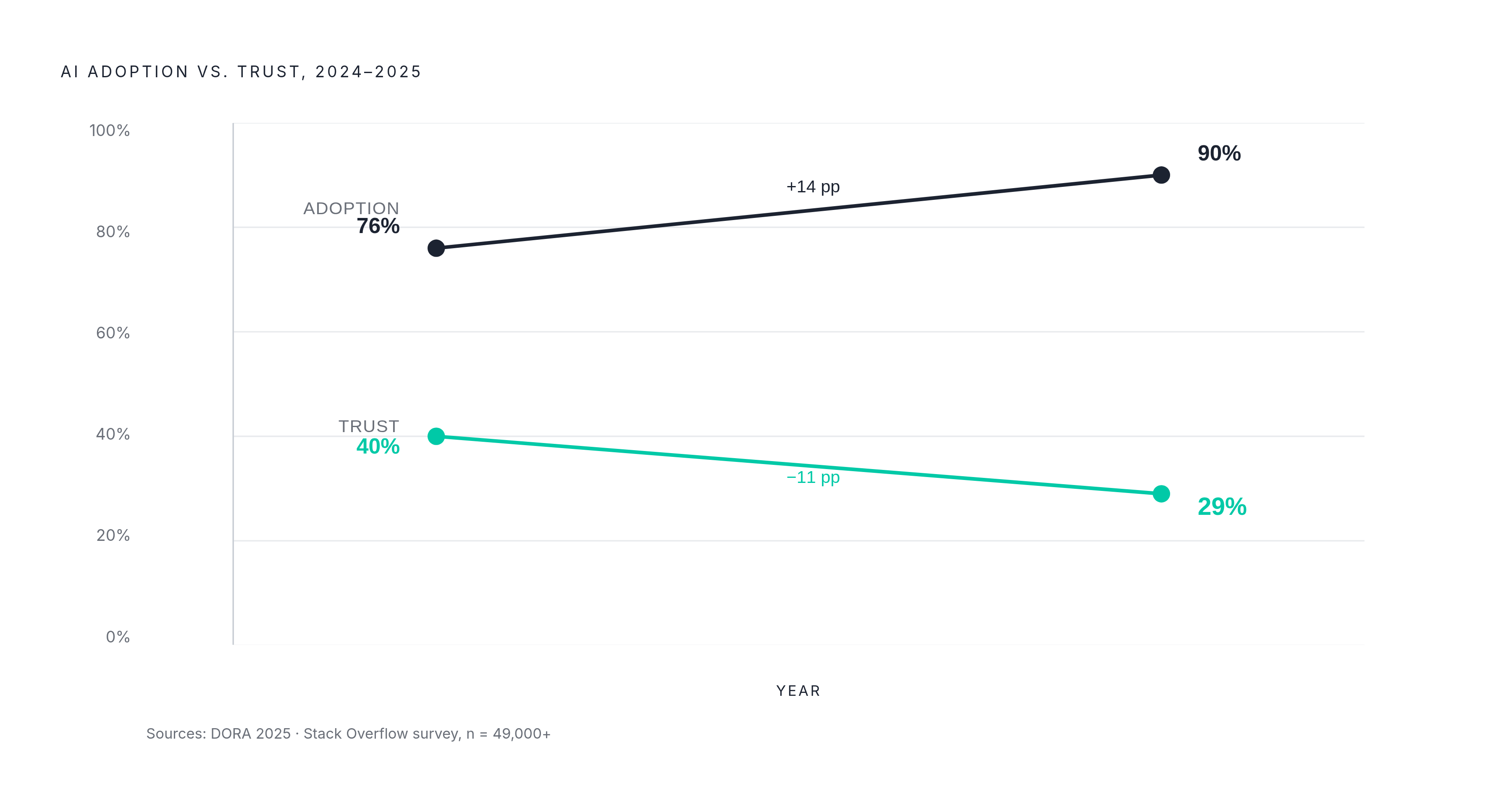
Engineers rapidly adopted AI coding tools, but trust in their output is crashing.
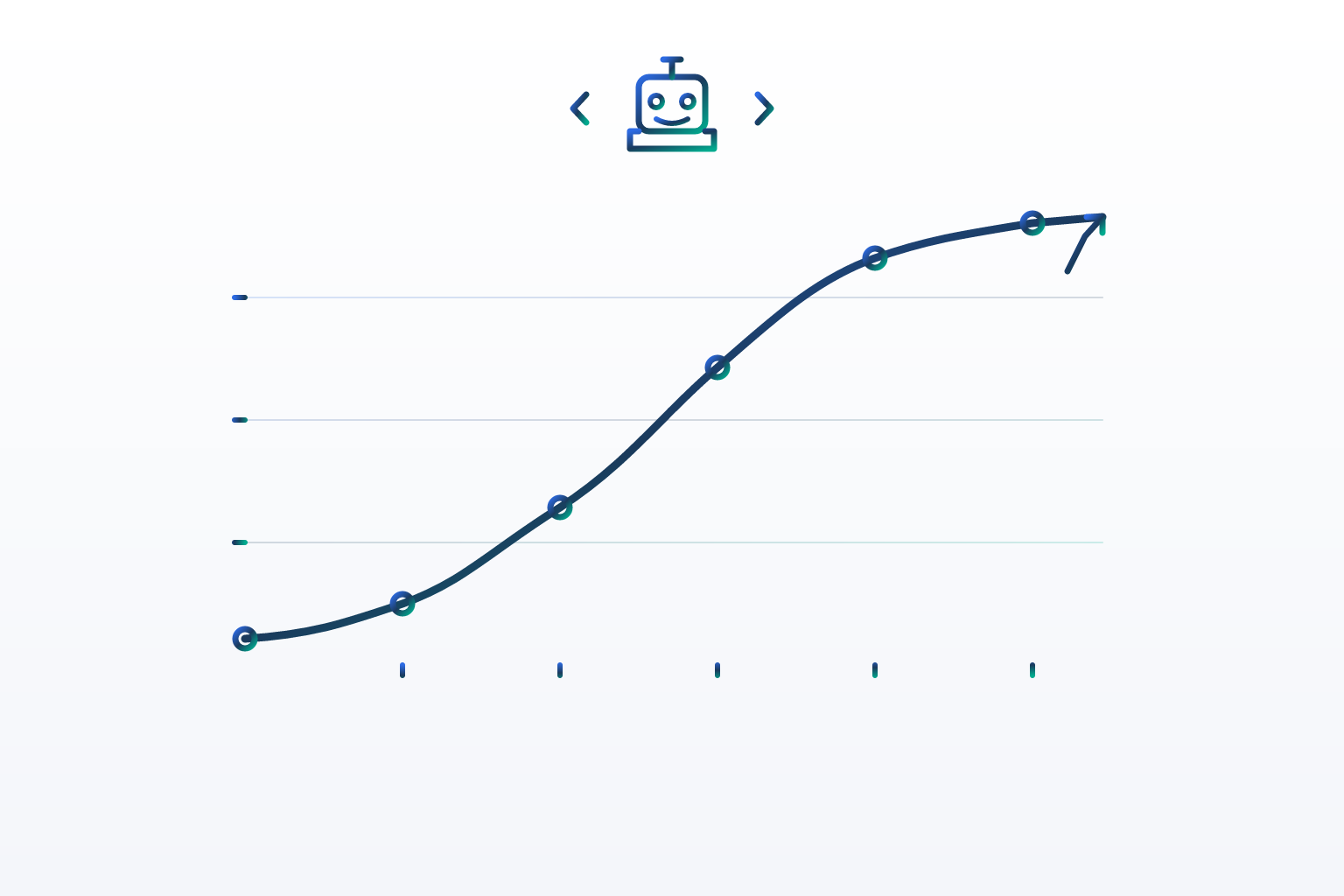
AI coding assistants have crossed into near-universal use among professional software engineers. That fact alone isn't the story anymore. Usage keeps climbing while trust in what these tools produce has dropped sharply even as adoption rose, and that gap between rising adoption and falling trust is the real story. Reading 90% adoption as a victory lap misses the point entirely, because the harder question, the one engineering leaders actually have to answer, is how teams navigate the gap between what these tools generate and what's safe to ship.
How adoption reached near-saturation so quickly
DORA's 2025 State of AI-Assisted Software Development report found that 90% of software development professionals had adopted AI tools at work, a 14 percentage-point jump from the year before. DORA's 2025 State of AI-Assisted Software Development report found that 90% of software development professionals had adopted AI tools at work, a 14 percentage-point jump from the year before. Stack Overflow's 2025 Developer Survey, with more than 49,000 respondents, put 84% of developers in the "using or planning to use" category, with 51% of professional developers using AI tools daily. DX's Q4 2025 impact report, drawing on more than 135,000 developers, found 91% adoption within its sample, though that sample skews toward organizations already running engineering intelligence platforms, not a random cross-section of the industry.
Those three numbers, 90%, 84%, 91%, look like they're confirming each other. They aren't quite. These surveys measure different things: Stack Overflow's figure counts people who use AI tools or plan to, DORA's tracks adoption specifically at work, and DX's comes from a self-selected, already AI-forward population. Anyone using these numbers to benchmark a team against the industry needs to know which definition they're borrowing.
What's more telling than the headline percentage is how deep the reliance goes. DORA found 65% of respondents heavily reliant on AI tools, with a median of two hours a day spent on AI-assisted work. That's not dabbling. GitHub's Octoverse 2025 report found that 80% of new developers on GitHub start using Copilot within their first week on the platform, which means adoption is now stitched into onboarding rather than something an individual engineer decides for themselves. And the next wave is already visible: a measurable share of professional developers now use AI agents that go beyond traditional autocomplete, suggesting agentic workflows are becoming the next default, not a niche experiment a few teams are running.
The tool landscape: from Copilot's near-monopoly to a fragmented multi-tool reality
Between 2022 and early 2026, the market went from one dominant player to something closer to a crowded field with no single winner. GitHub Copilot still carries scale: more than 20 million all-time users, 4.7 million paid subscribers as of January 2026, and deployment across 90% of Fortune 100 companies. Gartner sized the 2025 AI code-assistant market at $3.0 to $3.5 billion.
But Copilot's grip has loosened noticeably. JetBrains' AI Pulse survey, with more than 10,000 respondents, put Copilot's workplace usage at 29%. By the time JetBrains ran its Developer Ecosystem Survey 2026 between May and July, that number had slid to 21%. Part of that shift traces to pricing: GitHub moved most paid Copilot plans to usage-based, AI-credit billing on June 1, 2026, with annual Pro and Pro+ subscribers grandfathered until renewal. Gartner has flagged the downstream risk of that kind of consumption pricing directly, warning that 40% of enterprises on consumption-priced AI tools will see unplanned costs exceeding twice their budget by 2027.
Claude Code is the clearest beneficiary of that erosion. It grew from 18% adoption in JetBrains' January 2026 survey to 39% globally, and 47% in the United States, by the May to July 2026 survey window, making it the most widely adopted AI coding tool at work in that data set, used roughly twice as often as Copilot, and the primary tool for 31% of developers. Anthropic's Claude Code reportedly reached a $2.5 billion run rate within about nine months of its full launch, per Anthropic and Sacra reporting. Cursor, meanwhile, held 18% workplace adoption in January 2026 but dropped to 12% by mid-year, with a particularly sharp fall in China, from 28% down to 16%. It still leads on primary-tool share in some survey cuts, but the pressure is visible. OpenAI's Codex grew roughly fivefold over the same stretch, reaching 16% adoption as awareness jumped from 27% to 65% of developers.
None of this happens in isolation, either. Survey data indicates that 70% of engineers run two to four AI coding tools at once, which means the multi-tool stack is now standard practice, not an edge case. That has a quiet but real consequence for measurement: no single vendor's dashboard shows the full picture of AI-touched code moving through a given team. And the category itself keeps blurring at the edges. JetBrains' AI Pulse data found that 28% of developers use general-purpose ChatGPT for coding tasks, nearly matching Copilot's dedicated share at the time. The line between "coding assistant" and "general chatbot" is getting harder to draw with a straight face.
What productivity data shows, and where it falls apart
The most-cited productivity number in this space comes from GitHub and Peng et al.'s 2023 study, later replicated: developers completed a standardized programming task 55% faster using Copilot. It's a real result, but the task was well-defined and bounded, and that finding doesn't stretch cleanly to messier, multi-context engineering work. DX's Q4 2025 data adds a throughput signal on top: daily AI users merge roughly 60% more pull requests per week than non-users. That's a volume measure, not a quality one, and the two get conflated constantly.
Some numbers cut the other way, showing AI slowing experienced developers down even as those developers believe they've sped up. A METR study found that AI made experienced developers 19% slower on real-world tasks, even though those same developers believed they'd worked 20% faster. That gap between what developers feel and what gets measured suggests the productivity narrative around AI tools rests partly on perception rather than throughput. Gartner survey data backs this up from another angle: 42% of engineering staff say AI tools make complex, multi-context tasks harder to manage, not easier. The gains cluster in routine, bounded work. Architecture decisions, security-critical logic, and performance-sensitive systems are exactly where developers say they lean on AI the least.
An organizational wrinkle worth noting: AI adoption may raise individual productivity while sometimes affecting team-level delivery stability. Individual speed and collective throughput aren't the same metric, and treating them as interchangeable is where a lot of engineering leaders get the story wrong. AI tools deliver measurable productivity gains, but those gains apply to specific kinds of work. Applying it uniformly across every role, seniority level, and task type is the mistake, not the technology itself.
The lowest recorded level of developer trust in AI output
Start with the number, because it's the whole argument in miniature. Stack Overflow's 2025 survey, with more than 49,000 respondents, found that only 29% of developers trust AI output, down from 40% in 2024. That's a substantial drop in trust in a single year, happening at the exact same time adoption kept rising. Usage and confidence moved in opposite directions.
The frustration driving that drop isn't dramatic failure. It's something more corrosive: 66% of developers cite AI output that's "almost right, but not quite" as their single biggest frustration, according to that same Stack Overflow survey. Code that's obviously broken gets caught immediately. Code that looks plausible and runs but contains a subtle logic error can sit in a codebase for a long time before anyone notices. Forty-five percent of developers name debugging AI-generated code as time-consuming, the top complaint in that category.
Acceptance rates tell a related story. Across the broader user base, developers accept AI code suggestions somewhere between 21.2% and 23.5% of the time, meaning roughly three out of four suggestions get rejected. But less experienced developers accept at 31.9%, compared to 26.2% for senior engineers, a gap that suggests newer developers may be taking suggestions they don't yet have the context to fully evaluate. Security research adds weight to the caution: AI-generated code reportedly carries close to three times as many vulnerabilities as human-written code, with around half failing standard security benchmarks in available analysis, and fewer than half of developers are reported to review AI-generated code before committing it. Separate analysis found AI-coauthored pull requests carry roughly 1.7 times more issues than PRs written entirely by humans, and available estimates attribute roughly one in five security breaches to AI-generated code.
Behavior hasn't caught up to the skepticism yet, though. Only 48% of developers say they always review AI-generated code before merging. Trust dropped, in other words, but review discipline hasn't tightened to match. Seventy-seven percent of developers say full "vibe coding," generating entire applications from a prompt, has no place in their professional work, which is probably the clearest signal of where the trust gap actually sits.
The rising share of AI-authored code in production outpacing oversight practices
DX's Q4 2025 data put the share of merged code that's AI-authored at 22%, and some broader estimates put AI's share of all new commercial code at around 41%. Google's own leadership has said roughly 75% of new code at the company is AI-generated, with engineers reviewing the output before it ships.
That Google figure matters because it's the counterexample: high volumes of AI-assisted code carry no inherent danger when review scales alongside them. High volumes of code produced with AI assistance carry no inherent danger, provided review scales right alongside them. The risk appears when the volume of AI-generated code climbs and the review process doesn't climb with it, and CodeRabbit's finding of substantially more issues in AI-coauthored PRs is what that mismatch produces in practice, at scale, across an industry.
Enterprise governance is trying to keep pace, but unevenly. Larger organizations typically pair AI coding tools with access controls, logging, approved model lists, and CI policy gates, though this infrastructure is far from universal, and smaller organizations often lack the resources to build it. Regulatory pressure has stopped being theoretical, too: the EU AI Act's rules for high-risk systems and transparency obligations entered into application on August 2, 2026, per the European Commission's official timeline. Any organization building or shipping AI systems that touch the EU market is now operating under active compliance obligations, not a future deadline to plan around. Combine that with Gartner's warning about unplanned costs from consumption-priced AI tooling, and governance stops being purely about code quality. It becomes a budget and legal question too. Seat utilization numbers, the kind vendors love to put in a pitch deck, don't tell you whether the code those seats produced is actually safe to ship.
How adoption patterns differ by seniority, role, and geography
Age is one of the sharpest dividing lines in this data. Developers between 18 and 34 are roughly twice as likely to use AI coding assistants as developers over 45, and that same younger cohort accepts AI suggestions at 31.9% versus 26.2% for senior engineers, the same gap noted earlier, driven at least partly by less experience to weigh the output against.
Role matters almost as much as age. Stack Overflow's 2025 data puts full-stack developers at the front of adoption, around 32%, with frontend developers around 22% and backend developers trailing at roughly 9%. That backend lag isn't surprising once you consider what backend code tends to touch: the risk and complexity there is simply higher, and developers seem to know it. Usage patterns split by seniority too, not just adoption rates: junior developers gravitate toward autocompletion and explanation features, while senior engineers use AI more for scaffolding, so the two groups are effectively using different tools to solve different problems, and probably need different oversight built around each.
Geography adds another layer. JetBrains' survey found Claude Code adoption at 47% in the United States against 39% globally, Cursor's steepest adoption drop occurred in China, falling from 28% to 16% between January and mid-2026, and Google's Antigravity tool holds 15% adoption in India, nearly tying for third place there, compared to just 6% globally. For any team distributed across regions, that variation isn't a footnote. It means a single engineering organization might be running meaningfully different tool stacks depending on where its developers sit, which complicates any attempt at unified governance or quality measurement across the whole team. And the productivity split is visible at the management layer too: DX data shows that the pull request volume gap between daily AI users and non-users mirrors the pattern seen at the individual contributor level, suggesting the productivity split extends across roles.
The accuracy gap and its practical meaning for engineering teams
The question has quietly shifted. It's no longer "should this team adopt AI tools," because that decision is largely made. It's "can this team prove what it's actually getting from them," and most teams, honestly, can't answer that yet.
Some categories of work hold up fine under AI assistance: boilerplate, unit test generation, API integration scaffolding, documentation, straightforward refactoring. Low-risk, repetitive, and the cost of a subtle mistake stays contained. Other categories demand real caution: architecture decisions, security-critical logic, performance-sensitive systems, core business logic, the exact places where that 66% "looks right but isn't" frustration turns expensive rather than just annoying.
Review discipline is the lever that actually decides which way this goes, more than the generation rate itself. Google's model, 75% AI-generated code with every line reviewed, is the benchmark for handling high AI-code volume without a proportional drop in quality. A team where junior developers accept suggestions at 31.9% without matching that with proportional review is quietly building technical debt faster than PR cycle time alone would ever reveal. For teams building out distributed engineering capacity, whether through internal hiring or outside staff augmentation, governance isn't about whether every engineer has access to AI tools. It's whether engineers at every experience level and every location are applying the same review standard to what those tools produce. The EU AI Act's compliance deadline, already active as of August 2026, turns that from a quality preference into a legal obligation for any organization touching the EU market.
There's a burnout dimension tangled up in all of this that's easy to overlook. Sixty-five percent of developers still report burnout despite widespread AI tool use, and in plenty of cases, AI hasn't shrunk workload so much as expanded what's expected of a single engineer. The time savings AI promised hasn't actually resolved the underlying workload problem, and teams treating AI adoption as a way to cut headcount rather than add a capability layer risk making both problems worse at once. What the data supports, consistently, is a narrower and more useful claim: AI as an accelerator paired with real human review beats AI as a stand-in for engineering judgment. That only works, though, with experienced engineers still in the loop who know how to tell the difference between code that's correct and code that merely looks correct.