Engineering Manager Span of Control in Distributed Team Structures
Distributed teams need tighter management spans than office-based ones do.
Span of control, in engineering, means one thing on paper and another thing in practice. On paper, it's the count of people who report to a manager. In practice, it's a measure of how much judgment, coaching, and coordination that manager can give each person before all three start to slip. Most span-of-control benchmarks were built for offices where people sat next to each other and picked up context by osmosis. Distributed engineering teams don't get that for free, and the gap between the old number and the real one is where most management failures actually start.
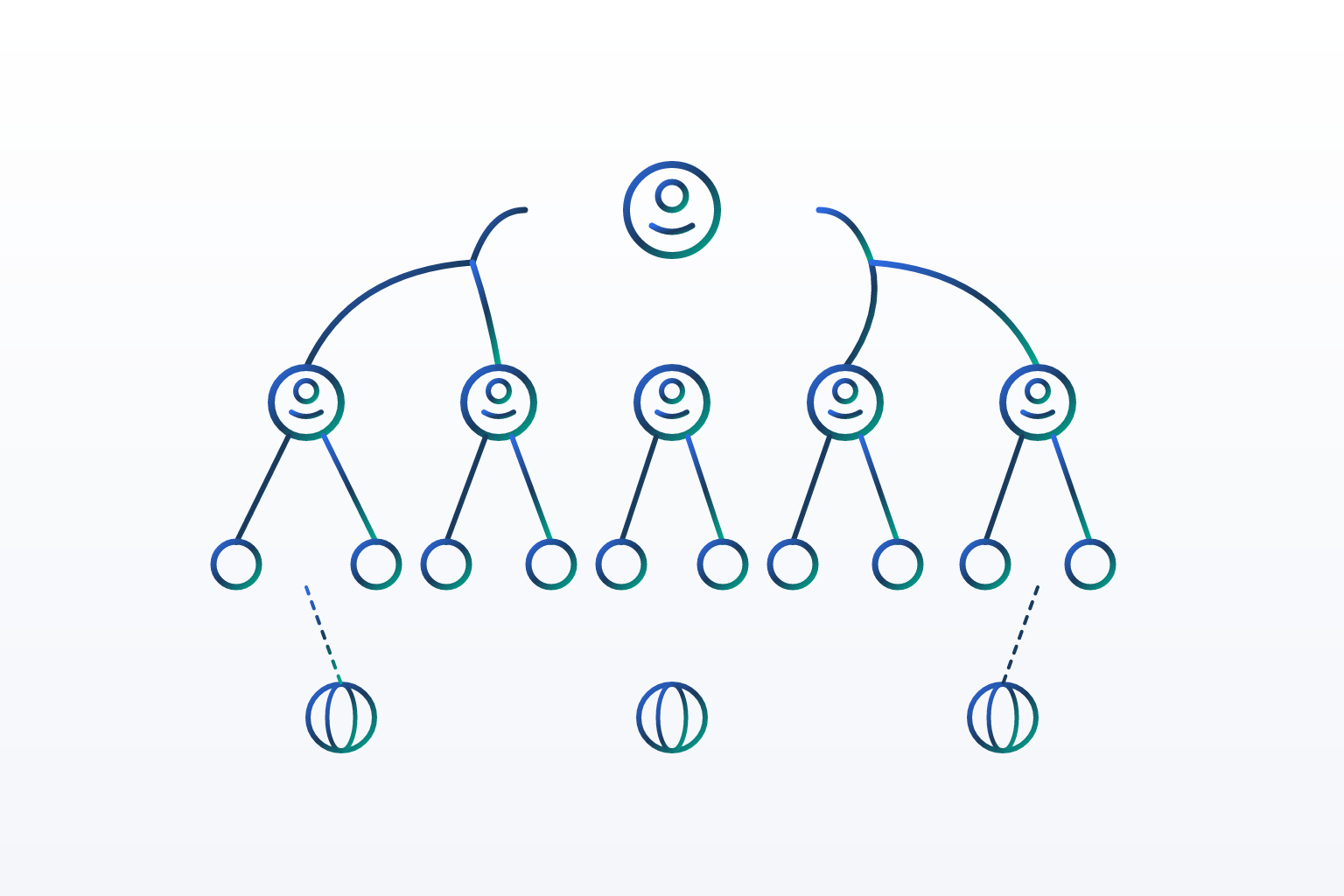
Corporate design work has long split management roles into tiers, and each tier carries different span expectations. A player-coach, someone still writing code or reviewing architecture alongside managing, supports 3 to 5 people well, not more. A coach, further removed from daily technical work, can stretch to 6 or 7. A supervisor overseeing routine, less interdependent work can handle up to 10. A coordinator, whose job is mostly administrative sign-off rather than judgment calls, can stretch past 15. Engineering management belongs in the first two categories, full stop. Anyone applying a coordinator's span to a coach's job is making a category error, not a judgment call. The work is interdependent, the decisions are judgment-heavy, and code review alone eats real hours every week. Staffing firm KORE1 has pointed to a figure near 6 engineers per manager as the number with actual evidence behind it. Everything wider than that, in most engineering orgs, is convention borrowed from other functions, not something proven to hold up under engineering's specific demands. The size of the team a manager owns isn't the real question. The real question is how much of that manager's attention each person is quietly consuming.
Where a particular country averages actually stand in 2025-2026 and why the median tells a different story
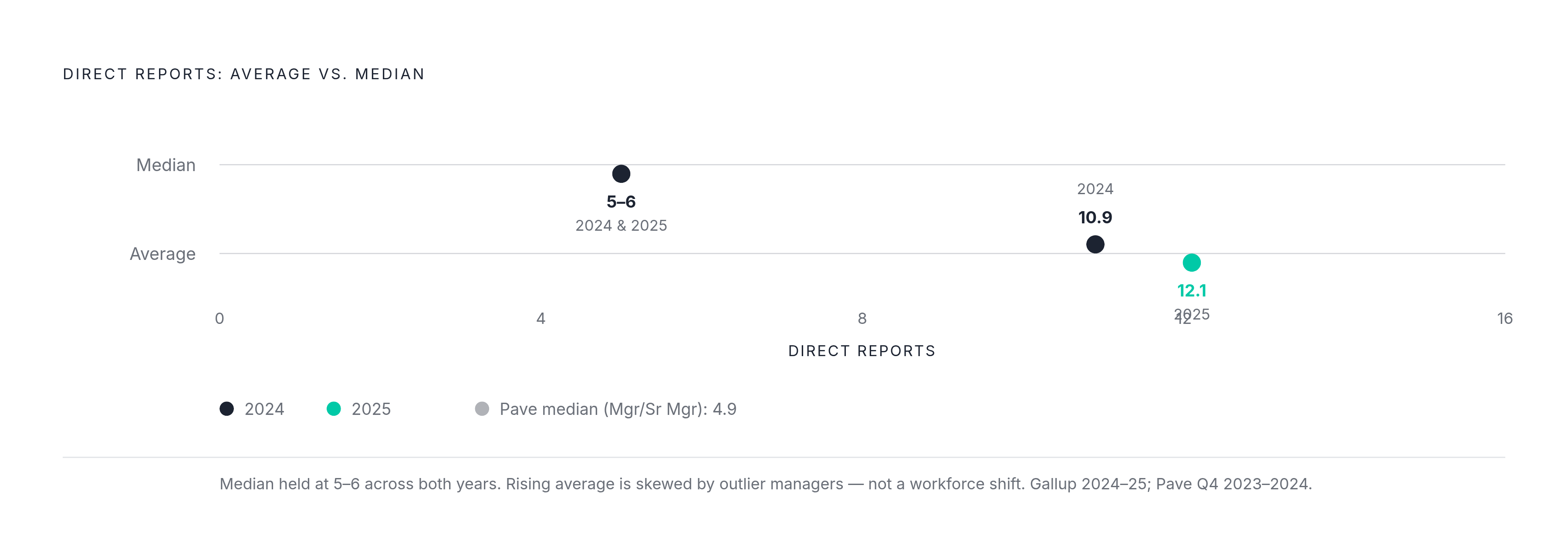
Gallup's tracking shows the average number of direct reports per manager climbing from 10.9 in 2024 to 12.1 in 2025, meaningfully higher than earlier Gallup baselines. Taken at face value, that number says span is expanding everywhere, across every kind of team and every function. It isn't, and treating the average as the real trend is the first mistake most org designers make with this data.
The median has held at 5 to 6 direct reports per manager, which means the average is being dragged upward by a smaller group of managers carrying very large teams, not by a broad shift across the whole workforce. Compensation data firm Pave, drawing on more than 257,000 managers, backs this up at the level of specific titles: Manager and Senior Manager roles average 4.9 direct reports, up from 4.4 in Q4 2023, and management-track roles one tier up average 4.6, up from 4.3 over the same stretch. Those are modest, real increases, not the near-doubling the Gallup average implies on its own.
What's happening underneath both data sets is a flattening of middle management. Layers get cut, and the managers who remain absorb whatever headcount is left over. Pave frames the dynamic Meta helped popularize as something closer to a market norm now, not an isolated cost-cutting move at one company. That distinction matters, because the average span figure is a byproduct of an org chart getting leaner, not a target anyone tested and found optimal. Treating "managers now average 12 reports" as a benchmark worth hitting means mistaking a symptom of cost pressure for a design decision, and that's exactly where span planning goes wrong.
Gallup's data holds a second wrinkle worth sitting with: most managers still do individual contributor work on top of managing. The median manager reportedly spends around 40% of the week on non-managerial tasks. So a manager's nominal 40-hour week doesn't come with 40 hours of management time attached to it, not close. Whatever span number an org sets has to be measured against the actual hours available for managing, not the hours sitting on the calendar.
How distributed team structures change the cost of each direct report
Seven people sitting in one office is a different management job than seven people spread across three time zones, even though the org chart shows the same number. Distributed structures need structured, deliberate communication to replace what proximity used to handle automatically, and that structure costs calendar time a manager doesn't get back.
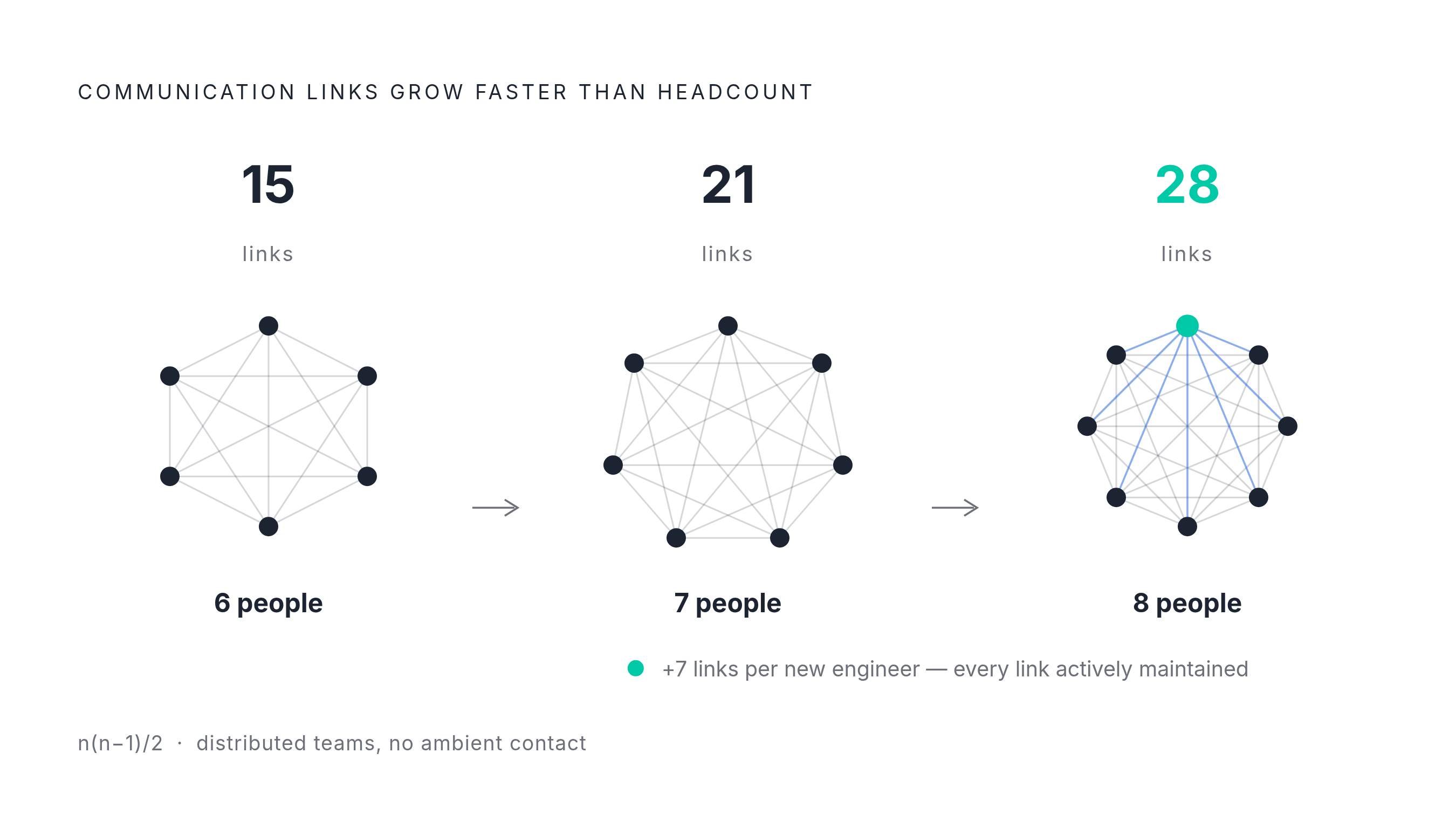
The math behind team coordination explains why this scales badly. The number of potential communication links in a group of size n is n(n-1)/2. At 6 people that's 15 links, at 7 it's 21, at 8 it's 28. Overhead grows faster than headcount does, and in a co-located team plenty of those links get maintained informally, in hallway conversations, at lunch, by overhearing someone else's problem. A distributed manager doesn't get that shortcut. Every one of those links has to be actively maintained through a scheduled call, a written update, or a deliberate check-in, because nothing is ambient anymore.
That loss of ambient awareness is the biggest hidden cost here, bigger than the time zone math itself. A manager in an office absorbs context passively, just by being present. A distributed manager has to schedule for the same awareness, which means it either happens on purpose or it doesn't happen at all. Timezone spread compounds this: a blocker that surfaces at the end of someone's day in one region can sit untouched for hours if nobody actively routes it to the right person. Team composition adds another layer on top: mixed seniority, a blend of staff and contractors, engineers working across several national contexts, each of which needs its own calibrated amount of attention rather than one uniform approach.
And if the manager is also a player-coach, still owning technical or architectural work, the real ceiling shrinks to something like 3 to 5 direct reports, no matter what the org chart says the span should be. A direct report managed across three time zones costs more of a manager's bandwidth than the same report sitting down the hall. That cost has to get counted before anyone decides what the "right" span number is, not after.
What AI coding tools do and don't change about this calculation
The tempting logic goes like this: AI tools make engineers individually faster, so management overhead per engineer should shrink, so spans can widen. It's a clean argument, and it's wrong. Widening span because AI sped up code generation confuses two different constraints, and the data on software delivery quality makes the confusion obvious.
CI/CD platform CircleCI's 2026 research, drawn from more than 28 million CI workflows, found main branch success rates falling to 70.8%, the lowest point in more than five years, while median recovery time from failures climbed to 72 minutes, up 13% over the year before. CircleCI's own read on this is blunt: writing code stopped being the bottleneck a while ago. Review, validation, integration, and recovery from breakage are where the friction actually lives now.
AI tools increase how much code gets written and how fast. They do nothing to increase a team's capacity to review that code safely, coach a junior engineer through a mistake buried in it, or keep a growing, faster-moving codebase coherent as a system. The actual work of a healthy engineering manager, developing people, absorbing ambiguity, cutting through cross-functional friction, making calls under uncertainty when there's no clean answer, isn't something AI touches at the team level. Deloitte's research points in the same direction: AI can surface useful signals about performance and collaboration that help a manager coach better, but it doesn't replace empathy, psychological safety, or the sense of connection a team needs to function.
Once span outruns what a manager can carry, management stops being management and turns into triage. In a distributed, AI-accelerated team, triage looks like reviews stacking up, blockers sitting unrouted, weaker performers drifting longer before anyone notices. The efficiency AI actually delivers is individual throughput. Coordination capacity is a separate constraint entirely, and any org that widens span on the strength of an AI tool is solving for the wrong variable.
Practical signals that span has exceeded what a distributed structure can support
The tell usually shows up in the calendar before it shows up in a dashboard. One-on-ones get rushed, or rescheduled, or rescheduled again, because they're the easiest thing to cut when a manager's week fills up. Feedback conversations that used to happen regularly slip to quarterly, then to whenever there's time, which in practice means rarely.
Organizational design firm Organimi flags a warning sign worth taking seriously: managers spending over 70% of their time on tactical oversight rather than coaching or unblocking people. When that happens, decisions back up behind the manager, because the manager has become the single routing point for too many async conversations at once, and nothing moves until they get to it.
Retention usually cracks before velocity does. A weaker performer drifting without correction is often the earliest visible sign that span has gone past what the manager can sustain, well before it shows up as a missed sprint or a slipping metric. Side channels start multiplying too, informal alignment breaking down once a team crosses a certain size, which is exactly what the coordination-links math predicts before it ever becomes visible in practice.
Engagement suffers in a measurable way. Organimi cites that employees getting meaningful feedback at least once a week are close to three times more likely to be engaged, and a stretched manager can't hold that cadence across too many people. If the manager is also a player-coach, watch for one more signal closely: missed technical commitments of their own, which usually means all their available bandwidth already went to people problems, and there was nothing left for the work.
Structural levers that let engineering organizations set spans they can actually sustain
Span shouldn't be a single number stamped across an entire engineering org, and treating it that way is the most common mistake in how these teams get built. It should follow the type of work, the seniority mix, and whether the manager in question is a player-coach, a coach, or something closer to a supervisor. A senior, highly autonomous team can carry a wider span comfortably. A mixed-seniority team navigating a hard architectural migration can't, even if both teams show the same headcount.
Platform teams absorb a real chunk of coordination load that would otherwise land on engineering managers directly. Google's DORA research program found that by 2025, 90% of organizations had adopted some form of internal developer platform, and 76% had a dedicated platform team running it. That's infrastructure and tooling work that no longer routes through a manager's inbox, which quietly widens the span that manager can sustainably carry.
Staff augmentation changes the math in a way that's easy to miss. When an augmented engineer joins a distributed team, the manager's coordination load goes up first, onboarding, context transfer, provisioning access, before it comes back down once that engineer is integrated. Planning for a short-term tightening of span at the point of integration beats discovering it after the fact.
Documentation works as a genuine force multiplier here, not a checkbox. Clear decision logs, well-kept runbooks, and written process reduce the amount of ambient routing work a manager has to do by hand, which lowers the coordination cost of each report without touching headcount at all. Creating tech lead or senior IC roles does something similar: it gives someone on the team formal responsibility for alignment work without adding another management layer, which takes pressure off the manager without stacking hierarchy on top of it.
KORE1 points to a specific breakpoint worth treating as a real threshold, not a soft guideline: above 8 engineers, one-on-ones alone consume roughly a day and a half of a manager's week. That's the point where span needs a deliberate review, not the point after a team has already started breaking down.
How distributed team composition, including nearshore and augmented engineers, affects the span calculation in practice
Where a team's engineers actually sit changes the coordination math directly, and pretending otherwise is how spans get set wrong from the start. Nearshore engineers, teams based in a nearby region working with companies elsewhere, tend to share substantial overlap with those companies' working day. Real-time collaboration stays genuinely viable in that setup, and the overlap meaningfully cuts the async coordination cost attached to each report compared with teams sourced farther away.
Offshore arrangements with something closer to 30 minutes of overlap against a given working day work differently, and worse. Every handoff has to get scheduled in advance rather than happening as a normal back-and-forth, and that turns each offshore report into a heavier draw on the manager's coordination bandwidth than a nearshore or domestic one. Sourcing location is more than a cost decision. It's a span decision. A manager carrying 6 nearshore engineers and 6 offshore engineers isn't managing 12 equivalent people, even though the org chart reads that way. The offshore half draws disproportionately on the manager's time, every week, without fail.
Augmented staff bring their own version of this. They work under the direction of the internal team, and they land inside the manager's span the moment they're onboarded, not after some grace period. There's no ramp where they're someone else's responsibility first. Vetting quality matters more here than it gets credit for: a rigorous vetting process ahead of placement cuts down the onboarding friction and course-correction the manager has to absorb later, while a weak vetting process is a hidden way span quietly gets wider without anyone deciding it should.
Running augmented staff through structured agile practice, Scrum or Kanban, helps too. The sprint cadence itself absorbs some of the alignment work that would otherwise land as a direct conversation with the manager, without adding another meeting to anyone's calendar. The practical guideline that falls out of all this is simple: model the coordination cost of a sourcing arrangement before setting a manager's span, not after the team is built and the manager is already underwater.
Treating span as a dynamic variable rather than an org-chart constant
No single number is right across an entire engineering organization, and any policy that tries to apply one span uniformly is solving the wrong problem. The honest reading of every benchmark discussed here is that 5 to 8 direct reports is a starting range for knowledge work, not a fixed policy to stamp onto teams that look nothing alike. Three questions do most of the real calibration work: is this manager a player-coach or closer to a pure coordinator, how much time zone spread sits across the team, and how senior and self-directed are the engineers actually on it.
Span should get revisited at real structural inflection points, not on a fixed HR calendar. KORE1's framing of specific breakpoints, like the point past 8 reports where one-on-ones alone eat a day and a half a week, gives managers something concrete to watch for instead of waiting for an annual review cycle to catch a problem that's been live for months already.
AI's honest role in this is to surface performance and collaboration signals earlier, so a manager can act before retention or velocity numbers force the issue. That's a genuinely useful function. It is not, on its own, a reason to widen span, and any org that treats it that way is confusing a monitoring tool for a capacity increase. The cost of getting span wrong compounds specifically in distributed teams: burnout, thin and infrequent feedback, missed retention warnings, and slower recovery from incidents, the same 72-minute median recovery time CircleCI's data shows climbing amid rising change volume, are all downstream consequences of a span decision made without the full math behind it.
For any team scaling through nearshore partnerships or staff augmentation, span belongs in the team design conversation from day one. It's a structural input to decide in advance, not something to notice only after the manager is already stretched past what the team's structure can actually support.