Structured Scoring Rubrics for Technical Interview Panels
Shared scoring rubrics turn subjective panel verdicts into defensible hiring decisions.

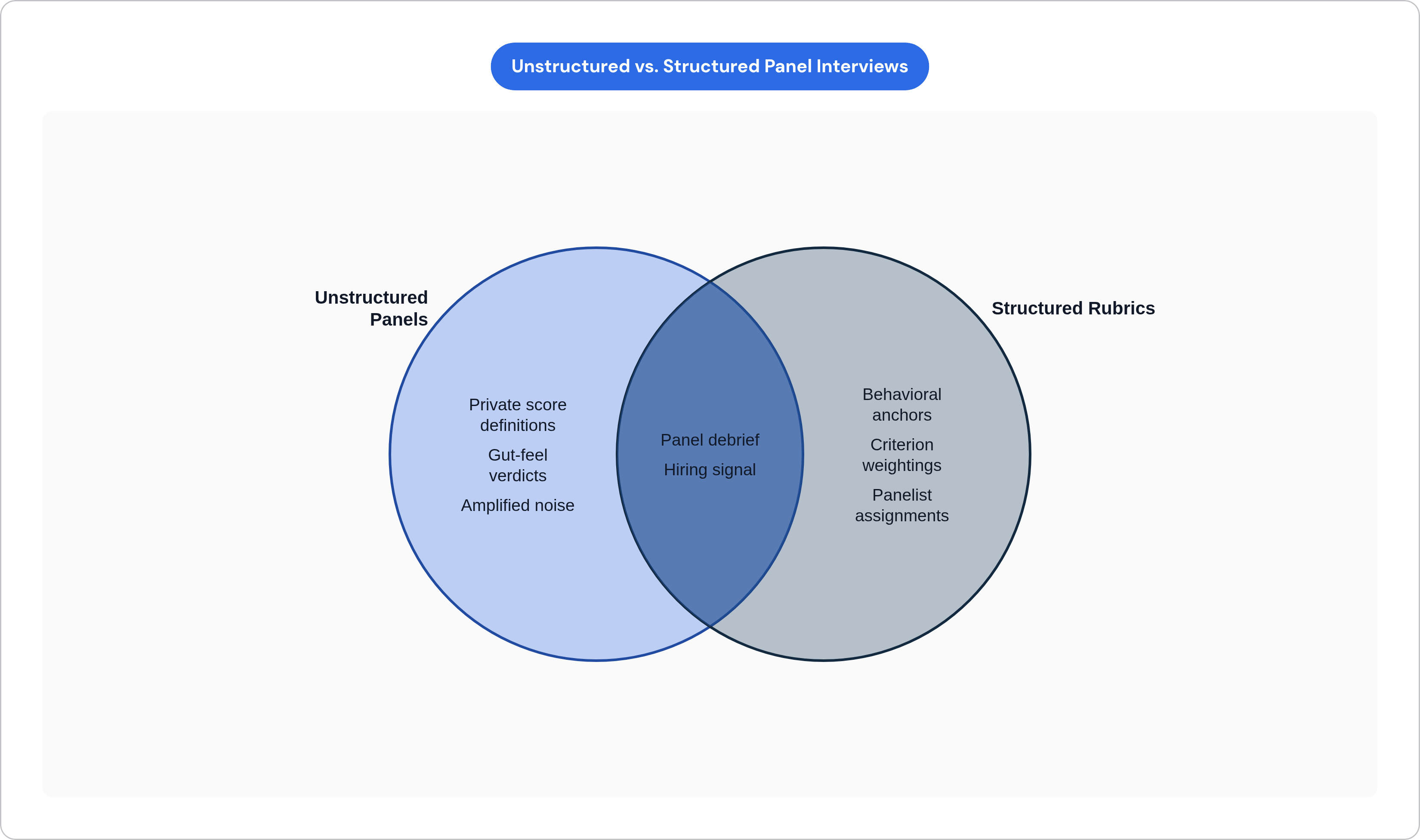
Technical interview panels fail in a specific, predictable way: five engineers sit through the same one-hour conversation with a candidate, and each one walks away with a different verdict, because each one arrived with a different private definition of what "strong" even means. One panelist weights whiteboard fluency; another weights how the candidate handled being wrong about an edge case. Neither has told the other what they're looking for. This is the default state of technical hiring, and a structured scoring rubric is the tool built to eliminate it.
The failure isn't really about the candidate. It's about what happens after the interview ends, when five people sit down to debrief and discover they weren't evaluating the same thing at all. Without a shared standard, the debrief conversation turns into a negotiation, and negotiations get won by whoever is most confident, not whoever has the best signal. A senior engineer says "I just don't think they're strong enough" and nobody asks what "strong enough" was supposed to mean in the first place, because there was never a definition to point back to. That veto sticks. It sticks because there's no criterion to check it against, and disagreeing with a confident colleague's gut feeling, absent a shared standard, just looks like disagreeing with confidence itself.
Panels exist, in theory, to cancel out individual bias by pooling multiple perspectives. That's the pitch: five subjective readings average out to something closer to the truth. But pooling subjective impressions doesn't cancel bias; it compounds it, because unstructured impressions tend to correlate with the same surface-level signals across evaluators, things like articulateness, confidence, and cultural resemblance to the interviewer. The result is a hiring decision nobody can actually explain six months later, defend if challenged, or learn from the next time around. That's the specific problem this piece is about solving.
What a structured scoring rubric is and what it actually defines
A rubric is a scoring tool built before the interview happens, and it specifies exactly what a candidate has to demonstrate to earn each score on each criterion. It is not a checklist of topics to cover. It is not a 1-to-5 rating scale by itself, either; a scale without anchor descriptions is still just a number pulled from someone's impression, dressed up to look objective.
The anchors are the whole point. For each competency a rubric assesses, it needs to define four things: the competency itself (system design, debugging, collaboration under pressure), what a candidate must show at each score level to earn it, how much that criterion counts relative to the others for this specific role, and a required field for notes tied to something the candidate actually said or did. That last piece matters more than people give it credit for. A score with no evidence behind it is a gut feeling wearing a number.
For a panel specifically, there's one more layer: the rubric assigns each criterion to a single panelist responsible for evaluating it. Not everyone scores everything. Some teams also swap numeric scales for a "strong yes / yes / no / strong no" format, which forces an actual hiring signal instead of letting nervous evaluators retreat to a neutral middle score that says nothing.
None of this scripts the conversation. A rubric doesn't tell a panelist what questions to ask word-for-word, and it doesn't remove judgment from the process. It structures where judgment gets applied, so five people are exercising judgment against the same yardstick instead of five different ones.
The empirical case for structured evaluation over unstructured panel impressions
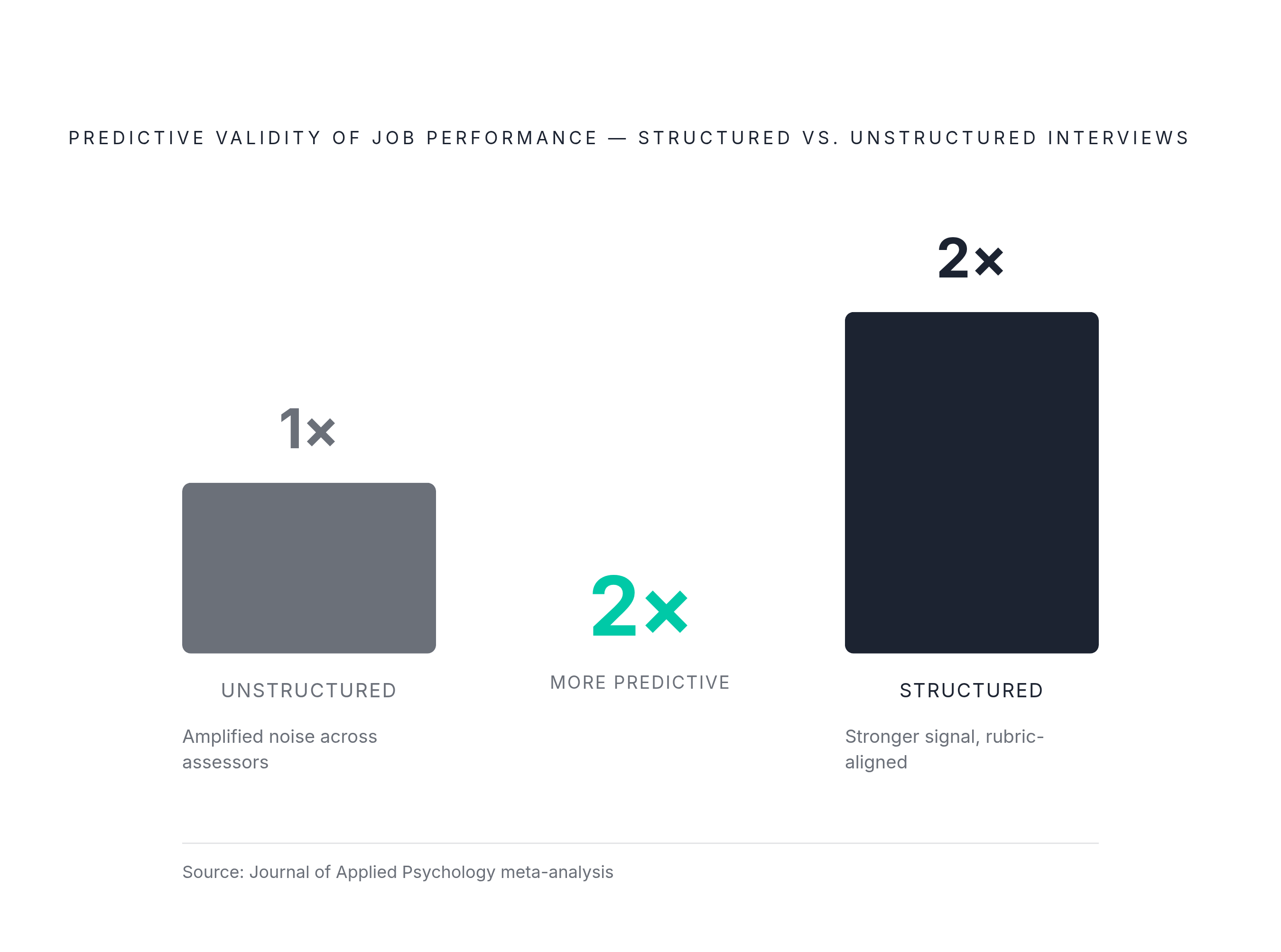
The research on this isn't ambiguous. A meta-analysis published in the Journal of Applied Psychology found structured interviews are roughly twice as predictive of job performance as unstructured ones. That's not a marginal improvement; it's a doubling of the thing you're actually trying to measure.
The multiplier effect matters even more in a panel setting than in a single interview, because a panel amplifies whatever quality of signal you feed into it. Structured inputs across five interviewers produce a stronger combined signal. Unstructured inputs produce amplified noise, five separate guesses that feel like consensus because they happened to point the same direction.
A 2025 meta-analysis in the International Journal of Selection and Assessment, led by Wingate and colleagues, found that structured formats hold similar predictive validity whether you're measuring technical task performance or contextual performance, things like collaboration and communication. The rubric isn't just a coding-assessment tool; it works about as well evaluating how someone handles a disagreement with a teammate as it does evaluating how they debug a race condition.
The same body of research shows structured evaluation meaningfully reduces bias effects when standardized questions and rubrics replace ad hoc questioning. And it's not just an internal hiring-quality issue. Talent Board's 2024 Candidate Experience research found candidates report noticeably higher fairness ratings from organizations using structured evaluation. Candidates can tell when they're being asked the same core questions as everyone else versus when the interview is improvised around whatever the interviewer feels like exploring that day.
There's also a broader shift happening in how employers think about interviews at all. NACE's 2026 research found most employers now assess specific, named skills at the interview stage rather than relying on résumé signals or general impressions. A rubric is the mechanism that makes that kind of skills-based assessment real instead of aspirational, because without one, "we assess skills" just means "we talk about skills" and scoring reverts to vibes.
None of this settles every question. The validity data comes from interview research broadly, not from rubrics in isolation, and a rubric's quality still depends entirely on how well its criteria map to what the job actually requires. A rubric built around the wrong competencies will produce clean, defensible, consistently wrong scores. Structure disciplines the process; it doesn't substitute for getting the content right.
The five components every technical panel rubric needs
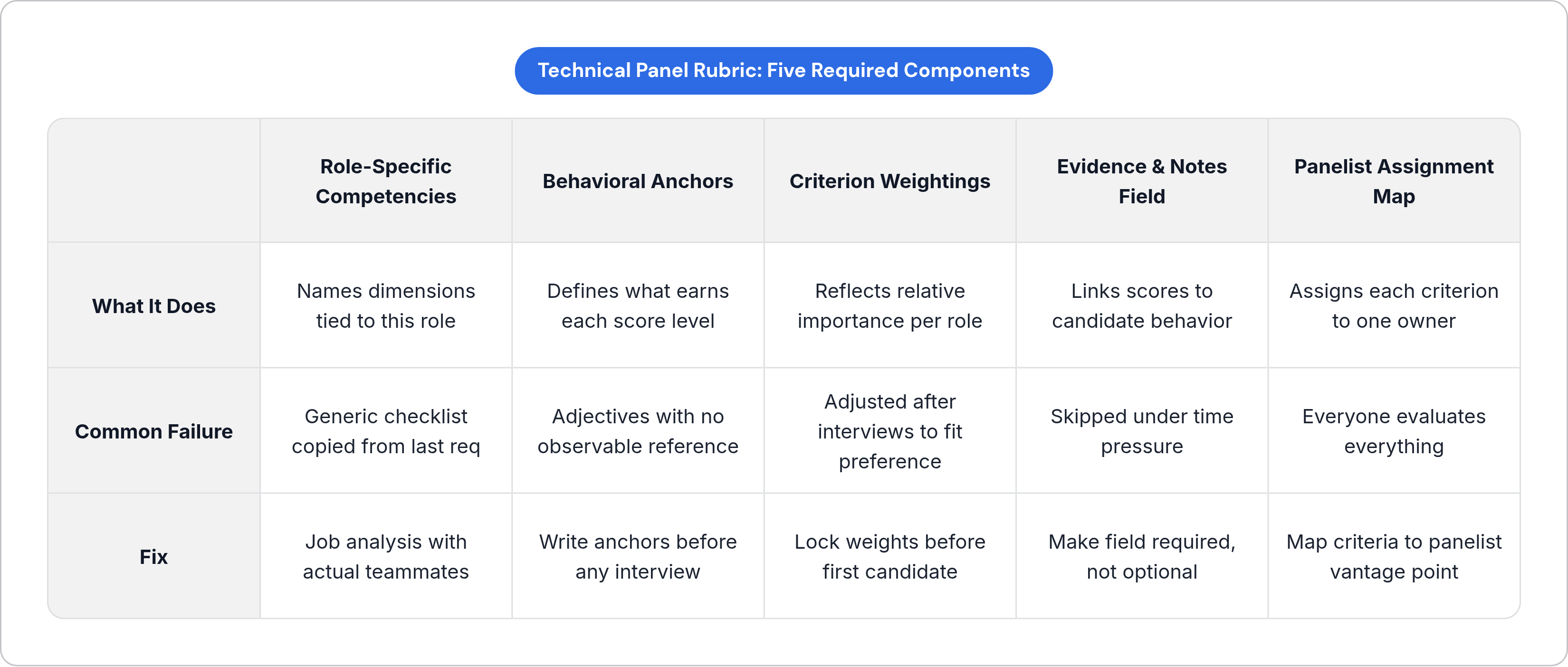
Role-specific competency dimensions. These should come out of a job analysis, meaning conversations with the people this hire will actually work with, not a generic engineering checklist copied from the last req. Typical technical dimensions include technical depth, problem-solving process, system thinking, communication under pressure, and collaboration signals. Culture-add deserves its own defined criterion, kept separate from culture-fit; fit tends to become a proxy for "would I want to grab a beer with this person," which is exactly the kind of unanchored impression a rubric exists to prevent.
Behavioral and technical anchors at every score level. Each score needs a plain description of what earns it, and that description has to reference something observable, not an adjective. "Excellent" and "poor" tell a panelist nothing they can apply consistently. A "5" on problem-solving might mean the candidate named the trade-offs unprompted and adjusted their approach the moment you introduced a new constraint, not simply that they arrived at the correct answer.
Criterion weightings. Not every dimension matters equally for every role. System thinking should carry more weight for a staff architect than for someone two years out of school, and those weights need to be locked in before anyone walks into an interview room, not adjusted afterward to justify whoever the team already liked.
An evidence and notes field. Every score needs a note pointing back to something the candidate actually said or did. This is what separates a defensible score from an impression with a number attached to it.
A panelist assignment map. Each criterion belongs to one panelist, who asks the relevant questions and owns that score. This keeps four people from all asking the same warm-up question about a past project while nobody actually probes system design.
How to structure a panel so the rubric actually produces independent scores
The format that works: a fixed set of questions organized by criterion, mapped to specific panelists, scored privately before anyone opens their mouth in debrief. For most professional technical roles, 45 to 60 minutes gives each panelist room for their core questions plus a follow-up probe or two. Push much past that and scoring consistency starts to slip, because panelists get tired and start filling gaps with impression instead of evidence.
The pre-brief is the cheapest, highest-leverage thing a hiring team can add to this process, and it's the one most teams skip. Fifteen minutes before the candidate arrives, the panel reviews the rubric together: who owns which criterion, what the anchor descriptions actually mean in practice, and what an acceptable follow-up probe looks like so nobody's improvising mid-interview. Teams that do this consistently score with noticeably more agreement than teams that wing it, because half of scoring inconsistency comes from interpretive gaps that never get surfaced until it's too late to fix them.
Then comes the part that actually protects the statistical value of having a panel at all: independent score submission. Every panelist submits their scorecard before any group discussion happens. No comparing notes in the hallway. No "what did you think of the system design answer?" before scores are locked. Digital scorecard tools with a submission lock are the cleanest way to enforce this; a stack of printed rubrics collected before anyone speaks works almost as well. Skip this step, and you don't have five independent assessors anymore. You have one anchored opinion, usually the first person who spoke, replicated five times and mistaken for consensus.
The debrief itself isn't there to average scores into agreement. Its job is to surface the disagreements and interrogate them. A panelist who scores well outside the group isn't a problem to smooth over; that gap is information, and it deserves a real conversation about what that panelist saw that the others missed, or vice versa.
Where panel rubrics break down and how to prevent it
Vague criteria are the most common failure. "Communication skills" without a behavioral anchor gets scored five different ways by five different people, and the rubric exists on paper but does nothing in the room. Fix it by writing anchors in observable terms before the first interview is ever scheduled, not while you're mid-calibration trying to reconcile wildly different scores after the fact.
Score contamination is the second, and it's sneakier because it looks harmless. Someone says, in the hallway, "did anyone else think the system design answer was weak?" before scores are submitted, and that single comment collapses the whole independent-assessment premise the panel was built on. The fix is procedural, not cultural: treat score submission as a hard gate, not a norm people are trusted to remember.
Generic rubrics are another quiet failure. A rubric written for a backend engineer, reused unchanged for a data engineer or a DevOps hire, scores the wrong things well and the right things not at all. The dimensions are wrong, so no amount of process discipline saves the outcome. Templates are a fine starting point; the criteria and weights still need to reflect what this specific role actually demands.
Skipping the evidence field under time pressure guts the whole system quietly, because you end up with a debrief full of numbers and no way to interrogate where they came from. Make the field required, not optional, and say so explicitly during panelist orientation.
And then there's the failure that's really about intent, not mechanics: adjusting criterion weights after the fact to justify a decision that was already made. When weights move after interviews are done, the rubric stops being a measurement tool and becomes theater dressed up as rigor. Lock the weights before interviewing starts, and keep a log of any changes so the incentive to game it disappears.
How the AI-assisted interview era changes what a technical rubric needs to assess
A meaningful share of organizations still prohibit AI tool use in technical interviews. That position is getting harder to defend by the month, given how thoroughly AI has become part of everyday engineering work. Karat's 2026 survey of 400 engineering leaders found most of them say AI is making technical skills harder to assess, and the reason isn't that candidates suddenly know less. It's that the observable signal has shifted, and most existing rubrics were built for a world where candidates solved problems unaided.
That gap needs new criteria, not a patch on old ones. Panels evaluating AI-fluent engineers need a way to assess problem decomposition before the candidate reaches for a tool at all: do they understand the problem, or are they outsourcing the thinking along with the typing? They need to assess whether a candidate can critically evaluate AI-generated output for correctness, security, and fit rather than accepting it because it compiled. They need reasoning transparency, meaning the candidate can explain a decision made with AI help just as clearly as one made without it. And they need judgment about when not to reach for the tool at all, because scope awareness is its own competency now, not a footnote.
Live interview formats gain real value here, more than they had before. Watching someone work through a problem in real time, whether or not they're touching a model, produces richer signal than an asynchronous take-home where you can't see how the tool got used. And the honest finding worth sitting with is that AI seems to widen the gap between strong and weak engineers rather than closing it; the candidates who reason well without AI tend to reason well with it, and the ones who don't, don't. Rubrics built to separate top performers from the middle of the pack need anchor descriptions that reflect what sophisticated AI use actually looks like against shallow AI use, not just whether the final code ran.
Legal defensibility and operational efficiency as secondary gains from rubric adoption
The legal case for rubrics tends to get treated as an afterthought, but it shouldn't be. EEOC scrutiny consistently favors structured, job-analysis-based questions over ad hoc ones, and a documented rubric tied to specific job requirements is a real record. A "gut feel" rejection is not. When a candidate challenges a hiring decision, scores tied to named competencies with evidence notes attached make the reasoning legible after the fact. A rubric won't stop a challenge from happening; it puts the organization in a genuinely stronger position when one does.
There's a quieter benefit tied to the same mechanism. Rubrics surface implicit bias in a way an informal panel simply can't, because a panelist scoring a candidate far below everyone else, with no evidence to back it up, becomes a visible discrepancy that has to be discussed rather than a quiet veto that gets absorbed into the group's decision unchallenged.
On the operational side, Google's re:Work research found that pre-built structured interview guides eliminate roughly 40 minutes of ad hoc question planning per interview. Multiply that across a panel, across roles, across hiring cycles, and it adds up to real hours for engineering leads who are also shipping product on the side. There's a compounding benefit too: teams that keep structured scorecard data across cycles can actually go back and check what early rubric scores predicted about later on-the-job performance. Unstructured panels leave nothing behind to analyze. A well-built rubric for a senior backend role doesn't expire after one hiring round either; it gets sharper every time it's used, as anchor descriptions get refined against real candidates instead of hypothetical ones.
Building a rubric from scratch: a practical starting sequence for technical hiring teams
Start with a job analysis, not a job description. Talk to the people this hire will actually work alongside and ask what problems this person needs to solve in their first ninety days. Out of that conversation, pull three to five competencies that genuinely predict success in this specific role, not a laundry list of nice-to-haves.
Write the behavioral anchors before you write a single interview question. Define what a top-quartile answer looks like against a borderline one; this step forces the team to get honest about what they're actually hiring for, and it's usually harder than it sounds. Anchors describe behavior, not personality traits.
Assign criteria to panelists based on their vantage point. The engineering lead is probably best positioned to assess technical depth. A peer engineer is better placed to judge collaboration and how someone works through a problem. A cross-functional stakeholder, someone from product or design, often reads communication and adaptability better than another engineer would. No single person assesses every dimension, and that division of labor is what makes a panel structurally different from five separate one-on-ones stapled together.
Set the weights before any candidate walks in the door. The hiring team agrees, in advance, on how much each criterion matters for this particular role, and that agreement becomes the standard every subsequent debrief gets measured against. Once that's locked, the rubric stops being a document and starts being the thing that actually runs the interview.