Workforce Engagement Tactics for Distributed Engineering Teams
Timezone overlap determines which engagement tactics actually work for distributed teams.
Distributed engineering is the default operating model for a substantial share of software teams now. Yet most companies still run engagement programs built for offices: all-hands meetings, open-door policies, hallway feedback, the ambient sense of who's working on what because you can see it happening from your desk. Almost none of that survives the transition to distributed work. Pretending otherwise is why so many distributed teams quietly disengage while every dashboard still looks fine.
The risks are specific. Engineers who never overlap with the "live" workday start to feel like contractors rather than teammates. Async channels fill up with threads that never resolve, producing a low hum of fatigue and a sense that nothing gets decided. Progress that used to be visible through physical presence now hides inside code reviews and standup messages, so individual contribution gets harder to recognize and harder to feel proud of. Belonging stops happening on its own; a team has to build it on purpose. And accountability, without someone able to tap a shoulder in the hallway, diffuses fast. Unclear ownership in a distributed squad compounds in days, not weeks.
This shows up in delivery velocity. It shows up in retention, and in the actual quality of shipped code. Closing these gaps takes tactics built for distributed conditions specifically, and office-era programs with a Zoom link bolted on top tend to fall short.
How timezone spread changes what engagement actually requires
Timezone overlap is the variable that decides what's even possible here. Get it wrong and every other tactic in this piece gets misapplied.
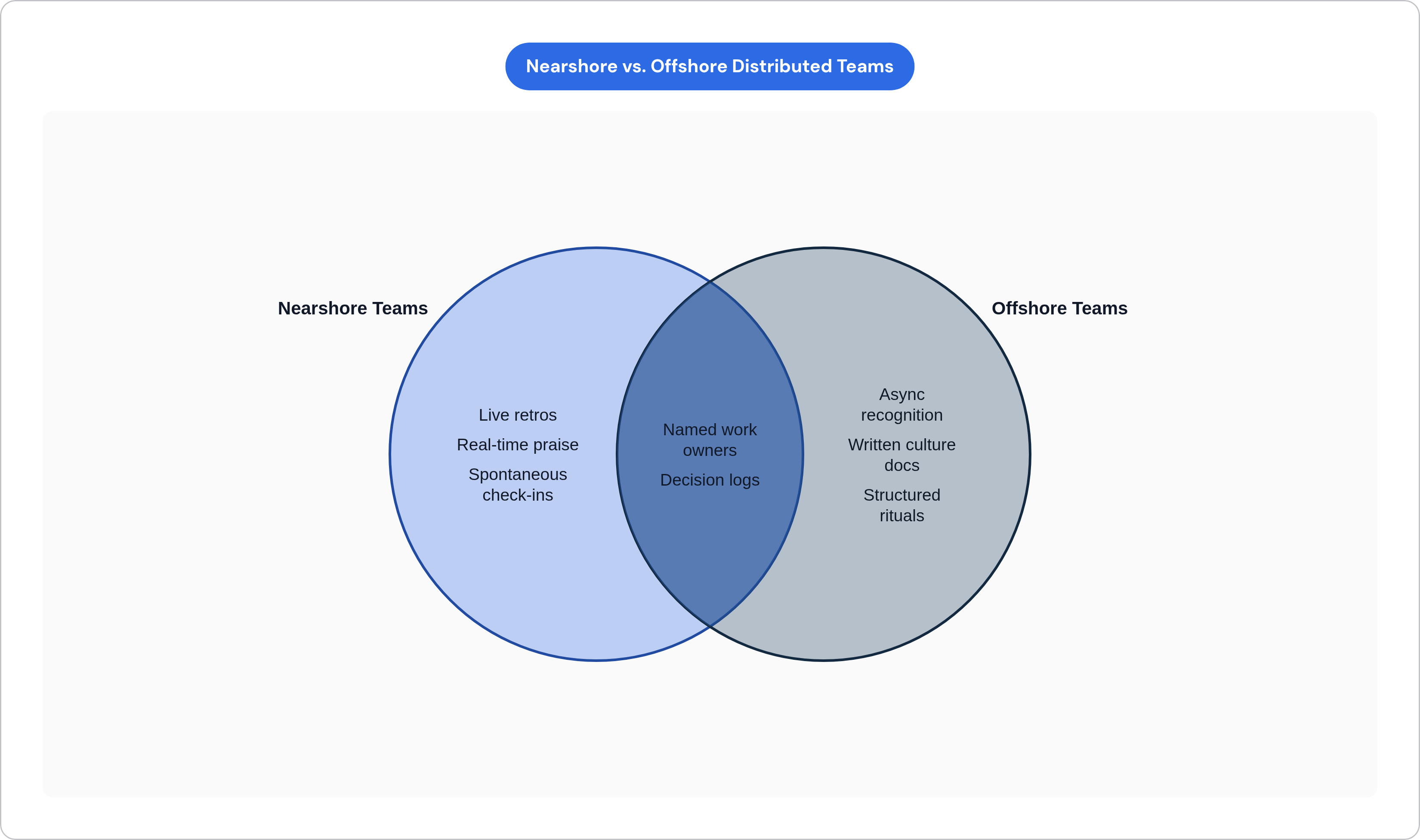
Two fundamentally different realities exist under the "distributed" label. Minimal overlap, the offshore model, runs on handoff-style workflows, feedback loops measured in a day or two, a heavy documentation burden, engineers who might go a full week without hearing their name said out loud in a live meeting. Significant overlap, the nearshore model, gives you daily windows of shared working hours, the ability to solve a problem together in real time, recognition given the moment it's earned. A team in Latin America working alongside US-based engineering leads can run something close to the full co-located playbook, because the overlap actually supports it. The same engagement plan can succeed with one team and fall flat with another, and the difference almost always traces back to how many live hours they actually share, not how well-designed the plan is on paper.
Overlap hours are finite; you can't manufacture them. A team sharing four live hours a day has categorically more engagement options than a team sharing zero. Nearshore arrangements can run live retros, paired debugging sessions, real-time praise in a stand-up, in ways that simply aren't available otherwise. Offshore arrangements need something else entirely: async recognition systems, written culture documentation, structured rituals that build rhythm without requiring anyone to be awake at the same time.
A manager who insists on a daily live stand-up across a twelve-hour gap is burning goodwill and sleep schedules, and usually doesn't notice until attrition tells them. Audit your actual overlap hours before picking a single tactic off this list.
Structuring async communication so it creates clarity rather than fatigue
Unstructured async is the real problem here, and leaders confuse it with async itself constantly, blaming the tool for what's actually a design failure.
The pattern is familiar to anyone who's worked distributed for more than a quarter. Slack threads sprawl for forty messages without a resolution. Jira comments ask questions nobody owns. PR feedback shows up three days late and reopens a decision the team thought was closed. These are symptoms of missing structure, not evidence against async as a medium.
A functional system needs defined channels with defined purposes, so a quick question and a real technical decision aren't competing for the same real estate. It needs response-time norms attached to each channel, because a question in team chat and a proposal in a documented RFC carry different urgency by design, not by guesswork. And it needs decision logs: when async discussion produces an actual decision, someone writes it down, attributes it, and makes it findable later, instead of leaving it buried in a thread nobody will scroll back to.
Written communication also creates an unintentional record of who talks and who doesn't. Engineers who write less can look disengaged even while doing serious, quiet technical work in the background, and leaders need to design around that instead of assuming silence equals absence.
End-of-day written stand-ups in a consistent format, completed, blocked, starting next, build rhythm without needing everyone online at once. So does a weekly written retro prompt anyone can answer in their own window, or a decision thread with a named owner and a close date so debate doesn't drift for a week. Even so, over-relying on async erodes cohesion over time, even for teams with real overlap. Protect live time for what async genuinely can't do: resolving ambiguity, delivering hard feedback, celebrating a win the moment it happens.
Designing live sync time around the moments that actually require it
When overlap is scarce, treat it like the resource it is. Most distributed teams waste it on status updates that should have been written down instead.
Here's a test that holds up: if information only needs to travel one direction, it belongs in an async artifact. If the outcome depends on how people react to each other in real time, it earns a meeting slot. Sprint planning falls in the second category, because shared commitment is genuinely harder to build in writing. Retrospectives do too; psychological safety during reflection benefits from a human facilitating in the room, reading the silence, following up on the hesitation nobody typed out loud. Architecture decisions with real tradeoffs need live time as well. Async threads on contested technical calls tend to stall out or split into camps that never actually talk to each other. Performance conversations need tone and empathy that text strips out, and onboarding touchpoints belong here too, since belonging gets built fastest through real-time interaction rather than a Notion page.
Meeting design itself is an engagement lever, and it's underused. Rotating who facilitates gives more engineers a stake in how the team functions, and it costs nothing. A structured opening round, something as simple as "what's one thing outside work on your mind this week," closes the social distance that pure remote interaction tends to widen. Every live meeting should end with named owners and written next steps, so the momentum built in sync doesn't evaporate the second the call ends.
For nearshore teams with genuine overlap, the job is protecting that window. Filling it with meetings that could've been a message wastes it one way. Letting it default into pure async because nobody scheduled the conversation that needed a room wastes it the other way.
Building individual accountability without surveillance
The instinct, when you can't see someone working, is to measure them instead. Ticket velocity, hours logged, commit counts. It's an understandable instinct, and it backfires almost every time.
Engineers who feel measured like this respond exactly the way you'd expect: they game the metrics, take fewer risks, and the strongest performers, the ones with options, leave. Surveillance-flavored accountability produces the disengagement it was built to prevent. This dynamic is well recognized in incentive design more broadly: measuring the proxy instead of the outcome distorts the very behavior you wanted.
Real accountability comes from structure, not observation. Every piece of work needs a named individual owner, not a team owner, because ambiguity is where distributed accountability quietly dies. Commitments need to be written and acknowledged; an unwritten commitment in distributed work doesn't practically exist, no matter how clearly it was said out loud on a call. And the dashboards that matter show visible progress rather than visible effort: sprint burndown, PR review cycle time, deployment frequency. These give the team a shared picture without turning into a surveillance feed on any one person.
The loop that actually works is unglamorous. A weekly or biweekly one-on-one focused on blockers, growth, and clarity, more than status, does most of the work. For engineers brought on through staff augmentation, nearshore or otherwise, this structure matters even more during integration, since ambiguity is exactly what slows an augmented engagement down before it gets going. Done right, accountability and autonomy reinforce each other. Engineers who know precisely what they own, and how their progress will be seen, take more initiative rather than less.
Creating belonging across distributed teams when proximity can't do the work
In a co-located office, belonging is mostly ambient. It comes from shared physical space, hallway conversation, watching a teammate visibly grind through a hard problem at the next desk. Distributed teams don't get any of that for free.
Recognition needs to be visible to the whole team, not delivered quietly in a DM. Being seen by peers carries a weight that a private "nice work" from a manager doesn't replace. Non-work channels matter more than people give them credit for: a shared playlist, a book thread, a two-minute show-and-tell slot in the weekly sync, anything that gives an engineer a dimension beyond the ticket queue. Team narrative needs restating explicitly too, since distributed work strips context by default. Engineers who understand how their work ladders up to a real product outcome tend to stay more connected to it, and that connection doesn't survive remotely unless someone keeps saying it out loud.
Who gets included in informal moments matters just as much as the moments themselves. Rotate the timing of casual touchpoints so the same engineer isn't always the one joining at midnight their time. Record internal demos and share them, so engineers in every timezone can actually watch and react instead of reading a summary secondhand.
For teams built through staff augmentation, where nearshore engineers join an existing team for a defined stretch, belonging tactics matter as much as any technical process. They speed up integration and protect what the team knows when the engagement eventually ends. Engineers who feel like contractors at arm's length disengage faster and hand off less cleanly. Nearshore arrangements get a structural advantage here that offshore ones can't replicate: timezone proximity allows for the small, spontaneous human moments, a quick end-of-day check-in, a lunch call, that no amount of scheduling recreates across a twelve-hour gap.
Onboarding distributed engineers in a way that compresses time to contribution
The first weeks set the pattern for the entire engagement. Good onboarding compresses time to contribution. Bad onboarding builds disengagement before the engineer has shipped a single feature.
The failures repeat across distributed onboarding situations consistently. Documentation explains what to do but never why the team does it that way, leaving a new engineer technically set up but culturally lost. Nobody's designated to answer questions, so the engineer gets told to "just ask" with no real idea who's supposed to respond. And the first contribution gets delayed. A new distributed hire still waiting on repo access at the end of week one is already halfway to disengaged, whether anyone notices yet or not.
The fix is structural. Write a "how we work" document covering communication norms, decision-making conventions, code review expectations, and cultural context, built specifically for that team rather than pulled from a generic wiki template. Assign a named onboarding buddy with explicit responsibility for the first two weeks: answering questions, making introductions, catching blockers before they pile up. And build a genuine "first ship" milestone into week one, a small, well-scoped ticket that gives the new engineer a real contribution and a real code review cycle. Belonging comes from participation, more than from a slide deck.
This matters more for augmented engineers coming through nearshore partners, not less. The speed advantage staff augmentation is supposed to deliver evaporates fast if the integration phase is sloppy. AI coding tools are compressing the ramp-up curve for engineers joining teams with strong foundations already in place, but they amplify whatever onboarding environment already exists, good or bad, without replacing the need to build one.
Using retrospectives and feedback loops to keep distributed teams self-correcting
Distributed teams drift. Without deliberate feedback loops, small engagement problems compound quietly until they show up as attrition or a missed release, and by then the fix costs far more than it would have three months earlier.
The retrospective is the most underused engagement tool available, mostly because teams treat it as a process review rather than a genuine feedback mechanism. Engineers who have a structured place to name what isn't working are less likely to disengage silently; raising a problem is itself a form of investment in the team continuing to exist. A retro that generates insight nobody acts on, though, is worse than skipping it entirely, because it teaches the team that feedback is theater.
Distributed formats need adjusting from the standard playbook. Written pre-work submitted before the live session lets engineers in awkward timezones contribute fully even if they join late or not at all. Anonymous input matters for teams where a senior engineer's presence quietly discourages junior feedback from surfacing. A dedicated "how are we doing as a team" question, separate from "what should we change," catches things a pure process retro misses entirely.
Beyond the retro itself, a few lightweight signals are worth tracking without tipping into surveillance: participation patterns in async threads, since dropping off is often the earliest sign of disengagement, and PR review turnaround as a rough proxy for how invested people still feel. In one-on-ones, notice when a previously candid engineer stops raising issues. That silence is information, and it's usually the loudest signal in the room. Feedback has to run both directions. Engineers who get craft-level commentary on their actual work, beyond a ticket closed with a checkmark, stay more engaged than those operating in a vacuum.
What technical leaders get wrong when they try to adapt co-located engagement programs to distributed teams
The single most common mistake is lifting an office engagement program wholesale and dropping it into a distributed context without questioning a single assumption underneath it.
Mandatory fun is the clearest example. A virtual happy hour or an online team game, imposed on engineers already fatigued from a full day of screens, reads as a cost on their evening rather than an investment in their wellbeing. Voluntary, low-commitment social touchpoints consistently outperform anything mandatory, because the moment attendance becomes an obligation, it stops functioning as belonging and starts functioning as another meeting.
Engagement surveys without follow-through do similar damage. Collecting sentiment data from a distributed team and producing no visible response actively erodes trust, because it tells engineers their input was collected, not heard. Both mistakes share the same root: importing the form of a co-located program without reckoning with why it worked in an office in the first place, proximity, informality, low stakes, and assuming the same form carries the same meaning over a video call. Distributed engagement has to account for the conditions it actually operates in, since the conditions most co-located programs assumed no longer exist for most of the team.