Performance Improvement Plans in Engineering Teams
Most engineering PIPs fail because they arrive as legal cover-up, not genuine recovery plans.

Performance improvement plans are becoming more common across the tech workforce. HR Acuity's 2023 data shows formal performance procedures now touch a meaningfully larger share of US employees than they did just a few years back, and engineering culture has moved with that trend, trading tolerance for a learning curve for rigid delivery accountability. PIPs have drifted from their original purpose as tools for genuine recovery into something closer to legal paperwork: a documented countdown to an exit that's already been decided. Most employees placed on a PIP resign or get let go during the plan or shortly after, and depending on whose numbers you trust, the failure rate runs from "most" to "nearly all." For an engineering leader, losing a mid-senior engineer mid-project costs real money, wrecks sprint velocity, and demoralizes whoever inherits the work, which is reason enough to ask what a PIP looks like when someone actually builds it to succeed.
The structural reasons PIPs fail before the engineer ever sees them
Three failure modes show up over and over. I've watched all three happen inside the same company in the same quarter.
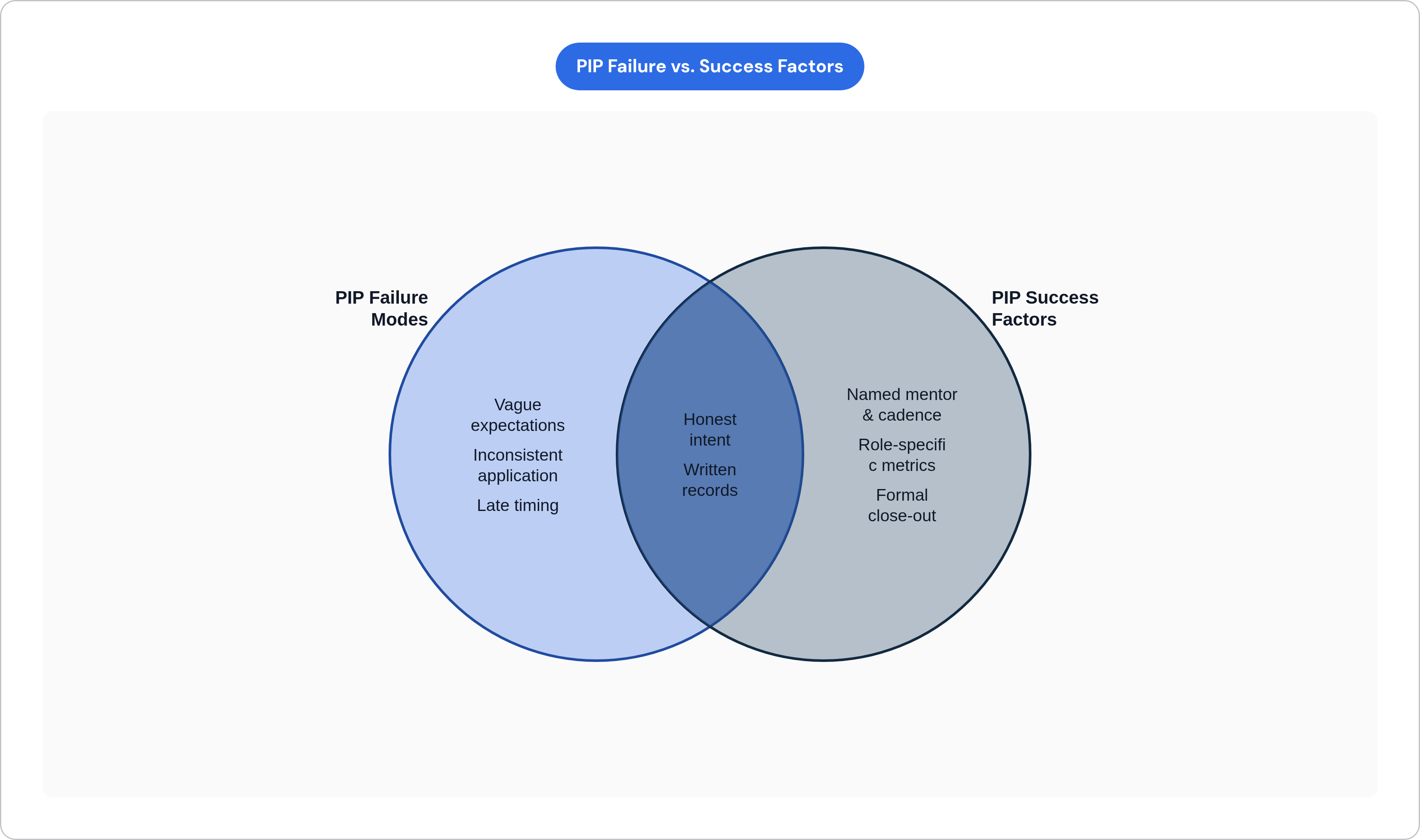
The first is vague expectations. "Improve communication skills" is a platitude wearing the costume of feedback. An engineer needs something checkable: respond to PR comments within four business hours, post an async standup update by 10am, ship the daily status note in the team channel. Something a manager can verify by looking, not by feeling.
The second is inconsistent application. A high performer who stumbles gets coaching and a second chance. An average performer who stumbles gets a PIP. Engineering teams gossip, and once people clock who gets grace and who gets paperwork, the PIP stops looking like a recovery tool and starts looking like a weapon leadership reaches for when it's convenient.
The third is timing. Most PIPs land after months of undocumented frustration (the one-on-one where the feedback got softened into mush, the sprint retro where nobody said the quiet thing out loud). By the time the document exists, the relational damage is already done. Usually, the engineer has already checked out before reading past the first paragraph.
Underneath all three sits a managerial incentive problem. Writing a defensible PIP is easier than having the harder conversation six months earlier, when the underperformance was still small enough to fix quietly. A document protects the company; a conversation actually risks something, so managers reach for the document. What lands on the engineer's desk, then, is a plan that arrives without warning, sets goals nobody can measure, and signals that the decision has already been made. Research on high-performing teams consistently links collaboration and trust to stronger output, so a badly run PIP doesn't just fail the one engineer. It poisons the well for everyone still on the roster watching how this played out.
Diagnosing what is actually wrong before writing any plan
Performance gaps in engineering split into two rough buckets, and they call for different fixes entirely. Technical gaps: code quality, architecture judgment, database or cloud competence, test coverage, deployment discipline. Interpersonal and workflow gaps: communication, collaboration, time management, documentation, responsiveness in review. Confuse the two, and the PIP goes sideways before the ink dries.
Before writing a single target, answer the question most managers skip: is this a skill gap, a motivation gap, or a fit gap? Each has a different fix, and a PIP can only touch the first two. A fit gap (where the role quietly outgrew what the engineer signed up for, or where the team's own structure works against them) will happily disguise itself as a skill gap for months. Catching that early saves everyone time, including the engineer, who might need a different seat more than a remediation plan.
Start the diagnosis with strengths, not deficits. Map what the engineer does well before writing a single target aimed at what they don't. The goal is a full picture of the person, weighed evenly against a clear account of the gap.
I once watched a manager draft a documentation-focused PIP for an engineer whose architecture instincts nobody on the team could match; his designs held up under load that would have buckled anyone else's. The fix that worked was adding a technical writer to the team and letting him keep doing the thing he was actually good at. Performance "concerns" evaporated, and team velocity went up the same quarter. Sometimes the right call is redesigning the role, not writing a plan around a gap that was never really his to close.
What role-specific, measurable targets look like for engineers
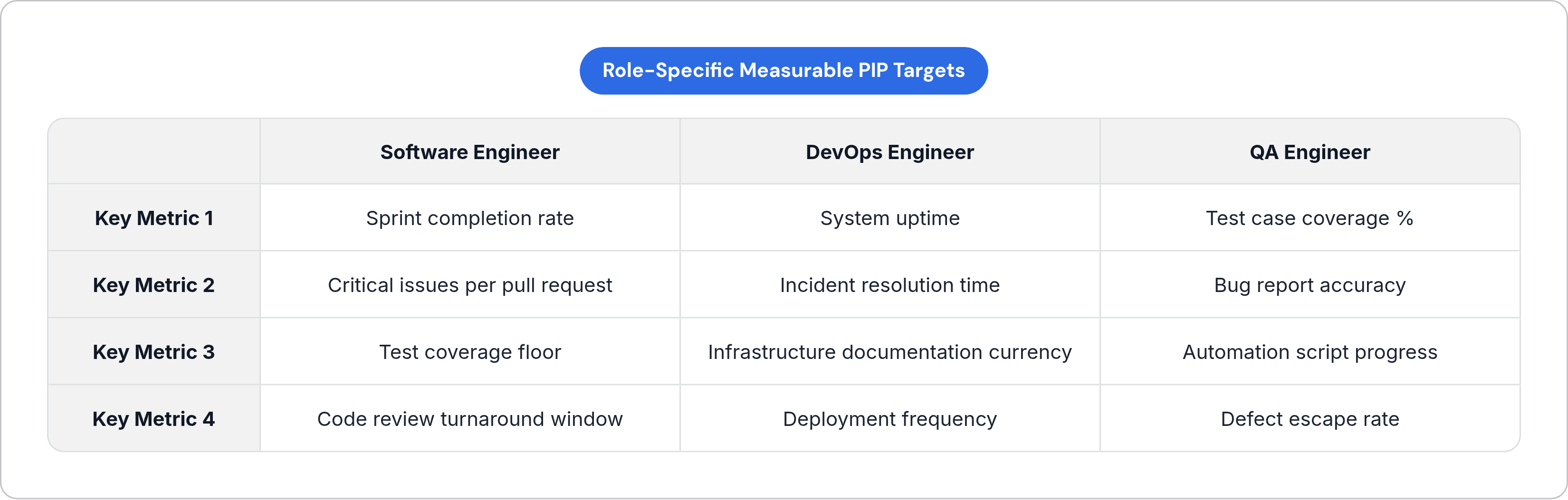
SMART goals matter here, but on their own they're not enough. A target also has to be specific to the role and pulled from numbers the team already watches, or it reads as arbitrary even when it's technically well-formed.
For a software engineer: sprint completion rate, a cap on critical issues per pull request, a test coverage floor, a code review turnaround window. For a DevOps engineer: system uptime, incident resolution time, infrastructure documentation that's actually current. For QA: test case coverage percentage, bug report accuracy, measurable movement on automation scripts. These numbers should come from the dashboard the team already checks every sprint standup, not from an HR template.
Anchor the targets to benchmarks the team already tracks, not standards invented for the occasion. If the team already watches lead time, PR merge rate, and deployment frequency, build from those. Engineering productivity research gives a credible read on what high-performing teams actually hit on these dimensions in 2025, which lets a PIP aim at realistic recovery grounded in what comparable teams actually clear.
There's a side benefit here that's easy to miss. If the team isn't tracking these numbers before the PIP starts, that measurement gap needs fixing regardless of what happens with this one engineer. Skip the generic language entirely, too: "demonstrates improved performance" tells an engineer nothing about what winning actually looks like.
The support infrastructure a PIP requires to have any chance of working
A PIP without support is a warning with a due date attached.
The floor looks like this: a named mentor with relevant technical depth and actual calendar time set aside every week, not vague access to "the team" whenever someone happens to be free. Pair programming and review cadences scheduled in advance, because ad hoc support stops happening the moment anyone gets slammed with their own deadlines. Training tied to the specific gap, embedded in real tickets rather than assigned as a course to finish quietly on the side. And increasingly, tools like Claude, ChatGPT, or Cursor as scaffolding, genuinely useful for an engineer racing to close a skill gap while still shipping.
Check-ins need structure too. Weekly conversations the manager initiates, not an open-door policy that puts the burden on the struggling engineer to knock. Written notes after each one, so both people are working from the same record of what got discussed and what progress actually means.
Skip the infrastructure, and the engineer receives a document that's technically compliant and reads it correctly as a formality rather than an offer of help. Research out of axify.io in 2025 found teams with high collaboration standards seeing performance lifts approaching 81%, which turns mentorship and pair programming into a measurable performance lever. Still, none of it works if the manager doesn't show up every single week with something specific to say. Vague encouragement tells an engineer nothing they can act on.
How to structure the timeline and decision points inside the plan
PIP length in engineering usually runs 30, 60, or 90 days, and the right number depends on the gap's complexity, not on whatever the HR template defaults to. A technical skill gap needs a longer runway than a workflow issue does; trying to close an architecture knowledge gap in 30 days sets someone up to fail before they've had a real shot.
Build in explicit checkpoints, with clear criteria for what "on track" means at each one, so nobody is left guessing at the halfway mark.
The conversation that launches the plan carries as much weight as the document itself. A PIP opened as a direct, private conversation that actually communicates intent to help lands very differently from a plan handed over as a finished legal artifact with zero room to talk. Build in three real decision points. Early, at roughly the one-third mark: is the engineer engaging, and is the promised support actually showing up, because if it isn't, the plan itself might be the problem. At the midpoint: is there real movement, or a plateau, and does support need to shift or escalate. At the end: apply criteria for success, extension, or separation that got written down before the plan started, not invented under pressure in the final week.
Don't move the goalposts mid-flight. Changing the target after the fact tells the engineer the whole process was rigged from the start, and that story travels through the rest of the team fast.
One more thing, for distributed teams especially: timezone-aligned oversight isn't optional. An engineer on a nearshore or remote team needs the same check-in cadence and the same mentor access as anyone sitting in the home office, and that only happens with deliberate scheduling. Nobody stumbles into availability across time zones by accident.
What a resolved PIP looks like (and what it signals when one cannot be resolved)
A clean resolution looks like this: the engineer hits the defined bar, slides back into the normal rhythm of the team, and the PIP gets formally closed out loud. It shouldn't linger as some informal probation nobody's sure has actually ended. Say so directly when it closes, because a PIP that quietly fades without anyone acknowledging it leaves the engineer guessing where they stand, which undercuts the trust the entire process was supposed to rebuild.
Partial improvement is its own category and deserves honest treatment, not a shortcut. Some engineers make real, visible progress without fully closing the gap. That calls for a straight conversation about whether the role still fits, rather than a second PIP that repeats the same structure and hopes for a different ending.
When a plan genuinely can't be resolved, a separation handled clearly and early does less damage to team health than a drawn-out process that leaves everyone hanging. The team notices either way; a prolonged, ambiguous ending corrodes morale far worse than a clean, honest one ever does.
That morale point is worth sitting with. How a PIP gets run, regardless of outcome, tells the rest of the team exactly what to expect if they ever land in the same seat. A process people see as fair and genuinely supportive builds psychological safety even when it ends in separation, while a process people see as theater destroys it no matter how it ends. Keep written records of the conversations, the adjustments, the decisions, throughout, so the process protects everyone involved and holds up the next time someone has to run it.
Built around specific metrics, real support, and honest intent, a PIP is still one of the few tools that can rehabilitate performance without losing the person. When the diagnosis actually calls for one, it's worth doing right.