Engagement Survey Design for Remote Engineering Teams
Standard engagement surveys miss the real reasons remote engineers quit.
Most employee engagement surveys were built for people who work in the same building. They assume shared physical cues, observable participation, and feedback that happens in real time, over a shoulder or across a desk. Apply that instrument to a distributed engineering team and the assumptions collapse quietly, producing scores that look stable while the engineers behind them are already halfway out the door.
The failure isn't that remote engineers refuse to answer honestly. It's that the survey asks the wrong question, and they answer it correctly. "Do you feel comfortable raising concerns in meetings?" doesn't map onto a team running async standups in Slack threads and reviewing pull requests across three timezones. The engineer says "somewhat agree," the dashboard turns green, and six weeks later that engineer gives notice. Nobody saw it coming because nobody built an instrument capable of seeing it.
The specific disengagement pressures remote engineers face that surveys rarely ask about
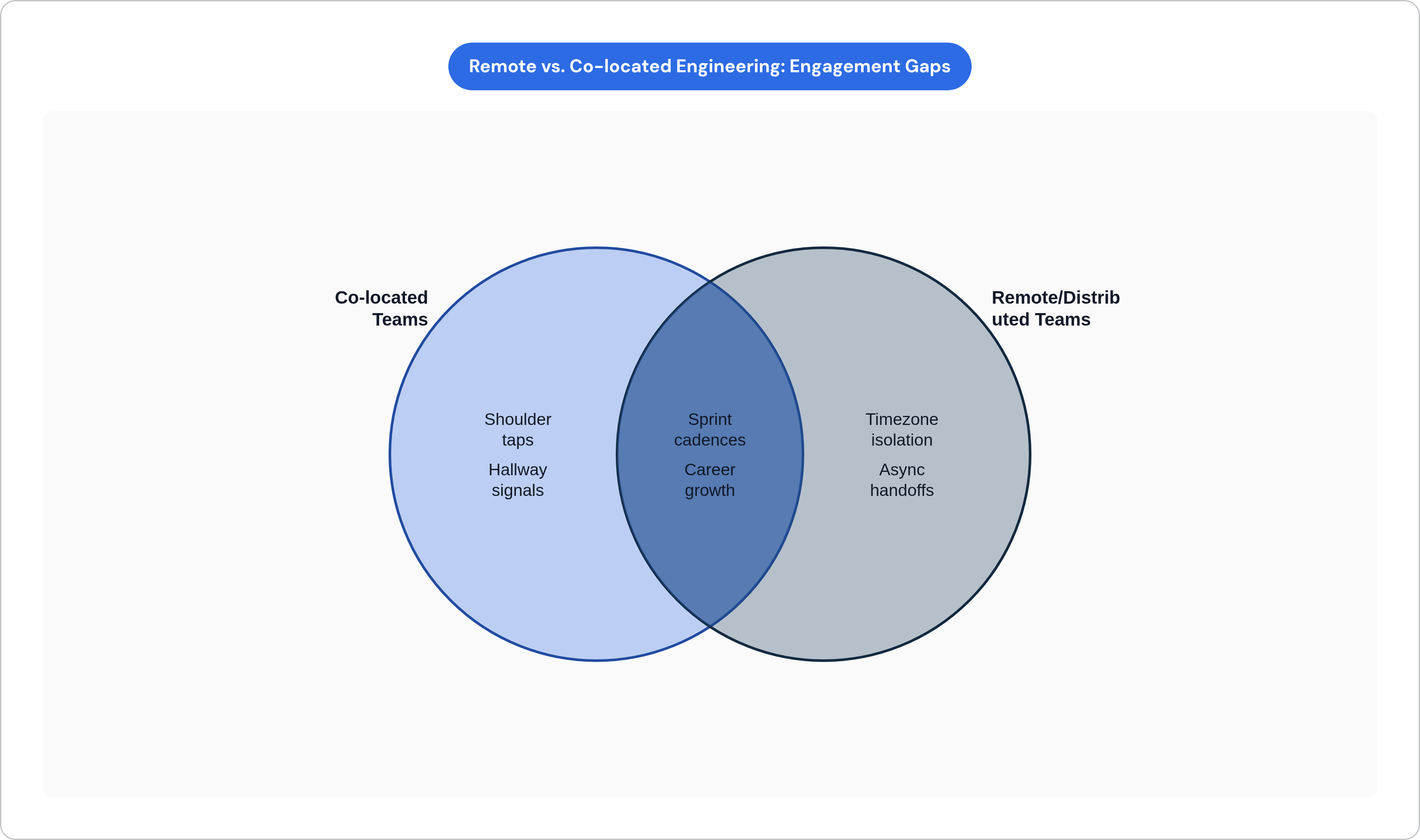
Start with the mechanics of getting blocked. On a co-located team, a blocked engineer taps a shoulder. On a distributed team, that same engineer posts in Slack and waits, sometimes for hours, sometimes overnight, because the person with the answer is asleep in a different hemisphere. A decision gets made in a thread at 9am EST; an engineer working from a nearshore timezone that overlaps for six of eight hours misses it entirely and finds out about it secondhand, after it's already shaped the sprint.
Timezone isolation compounds this even when the gap looks small on paper. A three-hour offset doesn't sound like much until you're the one engineer whose entire collaborative window sits at the edge of everyone else's day, watching conversations happen in the hour before you log off and the hour after you log on, never quite inside them. There's no hallway conversation to signal that a shipped feature mattered, and no one leans over to say nice work. The silence isn't hostile; it's just structural, and structural silence reads as indifference whether or not anyone intended it that way.
Contribution visibility is its own problem, separate from timezone. Code merged into a repository doesn't announce itself. In many distributed orgs, the work that gets noticed by leadership is the work performed in meetings: the person who speaks up on the leadership sync, not the senior engineer who quietly closed out four critical bugs while everyone else slept. That inversion, where visibility tracks meeting attendance rather than output, punishes exactly the engineers doing the most technically demanding work.
Ownership diffuses the same way. Cross-cutting concerns like security review, performance tuning, and documentation need someone accountable for them, and in a physical office that accountability often gets settled informally, through proximity and repetition. Distributed teams lose that mechanism and rarely replace it with anything explicit, so engineers are left guessing where their responsibility ends and someone else's begins.
Career development suffers from the same opacity. Co-located engineers pick up dozens of small signals about how they're perceived: a mentor stopping by, an offhand comment from a director, inclusion in a hallway conversation about the roadmap. Remote engineers get none of that ambient data, which means the only information they have about their trajectory is whatever gets said explicitly, and explicit conversations happen far less often than implicit ones.
DORA's 2025 research on AI-assisted software delivery adds a newer wrinkle: AI tooling amplifies whatever organizational conditions already exist. Teams with clear priorities and well-defined ownership get faster and more consistent. Teams without that clarity see the inconsistency scale up alongside the tooling, not shrink. Distributed teams with fragmented ownership are, structurally, more exposed to this dynamic, and the engineers absorbing it are often the same ones already dealing with visibility and ownership gaps described above.
None of this is a complaint about remote work as a model. These are structural conditions, as real and measurable as sprint velocity, and a survey that isn't built to detect them will simply miss the thing it exists to find.
What effective engagement measurement actually needs to detect in a distributed engineering context
Engagement isn't one number. It splits into at least three connections worth measuring separately: connection to the work itself, connection to the team, and connection to the organization. An engineer can score high on the first (I know my code matters) while scoring low on the second (I don't feel like a real member of this team, more like a contractor who happens to have a badge). Collapse those into a single engagement score and you lose the ability to diagnose anything.
The instrument's job is to catch early movement in these dimensions, not to audit satisfaction after the fact. A good survey behaves like a leading indicator, the way a build failure rate predicts a rough release before the release actually ships. For distributed engineering specifically, that means surfacing whether async workflows are quietly creating blocked or invisible work, whether the overlapping hours a team shares actually feel sufficient for the kind of collaboration the work requires, and whether engineers believe their output gets attributed to them rather than absorbed into the team's general output.
It also means designing around asynchronicity instead of ignoring it. A survey link sent at 2pm EST on a Tuesday is a completely different experience depending on where you sit. For an engineer in Boston, it's mid-afternoon; for an engineer in Buenos Aires, it might already be evening, and for one further out, it could land in the middle of the night. Treating that difference as a rounding error rather than a design constraint is exactly the co-location bias this whole exercise is supposed to correct.
The pattern worth hunting for above all others is quiet disengagement: high task completion paired with low team investment. This is the profile of an engineer who ships everything on time, closes every ticket, and has already stopped caring whether the team succeeds. It's the single most common precursor to attrition in distributed engineering, and it's invisible to any survey that only measures output.
Survey cadence choices and how they interact with remote engineering rhythms
Annual surveys are close to worthless here. The feedback loop is too slow to act on anything specific, and the results get so aggregated that distributed-specific friction disappears into the noise of everything else. By the time an annual survey flags a problem, the engineer who raised it has usually already had two conversations with a recruiter.
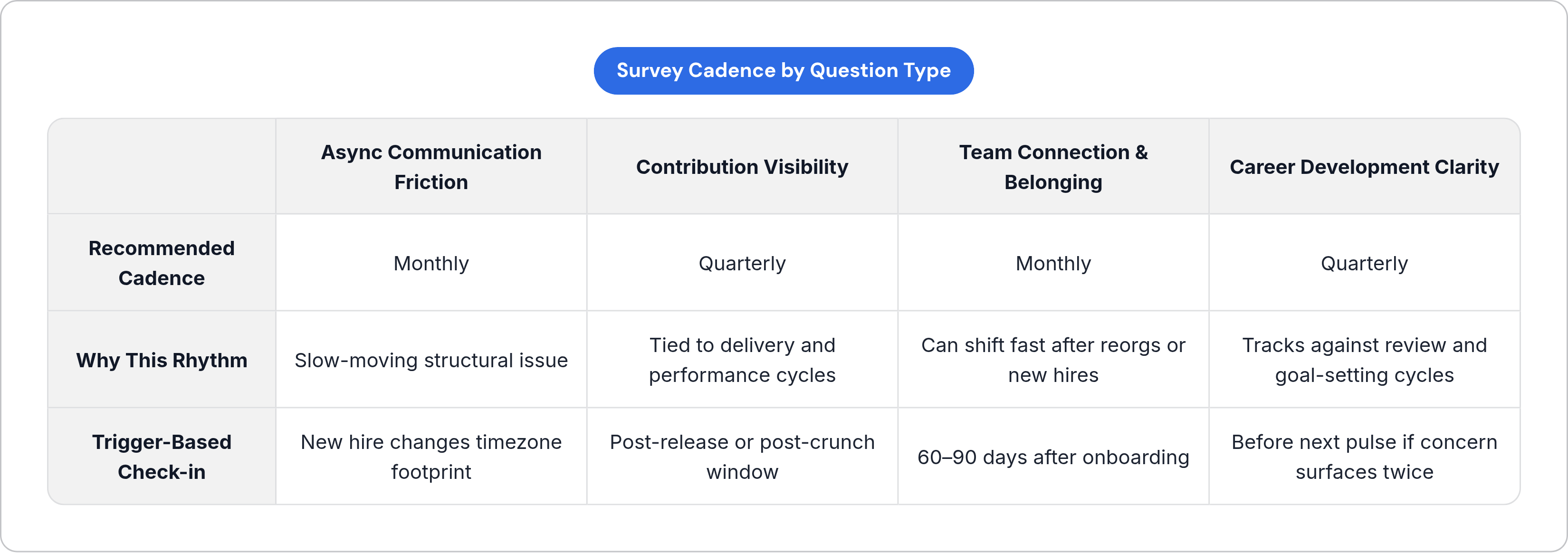
Pulse surveys, run every two weeks or monthly, line up much better with sprint cadences and give managers a window where intervention is still possible. But cadence shouldn't be uniform across every question type. Async communication friction is a slow-moving structural issue and doesn't need weekly measurement, so monthly works. Contribution visibility ties naturally to project delivery and performance cycles, so quarterly makes sense there. Team connection and belonging can shift fast, particularly after a reorg or a new hire changes the team's timezone footprint, so that one belongs on a monthly rhythm. Career development clarity tracks well against quarterly review and goal-setting cycles.
Layer trigger-based check-ins on top of the schedule. A new engineer joining from a distant timezone changes the collaboration architecture overnight, and that's worth checking on directly rather than waiting for the next scheduled pulse. The same goes for the recovery window after a major release or a crunch period; disengagement often shows up after the adrenaline of a hard push fades, not during it. And the 60 to 90 day mark after onboarding is when a remote engineer either feels folded into the team or starts quietly drifting away from it, which makes it one of the highest-value moments to ask a direct question.
Delivery timing matters as much as frequency. Send the survey asynchronously, with a 48-hour completion window instead of a same-day deadline, and completion rates go up without forcing anyone into synchronous participation they don't have. Keep it short, with five to eight questions per pulse and one or maybe two open-text fields. Distributed engineers already carry a heavier written-communication load than their co-located counterparts; a bloated survey just becomes one more async obligation they resent.
Question design principles specific to remote engineering teams
Name the condition; that's the whole principle, really. "Do you feel supported by your team?" could mean literally anything to literally anyone, and the vagueness is the problem. Compare that to: "When you're blocked on a task and your nearest collaborator is offline, how long does it typically take to get unblocked?" That question names the exact structural condition under review and produces an answer someone can act on, whether that's two hours or two days.
Contribution visibility needs its own direct language. Try: "In the last sprint, did you feel your completed work was visible to the people whose opinions matter to your career here?" Or: "When you ship something significant, how often does it get acknowledged by someone outside your immediate team?" These are uncomfortable questions to ask, honestly, because the answers are sometimes bad. But a generic "I feel valued" item lets that discomfort hide, and hiding it doesn't make it go away.
Async friction deserves similarly specific phrasing: "How often do communication delays across timezones slow your work in a meaningful way?" and "When you miss a decision made during hours you're not online, how often do you find out in time to actually provide input?" The second question in particular gets at something most surveys never touch, which is whether the engineer has any real influence over decisions made without them.
Belonging questions for remote teams should probe the relationship layer directly, because that's the layer remote work erodes first. "Do you feel like a full member of this team, or more like an external contributor?" is blunt, and it should be. So is "How often do you have an interaction with a teammate that isn't about a task?" People who can't remember the last non-work conversation they had with a colleague are telling you something important about the state of the team.
Career development questions need the same directness: "In the last 90 days, have you had a meaningful conversation about your growth here, not a project status check?" and "Do you have a clear sense of what you need to do to advance on this team?" Vague versions of these questions get vague, comfortable answers. Specific versions get answers you can actually use.
Avoid anything that assumes co-location norms without realizing it. Asking a fully remote team about "office atmosphere this quarter" doesn't just produce bad data, it signals that leadership hasn't thought carefully about the team it's managing, which does its own quiet damage to trust.
Mix closed scales with open text, but keep the open text to one prompt. Closed scales, one to five on frequency or agreement, give clean trend data over time. The single open prompt is where engineers tell you the thing you didn't think to ask about, and it's usually the most useful sentence in the whole survey.
For teams leaning heavily on AI-assisted development, add a question about whether the tooling is creating clarity or piling on cognitive load. DORA's 2025 findings are direct on this point: AI amplifies whatever conditions already exist on a team. Disengagement can hide inside output metrics that look great on a dashboard, because an engineer can be highly "productive" by AI-assisted measures while checked out from the team around them.
How to structure questions differently for nearshore versus broadly offshore distributed teams
Timezone overlap is the single most consequential variable separating one distributed team from another, and treating all distributed teams as one category is where a lot of survey design goes wrong. Nearshore configurations, Latin America working with US-based clients being the clearest example, typically share four to eight overlapping working hours. That's enough for real-time standups, live PR review, and a call that gets scheduled with fifteen minutes' notice. Broadly offshore setups, with large timezone gaps, don't have that option; they run on async handoffs almost by default, which is a genuinely different collaboration architecture, not a lesser version of the nearshore one.
For nearshore teams, the survey should ask whether the overlap that exists is actually being used for something worthwhile. "Are the overlapping hours your team shares used for high-value collaboration, or are they filled with status meetings?" is a fair question, and often an uncomfortable one, because a lot of nearshore teams burn their shared hours on synchronous updates that could have been a written note. "Do you feel the communication window between your timezone and the client's is wide enough for your work?" gets at whether four hours of overlap is enough for the kind of problem-solving the role actually requires. These questions only make sense where overlap exists in the first place; asking them of a team on a follow-the-sun model is asking about a resource that isn't there.
For teams with wider timezone spreads, shift the questions toward async quality instead of overlap quality. Is the documentation good enough that an engineer can unblock themselves without waiting for a synchronous conversation that might not happen for twelve hours? Are decisions made during off-hours written up with enough context that someone reading them the next morning can act without needing to ask five clarifying questions first?
Cultural distance is a second variable worth separating from timezone distance, and the two don't always move together. A team with close cultural alignment between client and engineers will show a different belonging and communication profile than one bridging a much larger cultural gap, even if the timezone overlap is identical in both cases. A survey that can't tell those two frictions apart will misattribute one for the other, and the fix for a cultural-alignment problem looks nothing like the fix for a timezone problem.
The practical takeaway: segment before you interpret. Applying one template across every distributed team configuration and comparing the scores side by side will produce results that look meaningful and aren't.
Turning survey results into action before disengagement becomes attrition
The most common failure isn't a badly designed survey. It's a well-designed survey whose results sit in a shared drive until the next annual review cycle, while the engineers who answered it honestly have already updated their LinkedIn profiles and started taking calls.
Build the commitment into the survey itself. Tell engineers, in the survey or right after it, what happens to their answers, by when, and who owns the response. On a distributed team, there's no physical signal, no visible huddle in a conference room, to reassure people that leadership took the feedback seriously. The follow-up has to do that work explicitly, or the next survey gets treated as theater.
Triage by what the signal actually is. If multiple engineers flag async communication friction, that's structural, and it needs engineering leadership to own a process fix within the current sprint cycle, not a vague promise to "look into it." If one engineer raises a contribution visibility concern, that's not a team-wide initiative; that's a 1:1 with their manager inside a week. Career development opacity should trigger a scheduled growth conversation before the next pulse survey goes out; letting the same concern surface twice unanswered tells the engineer their input doesn't move anything.
Aggregate carefully. Distributed teams are often small enough that an open-text response is identifiable by writing style alone, let alone content. Roll open responses up to the team level, and only ever share verbatims in aggregate form, never attributed to an individual, even internally.
Track the trend line, not the single data point. One pulse showing a dip in contribution visibility is noise, but three consecutive pulses showing the same decline on the same team is a structural problem that needs a structural response, and a simple dashboard tracking direction over time will tell you that faster than staring at any single snapshot.
For managers running nearshore augmented teams, survey data should shape the collaboration model itself, not just individual coaching conversations. If engineers keep flagging insufficient timezone overlap, that's telling you something about how the engagement is structured, not about anyone's attitude or effort.
Close the loop out loud. When a survey result actually leads to a change, say so, specifically: "You told us async decision communication was unclear, so we're piloting decision logs in Confluence starting next sprint." That single sentence, repeated every time it's true, is what convinces an engineer three time zones away that answering honestly is worth their time. Skip it, and the next survey gets the polite, noncommittal answers that got everyone into this problem in the first place.