Code Review Cadence Design for Augmented Engineering Teams
AI-assisted developers ship faster code but create review bottlenecks that slow overall delivery.
Engineering teams that adopted AI coding assistants report a strange contradiction: developers feel faster, and the calendar says otherwise. Developers close more tickets, write more functions, and open pull requests at a pace that would have been unreasonable to ask of a human-only team two years ago. But the extra code has to go somewhere before it ships, and that somewhere is a reviewer's queue. The sense of speed comes from the part of the pipeline that got faster, while verification, which didn't get faster, absorbs the surplus and lengthens the time between a commit and a release. Teams get a velocity trap: the front end accelerates, the queue behind it thickens, and the people living inside the system feel like they're moving quickly even as the actual cycle time, the number that appears in delivery metrics, gets worse.
The work of review has changed in substance as much as volume. The standard has to hold regardless of who, or what, wrote the diff: no behavioral change merges without a test, and a green CI run is not proof of correctness, only proof that the tests that exist still pass. When augmented engineers and AI tools generate code in the same repository, review has to clear two separate hurdles at once, whether the AI-generated logic is sound, and whether an engineer who didn't build the system understands how it's supposed to fit together. Both hurdles land on the same reviewer, at the same time, in the same pull request.
The bottleneck in augmented teams
Augmented teams don't face a worse version of this problem by accident. The engagement model itself is built from asynchronous handoffs, and each one adds a delay that a fully co-located team never has to pay. A pull request that has to cross a time zone boundary to reach its reviewer carries that boundary's latency as a fixed cost, and a PR crossing several boundaries before merge accumulates each one's delay in turn. In that setup, batch size becomes the main tool available to the team for controlling how long anything takes to ship. Nearshore arrangements close much of that gap. Several hours of overlap between, for instance, Latin American engineering teams and US-based reviewers make four-hour response SLAs realistic and leave room for a live conversation when one is actually needed. Even so, overlap hours don't remove the underlying need to design how review happens; they just make the design easier to execute.
The augmented model also puts pressure on the most limited resource a team has: senior engineering judgment, right as AI tooling pushes more of the review burden onto that same judgment. None of that is risk introduced by augmented engineers themselves. It's a structural fact about where judgment concentrates once routine work is automated. Left undesigned, every large or ambiguous pull request ends up in a line behind a small number of senior engineers, and that line becomes the actual constraint on how fast the team ships, regardless of how many contributors are generating code.
PR size, artifact quality, and cycle time before any SLA
Before any service-level agreement or review schedule enters the picture, two properties of the pull request itself decide how long review will take: its size and the quality of its description. No cadence policy fixes an oversized diff or a PR with an empty description field. Those are upstream inputs, and they set a floor under cycle time that no downstream process can lower.
Size matters because attention is finite. Reviewer effectiveness drops sharply once a change passes roughly 400 lines of code, and past that point a large PR tends to get worse scrutiny than a small one, not better, because the reviewer loses the ability to hold the whole change in mind and starts approving on faith rather than reading closely. Auto-generated code, database migrations, and generated API client updates can reasonably exceed that threshold, because the reviewer's job there is to confirm the generation step ran correctly, not to read every generated line as if a person wrote it by hand. That distinction matters more as AI tools generate a larger share of routine scaffolding, and a cadence policy that treats all large diffs identically wastes review time on exactly the changes that need the least of it.
Description quality matters just as much, and it costs nothing to fix. A structured description, what changed, why it changed, how it was implemented, how to test it, screenshots attached for anything touching the UI, removes that reconstruction cost entirely and lets review start on the actual content of the change.
The stacked pull request pattern, breaking one large feature into a sequence of small, dependent PRs that each build on the last, is simply small-batch discipline applied to work that can't ship as a single unit. A sequence of small, focused PRs lets a reviewer follow the logic of a large feature step by step, instead of confronting one opaque diff and having to reconstruct architectural intent from scratch.
The structural choices that turn review timing from informal norms into engineered constraints
High-performing distributed teams don't leave review timing to social pressure or good intentions. They build it as a set of defined tiers with explicit expectations attached to each one. A common pattern assigns differentiated response windows by the type of change involved: a high-risk change, one touching authentication, a public API, or a database schema, gets acknowledged quickly and routed straight to a deeper review. The point of a tier system like this is to make "initial review" mean something concrete: approval or substantive feedback, not a placeholder "looks good" that defers the real work to a later round.
Ownership has to be unambiguous for any of this to function asynchronously. Scheduling matters just as much as ownership. Batching review into fixed windows, for example two blocks a day, one in the morning and one after the midday break, tends to outperform a reactive pattern where engineers respond to every PR notification the moment it arrives. That's not a retreat from responsiveness. It protects deep-work time by preventing the constant context-switching that fragments both the reviewer's and the author's productivity, while SLA commitments still get met inside the scheduled windows.
Comment conventions do the same work at the level of language. Pairing that with an "approve with comments" option for non-blocking feedback keeps a pull request from sitting open over a nitpick. Async review should be the default path, and a synchronous conversation should be the deliberate exception: appropriate when an async thread has gone back and forth for a full round without resolving, or when a change is genuinely too complicated to explain in writing. In practice, teams tend to settle into three modes: ordinary async review for most changes, scheduled review sessions for anything crossing team boundaries, and live pair or mob review reserved for complex refactors. Treated this way, scarce overlap hours get spent on the problems that actually need a live conversation, not on routine approvals that could have happened asynchronously.
Where automation belongs in the review pipeline
Automation's job is to raise the floor so that human attention goes entirely to whether the logic is sound, whether the architecture holds up, and whether the change actually serves the business need it claims to solve. A well-built pipeline sequences these layers in order. Continuous integration runs the full test suite. Automated code review tools run in parallel with CI and post findings as comments within minutes. Human review comes last, once everything a machine can check has already been checked.
If two people are debating a formatting choice or a lint warning inside a pull request thread, that's time taken from a conversation that should have happened in software instead. Security scanning tools like Dependabot and Snyk, type checking through TypeScript's strict mode or mypy, and enforced test coverage thresholds all belong on that automated floor. None of them should live on a human reviewer's mental checklist, because every item that does is an item not spent on judgment.
AI-assisted review tools add something past that floor: a sorting layer that flags a pull request by the kind of risk it carries, security, architecture, performance, in addition to which files it touches. That sorting turns what used to be a manual tuning decision into an automatic routing decision. A low-risk change can clear automatically. A higher-risk one reaches a human reviewer already flagged by the dimension that triggered the concern, so the reviewer opens straight to the relevant section. Where the line falls is simple to state: automation checks whether code follows known rules, and a human decides whether it's actually fit for the purpose it was written for. That boundary doesn't move, no matter how good the tooling gets. Every behavioral change still needs a test, because a test is the cheapest proof available that code does what it's supposed to, and no review tool, automated or human, replaces that proof.
Integrating augmented engineers into the review system without creating parallel tracks
Review queue delays are the first sign that integration wasn't designed properly, before the problem ever reaches a retrospective. Pull requests from an augmented engineer start sitting longer than everyone else's, approvals start requiring extra justification that internal engineers never face, and the stall accumulates quietly for a sprint or two before anyone names it as a problem. By the time it appears in a planning meeting, it has already cost real throughput.
The principle that prevents this is straightforward: one workflow, applied identically in both directions, with no separate track for contracted engineers. Staff augmentation only works when the engineering quality bar stays inside the client team's own process, meaning augmented engineers work under the client's direction, follow the client's existing code review process, and meet the same standards already set for everyone else, rather than operating under a lighter or separate set of rules. Splitting the workflow, lighter review for contracted engineers, or walling them off from reviewing internal work, adds operational friction and sends a clear signal that these engineers are second-class contributors, which costs the team on both quality and retention.
Making this work requires someone inside the organization to own it personally. A specific internal champion, an engineering manager, tech lead, or senior developer, needs to be accountable for onboarding an augmented engineer and for how that engineer integrates over time. Engagements that skip this step tend to follow a familiar failure pattern: a contract gets signed, new engineers get added to a Slack channel, and the organization expects output to double without anyone doing the work of actually folding those engineers into how the team operates.
Knowledge continuity has to be designed into the review process from day one, not handled as an offboarding task once someone is already leaving. Done well, an engagement leaves behind documented decision trails, clear habits around how AI-generated code gets reviewed, and review practices the internal team has actually adopted, so the in-house team is measurably better equipped at the end of the engagement than it was at the start, independent of whether any particular augmented engineer is still around.
The review metrics that reveal whether cadence is working as a system
A review cadence only functions as real infrastructure if a team can see how it's performing and adjust it when it isn't. The metrics that expose where the pipeline is actually slowing down are the ones worth tracking, not a raw count of merged pull requests that says nothing about how long anything took to get there.
Three measurements carry most of the signal. The time from a pull request's submission to its first substantive review, meaning genuine engaged feedback or an actual approval rather than a placeholder "LGTM", shows whether SLA tiers are being met and whether reviewers have the bandwidth the schedule assumes they have. The number of review round-trips a pull request goes through before merge shows the health of the artifacts themselves: a rising round-trip count usually means descriptions are getting thinner or PRs are growing too large again, reverting to the problems a cadence system is built to prevent. The total time from submission to merge is the end-to-end check, and if that number climbs while the first two stay flat, the slowdown has moved downstream, into deployment or merge infrastructure.
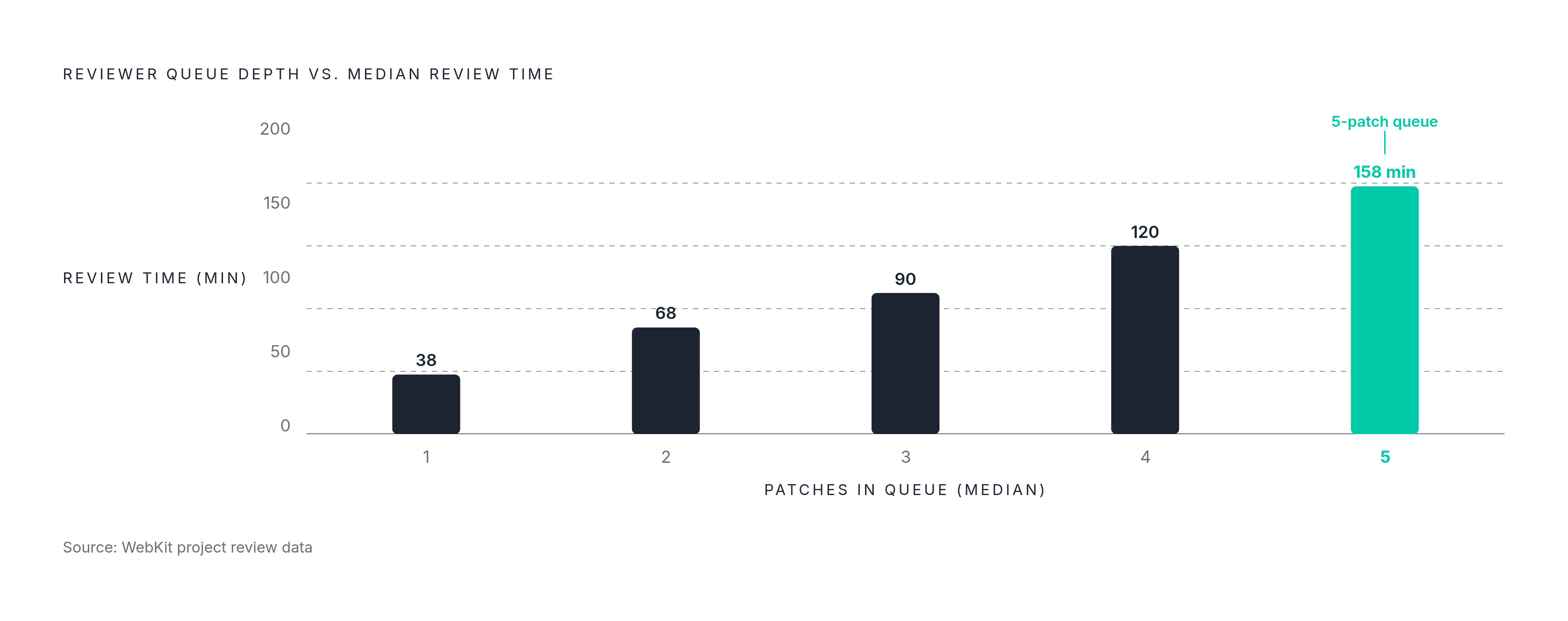
Making these numbers visible changes how a team behaves around them. WebKit's own data shows median review time climbing to 158 minutes once reviewers were carrying a median queue of five patches at once, a clear demonstration that queue depth is a bottleneck a team can watch directly once it's being measured, and that visibility is the precondition for the team taking collective responsibility for fixing it rather than treating slow review as an individual failing.
None of this is a one-time setup. As AI tools generate a growing share of the code moving through the pipeline, the balance between automation and human judgment described earlier will keep shifting, and the SLA tiers, depth triggers, and automation layers built today will need rebalancing as that ratio changes. Teams that revisit batch-size thresholds, SLA tiers, and automation boundaries on a regular cycle, quarterly, as team composition changes, as tooling improves, keep compounding the gains review design delivers. The investment pays forward precisely because it isn't static: a cadence built once and never revisited degrades quietly, while one treated as a living system keeps paying returns as the volume and character of the code running through it keeps changing.