Evaluating Distributed Team Fit During Candidate Interviews
Skip the soft signals: five concrete traits predict whether remote engineers actually work out.
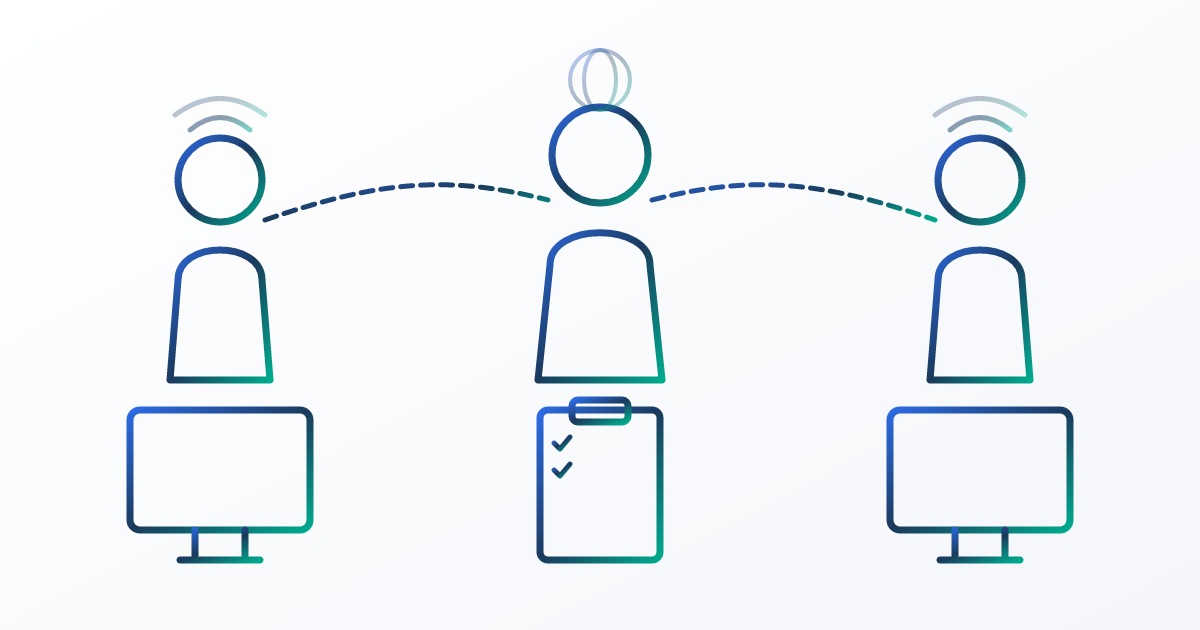
Two years back, I hired a backend engineer who went quiet for three days on a blocked ticket rather than say so in Slack. Great résumé, clean technical screen, all the right words about "thriving independently." Nobody caught it until standup, and by then the delay had already knocked a client deadline sideways. The interview process hadn't tested for any of this. I'd run a co-located loop with a webcam bolted on for a dozen hires before that one, and never noticed the seam until it tore.
That's the pattern I want to name here. Hallway rapport, the sense that someone looks busy, the vague read you get off body language in a room: none of it survives the trip to remote work. The traits that predict whether a distributed hire actually works out go untested until the person is three weeks in, and the damage is already sitting in a Jira ticket somewhere. What follows is the framework I've rebuilt twice since that hire went sideways, and its whole purpose is catching the problem before an offer letter goes out.
A distributed engineer who needs constant hand-holding creates drag that compounds across every handoff and every sprint review, and time zone overlap doesn't absorb that kind of friction the way an open floor plan might. Most interview questions were written for the floor plan and never updated. Technical skill is rarely the failure mode in a bad remote hire; I've sat through enough of these postmortems to know the person could usually write the code fine. The gap was always in working the way distributed work actually demands, independently, asynchronously, mostly in writing. "Tell me about your greatest weakness" was a weak question even for office hiring. Here it's close to useless. It produces a rehearsed answer with zero bearing on what someone does with a blocked ticket at 9pm when nobody else is online.
The five traits that actually predict performance in distributed roles
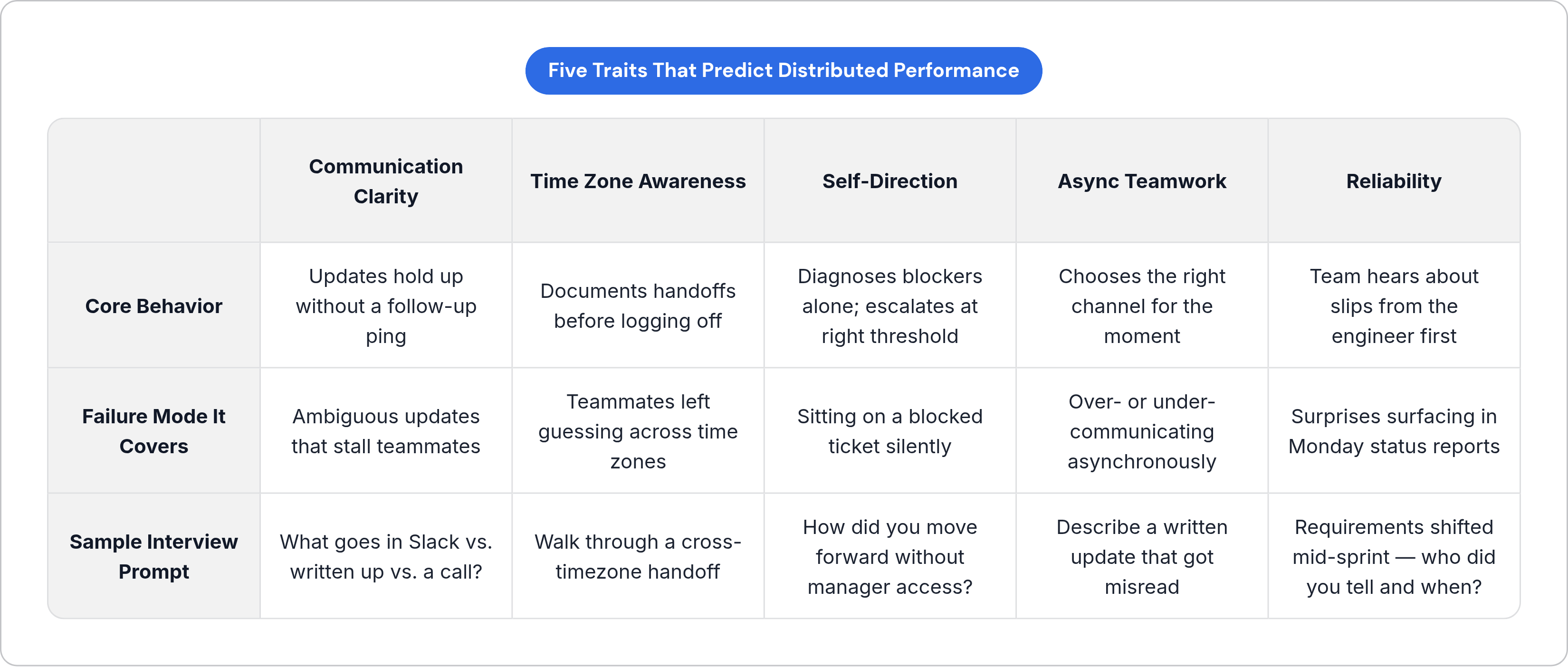
The real question is whether someone can do the job with limited supervision, across time zones, through tools like Slack, Notion, and Jira, where tone and clarity are the only signal you get. Five traits answer that question, and each one is observable. None of them are personality labels you slap on after someone seems likeable in the room.
Communication clarity means the person writes updates that hold up without a follow-up ping, and can explain a technical tradeoff to someone who isn't an engineer. Time zone awareness shows up in how someone plans a handoff before logging off. Do they document the blocker, or leave a teammate in Manila guessing what "still working on it" is supposed to mean? Self-direction is diagnosing a blocker alone, making a reasonable call within scope, and knowing when to escalate instead of sitting on it. Async teamwork is knowing when a five-minute call beats a wall of Slack messages, and when a written doc beats both; it also means giving feedback that still lands when the recipient reads it eight hours after you sent it.
Reliability is the simplest to state and the hardest to fake. When a deadline slips, the team hears it from the engineer first, not from a status report that blindsides everyone Monday morning.
Here's why these five hang together: each one covers a failure mode a co-located manager can paper over without even noticing, and a distributed manager can't. Walk over, clarify the fuzzy instruction, problem solved, if you're in the same office. A distributed manager finds out three days later that the instruction was fuzzy, usually because what came back doesn't match what was asked. Presence gives an engineer context for free, overheard conversations, hallway asides picked up sideways. Remote work strips that away, and most candidates have never once been asked whether they know how to build it back on purpose.
Worth flagging before moving on: this is culture add, sitting alongside culture match, not a replacement for it. Five people who all work identically isn't the goal. Distributed teams get stronger from a spread of styles and backgrounds. These traits describe habits, not a mold to stamp candidates into.
Replacing vague interview questions with prompts that surface real distributed behavior
Broad questions get you a performance. Narrow ones get you evidence. "How do you stay organized" invites someone to describe their ideal self. "How do you decide what goes in Slack, what gets written up, and what waits for a call" forces an actual decision process onto the table, one the candidate either has or doesn't.
For self-direction: "Tell me about a time you had to move a project forward without immediate access to a manager or teammate. What did you do first, and where did you draw the line between deciding on your own and waiting for input?" For async communication: "Describe a situation where a written update you sent got misread. What happened, and what did you change about how you write updates after that?" For time zone awareness: "Walk me through a handoff with a teammate in a very different time zone. What did you do to keep anything from falling into the gap?" For reliability under ambiguity: "Requirements shifted mid-sprint and your estimate had to change. Who did you tell, how, and when?"
There's a tell separating a real answer from one that just sounds good. Candidates describing what they'd do, instead of what they did, are handing you a hypothetical dressed as an anecdote. Candidates crediting "the team" for every outcome without naming their own move are doing the same thing from the other direction. The green flag is almost anticlimactic in comparison: they name the actual tool, the actual channel, the actual document. "I updated the ticket with the blocker and tagged my lead before logging off" is real. "I made sure everyone was aligned" is nothing.
Honestly, the most useful question in the room is usually the second one, not the first. "And what did you do when that didn't work?" is where the rehearsed answer runs out of script.
Testing async communication directly, not just asking about it
Every candidate claims strong communication skills. Almost none have ever been asked to prove it before getting hired, which is strange given how much of the job depends on exactly that.
Two exercises close the gap without much overhead. First: after the interview, ask for a short written recap covering what the candidate understood about the role, what's still unclear, and how they see themselves contributing. Costs nothing to schedule, produces an unscripted writing sample. Second: send a short scenario, a blocked task, a conflicting priority, a requirement left deliberately vague, and ask for a written response inside a tight time box.
What comes back tells you things an interview can't. Does the candidate write in complete thoughts, or assume the reader has context they don't actually have? Do they flag their own uncertainty, or paper over it with confident filler? Do they lead with the blocker and the ask, or bury both under three paragraphs of preamble?
One thing worth saying plainly: AI-assisted writing means a candidate can now submit something polished that has nothing to do with how they write on the job day to day. Pair the exercise with a short live follow-up rather than just filing it away. "Walk me through your thinking on the scenario you sent." The gap between the written answer and the verbal explanation is itself the diagnostic. Someone who can't unpack their own submission either didn't write it, or didn't think it through, and you want to know which before the offer goes out, not after.
Building a scorecard that makes distributed fit measurable across interviewers
Unstructured debriefs fail here for a specific reason. Gut feel rewards polish and quietly penalizes introversion, and neither one predicts how someone performs across a distributed team. Without a shared rubric, four interviewers walk into a debrief believing they're aligned when they've each scored something different and called it consensus. None of this is new: structured interviews have consistently beaten unstructured ones on predictive validity, and a handful of well-built structured interviews carries more signal than a much bigger pile of loosely run ones.
Score behaviors, not traits. Simple to state, oddly easy to violate. "Communication" as a scorecard line collapses into a vibe within ten seconds of debrief. "Writes concise, complete updates with clear next steps and no assumed context" holds up, because you can check it against something the candidate actually produced. "Independent" falls into the same trap wearing a different coat. "Can prioritize their own work and escalate blockers at an appropriate threshold without prompting" is scoreable in a way "independent" never was.
Each of the five traits should map to one or two behaviors along these lines, with a short description of what "below bar," "meets bar," and "exceeds bar" look like, written before a single interview happens rather than reverse-engineered afterward to justify whoever the panel already liked. Assign each dimension to whichever interviewer is best positioned to actually watch it play out. Not everyone needs to grade everything. That's how a scorecard turns into five copies of the same gut feeling.
This tracks a shift already reshaping hiring more broadly, away from credential and pedigree as stand-ins for capability, toward scoring capability directly. A distributed-fit scorecard is that same move, aimed at a narrower and more neglected problem. There's a defensive upside too. When criteria are explicit and behavioral, it's a lot harder to mark someone down for "culture fit" when what actually happened is the panel just found their style unfamiliar.
How the interview process itself signals what distributed work will feel like
Good candidates run their own evaluation in parallel with yours, whether you notice or not. A disorganized loop, late links, no agenda, an interviewer who obviously hasn't opened the résumé, tells a sharp candidate exactly what async coordination looks like on that team. The people worth competing for pick up on this, and it factors into whether they take the offer at all.
The fix is to model the behavior you're hiring for. Send a written brief before the interview: who's on the call, what each conversation covers, what to expect. That one document says more about your team's documentation habits than any answer a hiring manager could give if asked directly. Build in at least one async touchpoint, which the written exercise already covers, and close the loop in writing, promptly, instead of leaving someone refreshing their inbox for two weeks.
Scheduling is its own signal, and a blunt one at that. How a team handles interview timing across zones previews exactly how that candidate gets treated once hired. Asking someone to take an 11pm call because it suits the interviewer's calendar is disqualifying information on its own, and a self-aware distributed candidate reads it that way immediately.
A team that can't run a distributed interview well probably can't run distributed work well either. Strong candidates already know this.
Applying the framework when sourcing engineers across time zones and geographies
The five traits stay fixed regardless of geography, but the weight on each shifts. Async discipline, self-direction, time zone awareness: all of it matters whether the candidate sits two hours away or twelve. A candidate with two to four hours of daily overlap can resolve ambiguity in a live conversation far more often than one twelve time zones out, and that changes what you probe hardest in the interview. Documentation discipline is non-negotiable at twelve hours of separation. At four hours, it's merely important.
Nearshore sourcing, Latin America to North America being the clearest case, preserves enough overlap to run a real agile cycle: synchronous standups, same-day code review, live pairing when something gets stuck. That lets the evaluation lean on live collaboration signals alongside the async evidence, something a fully offshore process usually can't offer. Cultural and linguistic alignment in nearshore arrangements also cuts the communication overhead that quietly inflates cost in more distant setups. Still, verify it in the interview. Don't assume it because a résumé lists a nearby country.
When sourcing runs through a staffing partner instead of a direct hire, the partner's own screening process becomes something worth interrogating, not trusting on faith. Does the partner test for async communication and self-direction, or only for technical skill? Can they show you the actual behavioral criteria they screen against, or is "culture fit" a black box on their end too? A partner who vets coding ability and hands off the rest as an assumption is doing half the job and calling it finished.
BairesDev is one example I've seen run this well: they source from a deep pool of regional talent and put candidates through several stages of vetting before a client ever sees them, which pre-qualifies a good chunk of what this framework is trying to surface. The client-side interview turns into more of a confirmation than a cold evaluation at that point, checking alignment on someone already tested against these traits instead of starting the diagnostic from zero.
Teams running structured, trait-mapped evaluation get to real productivity faster than teams leaning on technical screens alone and hoping the rest sorts itself out. And the framework doesn't get thrown away after one hiring cycle. The scorecard, the question set, the async exercise: all of it carries forward into the next hire, the next engagement, the next time zone the team expands into.