Generative AI Impact on Engineering Headcount Planning
AI fluency and validation skills now matter more than raw engineer count.

Generative AI isn't shrinking engineering headcount so much as it's rewriting what headcount measures. The old model counted bodies and billable hours; the new one has to count skill density, AI fluency, and the judgment required to catch what a model gets wrong. Engineering leaders still planning around the first model are optimizing for a variable that no longer predicts output, and most of them haven't noticed yet. This piece is about what the second model looks like in practice, and why the leaders who've figured it out are pulling ahead of the ones who haven't.
What the corporate actions of 2025-2026 actually reveal
Salesforce cut its support headcount from roughly 9,000 to about 5,000 as AI tools absorbed routine customer conversations, and hired zero new engineers in fiscal year 2026. That second detail matters more than the first. A support team shrinking is one thing. An engineering org that stops hiring altogether, even as the company keeps shipping product, is a CEO-level admission that AI substitution has moved from theory into a budget line.
Amazon cut 16,000 corporate jobs in January 2026, on the heels of 14,000 cuts in October 2025, roughly 9% of its corporate workforce gone inside three months. Microsoft offered voluntary buyouts to as many as 8,750 employees in April 2026, the first voluntary buyout program of its kind, in the same year it committed $190 billion in capex to AI infrastructure. The buyout and the capex commitment are the same decision, read off two different ledgers, and the timing isn't a coincidence worth glossing over.
None of this reads as uniform contraction, and treating it as one is the mistake most outside observers make. Meta laid off 8,000 employees and, in the same stretch, moved roughly 7,000 into new AI-focused roles. IBM has been expanding entry-level hiring for AI and hybrid-cloud positions even as it trims elsewhere. The pattern holds once you stop looking at the aggregate number and start looking at where the cuts land: they cluster in roles where AI now handles the routine output, and the growth clusters in roles that direct, build, or validate AI systems. Call it reallocation, not shrinkage. Conflating the two is how a board ends up cutting the wrong 3,000 people instead of the right 3,000.
A messier pattern complicates the first one. A Harvard Business Review study of 1,006 global executives from December 2025 found that 39% had already made low-to-moderate headcount reductions in anticipation of AI productivity gains, before those gains were measured against actual output. Cutting ahead of evidence is a different mistake than replanning around confirmed capability. Both are happening right now, inside the same industry, sometimes inside the same company. Only one of them is defensible, and it isn't the one running ahead of the data.
What AI tools are actually doing inside engineering workflows right now
Adoption stopped being a debate a while back. Weekly AI tool use among developers hit 82% in Q1 2025, with 59% running three or more tools in parallel. The question worth asking isn't whether engineers use AI, it's where the effort concentrates, and it concentrates in one place: boilerplate, test generation, refactoring, documentation, debugging suggestions, API integrations. Repeatable work with a clear right answer.
The seniority split is where planning gets interesting. Gartner's May 2025 framing describes AI as scaffolding for experienced engineers, letting them move across platforms and projects faster than before. Junior engineers get something different: time back on routine tasks, freed up for the harder problems that still demand judgment AI can't supply on its own. Gartner also finds the productivity gains land hardest for senior developers inside organizations with mature engineering practices already in place, which is a pointed warning to any org expecting AI to compensate for a junior-heavy, process-light team. It won't.
Here's the catch planners can't skip past. Research into AI-assisted development has found that AI-coauthored pull requests tend to carry meaningfully more issues than human-authored ones. A significant share of AI-suggested code requires revision before acceptance, and many developers report reservations about trusting what the tools hand them. Put together, the productivity story is real but conditional: it depends entirely on having engineers who can review, validate, and correct AI output before it ships. A team without that capacity doesn't just fail to capture the gain, it inherits the risk on top of the loss, which is the worse of the two outcomes and the one most cost-driven cuts ignore.
The value of an engineer now lies less in what they can build and more in what they can catch before it merges.
How the skill profile of an engineering team is shifting
Gartner projects that 80% of the engineering workforce will need to upskill through 2027, and that by the same year, a large majority of software engineering leader job descriptions will explicitly require oversight of generative AI, a marked shift from when Gartner published the analysis in October 2024. That's most of an industry's job descriptions getting rewritten inside three years, not a gradual drift anyone can afford to wait out.
The skills moving to the center of the role barely existed as hiring requirements a few years back: natural-language prompt engineering, retrieval-augmented generation, and AI output validation. Gartner has flagged an emerging role it calls the "AI engineer," combining software engineering, data science, and AI/ML skills, and frames it as the role organizations will need most as AI-generated software becomes the default rather than the exception.
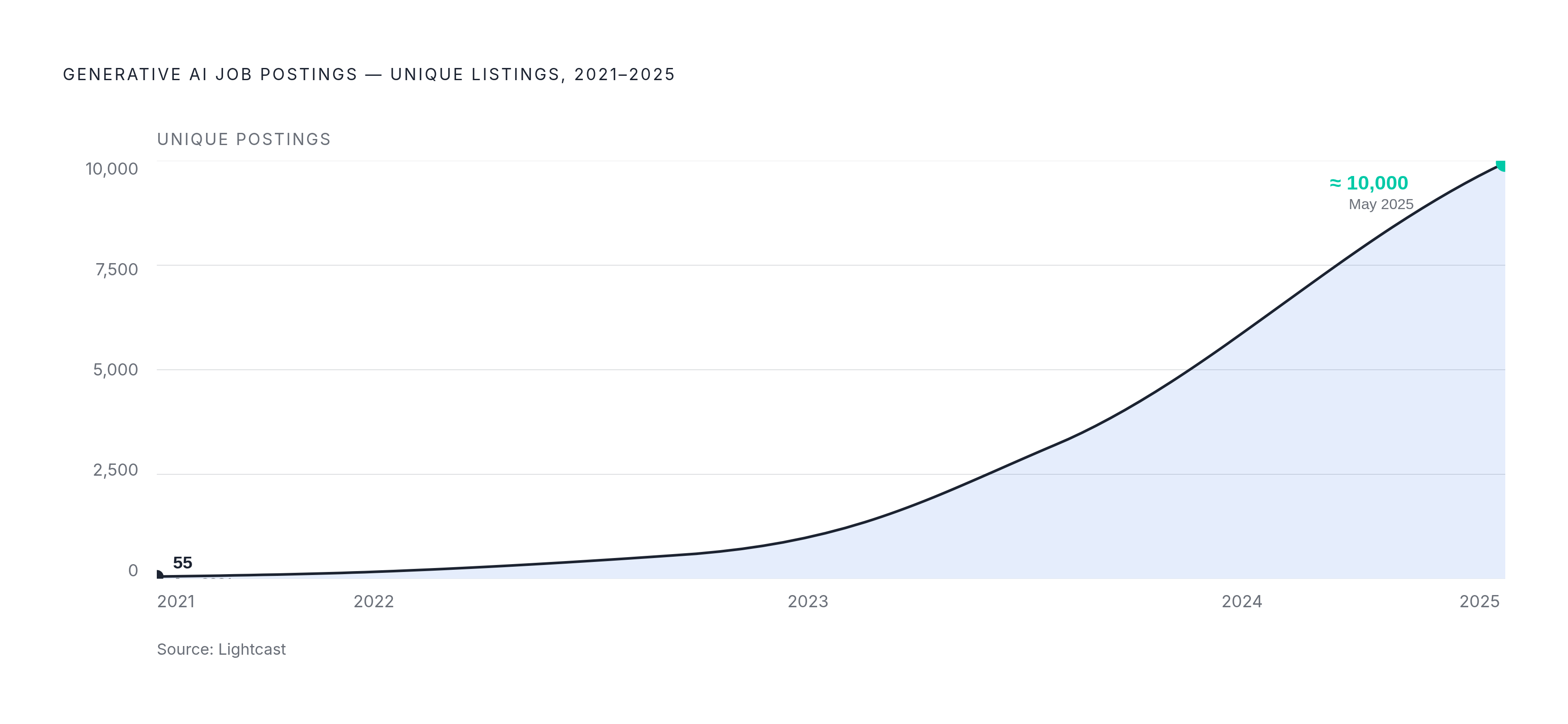
Lightcast tracked unique job postings requiring generative AI skills growing from 55 in January 2021 to nearly 10,000 by May 2025. That's not a market correcting, that's a market discovering a skill it didn't know to price five years ago.
What that means for a headcount plan is uncomfortable but not complicated: a smaller team with real AI fluency and strong review instincts now out-produces a larger team without those traits. Planning headcount without planning skill density is planning to lose a race you didn't know you were running. Stop asking how many engineers the team needs, and ask instead what combination of skills it needs, and in what ratio to each other, because that ratio is the actual unit of output now.
There's a governance layer to this too, and it isn't optional decoration. Engineering leaders increasingly need explicit policies assigning responsibility for model retraining and version rollbacks, because these have become shared responsibilities rather than something one team owns quietly in the background. That belongs in the headcount plan itself, not bolted on afterward as a compliance memo nobody reads until something breaks.
Why leaner teams only work when vetting standards go up
Leverage cuts both directions, and that's the part easy to miss when the conversation is all efficiency gains and no downside case. A highly AI-fluent engineer on a lean team multiplies what that team ships. An engineer with weak judgment on the same lean team multiplies defects and rework, and there are fewer people left to absorb the damage before it reaches production.
The data already shows the shape of the risk. DX's Q4 2025 research, covering more than 135,000 developers, found 22% of merged code is now AI-authored, and the elevated issue rate on AI-coauthored pull requests applies directly to that growing share. A lean team whose reviewers can't catch that error rate isn't just understaffed, it's exposed, and the exposure compounds every sprint the gap goes unaddressed.
So the vetting bar has to move, in a specific direction. AI tool proficiency stopped being a differentiator once the large majority of developers started using these tools weekly. The real question now is depth of judgment, not whether someone has Copilot open. Can the engineer spot a hallucinated API call before it merges? Can they catch a logic error buried inside code that looks clean at a glance? Do they know when to reject a suggestion outright rather than patch around it? System-level thinking matters more than it used to as well: AI is good at local code generation but blind to cross-component effects and long-term maintainability, so the engineers worth hiring are the ones who see three files past the one AI just touched. Catching systemic code quality issues before they calcify into technical debt is part of the job now, whether it's written into the role description or not.
Fewer seats at the table means each seat carries more leverage and more risk at once. That's the argument for vetting getting stricter as teams get leaner, not looser, and it applies with extra force to any leader sourcing talent across geographies. The process for evaluating AI fluency and review judgment there needs to be every bit as tight as the process for evaluating raw coding skill. Loosen it, and the savings on the invoice show up as defects six months later.
How nearshore staff augmentation fits into AI-era headcount planning
The engineers organizations need most right now, AI-fluent, strong reviewers, comfortable thinking in systems rather than files, are scarce and expensive in domestic markets. That scarcity is exactly what the rapid growth in generative AI job postings signals, and it's exactly the gap nearshore staff augmentation is positioned to close, for reasons that go beyond simple cost arbitrage.
Timezone alignment matters more in an AI-assisted workflow than it did before, and this is the point most cost-focused arguments for offshoring miss. Reviewing AI-generated output well isn't an async task done well at 2 a.m. on the other side of the planet. It needs overlapping working hours and quick back-and-forth, someone available to answer "why did the model do this" in real time rather than the next morning. Nearshore models built around Latin America carry a structural advantage here, given the region's timezone overlap with North America.
Augmentation also fits the more dynamic planning cycle AI is forcing on engineering orgs generally. Skill needs shift as tools mature, and a fixed annual headcount plan is a poor match for that pace of change. Staff augmentation lets a leader compose a team around specific skill profiles, adding an AI engineer here, a validation-focused senior reviewer there, or a prompt engineering specialist for a defined project window, adjusting the mix as the technology and the workload evolve. That beats locking into a static roster of generalists signed a year in advance and hoping the shape still fits by month nine.
None of it works without the same vetting discipline the previous section argued for. An augmentation partner is only as useful as its screening process for AI fluency and review judgment, and that screening needs to hold the same bar as an internal hire, not a lower one. Organizations that treat augmentation as a standing part of the staffing strategy, not a stopgap, tend to build more durable client relationships over time. That continuity is what lets institutional knowledge about a codebase and its AI-assisted quirks actually accumulate, and longevity, not price, is the strongest signal of a partner worth trusting on this front.
What a skill-density headcount plan looks like in practice
Putting this into practice means moving off FTE counts and onto skill-mix targets. Define what AI fluency actually means for each role on the team, not as a binary of uses-AI or doesn't, but as a spectrum running from tool user, to prompt engineer, to AI output validator, to full AI systems builder. Map which tasks are already AI-assisted and which still demand judgment AI can't supply, because that map, not a headcount formula inherited from three planning cycles ago, is what sets the ratio of senior to junior engineers the team actually needs. Treat validation capacity itself as a planning input, not an afterthought: the team's ability to review AI-generated code at scale sets a hard ceiling on how much AI leverage it can safely extract, no matter how good the tools get.
Scenario planning belongs in this process too. Workday's CFO AI Indicator Report named scenario planning one of the top three areas AI is transforming inside finance and operations functions, and the same logic applies directly to engineering: model team configurations against expected project demand, rather than locking a shape in place for twelve months and hoping it still fits in month nine.
Upskilling isn't a side project here, either. Gartner's 80% upskilling figure through 2027 means most existing teams need a training plan running parallel to any hiring plan, and a Q4 2024 Gartner survey of 400 software engineering leaders found up to half their teams were already using generative AI tools regularly, well before most formal training programs caught up to them. The organizations ahead of the curve have folded that learning into daily workflow instead of farming it out to a quarterly HR module nobody finishes. Ownership of AI-specific failure modes, model drift, version rollbacks, hallucinations that slip into generated code, needs to be assigned as part of team design from the start, echoing the accountability structures that engineering leaders increasingly need to formalize as AI becomes embedded in the development lifecycle.
Judging whether any of this works requires new metrics, not the old ones: defect rate in AI-assisted output measured against human-authored output, review throughput (how fast and how accurately engineers catch the issues AI introduces), and skill growth velocity (how quickly the team's AI fluency deepens as the tools keep changing underneath it).
The engineering leaders building the highest-leverage teams over the next three years won't be the ones who cut headcount reflexively because AI made the spreadsheet look tempting. They'll be the ones who replanned headcount around a clear-eyed read of what AI actually makes possible, and an equally clear-eyed read of what it still can't touch. Betting on the spreadsheet over the judgment call is the mistake this whole piece has been arguing against.
Sources
- Gartner Says Generative AI will Require 80% of Engineering Workforce to Upskill Through 2027
- Generative AI is Redefining the Role of Software Engineering Leaders
- The Generative AI Job Market: 2025 Data Insights
- getpanto.ai
- Software Engineer Layoff Statistics 2026: Companies
- List of Companies Announcing AI-Driven Layoffs
- Companies Are Laying Off Workers Because of AI’s Potential—Not Its Performance
- How Generative AI Is Reinventing Scenario Planning | Workday US