Rise of the Skills-Based Hiring Model
Most employers claim to hire for skills, but only 0.14% of actual hires reflect the change.

The numbers are substantial enough to demand attention. As of 2025, 85% of employers report using skills-based hiring, up from 81% in 2024, while résumé usage has fallen from 73% to 67% over the same period. The number of roles eliminating degree requirements rose fourfold between 2014 and 2023. These aren't rounding errors. They are directional signals from a labor market under genuine structural pressure.
That pressure has a specific shape. Eighty-seven percent of companies either face a skills gap now or expect one within two years, and 60% identify skills gaps in the local labor market as their single largest barrier to transformation. When the supply of credentialed candidates runs short, the rational response is to look for capability wherever it actually lives. Simple enough in principle. The problem is that most hiring infrastructure was never architected with that principle in mind, so acting on it requires dismantling systems that were built to do something else entirely.
AI is accelerating the administrative side of this shift. AI usage in recruitment nearly doubled, from 26% to 53% of organizations, between 2023 and 2024. Skills-based screening tools account for a meaningful share of that growth, automating early-stage evaluation in ways that make structured assessment scalable for organizations that couldn't have staffed it manually five years ago.
What makes the trajectory durable is that it is driven by structural labor shortages, demographic realities, and the accelerating obsolescence of academic credentials in fast-moving technical fields. This isn't a cyclical hiring fashion that reverses when the economy softens. The underlying forces are not going away.
The gap between removing a degree requirement and changing who actually gets hired
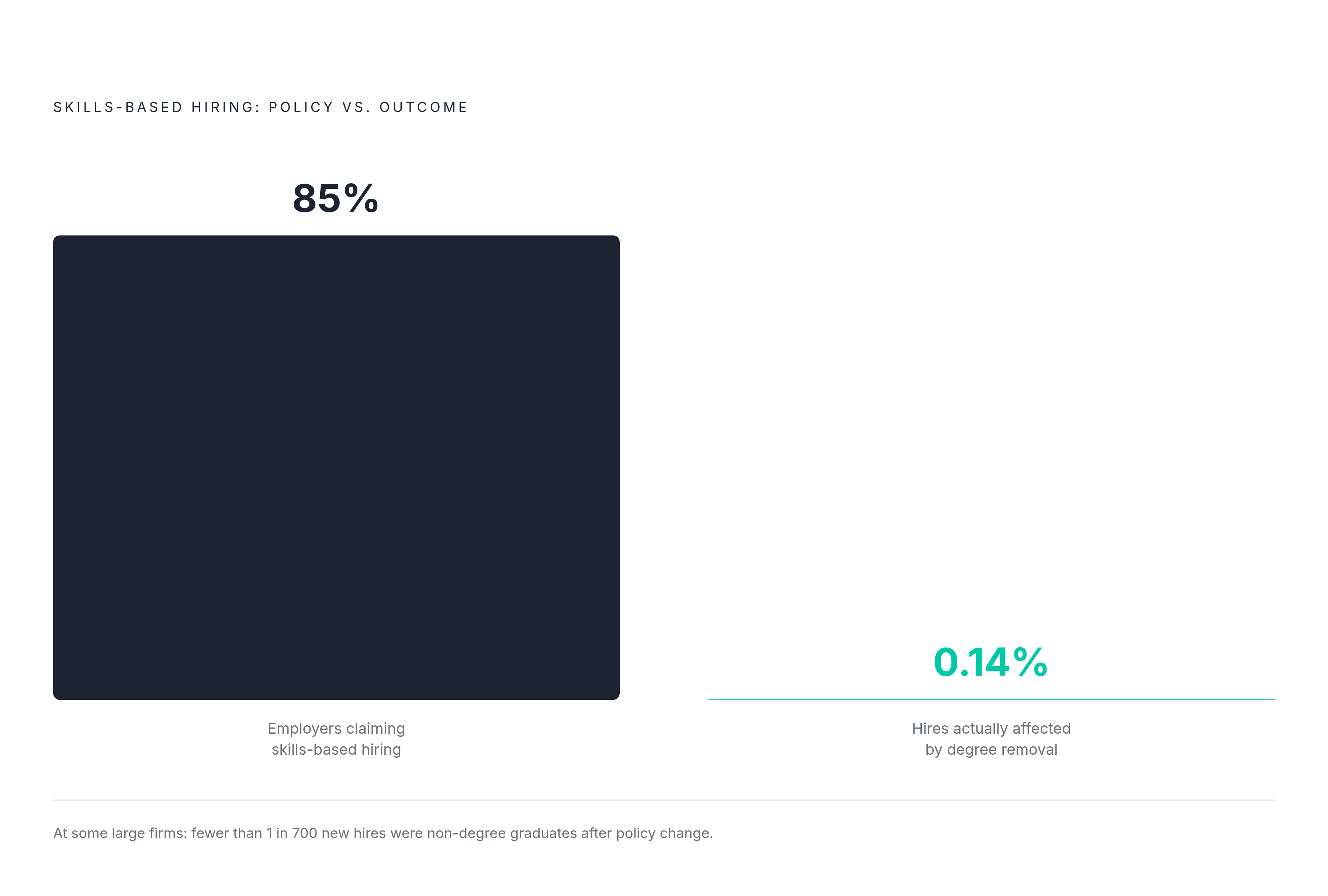
The headline adoption numbers carry a puncturing caveat. A 2024 analysis by Harvard Business School and the Burning Glass Institute found that only 0.14% of hires are actually affected by degree requirement removal, despite widespread employer claims of having adopted skills-based practices. At some large firms, fewer than 1 in 700 new hires were non-college graduates even after degree language was stripped from job postings.
That number deserves to sit for a moment, because it identifies where implementations actually collapse. Removing a filter from a job posting is a policy change. Changing what recruiters screen for, what hiring managers weight, and what applicant tracking system logic surfaces is a systems change. Most organizations have done the first while leaving the second entirely intact. The posting changed. The behavior didn't.
Sourcing channels weren't rebuilt. If you keep posting where degreed candidates congregate, the applicant pool doesn't shift regardless of what the posting says. Interviewers default to familiar proxies, school name, previous employer prestige, when no structured assessment replaces the credential as an evaluation anchor. Sixty-two percent of HR professionals report that skill validation remains a genuine challenge even when the intent to hire for skills is sincere. Verification is hard. Translating "we want to hire for capability" into a process that consistently surfaces capable people is harder still. That gap is where most implementations quietly collapse.
There is also something worth naming about the organizational psychology here. Degree requirements function partly as liability cover. When a hire goes wrong, a recruiter who screened for credentials can point to a defensible process. Removing that cover without replacing it with something equally legible to the organization creates institutional anxiety, and anxious hiring systems revert. You see this in the data. You also see it, less quantifiably, in the way job descriptions get quietly re-credentialed over time after an initial reform effort loses momentum.
Why tech hiring specifically is where skills-based methods either prove out or fall apart
Technology has always had a contested relationship with credentials. Strong self-taught engineers, bootcamp graduates, and contributors to major open-source projects have long outperformed credentialed peers on the work that actually matters. The industry has accumulated years of evidence on this. It has been slower to institutionalize the lesson.
Part of the reason for that lag is cultural. Technical hiring still carries residual deference to certain institutional names, a holdover from an era when the signaling function of a CS degree from a particular university was harder to independently verify. That era is over. The skills in demand right now are specific enough to test directly, which means there is no longer a defensible excuse not to. In AI and machine learning, that means Python fluency, model evaluation, and applied AI ethics judgment. In cloud infrastructure, it means architectural competence across major platforms, Kubernetes orchestration, and infrastructure-as-code tools like Terraform. In cybersecurity, it means penetration testing methodology and zero-trust implementation. These aren't abstract competencies. A candidate either builds the pipeline or doesn't.
The credential shortcut is particularly unreliable in tech because the field moves faster than curricula can follow. A computer science degree from 2020 does not include LLM fine-tuning or modern infrastructure-as-code workflows. A self-taught engineer who has been practicing both for two years almost certainly does. The degree signals time spent in an institution, not current capability in a discipline that has changed substantially since that time was spent.
McKinsey's finding that hiring for skills is five times more predictive of job performance than hiring on education alone matters more acutely in tech than in most other fields, because the output is measurable and attribution is relatively clear. A mis-hire doesn't just fill a seat badly. It slows the engineers adjacent to it, introduces technical debt the whole team carries, and compounds over time in ways that are genuinely expensive to unwind. The cost isn't contained to the bad hire; it radiates.
What rigorous skills-based assessment actually looks like for technical roles
Credible assessment starts before the first candidate enters the process. Role decomposition comes first: breaking the job into the specific capabilities it requires, with real specificity, before writing a single assessment question. What does this engineer need to build on day one? What systems will they touch? What decisions will they make alone versus in collaboration? That analysis produces the rubric, and the rubric drives the assessment design. Skip that step and you're measuring against a standard you haven't defined, which is no standard at all.
Structured technical screens should mirror actual work, not academic puzzle-solving. Timed coding challenges, architecture walkthroughs, and debugging exercises have legitimate uses when they reflect the real problems the role encounters. Generic trivia-style challenges measure test-taking aptitude and anxiety tolerance more than engineering judgment, and they reliably filter out candidates who are strong practitioners but poor performers under artificial conditions. I've watched strong senior engineers flame out on whiteboard sessions and then go build exactly the thing the role needed. The test was selecting for the wrong thing.
Work samples are the most direct signal available. A realistic task, building a small feature, reviewing a pull request, designing a system component, produces observable output that assessors can evaluate against agreed criteria. The key word is agreed. Calibration matters more than most teams acknowledge. Assessors need alignment on what "good" looks like before they score anyone, or the rubric becomes decoration over subjective judgment and you've reintroduced the problem you were trying to solve.
Behavioral and collaboration signals aren't secondary in technical hiring; they are structural, especially in distributed teams. Evidence of async communication clarity, documentation habits, and the ability to exercise ownership under ambiguity tells you things a coding challenge cannot. These aren't soft signals. They determine whether a technically competent engineer actually functions inside a real team over time.
The process also has to be identical for every candidate. When evaluator discretion replaces the rubric, the rubric was never really in charge.
The outcomes, when execution is disciplined, are significant. Ninety-four percent of employers report skills-based hires outperform degree-based hires; 90% report a reduction in mis-hires. Ninety-one percent of companies using skills-based hiring saw reduced time-to-hire, with 40% reporting a decrease of more than 25%. That efficiency gain is real only when assessment replaces earlier, slower screening steps rather than layering on top of them. Front-end discipline is what makes the rest of the system function.
How skills-based hiring expands the pool (and the equity argument that goes with it)
When sourcing channels change alongside assessment criteria, the pool expands materially. Removing degree filters alone is insufficient. Paired with deliberate outreach into communities where capable candidates have historically been overlooked, the effect is significant and well-documented.
The gender effect in tech is specifically measured. LinkedIn's 2025 analysis found that shifting from job titles to skills increases women's share of AI talent pools by up to 24% globally, with engineering and software roles showing a 13% rise worldwide and 16% in the United States. Those numbers reflect the degree to which traditional credential and title filters have functioned as structural exclusion mechanisms, not accurate predictors of performance. They excluded people who could do the work because those people didn't fit the historical profile of people who had done the work before. That's a feedback loop, not a selection system.
The practical case and the equity case point at the same problem because they are both responding to the same bad input. A smaller, more homogeneous pool produces more of the same hires. A larger pool increases the probability of finding the strongest actual match. In a labor market where 87% of companies face a skills gap, leaving capable candidates invisible isn't a neutral default. It's a costly choice, made passively, with measurable consequences that accumulate quietly until they don't.
Retention data reinforces this. Skills-based hires report higher job satisfaction, with 38% describing themselves as very happy in their roles, compared to 28% of those hired primarily on experience or credential alone. When a hire is based on actual fit for the work rather than a proxy for fit, the relationship holds because the basis for it was real.
How the model applies when hiring across borders and building distributed technical teams
Credential-based hiring has always struggled across borders. Degree equivalency is opaque. Institutional reputation is geographically anchored. A foreign credential signals almost nothing reliable to a hiring manager with no frame of reference for the institution that issued it. The result, historically, has been that international technical talent gets evaluated on signals that are noisy at best and arbitrary at worst. Geography functions as a proxy for capability, which it has never been.
Skills-based assessment is the natural corrective. A structured technical screen doesn't care where the candidate went to school. It measures whether they can build what the role requires. This is where the model's core logic is most fully realized: consistent measurement of capability, applied regardless of geography.
In a nearshore context specifically, rigorous vetting means deep technical screens across the precise stack the client team uses, not a generalized assessment of programming ability. It means evaluating English fluency and async communication quality, because a distributed engineer's ability to document decisions, ask precise questions, and stay aligned across time zones is as operationally important as their technical competence. It means assessing collaboration signals that predict how well an external engineer integrates into an existing product team mid-sprint. Integration friction is real and carries real cost, and it's largely invisible until it isn't.
Any nearshore partner that claims to source from the top of a talent pool only substantiates that claim through the rigor of the vetting infrastructure behind it. Rubric-driven, repeatable, calibrated assessment is what separates that claim from a résumé filter applied at scale. For companies augmenting existing teams rather than building from scratch, the stakes are higher still. An external engineer joins mid-sprint, with no runway to absorb the slow ramp a mis-hire causes.
What organizations that execute this well actually do differently
The organizations that close the gap between skills-based policy and skills-based practice share behaviors that are organizational in character, not merely procedural. And the differences aren't subtle once you've seen both sides of it.
They define skills at the role level before opening a requisition, because a job posting written without a clear capability framework produces incoherent assessment design downstream. They rebuild sourcing channels alongside assessment criteria, because changing the filter without changing where you look produces the same pool with a different label on the funnel. They train interviewers and hiring managers on rubric application, because an untrained interviewer with a rubric in hand will override it with intuition. That intuition is precisely what the rubric was designed to displace.
They track outcomes: offer acceptance rates, 90-day performance, retention at 12 months. They use that data to refine the process. This isn't a methodology you install once and leave alone. Every startup I've watched get this right treats the hiring process as a living system with feedback loops, not a fixed procedure someone wrote up in a good quarter and filed away.
The Burning Glass and Harvard finding about 1 in 700 non-degreed hires is a systems failure, not a values failure. The intent existed. The infrastructure didn't. Organizations that close the say-do gap audit every stage of the funnel: sourcing, screening, assessment design, interviewer behavior, final offer decisions. A failure at any one of those stages compromises the whole effort, and failures are rarely evenly distributed. They tend to concentrate wherever accountability is weakest and visibility is lowest.
In tech specifically, the best-executing teams keep their skill frameworks current. A rubric built for 2022 backend development doesn't capture the AI fluency, cloud-native architecture expectations, and security-by-design requirements of 2025. The field moves; the assessment has to move with it, or it drifts back toward credentialing under a different name, with the same exclusions and the same mis-hires, just rebranded.
Skills-based hiring is a more demanding process, not a more convenient one. It replaces credential verification with something harder: actual capability measurement. The organizations that benefit most are the ones that take that trade seriously, build the infrastructure it requires, and hold themselves accountable to the outcomes it should produce.