Telephonic Interview Questions for Software Engineering Roles
Concept questions and behavioral probes beat coding in audio-only screens.

The telephonic screen is the most consequential thirty to fifty minutes in a software engineering hiring funnel, and most teams run it without a coherent framework. Interviewers improvise questions; candidates rehearse answers calibrated for the wrong format; and the result is a screen that either passes the wrong people or eliminates the right ones. Both outcomes are expensive, and both are preventable.
Why the Audio-Only, Time-Limited Format Changes What Questions Work
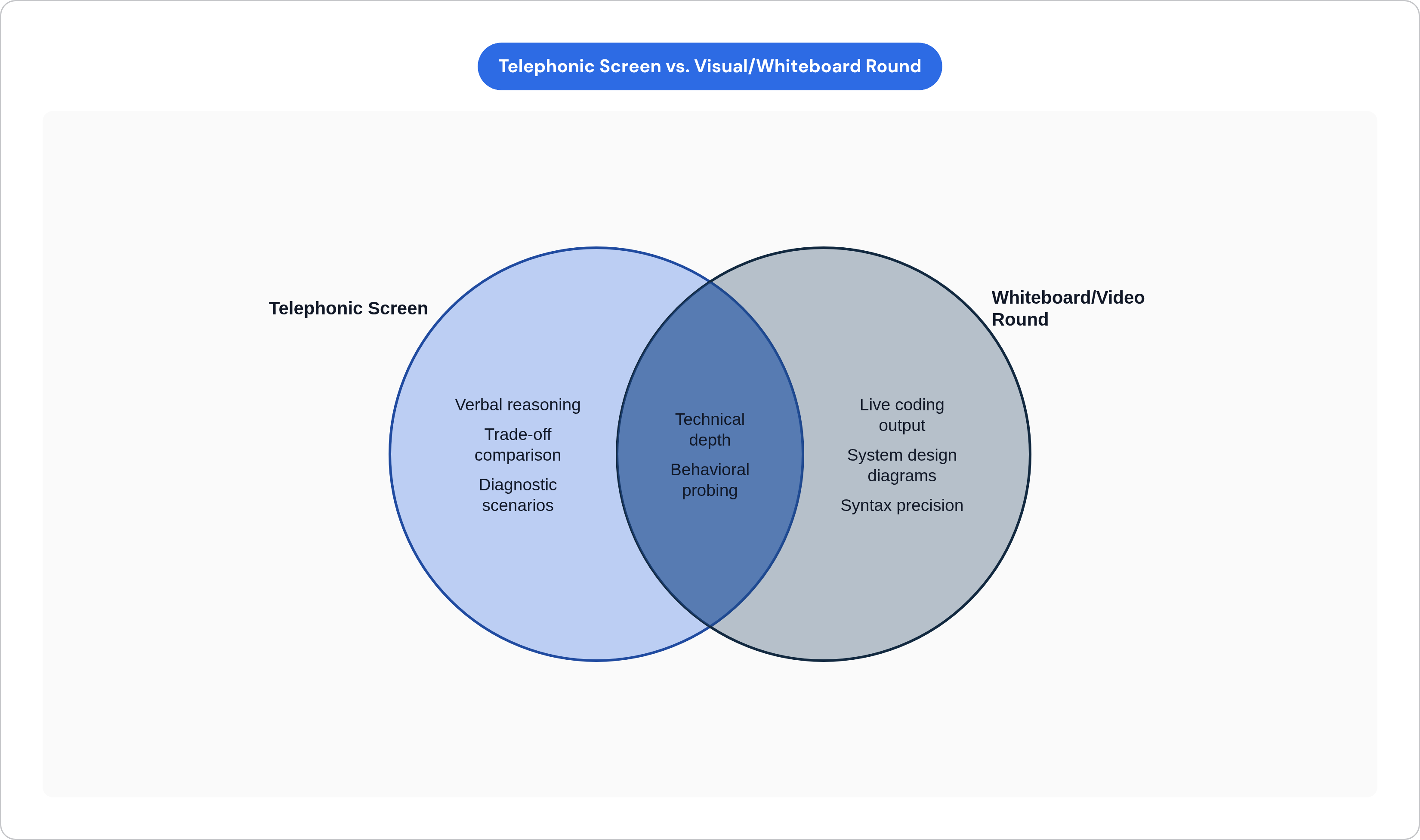
Without a shared screen, an interviewer cannot evaluate syntax, watch a candidate navigate a compiler error, or read the visual cues that accompany a drawing on a whiteboard. The signal shifts entirely from output to process. What did the candidate produce? becomes secondary to how does the candidate's reasoning hold up when articulated out loud, in real time, to someone who cannot see what they are thinking?
This reordering is consequential. Strong coders who communicate poorly are exposed quickly in this format. Candidates with solid conceptual understanding but weak execution in a live coding environment tend to perform better here than in a structured whiteboard round, which creates both an opportunity and a responsibility for the interviewer to calibrate accordingly.
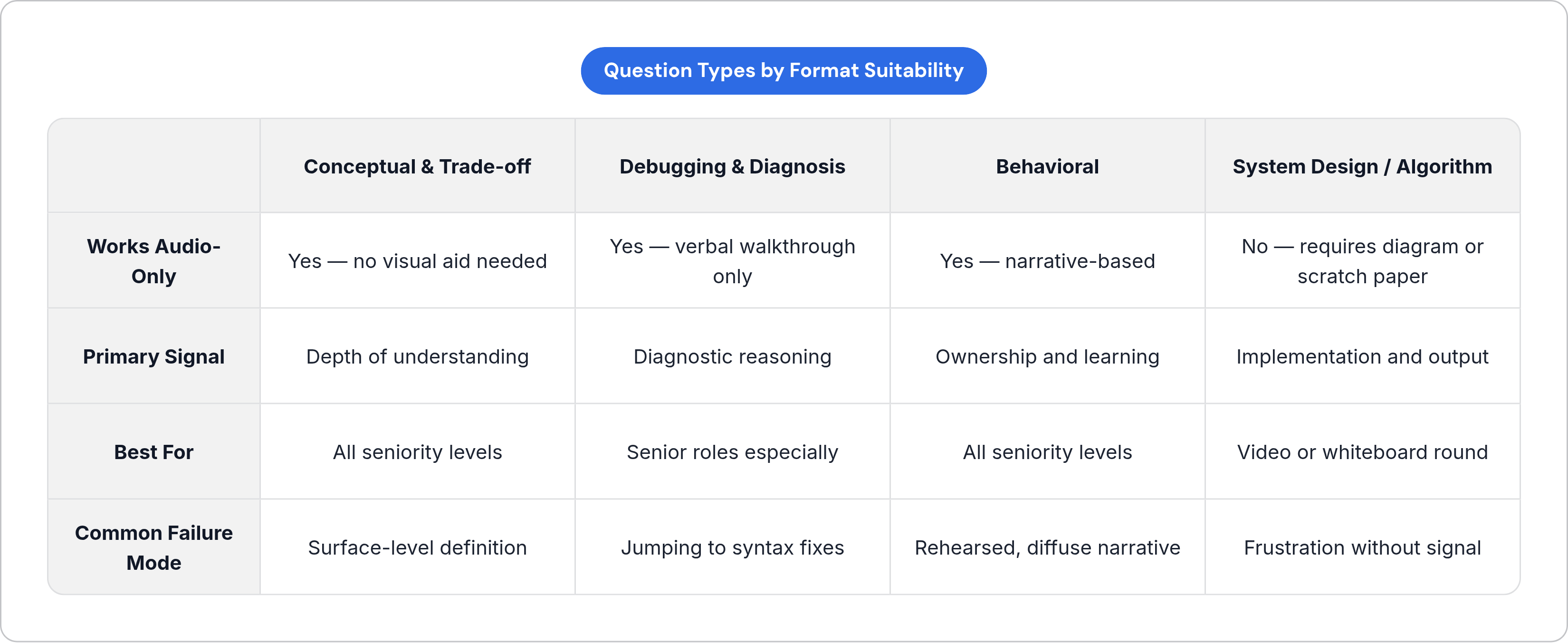
Question types that depend on visual scaffolding fail in this format. A multi-step dynamic programming problem that requires scratch paper to follow, or a system design prompt that only makes sense when drawn out, consumes time and produces frustration rather than signal. The telephonic screen rewards verbal precision: conceptual explanation, trade-off comparison, behavioral narrative, and diagnostic reasoning are all formats that survive the absence of a screen.
For distributed and nearshore team contexts, the format carries an additional dimension. The way a candidate communicates under audio-only constraints is exactly how they will communicate in async standups, recorded Loom walkthroughs, and written Slack threads. A telephonic screen is not just a filter; it is a preview.
Technical Questions That Work Without a Screen
Conceptual and Definitional Questions
Ask a candidate to explain a data structure, algorithm, or system concept in plain language, without implementing it. The framing matters: "Walk me through how a hash map handles collisions" requires the candidate to construct a verbal model of a mechanism they presumably understand, and the quality of that model tells you far more than whether they can write the code. Strong candidates can explain eventual consistency to a non-specialist; candidates with surface-level familiarity reveal gaps they would otherwise mask in a coding environment.
Trade-off Questions
Present two architectural or design choices and ask the candidate to compare them. "When would you choose a relational database over a document store?" or "What are the trade-offs between REST and GraphQL for a mobile client?" have no single correct answer, which is the point. The signal is whether the candidate thinks in context, weighing factors like query patterns, team familiarity, and client constraints, or whether they recite a preference without reasoning.
These questions deliver well verbally. They require no setup, no visual aid, and no more than two or three minutes to answer substantively.
Debugging and Diagnosis Scenarios
Describe a symptom: a query that degrades to thirty seconds at scale, a service that returns unexpected nulls on the third request but not the first two, a memory footprint that grows without apparent cause. Ask the candidate to walk through how they would investigate. This tests diagnostic reasoning, not syntax recall. For senior roles specifically, the methodical quality of a candidate's debugging instincts matters more than raw implementation speed, and this format surfaces it cleanly.
Avoid long multi-step algorithm problems that require scratch paper to follow, questions whose answers hinge on exact syntax recall, and system design prompts that depend on a diagram to communicate clearly. Reserve those for a video or whiteboard round where the format can actually support them.
Behavioral Questions That Reveal Problem-Solving Depth, Not Just Narrative Fluency
The STAR framework is a useful scaffold for candidates, but interviewers who accept the first-pass STAR answer without probing rarely learn what they came to find out. The polished version of a behavioral answer is often the rehearsed version, and the rehearsed version is where specificity goes to die.
The follow-up is where behavioral questions earn their place. "What did you personally contribute versus the team?" and "What would you do differently with what you know now?" push the candidate past their prepared narrative and into the texture of the actual experience.
Four behavioral questions that produce consistent, high-quality signal in a telephonic format:
- "Describe a technical decision you made that you later reversed. What changed your mind?" This tests intellectual honesty and learning orientation more directly than any question about best practices.
- "Walk me through a time you disagreed with a technical direction. What did you do?" This reveals how a candidate navigates authority, social pressure, and code quality simultaneously.
- "Tell me about a project where the requirements changed significantly mid-build. How did you respond?" For Agile teams and distributed environments, this is nearly a daily operating condition; candidates who have never encountered it or who have no coherent response to it are a genuine risk.
- "Describe a production bug you found. How did you find it, what was the impact, and what changed afterward?" In a single question, this surfaces ownership, diagnostic rigor, and systemic thinking.
Weak behavioral answers share recognizable features: diffuse agency ("we decided," "the team handled it"), narratives with no tension, and outcomes measured only in terms of shipping rather than learning. A candidate who has never, in any project, encountered meaningful friction is either misremembering or has not worked in environments that would stress-test them.
Communication and Collaboration Questions Specific to Distributed or Remote Contexts
For nearshore, remote, or time-zone-distributed roles, communication style is as much a technical skill as proficiency in any particular language or framework. This is not a soft-skills claim; it is an operational one. A senior engineer who cannot communicate a blocker clearly in writing, who goes silent rather than documenting their reasoning, or who cannot calibrate the tone of a code review comment for someone they have never met in person will create downstream costs that no amount of technical ability offsets.
Three questions worth including in a telephonic screen for remote or distributed roles:
- "How do you handle a situation where you're blocked and your team lead is in a different time zone?" The answer reveals async judgment: does the candidate spiral, make a unilateral call without documentation, or write up what they know and make measured progress while they wait for input?
- "How do you make sure your code review comments land well with someone you've never met face to face?" This surfaces written communication awareness and the kind of empathy that sustains remote collaboration over time.
- "Tell me about a time you had to explain a technical decision to a non-technical stakeholder. What did you cut and what did you keep?" For client-facing or cross-functional roles, audience distillation is a daily requirement; candidates who cannot do it create friction at every interface.
Listen for specificity. A candidate who describes particular tools, documentation rituals, or async communication habits they have actually developed is a different proposition from one who answers with "I communicate clearly and proactively." The latter is an aspiration; the former is evidence.
How AI Fluency Is Changing What Telephonic Screens Need to Test
AI coding tools have destabilized several traditional screening signals. A candidate who produces clean, fluent code in an unmonitored at-home coding screen demonstrates, at minimum, the ability to prompt an AI effectively. Whether they understand what that code does is a separate question, and the telephonic screen is now the most reliable format for answering it.
A candidate who can explain, verbally and in real time, why they would choose a particular approach, what its failure modes are, and how they would communicate that reasoning to a non-specialist is demonstrating comprehension that no AI tool can supply on their behalf. The telephonic format does not reward output; it rewards understanding. That distinction has become more important as AI tooling has proliferated.
Two questions that probe AI fluency directly:
- "How do you use AI tools in your day-to-day workflow? Where do you trust the output and where do you verify it?" Strong candidates describe specific workflows and clear-eyed skepticism. Candidates who claim they never use AI are, in the current environment, almost certainly misrepresenting themselves. Candidates who trust it uncritically have not yet encountered the failure mode that will teach them otherwise.
- "Tell me about a time an AI-generated suggestion led you in the wrong direction. How did you catch it?" This tests whether the candidate exercises genuine code review discipline or approves AI output without scrutiny.
An additional interviewing posture worth adopting: unusually articulate answers that arrive without hesitation deserve a follow-up that goes one layer deeper, asking the candidate to explain the reasoning behind their answer rather than restate it. If the candidate cannot go deeper, the initial answer was thin.
For most engineering roles in today's market, familiarity with at least one AI coding tool is table stakes, not a differentiator. The actual differentiator is whether the candidate uses it with judgment.
What the Candidate's Questions Reveal, and Why Interviewers Should Pay Attention to Them
Strong candidates treat the telephonic screen as a two-way evaluation. Their questions are diagnostic, not performative, and they reveal preparation, technical sophistication, and genuine engagement with the role in ways that no behavioral question can fully replicate.
Questions that signal genuine technical curiosity: "How does your team handle technical debt, formally or ad hoc?" or "What does your deployment pipeline look like, and how often does the team ship?" These questions indicate that the candidate has thought about the actual conditions of the work, not just the title and compensation.
Questions weighted heavily toward schedule and compensation are a data point when they dominate the candidate's inquiry, particularly in combination with other weak signals. They are not automatically disqualifying, but their prominence in a short conversation reveals something about where the candidate's attention is.
The absence of questions is its own signal. A candidate who has no curiosity about the role, team, or codebase either did not prepare, is not genuinely interested, or is interviewing at enough volume that this particular position is undifferentiated to them. For distributed and nearshore roles specifically, candidates who ask about communication rhythms, time zone overlap, and async norms are signaling exactly the kind of distributed-team awareness that predicts success in those environments.
How Interviewers Can Structure a Telephonic Screen That Produces Consistent, Comparable Signal
Consistency is not a procedural nicety; it is the mechanism by which a screen becomes a fair and reliable evaluative instrument. Candidates who answer different questions in different sequences cannot be meaningfully compared against each other, and a hiring decision made from incomparable data is, at best, an expensive guess.
A workable structure for a standard telephonic screen:
- Opening, five minutes: Role context, format overview, brief candidate background. This establishes a conversational register and reduces the performance anxiety that distorts early answers.
- Technical conceptual questions, fifteen to twenty minutes: Two or three questions drawn from the areas above. Prioritize depth on one question over shallow breadth across five; an interviewer who learns one thing well has more usable signal than one who learns five things poorly.
- Behavioral questions, fifteen minutes: One or two questions with structured follow-up probes. Accept the first-pass answer as the opening, not the conclusion.
- Communication or collaboration question, five to ten minutes: One question specific to how the candidate works with others, weighted toward remote or distributed contexts if the role demands it.
- Candidate questions, five to ten minutes: Leave genuine time, not a closing gesture after the clock has already run out.
Write evaluations immediately after the call. Not at the end of the day, not the next morning. Memory of specific answers degrades within hours, and detailed notes written from memory are largely confabulation. Score on a consistent rubric: technical understanding, communication clarity, reasoning depth, collaboration signals. Two interviewers reviewing the same candidate independently and comparing notes afterward catch bias and interpretive drift that solo evaluation misses.
For teams vetting external or augmented engineers, including nearshore placements, the telephonic screen is often the stage at which communication fit is established before any code is reviewed. Weight it accordingly. Partners like BairesDev conduct multi-stage technical vetting before a candidate reaches a client's own screen, which means the client-side telephonic interview can focus on role fit and communication style rather than reconstructing a technical baseline from scratch.
How Candidates Can Prepare for the Specific Demands of a Telephonic Software Engineering Screen
The core preparation shift is from practicing what you know to practicing how you explain what you know, out loud, under mild time pressure, without visual assistance. These are learnable skills, and most candidates underinvest in them relative to the time they spend reviewing data structures.
Technical Preparation
Review fundamentals that you can explain verbally, not to memorize definitions, but to be able to discuss trade-offs fluently in conversation. Run through questions like "When would you use a queue over a stack?" or "What happens under the hood when you call a REST endpoint?" Set a timer. The ability to maintain a coherent verbal explanation for two or three minutes without losing the thread is a specific capability that requires practice. Prepare one or two debugging or trade-off stories from your own experience, specific enough to feel real and structured enough to follow without visual scaffolding.
Communication Preparation
Conduct at least one mock interview in audio-only format. No video. The absence of visual feedback is disorienting at first; practicing with it removes the novelty so it does not consume cognitive bandwidth during the actual screen. Practice signposting, specifically: "First I would look at X, then I would check Y, then I would consider Z." Verbal structure carries the weight that physical presence and gesture normally share in face-to-face conversations.
Prepare two or three genuine questions about the role, team, and engineering culture. Questions that reflect actual curiosity are qualitatively different from questions that come from a checklist, and interviewers can tell.
Logistics That Candidates Underestimate
Audio quality affects perceived competence in ways candidates rarely account for. A noisy background or degraded connection does not just create friction; it signals to the interviewer that the candidate treats this interaction as a low-priority event. Confirm a quiet space before the call, not ten minutes before. Keep a notepad accessible. Jotting a quick note while the interviewer is still speaking preserves the full structure of a multi-part question, which is far preferable to answering the first part completely and losing the second.
The telephonic screen is a specific format with specific demands, and both sides of the conversation perform better when they treat it as such.