Strategic Interview Questions for Evaluating Senior Engineers
Look for engineers who multiply their team's capability, not just their own technical depth.

Years of experience is a lagging indicator, and a weak one at that. I've sat through enough of these interviews to notice two traits that most job descriptions never bother spelling out, plus a third trait that almost no interview process tests at all — and that third one turns out to matter most.
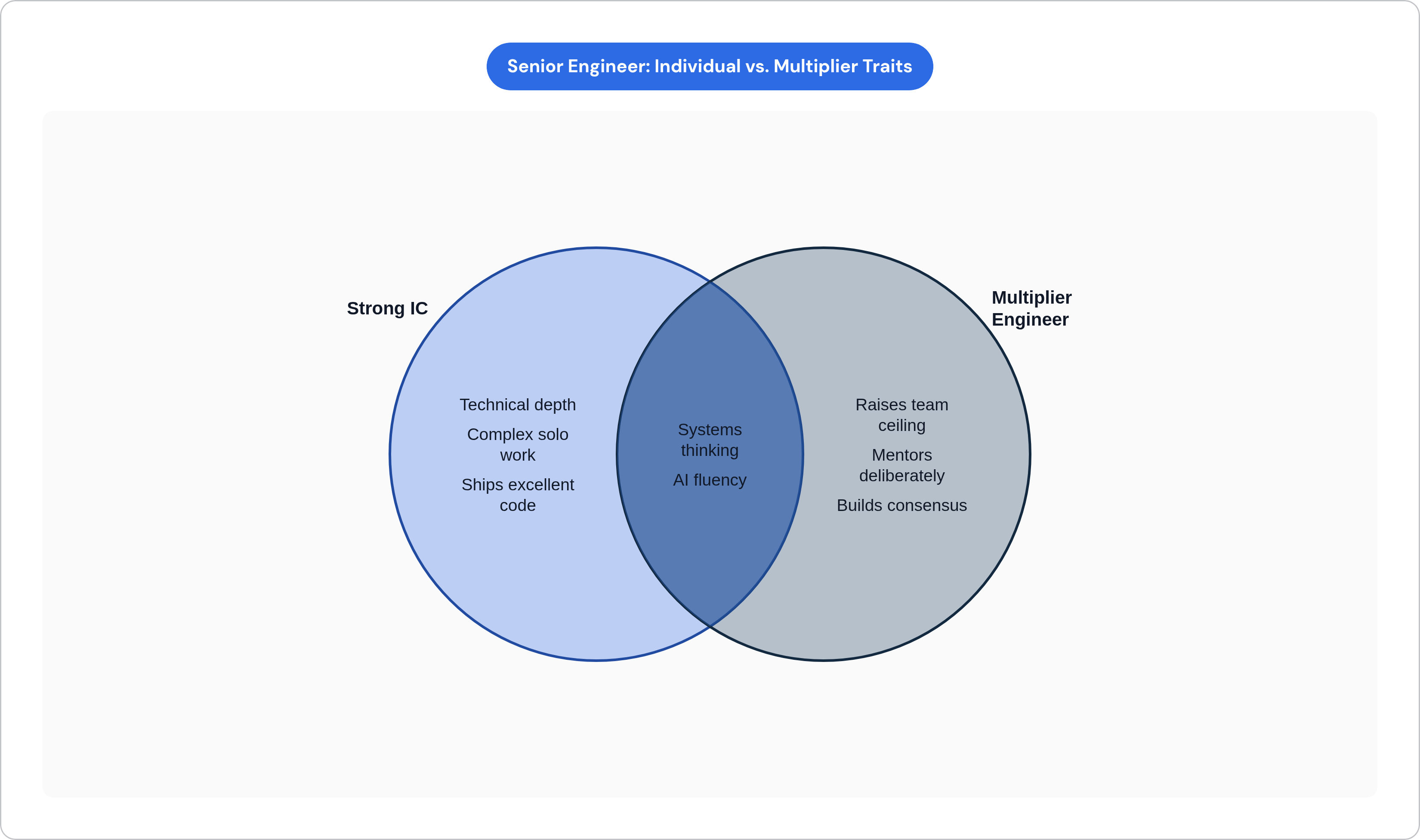
Technical depth is table stakes: understanding why a design works, not just that it does. Systems thinking comes next, tracing how a decision in one service ripples into three others six months out. The trait everyone skips is multiplication, whether someone's presence on a team makes the other engineers measurably better at their jobs. That third trait is the real dividing line. Plenty of strong individual contributors hold enormous complexity in their heads and ship excellent work solo, but fewer can explain a hard trade-off clearly enough that a mid-level engineer walks away smarter an hour later. Confusing the two is how a team ends up with five brilliant ICs and nobody who raises the group's ceiling.
Some of this shows up before the interview even starts. Listen to how a candidate describes past work: outcomes (latency dropped, on-call pages fell, a team shipped faster), or a list of features they personally touched? Watch a take-home unfold, too, since it tells you something similar: clarifying questions first, or straight into implementation without confirming what problem is actually being solved?
A real caution belongs here, and it took me a while to see it clearly. A team stacked entirely with senior engineers, nobody oriented toward pure execution, drifts into endless architectural debate and gold-plated over-engineering. I watched this happen at a twelve-person infrastructure team in 2019, three staff engineers deep into redesigning a queueing system nobody had asked them to touch, while the actual roadmap sat untouched for a quarter. Talented people filled that room, yet no one in it was pushing to ship. Seniority needs balance against a team's actual need to get product out the door, and every question category below assumes that tension is real.
Questions that surface how a candidate makes architectural decisions under real constraints
Asking someone to define CAP theorem tells you they read a textbook once, but it tells you nothing about whether they can reason through a real distributed-systems trade-off with a deadline closing in and half the team out sick. Recall isn't judgment, and judgment is the entire point of hiring someone senior.
Build constraints into the question itself: a small team, six weeks, a legacy service nobody wants to touch, a budget that won't stretch another dollar. Ask what decision they'd make, then push further and ask what they gave up to make it. Listen for humility about the parts they're unsure of, set against overconfidence that waves away every risk as though it weren't there.
A few questions do this reliably: "Walk me through a system you designed that you'd now do differently. What changed your mind?" "You're three weeks from launch and discover a core service won't scale to ten times current load. What do you do?" "How do you decide when a refactor is worth interrupting current delivery for?"
Good answers name the trade-off out loud: we accepted eventual consistency on the read path because the write path had to stay fast, and here's the debt that left behind. Weak answers describe what got built without ever touching why, or recite the textbook-correct architecture as though budget limits and legacy code and a half-staffed team simply didn't exist in their world.
Questions that reveal how a candidate handles technical disagreement and influences without authority
Senior engineers are rarely the most senior person in every room, and the job requires persuading people who don't report to them, usually with no formal authority to lean on when the persuading gets hard.
The pattern worth probing runs both directions. Has this person changed someone else's mind on a technical call, and has someone else ever changed theirs? Try: "Tell me about a time you disagreed with a technical direction your team was already committed to. What did you do?" "Describe a time you were overruled on an architectural choice. How did you handle it afterward?" "How do you get buy-in from engineers who don't report to you?"
The strongest signal I've found, across probably two hundred of these interviews at this point, is a candidate who describes changing their own mind when someone showed them evidence they hadn't considered. It took me several rounds of getting this wrong myself before I learned to listen for the gap between "I was right" and "we made a good decision together." That gap says more about seniority than almost anything else you'll hear in the room. Red flags cluster the other way: every story ends in vindication, no example of disagreement that actually improved the outcome, disagreement recast as personal grievance instead of a technical difference worth having.
This carries extra weight on remote or nearshore teams, where influence happens almost entirely through writing. No whiteboard to gesture at, no hallway chat to smooth things over afterward, so the words on the page have to carry all the persuasion. Can this person build consensus in a Slack thread or a design doc comment without ever standing in the same room as the person they're trying to persuade?
Questions that expose how a candidate thinks about code quality, technical debt, and long-term maintainability
Does the candidate optimize for the next two weeks or the next two years, and more important, do they know which one the moment actually calls for? Junior engineers tend to write for correctness, while senior engineers write for the person who inherits the code eighteen months from now and has never met them.
Good questions here: "How do you decide whether to pay down technical debt now or defer it? What does that conversation with product actually look like?" "What does a PR review from you check for, beyond bugs?" "Tell me about a codebase you inherited in rough shape. How did you approach it?"
Listen for whether they can put a dollar figure or a time cost on debt, alongside the engineering rationale, and for whether they treat PR review as teaching or as gatekeeping. Those are different postures, and only one of them scales.
There's a newer wrinkle worth naming directly, and it's one I had to sit with before I trusted the number. GitHub has reported that Copilot users see a large share of their code generated by the tool. That number changes what a senior engineer's review responsibility covers now, whether anyone's updated the job description to reflect it or not. Asking how someone reviews AI-generated output for maintainability, not just correctness, has gone from an optional probe to close to mandatory.
Questions that reveal how a candidate has developed, mentored, or multiplied other engineers
This is the multiplier test again, from a different angle. The best senior engineers raise the floor for everyone working near them, on top of raising their own ceiling.
Ask for specifics. "Tell me about a junior or mid-level engineer you worked with who grew significantly. What did you actually do?" "How do you handle an engineer who's technically capable but consistently misses the bigger picture?" "What does good onboarding look like to you, and have you ever built it?"
Strong candidates name a real person and describe something deliberate they did, not a vague gesture at being available if asked. Listen for whether they distinguish handing someone an answer from asking the question that leads them to find it themselves; that distinction is most of what mentorship actually is. In augmented team settings, where engineers come in through staff augmentation, this matters even more. Their ability to integrate, and to help new teammates integrate around them, sits close to raw technical skill in importance. Zero examples is the clear red flag, and so is mentorship defined as "I was around if people had questions."
Questions that test how a candidate navigates ambiguity and scope creep at the project level
Senior engineers sit at the boundary between product and engineering more than anyone else on the team. They absorb ambiguity that would otherwise stop the whole group cold, and that absorption is worth testing directly rather than assuming.
Try: "Tell me about a project where requirements changed significantly mid-build. How did you handle the technical side and the stakeholder side?" "How do you tell a non-technical stakeholder about a timeline slip, especially when the cause is debt you inherited and didn't create?" "When should an engineer push back on a feature request, and how do you do it without torching the relationship?"
Strong answers protect the team without hiding bad news from the people who need to hear it. They translate technical constraint into language a product manager can actually act on, and they show a clear sense of when to escalate versus when to just absorb the hit and keep moving. Here's one clean tell I only picked up on after watching enough of these go sideways: ask what "done" means on a complex project. Engineers who say "code complete" are thinking about a smaller job than engineers who mention stakeholder alignment, documentation, and knowledge transfer in the same breath.
How to structure the interview format so these questions actually generate signal
High-pressure formats measure stress tolerance more than judgment, and for senior candidates the two often run in opposite directions. The best architectural thinking shows up when someone slows down, not when they're rushed through a whiteboard sprint with a clock ticking down in the corner of the room.
Sequencing helps. Start with a technical design question, which carries lower emotional stakes. Move into conflict or disagreement territory next, which asks more of someone interpersonally. End with mentorship and ambiguity questions, since those require a kind of self-awareness that's easier to access once someone's warmed up.
Format matters as much as sequence. Live coding measures speed under pressure, useful but incomplete on its own. Take-homes tend to be more diagnostic for senior roles, because they reveal how someone structures an ambiguous problem and explains the decisions behind it without a clock forcing shortcuts. A portfolio walk-through, where the candidate talks through their own past work, surfaces real ownership and reflection in a way neither format quite matches.
For roles where the stakes justify it, a short paid trial project is the most accurate signal available. It shows whether this person actually integrates with how the team works day to day, beyond how they perform in a room for an hour. Run the behavioral interview, covering collaboration style, how someone takes feedback, general work ethic, as its own session, separate from the technical one, so neither read contaminates the other. Put a peer-level engineer on the panel too, not just hiring managers. Senior candidates often reveal more when the person across the table can push back at the same technical level they operate at.
How AI fluency has added a new evaluative dimension for senior engineers in 2025
The baseline moved fast, faster than most hiring processes have caught up to. Per the Jellyfish State of Engineering Management 2025 report, based on a sample of 645 respondents, nearly 90% of engineering teams now use AI coding tools, up from 61% the year before. AI fluency stopped being a differentiator sometime in the last eighteen months, and its absence is turning into a liability instead.
For a senior engineer, fluency means something specific. Can they spot the moment an AI suggestion quietly introduces architectural drift that won't surface as a bug for months? Do they review AI-generated code with the same skepticism they'd apply to a junior's pull request, or wave it through because it compiles clean, and can they judge, task by task, when AI acceleration is worth the risk and when it isn't?
Useful questions: "How has using AI coding tools changed the way you review code?" "Tell me about a time AI-generated output took you somewhere you wouldn't have gone on your own, good or bad." "How do you decide what to hand to an AI tool versus reason through yourself?"
The judgment being tested here cuts both ways. An engineer who distrusts AI tools entirely and refuses to touch them leaves real productivity on the table, while one who defers to AI output without question skips the exact oversight step their seniority exists to provide in the first place. Labor economists working with Anthropic project that roughly a third of current white-collar coding tasks will be automated or restructured within five years. The engineers worth hiring now can guide and vet that transition, with the judgment to know when to trust the output and when to override it.
What the full picture of a senior-engineer evaluation looks like when these dimensions are combined
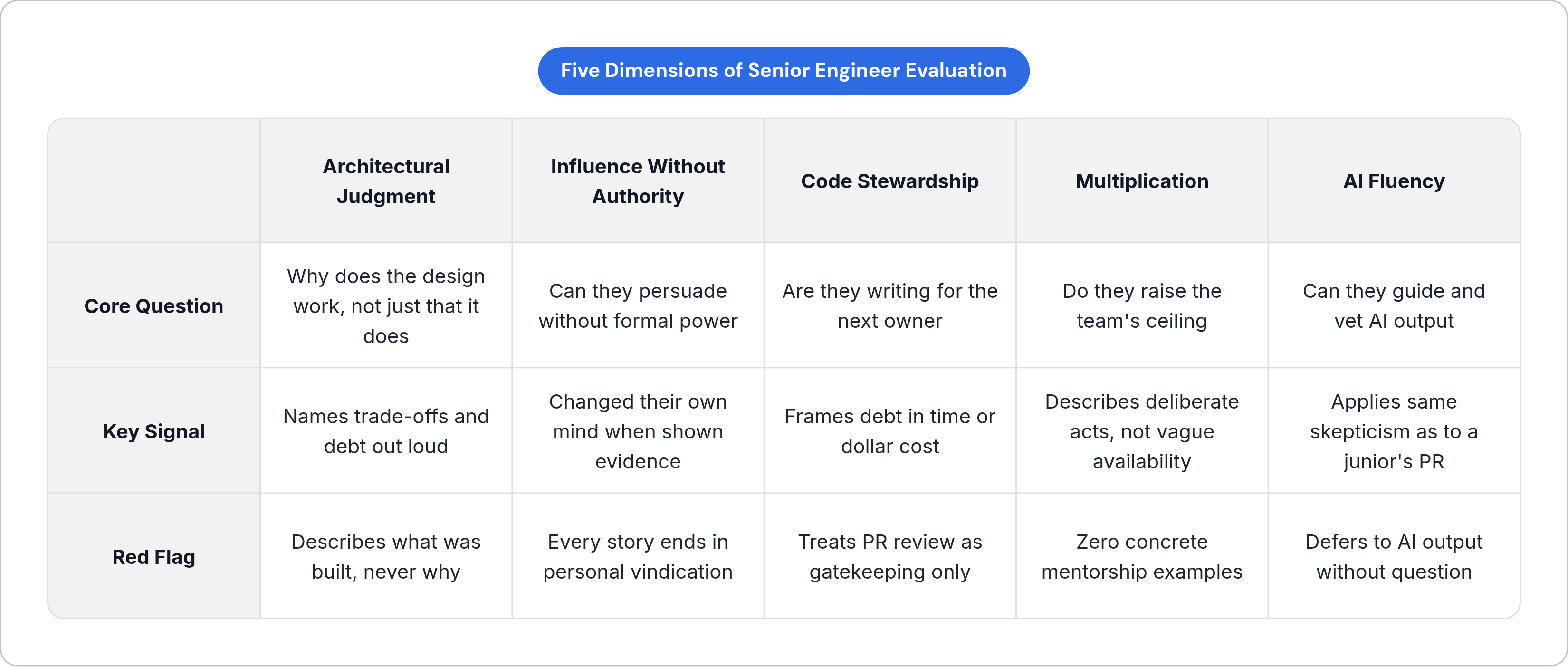
No single question, and no single dimension, is enough on its own. A candidate who nails every architecture question but shows zero mentorship instinct carries a different kind of risk than one who communicates beautifully but goes soft the moment you push on technical depth. Treating either as a clean pass is a mistake I've watched panels make more than once, usually in a hurry to fill a seat before the requisition expires.
Score each dimension separately first: architectural judgment, influence, code stewardship, multiplication, ambiguity management, AI fluency. Synthesize into an overall read only afterward. Combine too early, and one dazzling answer creates a halo that papers over real gaps everywhere else.
Underneath all of this sits a sharper question than the one most interviewers actually ask, and it's one I had to learn to ask myself before I trusted it in a panel setting. "Would I enjoy working with this person" is pleasant, and beside the point. "Would this person make my team better" is the one that should carry the weight, and most panels give it far less than it deserves.
Context shifts the target, too. A senior engineer joining a Series A startup needs a different mix of judgment than one joining a regulated enterprise with compliance baked into every deploy. The question set should flex to match, rather than get stamped identically across every role labeled "senior" regardless of what the role actually demands.
What follows from all this is a vetting standard, not a hiring tip. Rigorous evaluation at the senior level protects the codebase, the culture, and the trajectory of every engineer who works alongside that person for years afterward. Whether an engineer joins through staff augmentation or comes in as a direct hire, the same framework, applied with the same rigor, separates placing engineers who are genuinely senior from placing engineers who've simply been doing this a long time.