Candidate Experience as a Competitive Differentiator
Hiring speed and process transparency matter more than you think in winning technical talent.

The most common failure modes aren't exotic. They repeat across startups, mid-size companies, and enterprises with remarkable consistency, and they're almost entirely structural.
The application stage has become, functionally, a silent rejection machine. Automation has made top-of-funnel screening more aggressive, and most rejections now occur before any human contact. For the candidate, this means the application experience largely defines their entire impression of the company. A form that doesn't render on a smartphone, followed by an automated rejection with no rationale, has already communicated something about your organization's internal standards. Most applicants are applying via mobile, on job boards and portals built for desktop and never meaningfully redesigned. That gap isn't subtle. It's simply unexamined.
Communication failure is what candidates cite most consistently, and the data doesn't soften it. Roughly two-thirds of candidates report not receiving consistent communication throughout the process. Nearly half say poor communication alone would cause them to withdraw, before any other variable enters the picture. Ghosting after an interview has become widespread; Greenhouse data indicate it worsened across a two-year span. This isn't merely a courtesy problem. It's a conversion problem, a predictable and self-inflicted one.
Speed compounds everything. Most candidates expect scheduling within the first week of initial contact. The actual average process for senior technical roles stretches well beyond that, during which competing offers close and candidates make decisions without waiting. Time-to-fill isn't just an HR metric. Every organization I've watched underperform in technical hiring was treating it as one, measuring it in isolation rather than against what the market was doing in parallel.
Late-stage compensation misalignment deserves its own category, because it's routinely misread as a negotiation failure when it is, in practice, a design failure. Roughly 47% of job seekers now expect salary ranges in postings. When compensation surfaces only at the offer stage, candidates don't interpret this as standard practice. They interpret it as deliberate withholding, and the offers it costs are rarely examined honestly for what they actually represent.
The Tech and SaaS sector's specific vulnerability to candidate withdrawal
Here is the finding from Starred's benchmark research that should reframe how technical hiring leaders think about their pipelines. The Tech and SaaS sector records a positive candidate Net Promoter Score overall, yet also carries the highest candidate withdrawal rate, well above the cross-industry average of 13.5%. Engineers, on balance, don't dislike the companies interviewing them. They leave the process anyway.
Withdrawn-candidate feedback explains the mechanism. Engineers aren't withdrawing because they soured on a company; they're withdrawing because another company moved faster and gave them a reason to stop waiting. There's a meaningful difference between those two diagnoses. Conflating them produces the wrong solution reliably.
The strategic implication is direct. The goal isn't to become more appealing in the abstract. The goal is to be faster and more decisive. In markets with high competitive density for technical talent, the cost of a slow process is asymmetric. You lose the time, and you deliver the candidate to whoever moved first. A fast, well-structured hiring loop is a competitive capability, not an administrative convenience, and the companies winning this competition have already internalized that distinction.
How structured interviews and perceived fairness change the outcome
Despite substantial and consistent evidence in their favor, structured interview processes are used by only about two-thirds of employers, per 2024 CandE benchmark research. The remaining third is leaving a proven lever untouched, in plain sight of the data.
Companies that CandE recognizes for strong candidate experience show a 36% higher assessment perception of fairness and a 21% higher interview perception of fairness compared to all other companies. These aren't marginal differences, and for engineers specifically, perceived fairness carries weight that goes beyond general sentiment. A rigorous, consistent technical evaluation signals that the team values craft and demonstrated ability over credentials and familiarity. Anyone who has spent a career in environments where informal networks shaped outcomes more than actual skill knows what it means to finally encounter a process that is visibly meritocratic. That process is itself a competitive signal, before a single offer is made.
Structured processes also reduce interviewer variance, a practical reliability benefit that rarely gets named directly. A strong candidate screened out by an inconsistent panel is a loss that appears in no report. It simply disappears.
Structure without warmth or explanation can feel bureaucratic, and that's its own problem. A scoring rubric administered without any human acknowledgment of the candidate's experience isn't what the evidence supports. The goal is consistency plus transparency — a technical interview that is simultaneously rigorous and fair, where the interviewer can explain why the evaluation is structured the way it is. Candidates are reading that explanation carefully. Some of them are deciding, in that moment, whether they want to work for you.
What the referral multiplier reveals about the downstream value of a good hiring experience
The 2024 CandE benchmark research is specific. Organizations recognized for strong candidate experience show a 56% higher willingness-to-refer rating, with an NPS of 23 compared to 13 for all other companies in North America. Referrals account for 20% to 40% of total hires at most companies, a channel that is simultaneously lower-cost and higher-quality than cold sourcing. That channel is seeded directly by how the process treats people.
The more instructive finding involves rejected candidates. A person who didn't receive an offer but experienced transparency and respect throughout the process still generates referral behavior. The candidate who got the clear decline, with timely communication at every stage, still talks to their network. This effect is durable, and it compounds over time in ways that are real but rarely traced back to their origin.
The inverse is equally durable. A poor experience generates public reviews on platforms that carry genuine weight in employer brand research. In a market where employer brand is as visible as product reputation, a pattern of negative candidate reviews compounds into a recruitment liability that eventually shows up in offer acceptance rates and sourcing costs. The ROI calculation for candidate experience investment should include referral pipeline value and employer brand protection as line items, not as afterthoughts appended when budgets get reviewed.
Where AI-assisted recruiting helps and where it creates new trust problems
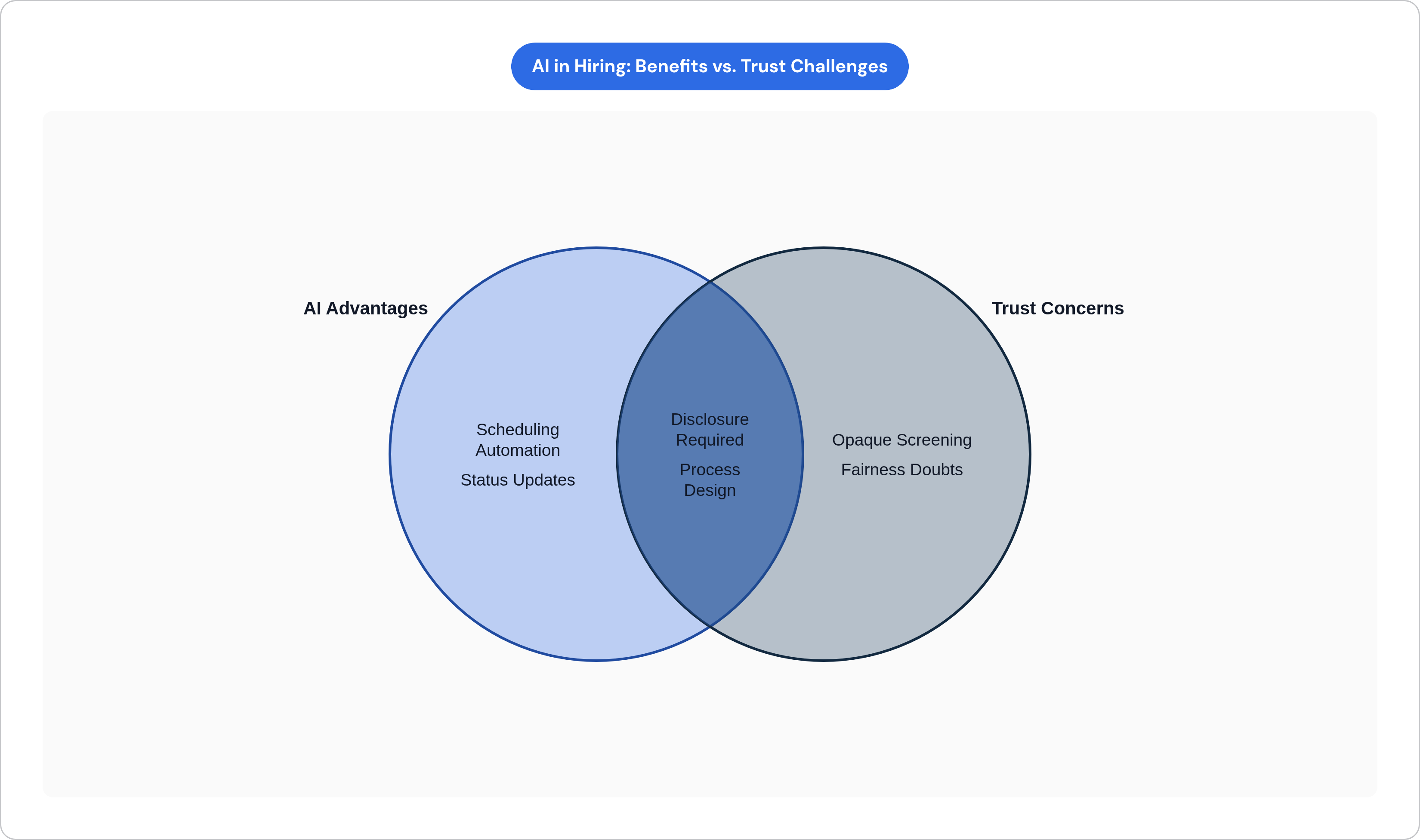
Approximately 19% of employers were using conversational AI chatbots in hiring workflows as of 2024. Adoption is growing, but this remains a minority practice. Most companies are still evaluating these tools rather than running them at scale, which means the lessons from early adopters aren't yet widely applied.
Where AI genuinely improves candidate experience is precisely where current processes fail most visibly — faster application acknowledgment, consistent status updates, scheduling automation. These are the communication gaps that appear in every survey of candidate complaints. AI addresses throughput and velocity, and both are worth solving.
The trust problem is equally real, and it doesn't cancel the throughput benefit so much as sit alongside it, requiring careful navigation. Only a minority of applicants trust AI to evaluate them fairly in hiring, per Gartner research. AI-assisted screening, when undisclosed or unexplained, actively damages the perception of fairness that structured interviews are designed to build. You can't construct a fair-feeling process on one side while running an opaque automated filter on the other and expect candidates to miss the tension.
The practical resolution isn't to avoid AI; it's to be deliberate about where it appears and to say so plainly. AI handles throughput and communication velocity. Human judgment handles evaluation and explanation. For technical candidates in particular, opaque automated screening reads as a cultural red flag. Engineers who work with AI systems daily recognize poorly deployed automation when they encounter it in a hiring flow. They read it as a signal about the team's technical judgment, because it is.
What this means for teams that hire through staff augmentation or nearshore partners
When a company hires through a staff augmentation or nearshore partner, a meaningful portion of the candidate experience shifts to that partner before the client ever enters the picture. The initial screening, vetting, and communication all happen upstream. The provider's process quality is a direct extension of the client's employer brand, whether the client treats it that way or not. Candidates who move through a poorly run screening experience arrive at the client already carrying an impression, regardless of how well the client's own process is designed.
Talent Board research associates strong candidate experience programs with a 70% improvement in quality-of-hire outcomes. That figure is only reachable when the full pipeline, including the partner's end, is built well. A partner who moves fast but treats candidates carelessly is delivering a liability that looks like efficiency until it shows up somewhere you'd rather it didn't.
What to evaluate in a partner's vetting process isn't complicated. Look for transparency to candidates about evaluation criteria, fast turnaround at each stage, structured technical assessment with clear criteria, and consistent communication throughout. These are the same criteria that apply to any direct hire process, applied one layer upstream.
BairesDev's model illustrates what this looks like in practice. Their process screens to the top tier of available technical talent, assessing English proficiency and technical depth before any candidate reaches a client. Candidates move through a multi-stage process with clear expectations at each step. The client receives pre-vetted engineers rather than a raw shortlist requiring a full additional evaluation cycle, and the candidate arrives having experienced a process that treated their time as something worth respecting.
The timeline advantage is real but conditional. A quality augmentation partner can surface pre-vetted candidates within days, compared to the weeks a traditional direct hire process typically requires. That speed is only an advantage if the candidate experience during the compressed window is strong enough to sustain engagement. Acceleration through a broken process doesn't fix it; it just shortens the distance to the same outcome.
Building a hiring process that engineers actually respect
Every friction point in the hiring process is a signal the candidate is actively reading. The process communicates values whether you intend it to or not.
Disclose compensation ranges in the job posting. Nearly half of candidates now expect this, and late disclosure costs offers while communicating something the company almost certainly didn't intend.
Schedule within the first week of initial contact. In a market where most competitors are slow, speed is genuine differentiation. It requires internal coordination that most organizations haven't built, which is exactly why it works.
Use structured interview formats consistently. The fairness perception gap between companies that do and those that don't is substantial and measurable. For engineers, that gap carries particular weight because it speaks directly to how the team actually values technical craft, as opposed to how it describes valuing it.
Communicate at every stage, including rejection. The referral and employer brand effects of a respectful, timely decline are real and they compound. The candidate who received a clear explanation of why they weren't selected isn't a closed chapter. They're a potential referral source, a future applicant, and someone who talks to other engineers.
Be transparent about where AI is used in the process. An engineer who discovers automated screening after the fact doesn't conclude the company is efficient. They conclude the company was withholding information, and that conclusion travels.
The hiring process isn't separate from engineering culture. It's the first chapter of it. Companies that consistently attract strong engineers have already decided what they value before the first interview question is asked, and have built a process that demonstrates those values rather than merely stating them. Where stated values and observable process diverge, candidates notice quickly, and they interpret the gap correctly. For companies hiring through nearshore or augmentation partners, this extends without exception — evaluate the partner's candidate experience with the same rigor applied to their technical assessment. The engineer who arrives carrying a poor first impression of how the process was run doesn't leave that impression at the door.