Skills Assessment Tools for Technical Candidate Screening
Use signal quality, not feature lists, to choose the right technical screening tool.

The core function of a technical screening tool is straightforward — evaluate a candidate's technical ability early in the hiring pipeline, before any interviewer time is committed. These tools exist at the top of the funnel. They're filters, not replacements for human judgment, and treating them as anything more misuses the category.
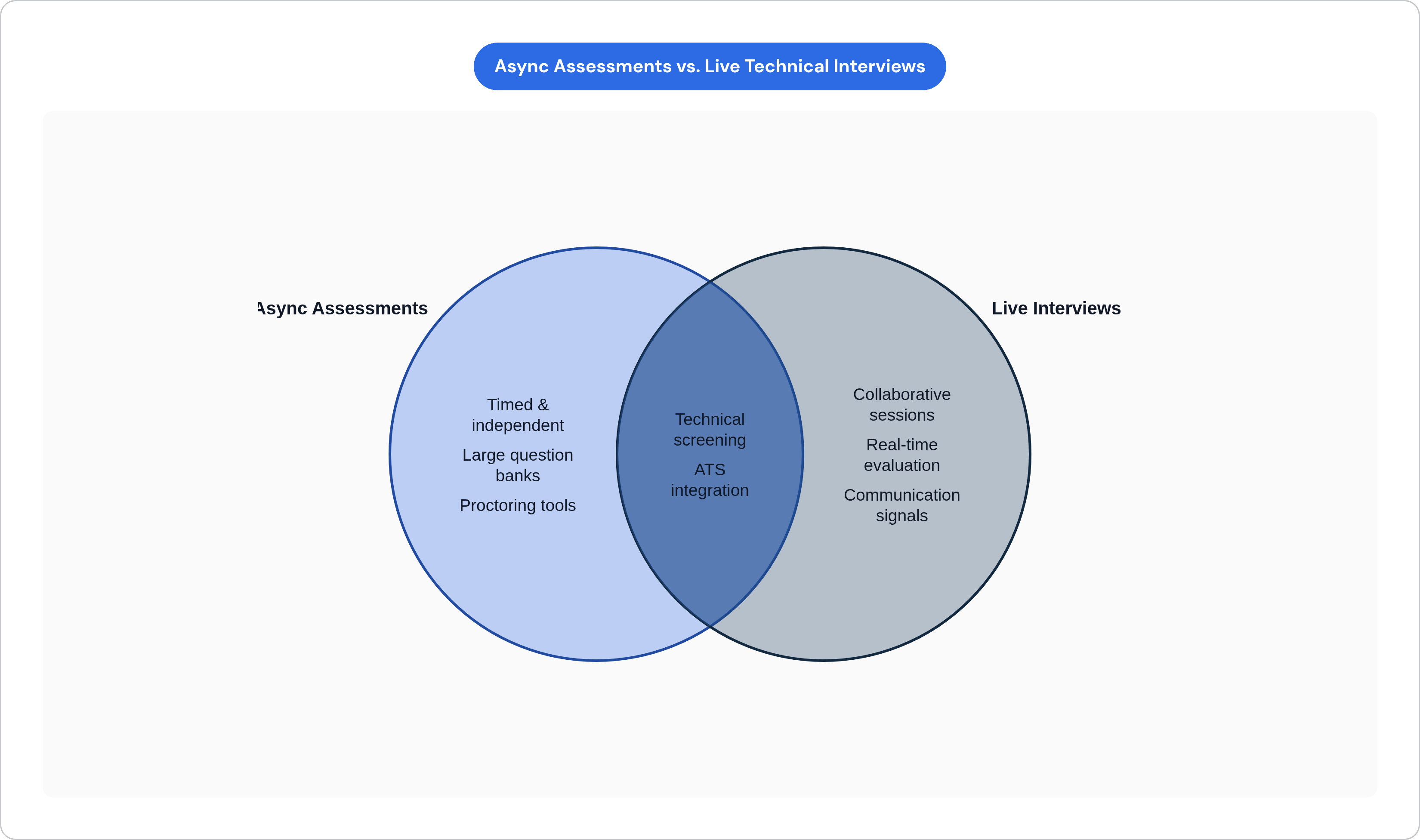
Most platforms fall into one of two families. Asynchronous assessment platforms have candidates complete structured tasks independently, usually timed and completed without a live evaluator present. Live technical interview platforms run collaborative sessions in real time, typically inside a shared coding environment. Both serve legitimate purposes, and the best hiring pipelines use both, sequenced deliberately: automated assessment for initial screening, structured live evaluation for final rounds. This is not an either/or architecture. It's a complementary one.
The category is mature enough now that feature lists across platforms have converged substantially. That convergence is precisely what makes surface-level feature comparison an unreliable basis for selection.
The Signal Problem: Why Feature Count Is the Wrong Way to Compare Platforms
Here is something that took me longer to fully accept than it should have — a platform advertising 200,000 questions in its bank is not automatically better than one with 36,000. I watched hiring teams spend real money on the larger catalog and walk away with weaker predictive data than they had before. Volume does not determine signal quality. The real question is whether a given tool produces meaningful signal about actual engineering ability, or whether it produces noise that resembles signal long enough to influence a hire.
Most platforms advertise similar capabilities at this point: large question banks, multiple language support, proctoring infrastructure, role-based test libraries, ATS integration. These are table stakes. Their presence doesn't distinguish a platform; their absence is a red flag, but their presence alone tells you very little.
The trap in feature-led evaluation is that teams end up optimizing for test completion rates, candidate experience scores, or interface aesthetics, while the underlying assessment produces weak predictive validity. Those metrics aren't worthless, but they're downstream of signal quality, not upstream of it. What follows applies that reframe as its primary lens.
What High-Signal Assessments Actually Measure
Not all assessments earn their predictive validity. The ones that do share specific properties, and identifying those properties is more useful than comparing feature lists.
Process, Not Just Output
A coding challenge that only evaluates whether a candidate produced a correct answer reveals comparatively little. High-signal assessments capture how a candidate thinks — the structure of their approach, how they handle edge cases, whether they reason through failure states. Engineering judgment lives in the process, not the product.
Real-World Task Fidelity
The closer an assessment mirrors actual day-to-day engineering work, the more predictive it is. Algorithmic puzzles disconnected from production code can identify candidates skilled at a narrow kind of problem-solving without revealing much about their ability to contribute to a functioning codebase. CodeSignal has built its orientation explicitly around practical coding ability rather than abstract puzzle-solving, which reflects a substantive philosophy about what employers are actually hiring for. CodinGame takes a different approach — its game-based format spans 60 technologies and achieves a 97% completion rate across its challenge library. That figure matters because a test a candidate abandons before completing produces no signal whatsoever.
Difficulty Calibration and Coverage
Tests that distinguish junior from senior performance require multiple difficulty tiers, not a single bar that filters broadly. Adaface covers more than 500 skill tests across cognitive, language, and personality dimensions. HackerEarth offers 36,000 coding questions organized into role-based assessments. Breadth alone, however, doesn't determine signal quality. What matters is whether the questions assess what they claim to assess, what researchers call construct validity, even though most platform marketing never uses that term.
One finding from the skills-hiring literature is worth examining critically: 94% of companies report that skills-based hires outperform those chosen by degree or experience. That figure is only meaningful if the assessments behind those decisions are actually measuring skill. A low-fidelity test still technically qualifies as "skills-based." The statistic depends entirely on the quality of the instruments producing it.
Integrity Infrastructure and Why It's Harder to Build Than Vendors Imply
The foundational integrity problem is simple. A candidate who found the answer before submitting it produces a false-positive signal. The platform records a passing score. The company makes a hire based on data that never reflected genuine ability.
Standard proctoring now includes webcam monitoring, off-tab detection, and video recording. These are table stakes. The harder and more consequential integrity work happens elsewhere.
Non-Googleable questions, problems specifically designed so that a solution can't be found by searching known databases, represent a genuine investment in signal integrity. Social listening, where vendors actively monitor for leaked questions and retire compromised items, is a real practice at serious platforms. Adaface explicitly surfaces this as part of its integrity methodology. Question freshness should be treated as a continuous operational responsibility, not a periodic cleanup.
The most complicated integrity question in 2026 concerns AI assistance. Candidates using AI coding tools during assessments is now a real variable, not a hypothetical. Platforms that flag all AI use as a proctoring violation are measuring the wrong thing entirely, because AI-assisted coding has become standard in professional engineering work. The relevant question is not whether a candidate used an AI tool, but whether they used it with genuine understanding and technical judgment.
Buyers should press vendors on question bank rotation frequency, the process for identifying and retiring leaked items, and how the platform distinguishes between candidates who understand the material and those who have simply encountered the question before. These answers reveal how seriously a platform treats the integrity of the signal it sells.
AI Fluency as a Screening Dimension That Most Tools Haven't Caught Up to Yet
I've watched this shift happen faster than anyone anticipated. By 2026, every engineering team I know treats AI fluency as a baseline expectation. Vibecoding — directing an AI model in natural language to generate software, reviewing and critiquing the output, refining prompts iteratively — is now an assessable and valued engineering skill. Most assessment platforms are not built to measure it.
The gap is structural. Most platforms were designed around one assumption — the candidate writes code from scratch, and the platform evaluates what they produce. That design philosophy doesn't translate cleanly to evaluating how well a candidate collaborates with an AI tool. A rigorous assessment of AI collaboration would need to measure the quality of prompt construction and refinement, the candidate's ability to evaluate and critique AI-generated code rather than accept it uncritically, and the judgment to know when AI assistance introduces more risk than it removes. Very few platforms have built this capability in any rigorous form.
The practical consequence is direct. Treating AI-assisted performance as a proctoring violation while simultaneously failing to assess AI collaboration skill leaves a real gap in hiring signal. The strongest engineers in 2026 score worse on legacy assessments than their actual ability warrants, precisely because those assessments penalize the workflow patterns that define modern, high-performing engineering.
How Objectivity Claims Hold Up Under Scrutiny, and Where Bias Still Enters
The legitimate case for skills-based screening rests on something real. Standardized assessments applied consistently reduce the influence of unconscious bias compared to unstructured interviews. This is not marketing language. It reflects decades of structured selection research demonstrating that unstructured human evaluation introduces systematic distortions based on factors unrelated to job performance.
Platform-adjacent research reports that 90% of companies see fewer hiring mistakes after adopting skills-based screening. The directional claim is consistent with the broader literature, even if the specific figure warrants scrutiny given its provenance.
Where bias re-enters is through design choices that rarely appear in marketing materials. Who built the questions, and whose definition of "good code" is encoded in the rubric, is a real variable. Cut-score calibration, where the pass threshold is set and whether it's been validated against actual job performance data, introduces another. Platforms that weight speed heavily inadvertently disadvantage candidates for whom rapid test-taking is culturally unfamiliar, or for whom English-language comprehension of the prompt introduces latency unrelated to technical ability. Using an algorithmic coding challenge to screen for a role that is primarily systems architecture or code review introduces assessment type mismatch, a form of bias that produces false negatives at scale.
A well-designed assessment reduces certain categories of bias while potentially introducing others. The tool is only as fair as the design choices behind it.
A Practical Framework for Evaluating Platforms Before Purchasing
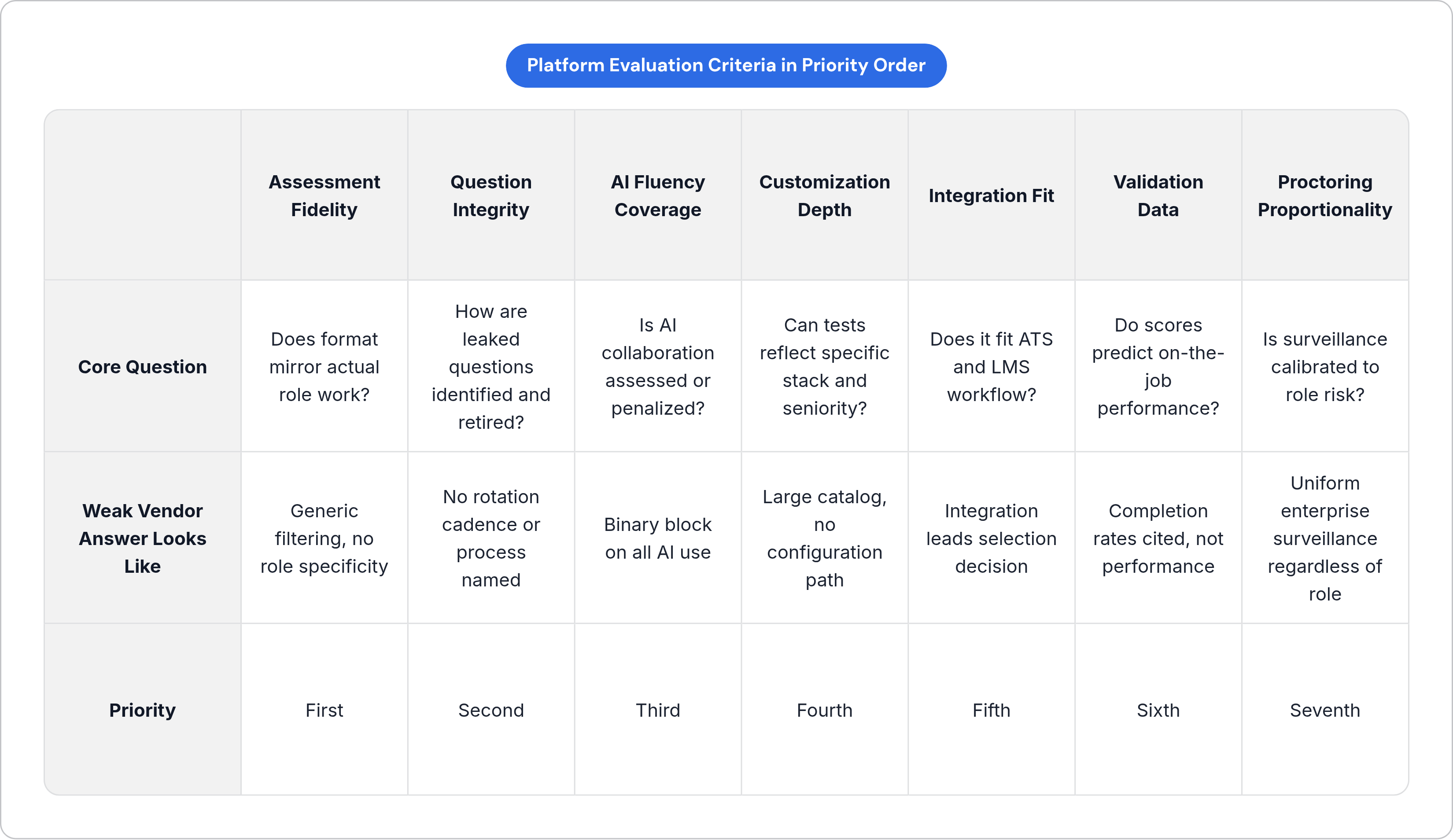
Seven criteria, applied in sequence, produce a defensible platform selection. Start with what the tool measures, then how it measures it, then how it fits the workflow. Reversing this order is how teams end up selecting platforms for integration convenience and discovering later that the underlying assessments don't predict performance.
Assessment fidelity. Do the test formats mirror the actual work of the role being hired for? A platform that can't answer this question specifically, for the specific role in question, is a generic filter, not a targeted signal.
Question integrity. How frequently is the question bank refreshed? What is the vendor's process for identifying and retiring leaked or AI-searchable questions? Weak answers indicate a platform harvesting completion data without protecting the predictive validity of the scores it reports.
AI fluency coverage. Does the platform assess how candidates work with AI tools, or does it treat all AI use as disqualifying by default? A platform without a considered position on this question is operating with an outdated model of what engineering work looks like.
Customization depth. Can assessments be configured to reflect the specific stack, seniority level, and role profile? WeCP's question bank spans more than 200,000 items across 2,000 technology skills and job roles, which is meaningful breadth. The relevant question is whether that breadth can be configured or whether buyers are navigating a large undifferentiated catalog. TestGorilla's library of more than 150 pre-built tests and HackerEarth's role-based assessment structure represent different philosophies — template-first versus role-first. Neither is categorically superior. The right choice depends on how standardized the hiring team's role definitions are.
Integration fit. Seamless ATS and LMS integration matters for workflow efficiency. It belongs fifth on this list, not first. Integration convenience should never drive platform selection before signal quality is confirmed.
Validation data. Can the vendor provide evidence that assessment scores predict on-the-job performance, not merely test completion rates? This is the hardest question to answer well, and the vendors who answer it have done the most rigorous work.
Proctoring proportionality. Is the proctoring stack calibrated to the actual risk profile of the role and hiring context, or is enterprise-level surveillance applied uniformly regardless of context? Proportionality matters for candidate experience, and it also matters for avoiding the false precision that comes from treating all assessment environments as equivalent security threats.
Where Human Judgment Stays Irreplaceable in a Tool-Assisted Pipeline
Technical screening tools answer one question well — does this candidate clear a technical threshold that warrants further investment of interviewer time? That is genuinely valuable. It's not the only question that determines whether a hire succeeds.
What screening tools can't reliably assess: how a candidate communicates under deadline pressure, whether their collaborative instincts fit the team's working style, how they behave when requirements change mid-project, and whether their values align with the engineering culture they would be joining. These are not peripheral concerns. They determine whether a technically qualified candidate becomes a productive contributor or an expensive misfit.
The hybrid model is not a compromise. It is the architecture of a well-functioning pipeline. Automated assessment narrows the field efficiently and consistently. Structured live evaluation examines what asynchronous testing cannot reach. For distributed and nearshore team contexts in particular, where screening must be followed by evaluation of timezone alignment, communication fluency, and collaborative working style, the assessment layer is necessary but explicitly preliminary.
The final signal quality check is always human — does this person perform the way the assessment predicted once they're actually on the team? Every organization I know that has closed this loop systematically has improved both its cut-score calibration and its ability to defend selection decisions over time. Building systematic feedback from post-hire performance back into assessment calibration and cut-score validation is how screening processes improve over time. It's also how organizations build a defensible record of whether the tools they're paying for are actually working. Skipping this step does not make the process more efficient. It makes it permanently unaccountable.