Candidate Screening Questions That Predict On-the-Job Performance
Structured interviews with fixed questions predict job performance twice as well as gut feeling.

Most companies hire on gut feeling dressed up as an interview process, and the data on how badly that fails is not new or ambiguous. Structured, competency-based interviews predict job performance at nearly double the rate of the unstructured conversations most hiring managers still default to. The question this piece answers is simple: what separates a screening question that reveals real capability from one that just rewards a candidate who rehearsed well? The answer has a lot to do with discipline: which questions you ask, how you score them, and whether you ever check if the scores meant anything.
Every hiring manager has a story about the candidate who dazzled in the room and fell apart on the job, and the inverse: the quiet one who undersold themselves and turned out to be the best hire of the year. That is a measurement problem. Most screening questions test how well someone performs in an interview, which is a distinct skill from performing in the actual role. Because most organizations still run unstructured interviews, no fixed questions, no shared rubric, no consistent scoring, they are measuring charisma and recall under pressure, not competency. The cost of getting this wrong shows up as recruiting fees sunk twice, months of onboarding that never pays off, a team absorbing the slack, and output that never materializes. Fixing the screen is cheaper than fixing the hire.
What research shows about which interview formats actually correlate with later performance
Predictive validity is the term industrial-organizational psychologists use to describe how well a selection method forecasts future job performance, and it matters more than almost anything else in the hiring conversation, because it's the measure that tells you whether your process works or just feels like it works. An interview can feel thorough, feel warm, feel decisive, and still predict nothing.
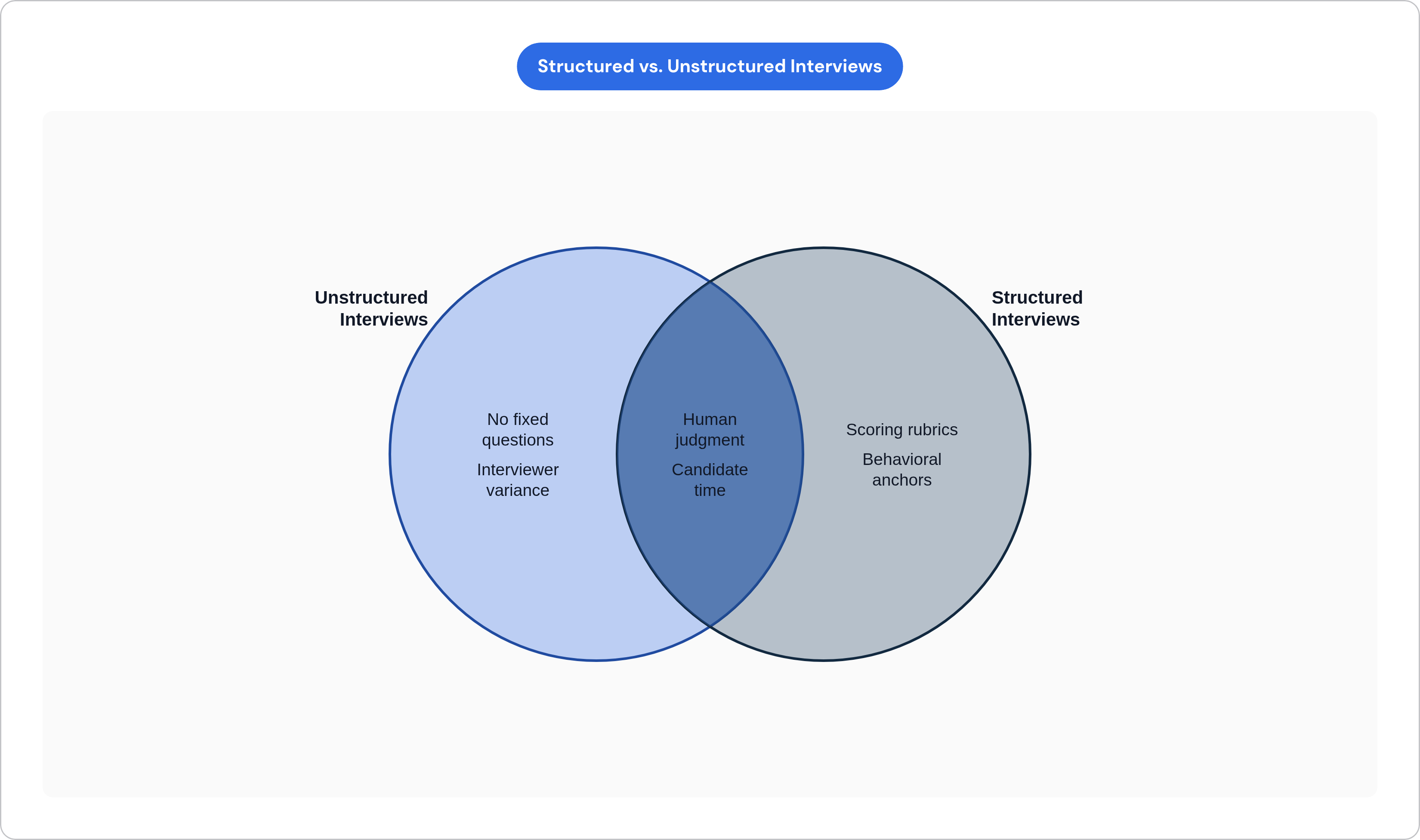
Unstructured interviews, the kind with no fixed question set and no scoring criteria, are the default at most companies, and they are also the weakest predictor of the formats commonly studied. Two interviewers can sit across from the same candidate, ask different questions in different orders, and walk away with wildly different impressions, not because the candidate was inconsistent but because the process was. That variance often signals a broken process more than it reveals anything true about the person in the chair.
Structured interviews close that gap by fixing the questions, fixing the order, and scoring responses against criteria set before the interview starts. This is the single most consistent lever available for improving hiring accuracy, and the format matters just as much as the specific questions you choose. A brilliant question asked inconsistently, scored differently by every interviewer, is not much better than no question at all.
The four question categories with the strongest signal-to-noise ratio
Not every question type carries the same predictive weight. Four categories consistently separate the candidates who will perform from the ones who interview well and then disappear.
Behavioral questions work on the premise that past behavior predicts future behavior better than a hypothetical ever will. "Tell me about a time you missed a deadline" beats "What would you do if you missed a deadline" because the former forces the candidate to reach into an actual memory instead of constructing a flattering hypothetical on the spot. Listen for how the candidate describes their own role versus the team's role, and whether the story lands on a concrete outcome. The weak signal here is a polished, textbook STAR-format answer that sounds rehearsed but goes soft on specifics the moment you ask a follow-up.
Situational and case questions test judgment under constraints pulled from the actual job, not an abstract puzzle. The value lies less in the answer itself and more in the reasoning path the candidate takes to get there, which means your follow-up questions carry as much diagnostic weight as the original prompt. These are especially useful for roles that require cross-functional judgment or prioritizing under ambiguity, situations where there's no clean textbook answer and you're really evaluating how someone thinks when the ground is uneven.
Competency and growth-orientation questions ask how a candidate's approach has changed over time, not what they currently know. This category predicts long-term fit and succession potential better than a static skills test, and it matters enormously in technical roles where the stack shifts every year or two. Someone who can articulate how they've updated their thinking is telling you something a resume never will.
Emotional intelligence and feedback-reception questions reveal coachability and self-awareness, and they matter more on distributed teams, where tone in a Slack message or a written code review carries weight a hallway conversation would otherwise absorb. The strongest candidates name the feedback directly, admit the discomfort honestly, and describe the adjustment they made. The weaker ones reframe the criticism as a misunderstanding, which is its own kind of answer.
Questions that reveal genuine interest and role fit, not just preparation
A candidate who actually researched the company before the call behaves differently after they're hired: faster ramp, better engagement, longer retention. So the goal in screening is to ask something the About page can't answer.
Genuine interest shows up in specificity. Ask what a candidate would want to learn in their first quarter, and you'll often find out fast whether their ambitions line up with what the role can actually offer, or whether they're projecting a job that doesn't exist onto the one you're hiring for. Ask about the constraints of the role, limited budget, a small team, a legacy stack that isn't going anywhere soon, and watch whether they've thought about the tradeoffs or only the upside.
The tell is in the pivot. A candidate who answers "why this company" by circling back to what they personally stand to gain, every single time, with no curiosity about what the team is actually trying to solve, is telling you something important about how they'll show up once the offer is signed.
How async and early-stage screens filter the pool before live interviews begin
A live interview is expensive. It costs the candidate's time, the interviewer's time, and the scheduling overhead of coordinating both, so the job of an async screen is to protect that investment before it's spent.
A short written or video prompt asking a candidate to walk through a recent professional decision shows you communication clarity and technical depth in the same five minutes. Look for logical structure, an honest accounting of tradeoffs, and how they characterize what they didn't know at the time versus what they learned afterward. Candidates who blur that line, who reconstruct the decision as if it were obviously correct from the start, are giving you a hindsight-biased answer, and that's worth noting.
Async formats also test remote-readiness directly. A candidate who can't organize a coherent point in writing or on camera, without someone else in the room to bounce off of, is going to struggle on a team that runs on Slack threads and recorded standups. Practically speaking, scheduling friction kills a real chunk of your pipeline before you ever get to the interview; async formats let candidates respond on their own clock, which cuts that drop-off meaningfully.
Structuring the scoring rubric so two interviewers reach the same conclusion
A question without a rubric functions more like a vibe check than an assessment.
Per-competency scoring fixes this: assign each dimension you're evaluating a numerical scale, and define what each point on that scale actually sounds like before the interview happens, not after. "5 = excellent" tells an interviewer nothing. A behavioral anchor that describes what a strong, acceptable, and weak response actually sounds like gives two different interviewers a shot at reaching the same conclusion independently.
Calibration sessions matter here more than most teams realize. Before a hiring cycle starts, have your interviewers score the same practice response and then sit down and reconcile where they disagreed. This single exercise does more to reduce between-interviewer variance than almost anything else in the process. Assign different interviewers to own different competency domains, so no single evaluator is carrying the whole decision on their read of one thirty-minute conversation. Write down the reasoning behind each score too, not just the number, because that written note is what surfaces bias later, when you're doing a post-hire retrospective and trying to figure out what actually went wrong.
Bias shapes hiring decisions more than most managers want to admit. A rubric doesn't eliminate that, but it makes the bias visible enough to correct, which is different from pretending good intentions will handle it.
Where identity verification and fraud prevention fit into the screening sequence
Proxy interviews and digitally altered identities are no longer an edge case in virtual hiring; they're a rising share of what recruiters are running into, and Gartner has projected that a substantial portion of candidate profiles will include fabricated elements within a few years. Directionally, this problem is getting worse, and pretending otherwise is a bet most companies can't afford to make.
The mitigations aren't exotic. Camera-on requirements for live video, identity document verification folded into the async stage, and proctored technical assessments for roles where the stakes justify it. For technical hires specifically, the most reliable defense is a live coding or problem-solving component that resists delegation, because a proxy's performance falls apart fast under real-time probing. Ask a follow-up that requires improvising off the candidate's own code, and someone reading answers off a second screen has nowhere to go.
This matters most for distributed hiring across geographies, where in-person verification was never part of the process to begin with. Building identity checks into the screening sequence is simply what a defensible process looks like now.
How AI-assisted screening tools extend the framework without replacing human judgment
A growing share of companies now use AI somewhere in the screening funnel, mostly for resume review and first-pass skill matching, and the accuracy on that skill-matching layer has gotten genuinely good in vendor studies. But accuracy is only as good as the competency model underneath it. Train the model on a bad rubric and it will make bad decisions faster and at greater scale than a human ever could.
That's the actual risk: AI screening without a rubric doesn't remove bias, it scales it. Well-designed AI interview tools can cut scoring inconsistency between evaluators compared to a traditional unstructured process, and the mechanism is exactly what a manual rubric does: standardization. That's the case for using these tools, and it stops well short of handing them the final call.
A meaningful share of recruiters override AI recommendations, and that's not inherently a problem; human judgment should have the last word. If those overrides aren't logged and reviewed, though, the same pattern bias the rubric was supposed to catch slips back in through the side door. Organizations that pair predictive analytics with a genuinely structured process report better hiring outcomes and lower regrettable turnover than teams relying on either approach alone. What AI still can't do reliably is infer culture fit, read motivation under real probing, or evaluate why someone actually made the career decisions they made. That's still a human job, and it's likely to stay one.
Adapting screening questions for distributed and nearshore engineering teams
For a distributed team, communication is job-critical, and it belongs in the rubric with the same weight as system design or code quality.
Ask how a candidate documents decisions when nobody's in the room to explain the context later. Ask how they flag a blocker when the team lead is offline in a different time zone. Ask directly about their experience working across time zones: candidates who've actually done it will describe the friction honestly, the missed handoffs, the three-day delay on a one-line question, while candidates who haven't tend to wave the problem away as something Slack will solve.
For nearshore engagements specifically, cultural fluency reduces the miscommunication overhead that quietly inflates the real cost of an offshore arrangement long after the contract is signed. A question that asks a candidate to describe navigating a cultural difference in a past collaboration is worth the interview time it takes.
The async component in the screening process itself doubles as a filter and a rehearsal, too. Candidates who take it seriously, who write clearly and think out loud in a structured way without someone coaching them through it live, tend to be the ones who integrate well once they're actually on a distributed team. Identifying the top tier of available engineers means evaluating not just technical depth but seniority-level communication, timezone adaptability, and the ability to slot into a client's existing workflow from day one. Those are the same competency dimensions this entire framework is built around, applied at the scale a nearshore staffing model actually requires.
Measuring whether your screening questions are actually predicting performance
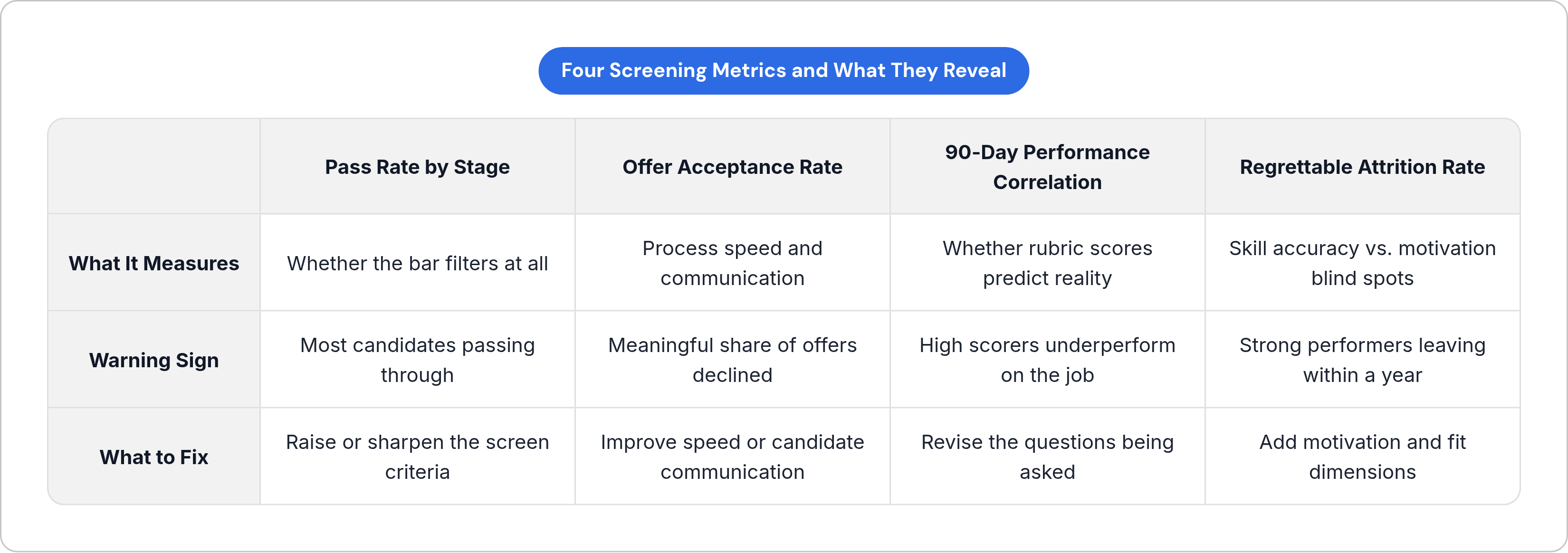
A screening process with no outcome tracking is a hypothesis nobody ever bothers to test. You wrote the questions, built the rubric, ran the interviews, and then just trusted it worked, which is hope with a process document attached.
Four metrics close the loop. Pass rate by stage tells you if your bar is set correctly: if your technical screen waves through the large majority of candidates, the bar is too low to be doing any filtering at all. Offer acceptance rate tells you something different: if a meaningful share of your offers get declined, that's usually a signal about process speed or communication breakdown, not candidate quality. Ninety-day performance correlation is the one that actually validates the rubric: do the candidates who scored highest in the interview actually perform best once they're on the job? If the answer is no, you're asking the wrong questions. Regrettable attrition rate catches what competency scoring alone misses: if your strongest performers on paper are leaving within the year, the process may be accurate on skill and blind on motivation or fit.
Run a retrospective after every hiring cohort. Compare the rubric scores against manager assessments at the ninety-day mark, and you'll find out exactly which questions predicted something real and which ones just felt good to ask in the room. This is the step most companies skip, and it's the one that compounds. Teams that build this feedback loop get measurably better at hiring with every cycle, while teams that skip it just repeat the same mistakes against a fresh set of candidates, year after year, and call it bad luck.
Structured questions, an honest rubric, and outcome tracking form an ongoing operating habit rather than a one-time project, and that habit is what separates the teams who consistently hire well from the ones who keep hiring hopefully.