Sourcing DevOps and Platform Engineers in a Shallow Talent Market
Cloud demand has outrun DevOps supply, and sharper role definitions help.

That growth curve alone would explain some hiring pressure. The deeper issue runs beyond demand outpacing supply in the usual cyclical sense: 94% of enterprises now run some form of cloud infrastructure. The need for people who can build and operate it has gone from a specialty function to a near-universal requirement https://www.kore1.com/hire-devops-engineers-2026-guide/. Supply never made that same jump.
The mismatch is about what the job demands. It is about what the job demands. Most CS curricula still treat infrastructure, security, and software delivery as separate electives, if they touch them at all. So the people who end up qualified for this work got there through years of on-the-job exposure, not through a degree program built for the role. That means the supply of qualified candidates grows slowly, no matter how fast demand grows, and it means the shortage is not a temporary market condition that better recruiting budgets will fix. It is closer to a permanent feature of the field, at least until training pipelines catch up to what the job has become. The global DevOps market reached approximately $15–16 billion in 2025, driven by cloud adoption, containerization, and continuous deployment demand, and Gartner projects 80% of organizations will adopt DevOps platforms by 2027. 94% of companies report struggling to find qualified DevOps talent, a shortage that is pervasive rather than isolated to a few industries.
How role fragmentation multiplies the sourcing problem
A single job title used to mean one thing. Not anymore. A "DevOps engineer" posting in 2026 could describe a CI/CD specialist, a platform engineer, a site reliability engineer, a cloud infrastructure architect, or a DevSecOps hire, and each of those carries different time-to-hire, acceptance rates, and salary expectations. Treating them as interchangeable in a job posting will attract the wrong applicants, or worse, the right applicants who read the vague scope as a sign that the hiring team doesn't know what it actually needs.
Platform engineering has pulled furthest away from the pack. Gartner predicts that 80% of software engineering organizations will have dedicated platform teams building Internal Developer Platforms by 2026, up from 45% in 2022. Platform engineers earn about 27% more than traditional DevOps engineers, which tells you the market has already priced in the scarcity https://ardura.consulting/blog/devops-staff-augmentation-guide/. Kube Careers' Q1 2025 data puts the North American average for platform engineers at $172,038, while the State of Platform Engineering Report puts it at $193,412 https://ardura.consulting/blog/devops-staff-augmentation-guide/.
DevSecOps sits in its own premium tier for a related reason. Security has moved from a bolt-on audit step to something embedded directly into the pipeline, and the shortage of people who can do that well is more acute in Europe than in the US. Layer on the skill signals that increasingly sort candidates by tier: Kubernetes fluency, expected rather than optional for most senior DevOps and SRE roles; multi-cloud depth, which commands a 22% premium in the US and 26% in Europe; and MLOps experience, which commands additional premium as companies race to productionize AI workloads https://ardura.consulting/blog/devops-staff-augmentation-guide/. What used to be one search is now five or six searches wearing the same job title https://ardura.consulting/blog/devops-staff-augmentation-guide/.
Defining the role sharply before sourcing begins
Most sourcing failures happen before anyone sends a single message. They happen at the point where the role gets written up, and the write-up is either too broad to mean anything or internally inconsistent, asking for a platform engineer's scope at a mid-level DevOps salary. Three decisions need to get locked down before sourcing starts.
The first is sub-specialization. CI/CD, platform engineering, SRE, DevSecOps, and cloud infrastructure are each a different search. The second is separating what's genuinely required from what's aspirational. The third is engagement model. Whether the role is a full-time hire, a contractor, or a staff augmentation placement determines which candidate pool is even reachable, since some of the strongest platform engineers will take a six-month contract who would never consider a permanent role right now https://ardura.consulting/blog/devops-staff-augmentation-guide/.
Compensation belongs in this same upfront decision, worked out before a candidate is already interested. Total compensation at large tech companies can run another 30% to 50% above base once equity, signing bonuses, and other incentives are counted, and an offer that ignores that math will lose a candidate who is comparing against a package, not a salary number. Industries outside pure tech, insurance, media, financial services, healthcare, often have to pay above generic tech salary averages to compete for the same talent pool, a detail that gets missed when hiring teams benchmark against surveys built around software companies rather than their own sector.
None of this happens in a vacuum of good intentions. Only 12% of U.S. HR leaders do strategic workforce planning with a horizon of three years or more, and the absence of that planning produces reactive, bloated job postings that confuse candidates and sourcers alike. Fixing reactive, bloated job postings starts with fixing the absence of strategic workforce planning behind them. US base salary ranges from approximately $115,000 at entry level to $160,000+ for senior and principal engineers.
Locating qualified DevOps engineers and reaching passive candidates
The best DevOps roles rarely appear on public job boards, and the engineers best suited to fill them are rarely browsing those boards anyway. A meaningful share of senior contract and permanent placements fill through existing staffing relationships before a job ever goes public. Sourcing has to go find that person where they already spend time, not wait for them to come looking.
GitHub is one of those places, since contribution history and repository activity reveal specialization depth long before a recruiter ever sends a message. LinkedIn remains the largest professional network for the field, with more than 500,000 DevOps profiles on the platform, but the volume cuts both ways: competition for attention is fierce, and message quality matters far more than message volume. Specialized communities, conference circuits, Kubernetes and Terraform forums, SRE Slack groups, platform engineering meetups, offer a narrower but far more receptive audience, provided the engagement is genuine rather than a mass outreach campaign wearing a community disguise.
Beyond organic channels, a set of platforms exists specifically to connect companies with vetted DevOps talent, and each serves a different kind of need. Hired focuses on full-time permanent placements at market-rate salaries. LinkedIn Recruiter, also subscription-based, draws on that same pool of 500,000-plus DevOps profiles, but it's better suited to relationship-building and network-driven search than to transactional, one-off hiring.
Across every one of those platforms, one variable separates the recruiters who land responses from the ones who get ignored: specificity. A message that opens with "I saw your profile" gets deleted without a second thought. A message that references a specific open-source contribution, names the Kubernetes project the candidate shipped, or describes the actual infrastructure problem the role exists to solve, gets read, because it signals the sender understands the work rather than just the job title. Arc.dev employs a 3-stage technical assessment with a modern toolchain focus, charges $60–$160/hour with an 11% service fee and no minimum commitment, and is rated highly for CI/CD and cloud platform specialists. Upwork spans broad categories with 150K+ DevOps professionals, rates of $40–$100/hour, and a 0–15% variable fee, making it useful for bounded, well-scoped engagements. Freelancer offers rates of $35–$120/hour with a 10% fee and milestone-based payments, best suited for discrete deliverables. Dice operates on a recruiter subscription model, giving access to 7M+ tech professionals with a specialist technical recruiting focus.
Staff augmentation closing the gap faster than a permanent search
Four situations tend to make staff augmentation the smarter first move rather than a fallback after a permanent search stalls. The first is a deadline that simply outruns the internal hiring timeline. A 3-month internal hiring process can miss a critical project deadline, while augmentation firms can place engineers within 1–2 weeks. The second is a narrow, specific skill gap, a Kubernetes migration, a DevSecOps tooling rollout, where the need is real but doesn't obviously justify adding permanent headcount. The third is temporary scale-up on a project basis, without a company wanting to carry that headcount once the project ends. The fourth is de-risking: bringing in an augmented engineer to validate that the need is real and that the working relationship functions, before converting anyone to a full-time offer.
That fourth point carries a financial logic, because it's not just about speed. Hiring a full-time senior DevOps engineer is a commitment north of €100,000 a year, and augmentation lets a company test whether that investment is warranted before signing up for it https://ardura.consulting/blog/devops-staff-augmentation-guide/. That's a risk-management argument as much as a scheduling one. Teams that lack integrated automation and oversight lose up to 30% of their productivity annually, and an augmented engineer who arrives already fluent in the right specialization can start closing that gap immediately, rather than waiting through a standard hire-and-onboard cycle that might take months before the person is fully productive https://ardura.consulting/blog/devops-staff-augmentation-guide/.
The clearest illustration comes from a European fintech that brought in offshore engineers through staff augmentation while adopting DevOps practices more broadly: downtime fell by 35%, and feature release velocity increased by 45% https://ardura.consulting/blog/devops-staff-augmentation-guide/. Those are concrete gains that make the case for augmentation on their own, without needing a theoretical argument about flexibility. They're the kind of numbers that make the case for augmentation on their own, without needing a theoretical argument about flexibility.
Onshore, Nearshore, and Offshore Models for DevOps Roles
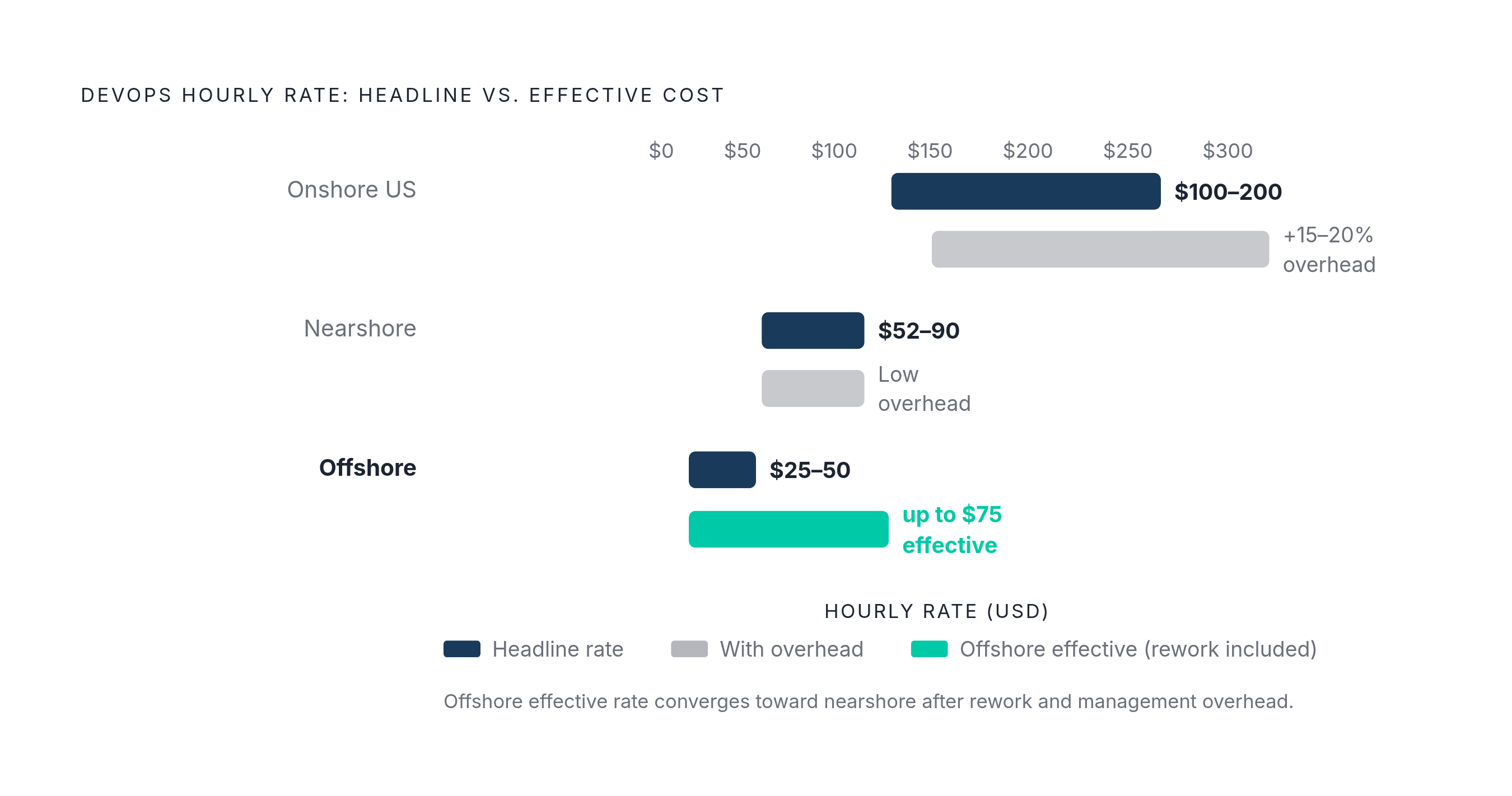
The headline rate difference between onshore and offshore talent looks enormous on paper, roughly a fourfold spread, but total cost of ownership narrows that gap more than the hourly rates suggest. US-based employees carry payroll taxes, benefits, recruiting costs, and ramp-up time on top of base salary, and the Bureau of Labor Statistics puts the median wage for software developers at $133,080 a year, a figure that understates true employer cost once everything else is added in https://ardura.consulting/blog/devops-staff-augmentation-guide/. Recruitment, retention, HR, and payroll management typically add 15% to 20% on top of base rates when handled separately rather than through a single vendor relationship https://ardura.consulting/blog/devops-staff-augmentation-guide/.
A nearshore team in San Jose, Costa Rica shares 6–8 hours of working overlap with a San Francisco Bay Area headquarters every business day https://ardura.consulting/blog/devops-staff-augmentation-guide/.
Offshore's savings are real, but they are not unconditional. Rework on offshore deliverables can add 30% to 50% in additional cost, and feedback loops and management time can push effective offshore cost toward nearshore, and sometimes onshore, levels for work requiring real collaboration https://ardura.consulting/blog/devops-staff-augmentation-guide/. On a project that genuinely needs tight, real-time collaboration, those three factors combine, and the effective cost of offshore work can climb back toward nearshore levels, and in some cases past onshore levels once quality and speed are accounted for. Offshore can be a good option for the right kind of work. It's that the savings are conditional on the type of work, and work requiring constant back-and-forth iteration is exactly where those conditions break down. Onshore US talent costs $100–$200/hour, with total comp including benefits and overhead making this the highest TCO option. Offshore talent in Eastern Europe and India costs $25–$50/hour, with monthly rates of $3,000–$5,500, delivering 60–80% raw savings against US equivalents. European nearshore talent in Poland and Romania costs $52–$78/hour for senior DevOps/SRE roles, providing equivalent technical output at structurally lower cost driven by cost-of-living differentials.
AI tooling's impact on DevOps pipelines and who you hire
AI has already become part of the daily DevOps toolchain, not an emerging trend still waiting to prove itself. As of 2026, 84% of developers use or plan to use AI coding tools, and 76% of DevOps teams had integrated some form of AI into their CI/CD pipelines by 2025, numbers that put AI assistance squarely in the category of baseline expectation rather than competitive edge https://ardura.consulting/blog/devops-staff-augmentation-guide/. GitHub Copilot alone counts roughly 20 million users, and Cursor reached $2 billion in annual recurring revenue by February 2026, both signs of how fast adoption moved from experimental to default https://ardura.consulting/blog/devops-staff-augmentation-guide/.
Trust hasn't kept pace with adoption, though, and that gap shows up as usage climbing while confidence declines. Only 29% of developers trust the output of AI coding tools, down from 40% just a year earlier in 2024 https://ardura.consulting/blog/devops-staff-augmentation-guide/. That's a striking direction to move in: usage climbing while confidence declines. It suggests engineers are running these tools constantly and, at the same time, learning exactly where they fail, catching subtle bugs, hallucinated dependencies, or configuration drift that a less experienced reviewer might miss. That combination, heavy reliance paired with active skepticism, changes what companies need to hire for.
On the operations side, the shift is even sharper. AI models can now predict deployment failures with better than 90% accuracy and automatically resolve up to 80% of incidents without a human ever stepping in. That capability doesn't eliminate the need for skilled DevOps and SRE engineers. It moves the job further up the judgment chain, away from manually triaging every incident and toward designing, training, and supervising the systems that now do the first pass of that triage automatically. Hiring for the role in 2026 increasingly means hiring for that supervisory judgment as well as for the ability to write a pipeline from scratch. AI is changing what DevOps roles actually do. 94% of companies report struggling to find qualified DevOps talent (Second Talent, https://www.secondtalent.com/resources/platforms-to-hire-devops-engineers/). Gartner projects that 80% of organizations will adopt DevOps platforms by 2027 (kore1.com, https://www.kore1.com/hire-devops-engineers-2026-guide/). DevOps engineer compensation in the US ranges from approximately $115,000 at entry level (BLS 2025, https://radixweb.com/blog/devops-statistics). DevOps engineer compensation in the US reaches $160,000+ for senior and principal engineers (BLS 2025, https://radixweb.com/blog/devops-statistics). Mid-career DevOps engineers with 3–7 years of experience typically earn $125,000–$145,000 in base salary (BLS 2025, https://radixweb.com/blog/devops-statistics). Offshore development typically costs $25–$50/hour in Eastern Europe and India (ardura.consulting, https://ardura.consulting/blog/devops-staff-augmentation-guide/). Onshore US development costs $100–$200/hour (ardura.consulting, https://ardura.consulting/blog/devops-staff-augmentation-guide/). Senior nearshore engineers bill roughly $50–$90/hour (ardura.consulting, https://ardura.consulting/blog/devops-staff-augmentation-guide/). Average nearshore developer monthly rates range from $4,000–$7,000 (ardura.consulting, https://ardura.consulting/blog/devops-staff-augmentation-guide/). Offshore developer rates average $3,000–$5,500/month (ardura.consulting, https://ardura.consulting/blog/devops-staff-augmentation-guide/). Nearshore development delivers 40–60% savings against US-based equivalents while maintaining collaboration velocity (ardura.consulting, https://ardura.consulting/blog/devops-staff-augmentation-guide/).