Sourcing Candidates on Niche Professional Communities
Find candidates actively contributing to GitHub, Stack Overflow, and niche technical communities.
A resume is a self-report. GitHub is a record. What an engineer claims they can do and what their commit history actually shows are often two different things, and after years of sourcing technical talent, I've come to treat that gap as one of the more reliable diagnostics in the process.
The obvious starting point is a candidate's own repositories, but the more illuminating signals live one layer deeper. Contribution recency and consistency matter more than raw volume. A developer who has committed steadily across eighteen months tells a different story than one who pushed heavily for a few weeks and then went quiet. Pull request behavior is worth examining closely. How does this person give code review feedback? Do their comments reflect systems thinking, or do they flag surface-level style issues? How do they receive criticism of their own work? Those answers predict collaborative performance better than almost anything you can assess before an interview.
Cross-repository contributions deserve particular attention. When an engineer submits a pull request to a project they don't own, they're demonstrating initiative, collaborative instinct, and willingness to operate in an unfamiliar codebase. That combination is rare, and it's difficult to fake at scale.
Maintainer activity is another underread signal. If a candidate has published their own project, look at how they handle issues. Is the documentation maintained? Are dependency updates applied? Do they respond to contributors? Someone who runs a tidy open-source project has already proven the habits that make senior engineers trustworthy when the stakes are high.
Tools like SeekOut and AmazingHiring can surface relevant GitHub profiles when you need to work through volume, but interpretation still requires judgment. A high star count often reflects marketing more than technical sophistication. A modestly starred project with a well-structured codebase and an active issues log is frequently the stronger find, and learning to tell the difference is a skill that takes time to develop.
When you're reaching out, lead with the repository. Skip pleasantries. The specific repository, the specific pull request, the specific architectural decision that caught your attention — that's what turns a cold message into something worth reading.
One caveat worth naming: not every strong engineer maintains an active public GitHub presence. Some of the most capable people work primarily in private repositories, in organizations whose code never gets open-sourced. GitHub is a powerful signal when it's present. Its absence proves nothing.
Reading Stack Overflow as a map of technical authority
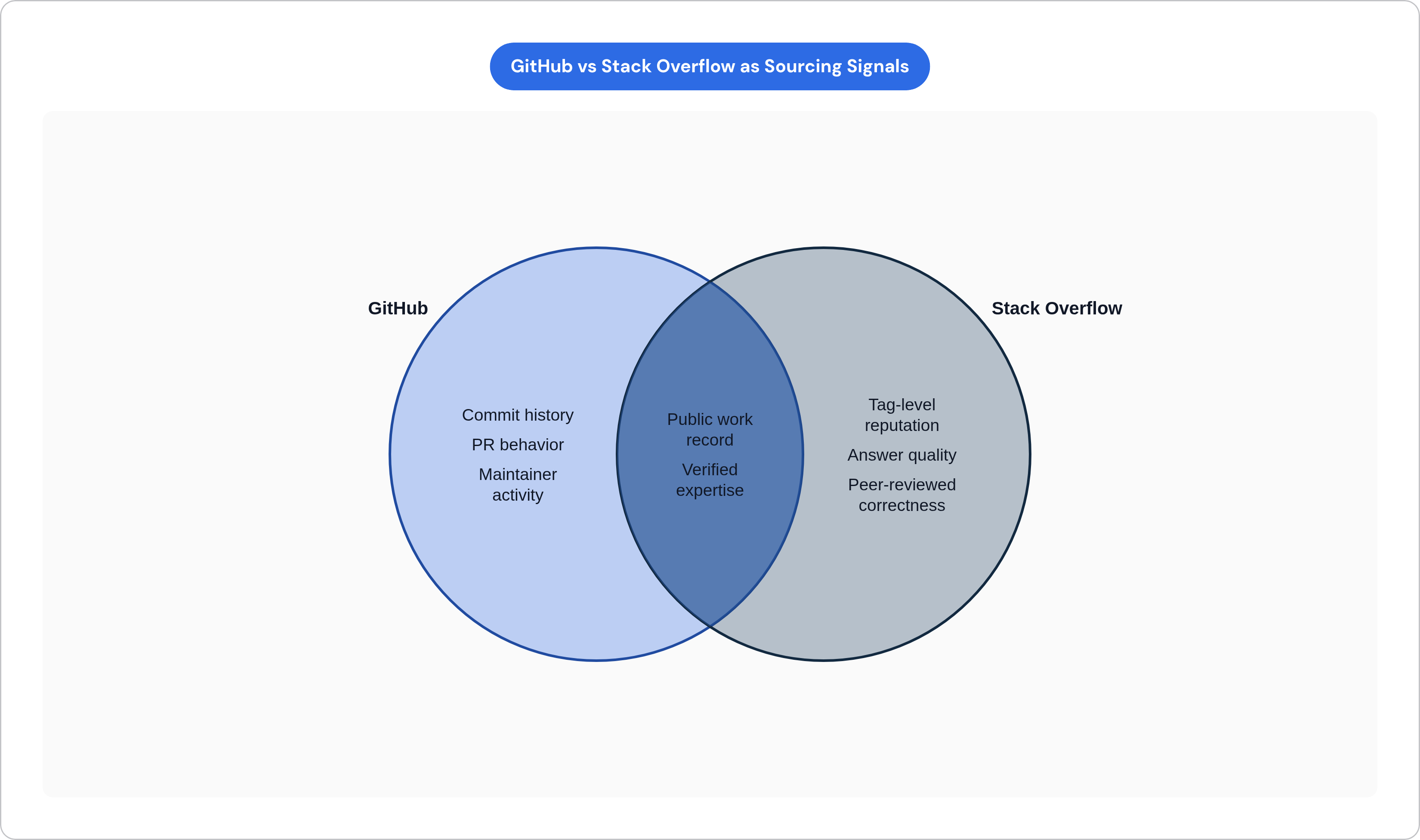
Stack Overflow reputation isn't simply a measure of activity; it's a measure of correctness under peer review. Answers get upvoted when they are accurate, useful, and clear. They get accepted when they solve the actual problem. The system is imperfect, but at sufficient scale and over time, it separates people who genuinely understand a technology from people who are merely fluent in its surface syntax.
The most useful sourcing signal on Stack Overflow isn't total reputation but tag-level reputation. A candidate with a high concentration of points in Kubernetes networking or PostgreSQL query optimization has been repeatedly right about a narrow technical domain, in public, in front of practitioners who would know if they were wrong. Resume keywords tell you someone claims an expertise; tag distribution tells you where a community has repeatedly confirmed it.
Answer quality matters beyond acceptance rates. Look at how candidates engage with edge cases and follow-up questions. Pattern-matching produces adequate answers to common questions. Depth shows up when the question gets complicated, when the asker pushes back, or when the original answer needs revision. The people who handle those moments well in public handle them well in production. I've found this to be one of the more predictive proxies available before a technical screen.
Stack Overflow's native search and tag filtering make this channel genuinely searchable without third-party tools. Filter by tag, sort by reputation, and you have a ranked list of contributors in a given technology in a few minutes. Most sourcing teams haven't done this, which is why the channel remains as open as it is.
High reputation is a shortlist filter, not a hiring credential. Someone who explains things brilliantly on a forum still needs to demonstrate they can ship code in a structured team environment. Treat the Stack Overflow signal as a reason to look more closely, not as a reason to skip assessment.
Stack Overflow's annual Developer Survey, which draws responses from tens of thousands of practitioners, also surfaces which technologies are gaining community density. That's useful intelligence when you're trying to get ahead of a hiring need rather than react to one.
Navigating Slack groups and Discord servers built around specific technologies
The engineers inside these communities joined because they cared enough about something to seek out others who care about the same thing. That self-selection is the sourcing signal. Membership in an active Rust or Elixir or data engineering community isn't a credential, but it's a demonstration of genuine investment in a craft, and that investment persists across jobs.
Some of these communities are large and relatively open: language and framework servers for Go, Vue, Python, or Elixir that number in the thousands of active members. Others are invite-only or application-required, filtering for demonstrated work or seniority. The latter tend to be denser with senior practitioners and lower in recruiter saturation. Both are worth finding; the approach inside them differs considerably.
There are also communities organized around underrepresented groups in tech. These channels matter for equity reasons in their own right, but from a sourcing standpoint, they also tend to have lower recruiter presence than mainstream channels, which means genuine outreach is more likely to land and less likely to be treated with suspicion.
The operating principle across all of these spaces is the same: join as a participant, not as a recruiter. Read for several weeks before posting. Understand what the community values and what it rejects. Many servers have explicit rules against unsolicited recruiting, and violating those rules doesn't just get you removed; it damages your company's reputation inside a network where engineers talk to each other constantly.
Legitimate presence looks specific. Answer questions in your area of competence. Share resources that are genuinely useful. When you mention a role, do it in channels designated for job postings. Better still, have engineers from your own team be the visible presence. A staff engineer answering questions in a community carries credibility that a recruiter with "Talent Acquisition" in their title simply can't replicate. The introductions that result are warmer, and they compound over time in ways that are difficult to quantify but impossible to miss.
The time horizon here is longer than most sourcing teams plan for. Assign one person consistent presence in a community for at least six months before measuring yield. The relationships that produce referrals don't form in weeks.
Other high-signal communities that most sourcing teams overlook
Kaggle competition leaderboards represent one of the few genuinely verifiable, ranked proxies for applied machine learning and data science ability. The names near the top of a serious competition are a small population of people who have proven performance on a real, well-defined problem. That's a different kind of signal from a resume claiming ML expertise or even a GitHub repository demonstrating Python fluency. The problem was specified, the evaluation criteria were fixed, and everyone was measured against the same benchmark.
Hugging Face surfaces a related but distinct signal: practitioners actively publishing models, datasets, and documentation in the AI and ML space. A candidate with substantive model cards and community contributions there is doing something qualitatively different from claiming experience in a job application. They're publishing work that other practitioners read and evaluate.
Subreddits organized around specific technologies, including r/rust, r/MachineLearning, and r/devops, carry a lower barrier to entry than invite-only communities but remain useful for identifying contributors who engage thoughtfully in technical discussions. The quality of a person's contributions to a thread reveals reasoning in a way that a profile page can't.
Hackathons and open-source sprints deserve particular attention. Sponsoring or participating in these events creates a natural context for outreach that sidesteps cold contact entirely. The conversation begins in a shared environment, around shared work. GitLab has built sourcing pipelines through exactly this kind of community cultivation, developing relationships years before specific roles opened. That patience is what makes the approach work; you can't replicate it by showing up urgently at the end of a quarter.
For roles requiring deep expertise in machine learning, systems research, or security, ResearchGate and arXiv are underused channels. Candidates publishing there often have expertise that never appears on a job board because they aren't looking for jobs. They're doing research. The sourcing effort required is higher, but the talent pool available through those channels has almost no overlap with what standard platforms surface.
A practical discipline worth applying across all of these: two well-maintained sourcing channels will outperform six half-attended ones. The strongest sourcing operations work from a concentrated set of communities per role family rather than spreading attention thin across every platform that will theoretically contain a relevant candidate.
What outreach in these communities actually needs to say
The performance gap between personalized and templated outreach isn't marginal. Personalized outreach on senior roles achieves response rates in the range of 15 to 20 percent; templated cold outreach lands between 4 and 8 percent. That differential isn't primarily a function of word count. It's a function of whether the recipient believes you actually read their work.
The single highest-leverage change in outreach copy is the first sentence. Every message needs one candidate-specific detail: the repository, the Stack Overflow answer, the talk, the contribution. "I saw you work in Python" is not specific. "I read your PR on the rate-limiter refactor in [repo name] and wanted to ask about your thinking on the backoff strategy" is specific. That specificity signals you found this person through their work, and that signal is what determines whether the message gets read at all. Engineers who spend time in technical communities have developed a finely calibrated sense for the difference between someone who actually looked and someone who ran a keyword filter.
Beyond the opening, the message should acknowledge what the candidate has built, explain why that work is relevant to the role, and make a small ask. A conversation, not a commitment. Don't lead with compensation. Avoid superlatives. Skip "exciting opportunity." These patterns are so associated with mass recruiting that they function as immediate credibility destroyers in communities where practitioners talk to each other daily and share particularly egregious examples for entertainment.
Timing matters in ways specific to community contexts. Reaching out shortly after someone has made a contribution, posted an answer, or given a talk creates a natural conversational opening. It reads as a response, which changes the recipient's orientation toward the message entirely.
For passive candidates, frame the conversation around career trajectory, not the immediate job opening. Many of the engineers you most want to hire aren't thinking about changing jobs. The only frame that reaches them starts with what they care about, not with what you need.
Building a sourcing presence before you have a role to fill
Reactive sourcing begins at the worst possible moment. The urgency that headcount approval creates is precisely the condition under which bad hiring decisions get made. Communities can't be built in three weeks, and the relationships that produce warm referrals take longer still.
The efficiency argument for proactive sourcing is straightforward. Gem's 2025 benchmarks show that the share of hires rediscovered from a company's existing CRM or ATS rose from 29.1 percent in 2021 to 44.0 percent in 2024. Past candidates and warm contacts who weren't right for a previous role represent an asset most sourcing teams leave underdeveloped. The pipeline you need already partially exists; it just isn't being worked.
Proactive presence takes specific forms: engineers on your team contributing to open-source projects in the ecosystem you hire from; sponsoring hackathons with a genuine technical presence rather than a logo on a banner; hosting office hours or AMAs with your engineering leadership in the communities where target candidates spend time; maintaining a warm pool of past candidates who were strong but not right for a previous role, with consistent follow-up over months.
The model that works is ownership-based. Assign one person to one community, whether a recruiter, an engineer, or a technical sourcer, and measure relationship depth rather than applications generated. Six to twelve months in, the question worth asking is how many people in that community know your team and trust that working with you would be worth their time. Everything else follows from that.
GitLab's approach of cultivating relationships in open-source communities years before specific hiring needs arise is the most cited example of this model working at scale. The reason it works isn't complicated: candidates who have interacted with your engineers in a community, who have seen how your team thinks and communicates, arrive at the first interview having already formed a positive prior. In a competitive market for senior talent, that prior is a meaningful advantage that no amount of late-stage recruiter activity can manufacture.
Validating the candidates you find before the hiring process begins
Community presence is a strong prior, not a credential. An active GitHub profile or a high Stack Overflow reputation narrows the pool significantly, but it doesn't replace assessment. The signal tells you where to look; it doesn't tell you what you've found.
85 percent of employers now use skills-based hiring, up from 81 percent the previous year, per TestGorilla's 2025 State of Skills-Based Hiring report, with 76 percent using skills assessments specifically to validate qualifications rather than relying on resume screening. Community-sourced candidates need the same rigor, with one modification: the public work they've produced replaces the resume scan and gives you concrete material to discuss before the assessment begins. The conversation starts differently, and that changes the quality of what you learn.
The right sequence runs as follows. Review their public work as a pre-screen; it tells you which skills to verify and gives you a specific anchor for the first conversation. Administer a short, role-relevant skills assessment calibrated to the actual work of the position, not a generic battery of algorithmic questions that has no bearing on what the job requires. Then move the technical interview faster than your standard process. Candidates who have demonstrated initiative, craft, and community standing know they've got options. A slow, bureaucratic process signals that your organization doesn't operate at the level they're used to.
Community visibility can be gamed. High follower counts on a GitHub profile can reflect trendy repositories rather than technical sophistication. High Stack Overflow answer volume doesn't always correspond to answer quality. The full sourcing-to-assessment loop exists to filter for people who are good at the work, not people who are good at being found. That distinction matters, and keeping it in view is what separates sourcing that builds teams from sourcing that fills headcount.
For distributed teams and augmented engineering arrangements, the sourcing effort is only as good as the integration that follows. A well-sourced engineer who joins remotely and isn't onboarded into standups, repositories, tooling, and team communication from day one won't perform at the level their portfolio suggests. The community signal gets you to the hire. The onboarding determines whether the hire delivers.