Talent Pipeline Building for Hard-to-Fill Roles
Build relationships with qualified engineers before roles open, not after.
A real pipeline is an ongoing set of warm relationships with qualified people who aren't yet candidates. That distinction is the operational heart of the whole strategy. A saved LinkedIn search, a spreadsheet of résumés, a folder of applications from the last search cycle: these feel like infrastructure. They are not.
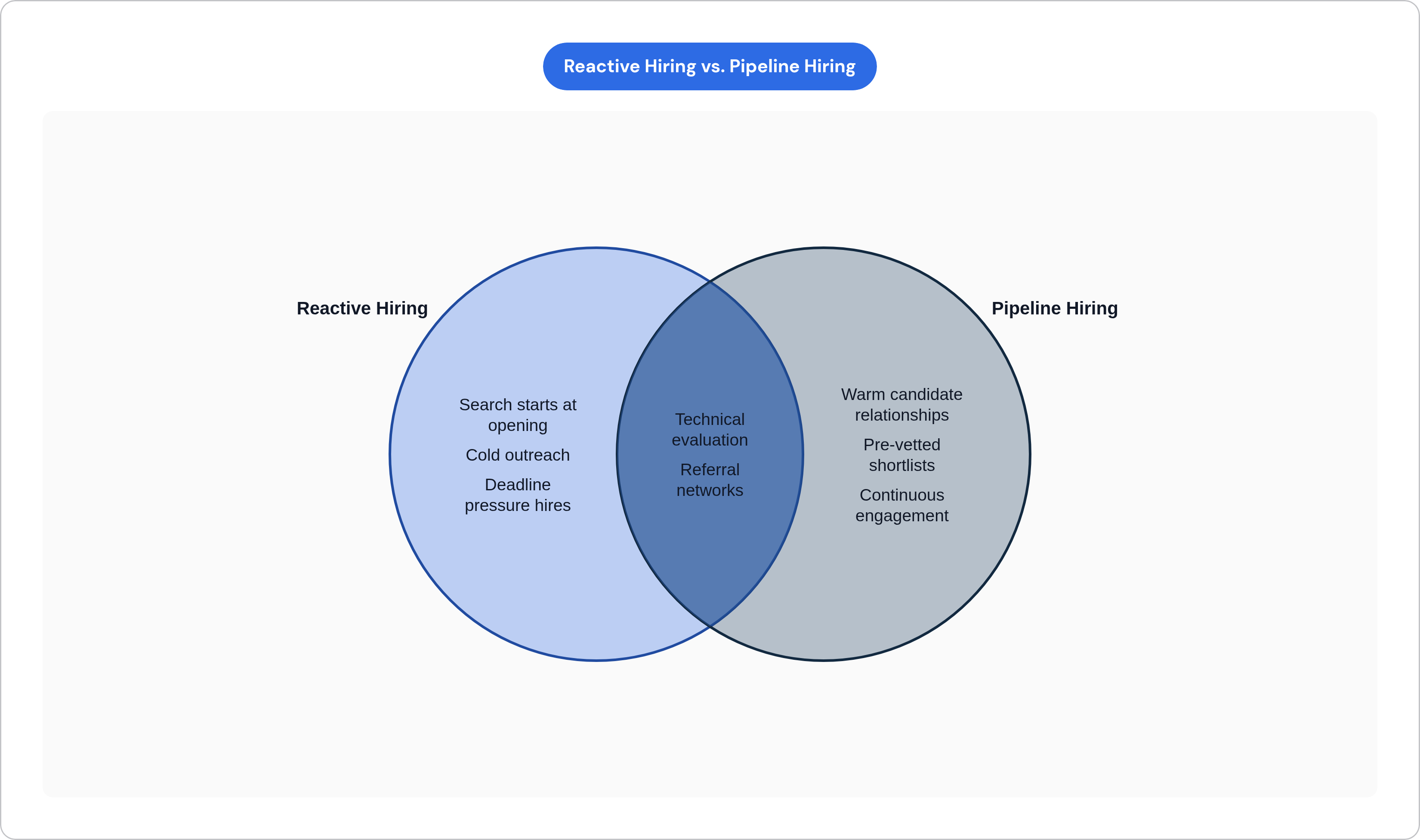
Reactive hiring follows a familiar sequence. A role opens, the search begins, the clock starts. Pipeline hiring inverts that. Relationships preexist the opening, and when the role materializes, the team draws from a warm shortlist rather than launching a cold search.
For generalist roles, reactive hiring is inefficient but survivable. The candidate pool is large enough that a diligent search usually produces a workable hire within an acceptable window. For specialized technical roles, the same approach produces one of two outcomes: a bad hire made under deadline pressure, or an open seat that the team gradually learns to work around. Neither is acceptable at the pace most engineering organizations need to operate.
A working pipeline has several distinct layers. Passive candidates who have been identified, engaged, and kept warm through repeated touchpoints. Former contractors and augmented engineers who already know the codebase and the team's delivery standards. Alumni from engineering programs, technical conferences, and open-source communities. Referrals from current engineers, followed up and tracked rather than dropped into an ATS and forgotten. Vetted external talent pools, through staff augmentation partners or specialized engineering networks, that can deliver qualified candidates in two to four weeks rather than two to three months.
One structural shift this requires: engineering managers and technical leads must be active participants in pipeline-building, not passive requesters who engage recruiting only when headcount is already approved. Passive candidates trust engineers. A recruiter's message is easy to ignore. A peer-level conversation with someone who understands the actual work is not.
The Multi-Channel Approach That Actually Surfaces Passive Technical Candidates
The candidates most worth hiring for specialized roles aren't reachable through job boards. They require presence in the places they already live professionally, and those places are not career sites.
GitHub activity is a live portfolio. Open-source contribution history reveals not just technical capability but how an engineer communicates under scrutiny, collaborates with peers, and approaches systems problems without a prescribed solution. Discord servers and Slack communities organized around specific stacks, whether Rust, Kubernetes, LLM tooling, or ML infrastructure, are dense concentrations of precisely the engineers who are hardest to find through conventional channels. Engineers who contribute consistently to these communities are self-selecting for expertise and engagement.
Conference and meetup presence matters for similar reasons. Engineers who speak at or attend niche technical events are signaling both depth and ambition. The value of being present at a specialized conference goes beyond the candidates encountered there; the presence signals to the broader technical community that the organization is a legitimate participant in that world, not merely a consumer of it. Those signals take time to accumulate, which is exactly why they're worth building before a hiring need is acute.
Referral programs deserve more structural rigor than they typically receive. The standard ask, "do you know anyone good?", produces vague answers and quickly forgotten obligations. The specific ask, "who is the best Kubernetes engineer you've ever worked with?", produces a name, and a name produces accountability. Specificity is the mechanism.
University and bootcamp partnerships are valuable for building the junior and mid-level pipeline tiers ahead of a predicted need. Former contractors and augmented engineers represent the warmest possible pipeline entrants. They know the codebase, they know the team, and re-engagement starts from a foundation of shared context that cold candidates can't match.
Multi-channel doesn't mean indiscriminate outreach. It means maintaining a consistent, credible presence in each channel so that when a candidate becomes open to a move, the organization is already in their field of view. One-time outreach produces one-time results. Pipeline relationships are built through repeated, low-pressure contact: sharing a relevant technical paper, commenting thoughtfully on an open-source contribution, extending an invitation to a technical talk the team is hosting. The organizational habit that makes this sustainable is a running pipeline log, maintained by engineering managers, where promising individuals encountered through any of these channels are recorded before any role exists.
How to Evaluate Technical Candidates Before a Seat Opens
A warm list of unvetted names isn't a pipeline. It's a false sense of readiness. What separates a real pipeline from a contact database is consistent, lightweight evaluation that accumulates over time, not a formal process triggered by open headcount.
The vetting challenge here is genuine. Traditional interview loops require a candidate's time, attention, and psychological buy-in. Asking a passive candidate to spend six hours in a formal process for a role that won't open for six months is both unrealistic and relationship-damaging. Pipeline vetting must be lighter in touch while still being diagnostic.
The skills that differentiate strong engineers have also shifted. Technical fluency in a specific language or framework still matters, but it has become less differentiating as tooling has matured. What separates strong from average in the current environment is the capacity to solve problems under ambiguity, to adapt across stacks and paradigms, to collaborate with AI systems productively, and to communicate architectural reasoning clearly to non-specialists. Karat's 2026 research, conducted across 400 engineering leaders in the US, India, and China, found that 73 percent regard strong engineers as worth at least three times their total compensation. The performance distribution is wide enough that hiring average under deadline pressure isn't a neutral outcome; it's a compounding liability.
Open-source contribution quality offers vetting signal without requiring the candidate's active participation. Not the quantity of commits, but the nature of the problems being addressed and how the engineer communicates in pull request reviews. Technical writing and conference talks reveal architectural thinking and communication clarity simultaneously. A short, informal conversation between a pipeline candidate and a senior engineer on the team, framed explicitly as a peer discussion, can surface genuine depth without the adversarial dynamics of a formal process. For roles where output is visible, data engineering, ML, front-end development, prior work tells more than any whiteboard problem ever will.
All of this must be documented. When the role opens, the team should be drawing on a structured record of vetting signals accumulated across months of genuine engagement, not reconstructing impressions from memory. The inverse matters equally: avoid running full interview loops on passive candidates speculatively. Small technical communities have long institutional memories. An organization that burns candidates with premature formal processes will find those communities harder to access the next time around.
Why Geographic Limits Are the Single Most Common Reason Pipelines Run Dry
Most talent pipelines, examined honestly, are implicitly local or domestic: candidates within commuting distance, willing to relocate, or already authorized to work in the country. For roles with abundant candidate supply, that aperture is sufficient. For specialized technical roles, it's the primary reason pipelines fail.
The roles hardest to fill are also the roles most saturated with competition. A strong ML engineer in any major US metro is receiving simultaneous attention from employers in London, Toronto, Berlin, and remote-first startups with competitive equity packages. A domestic-only pipeline isn't a neutral strategic choice. It's a decision to compete for the same thin slice of candidates as every other organization operating under the same constraint.
The compounding problem is that the roles most constrained by geographic insularity are also the roles where a bad hire causes the most damage. A mediocre senior ML engineer doesn't deliver neutral value; they generate technical debt, impede delivery, and introduce team disruption that outlasts their tenure. IDC estimates the global IT skills shortage will cost organizations roughly $5.5 trillion in delays and lost competitiveness by 2026, the aggregate cost of pipelines that ran dry because they were too narrow.
Expanding the geographic aperture isn't a concession on standards. It's access to a larger pool of candidates who meet the same standards. The practical question a pipeline strategy must answer, for each hard-to-fill role, is what the actual addressable talent pool looks like if geography is removed as a constraint. For most specialized technical roles, the answer is substantially larger. The follow-on question is which geographies offer the right combination of skill depth, timezone compatibility, and communication alignment to make distributed collaboration work without introducing the coordination overhead that undermines speed.
Timezone compatibility isn't a soft preference. It's the variable that determines whether an expanded aperture works operationally. Research on distributed engineering teams shows that groups spread across five or more time zones suffer measurable delivery delays driven by asynchronous feedback cycles. A pipeline built for speed can't absorb that overhead, which is why geography must be expanded selectively, toward talent pools that preserve real-time collaboration.
Latin America as a Working Pipeline Source for US Technical Teams
Latin America's engineering talent base has grown substantially over the past decade. Expanding university computer science programs, a generation of engineers trained on US-adjacent products and platforms, and a remote-work infrastructure that the pandemic accelerated significantly have all contributed. For the US engineering organizations that have built Latin America into their pipeline strategies, this isn't an emerging hypothesis. It's a demonstrated operational reality.
The timezone advantage is material. Latin American engineers working with US East or West Coast teams share the full working day: same standup, same Slack window, same afternoon design review. The asynchronous friction that plagues offshore arrangements in more distant geographies is largely absent. Peer-reviewed research on distributed software teams confirms that the delivery delays associated with wide timezone dispersion disappear when teams share a real-time collaboration window.
The cost profile matters too. Per Accelerance's 2024 Global Software Outsourcing Rates and Trends Guide, nearshore LATAM engineering rates typically fall between $34 and $92 per hour, compared to more than $100 for a US-based senior developer, and a fully loaded US senior engineer exceeds $200,000 annually before recruiting and onboarding costs. The cost argument is real, though it's secondary to the pipeline argument. Latin America offers a large, growing, English-communicating pool of engineers in precisely the roles most undersupplied domestically.
What makes nearshore Latin America function as a genuine pipeline asset, rather than a project outsourcing arrangement, is the augmentation model: engineers embedded into the client team, attending its standups, using its tooling, following its engineering practices. Not a vendor relationship managed at arm's length, but working team membership that creates the same shared context a domestic colleague develops over time. The timezone alignment is what makes this integration viable at the pace engineering teams actually operate.
A relationship with a vetted nearshore talent network is itself a pipeline asset. It provides access to pre-screened candidates who can be onboarded in two to four weeks, compared to the 42-day domestic average for a role that has already been opened. For a team filling a hard-to-fill role under roadmap pressure, that compression isn't marginal. It's the difference between a quarter lost and a quarter recovered.
How Vetted Talent Pools and Staff Augmentation Partners Compress Time-to-Fill
The core value of a high-quality staff augmentation partner, in a pipeline context, is that they maintain the pipeline so the client organization doesn't have to build it from scratch each time a need arises. The vetting, the relationships, the pre-screening infrastructure are already in place when the engagement begins.
Quality among augmentation providers varies enormously. The variable that matters most is how rigorously they evaluate candidates before a client ever sees one. A partner who delivers fast but unvetted names introduces the same risk as a bad hire made under deadline pressure. Speed is only valuable when the underlying quality holds.
Staff augmentation providers at the high end of the market can deliver qualified talent in two to four weeks. In-house hiring for a comparable specialized role typically requires two to three months, assuming a functional internal recruiting function operating under normal conditions. For a team with a live roadmap dependency on the open seat, that delta isn't marginal; it's the difference between a feature that ships in Q2 and one that slips to Q4.
The Staff Augmentation Services Market grew from $6.89 billion in 2024 to $7.35 billion in 2025 at a compound annual growth rate of 7.11 percent, according to Research and Markets' 2025 data. The model is expanding because it addresses a genuine supply constraint. Deloitte's 2024 Global Outsourcing Survey of more than 500 global business and technology leaders found that the share of organizations citing cost reduction as their primary outsourcing driver fell from 70 percent in 2020 to 34 percent in 2024. Talent access and organizational agility now lead. This is precisely how pipeline-oriented organizations think about augmentation.
The integration habits that determine whether augmented engineers become genuine pipeline assets are specific. Embed from day one using the same tools, the same rituals, the same communication channels as the core team. Establish a fixed daily overlap window where all distributed members are simultaneously available. Treat the engagement as a relationship rather than a transaction. Engineers who function as team members are the ones who return when a full-time role opens and who refer peers from their own networks. The augmentation engagement isn't just a delivery vehicle. It's a pipeline cultivation event, and treating it as anything less wastes the relationship being built.
Maintaining Pipeline Relationships Without a Role to Offer
The most common pipeline failure isn't a failure to build. It's a failure to maintain. Relationships cultivated during an active search, then abandoned when the role fills, leave the next search starting cold again. The pattern repeats until someone decides to break it deliberately.
Pipeline maintenance isn't recruiting. It's relationship management with a technical audience that has a low tolerance for the nurture sequences that work in sales contexts. Generic check-ins, template outreach, quarterly "just staying in touch" messages: these signal to an engineer that they're a name in a database. The relationship doesn't plateau at that point. It corrodes.
What actually works is contact that is specific and genuinely useful. Sharing a technical paper, tool, or talk the candidate will find valuable independent of any job conversation. Inviting pipeline candidates to internal technical events or demos where exposure to the team is organic and low-pressure. Following their public work, open-source contributions, blog posts, conference presentations, and engaging with it specifically, not with a recruiter's comment but with a peer's response. The message that lands is that someone here is paying attention to your work because it's interesting, not because a role just opened.
The organizational infrastructure that makes this sustainable is simple: a pipeline log with scheduled touchpoints, owned by engineering managers rather than recruiting coordinators. A note that reads "follow up in four months, share ML Ops paper when published" is worth more than a thousand cold outreach messages sent at scale. An engineer who hears from a team three times over eighteen months through genuinely useful contact isn't a passive candidate when the role opens. They're a warm one, and the 42-day average shrinks considerably when that relationship is already in place.
A pipeline is a living set of relationships. It compounds when the organization invests in it between searches and decays when it doesn't. The companies that fill the hardest roles fastest made a structural decision to treat that investment as continuous. They made it early, they sustained it, and when a seat opened, they weren't waiting.