Passive Candidate Outreach Messaging
Fit signals and concrete details—not flattery—move passive candidates to respond.

Passive candidates aren't indifferent to opportunity. They're indifferent to irrelevance. The recruiter's job, properly understood, is not to generate excitement but to signal fit quickly and credibly, before the candidate decides the message isn't worth finishing.
Among passive candidates who responded to outreach, 43% said it was because the role matched their skillset. Fit signaling is the primary trigger, not flattery, not urgency. Two forces are operating simultaneously: candidates are evaluating the role, and they're evaluating the sender. A vague or templated message doesn't just fail to communicate the opportunity; it communicates something about the person who sent it. Engineers in particular read cold outreach as a proxy for how a company treats its people. Vagueness reads less like mystery than like indifference, and most engineers have developed a fast and accurate filter for it.
What candidates want upfront is concrete. According to iHire's 2025 data, 60.5% of candidates want clarity on hiring timelines from the first message, and 57.1% want salary ranges included from the start. Withholding either signals that the sender doesn't know those numbers or is deliberately concealing them. Neither interpretation encourages a response from someone who wasn't looking in the first place.
Career growth framing consistently outperforms generic opportunity framing, and the reason isn't subtle. A message that connects the role to where the candidate is actually headed, whether that means expanded scope, a harder technical problem, or a different kind of organizational impact, addresses what a passive candidate actually weighs when considering a move. For someone not actively looking, the cost of engaging with unsolicited outreach is real. Being explicit about process length and next steps reduces that cost. It is more than courtesy; it is a response-rate lever.
How Personalization Works in Practice for Technical Candidates
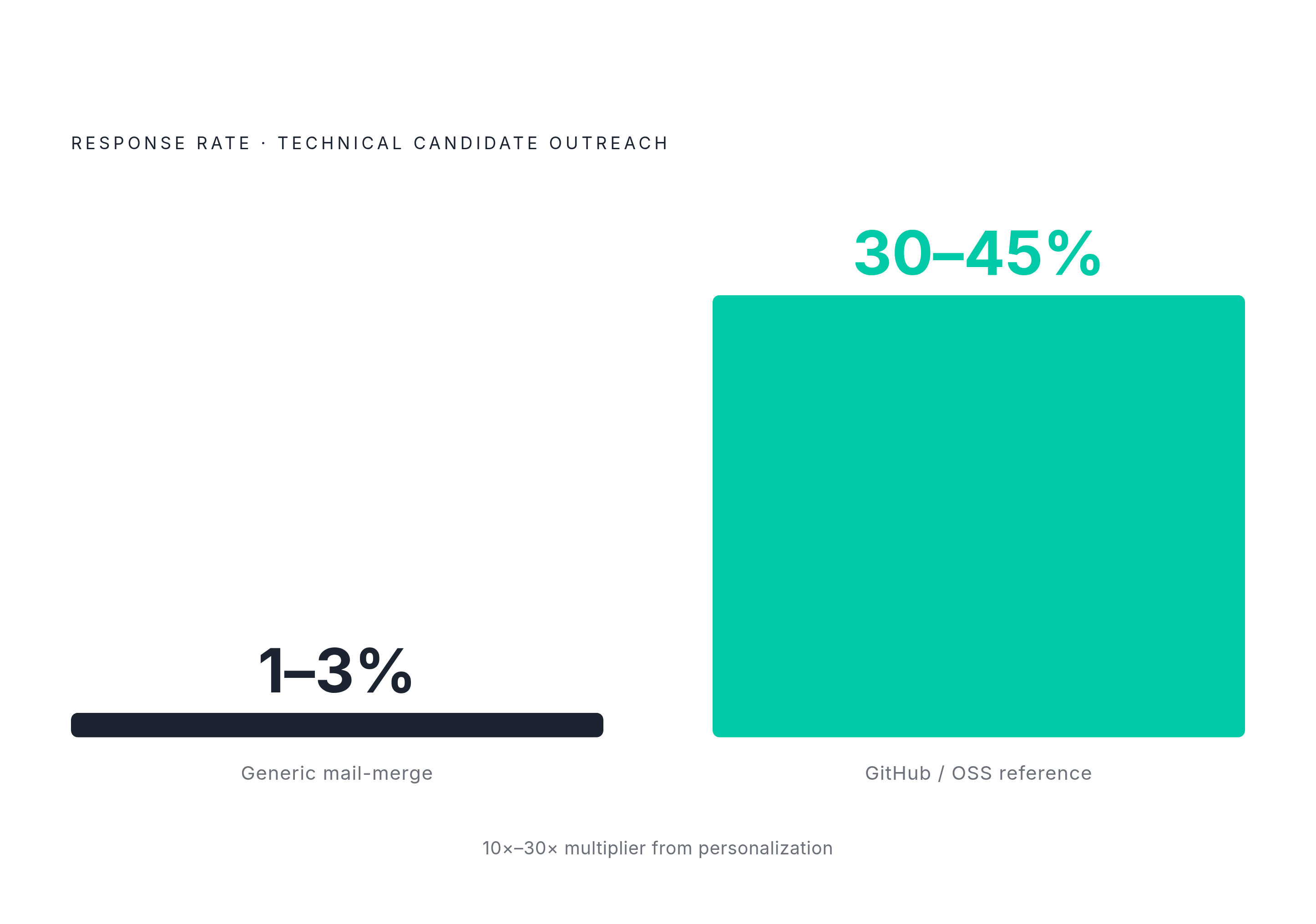
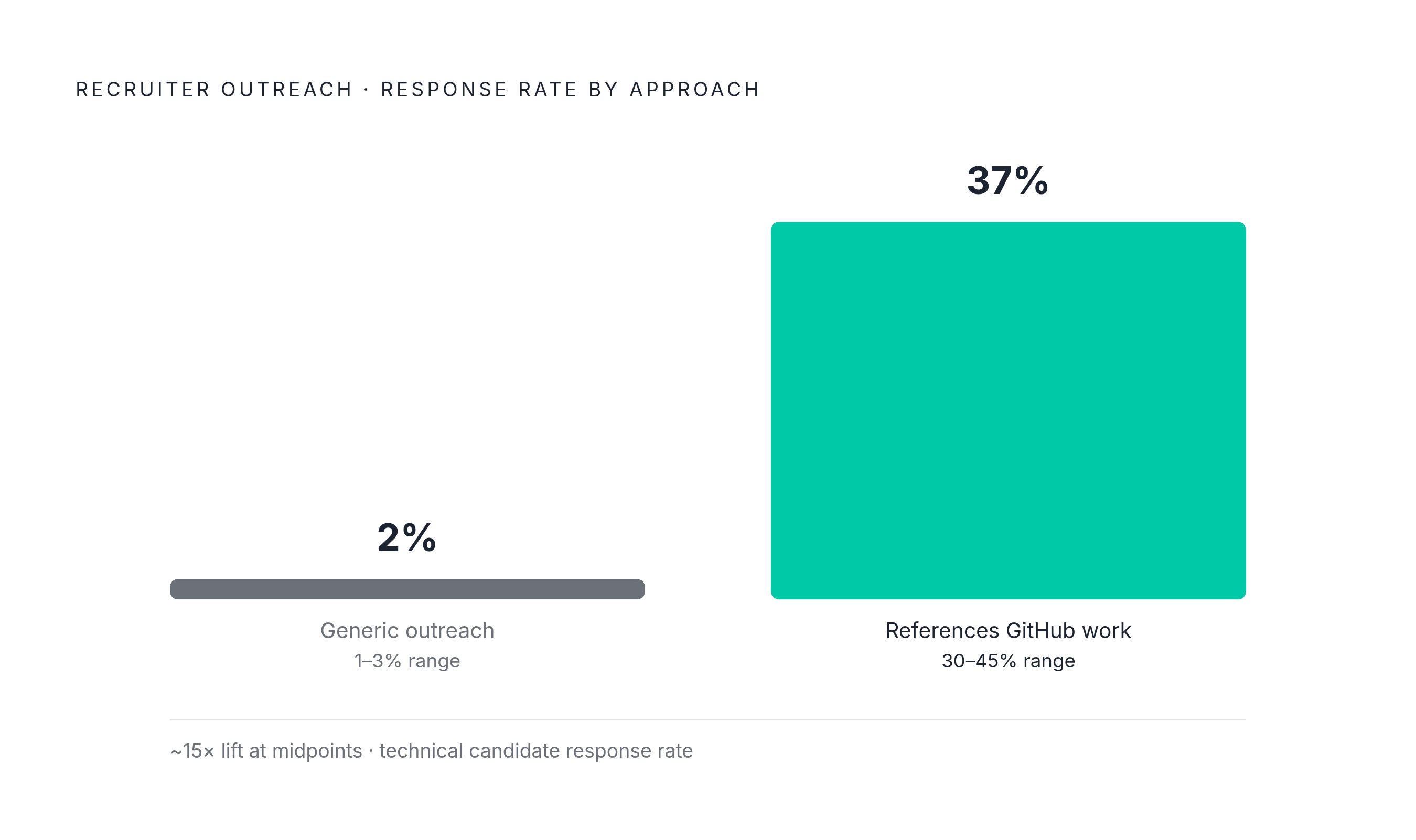
Generic outreach to engineers generates response rates in the range of 1% to 3%. Outreach that references a candidate's GitHub project or open-source contributions generates response rates of 30% to 45%. I've seen recruiters look at those numbers and nod, then go back to mail-merging first names into the same template they've used for two years. The spread doesn't matter if you don't change the behavior.
Personalization for technical candidates means naming a specific repository, a particular architectural decision visible in their public work, a conference talk they gave, a blog post, or a Stack Overflow answer that solved something non-trivial. It does not mean inserting a first name into a template, listing the candidate's current employer back at them, or deploying a compliment that could apply to anyone with a LinkedIn profile and a pulse. "Impressive background" is a signal of inattention. Engineers recognize the difference immediately, and the effect is precisely opposite to what was intended.
The sourcing work happens before the message is written. GitHub, Stack Overflow, niche technical communities, and Boolean and X-ray searches surface signals that LinkedIn profiles don't carry. A candidate who hasn't logged into LinkedIn in six months may have committed code last week or answered questions in a community forum yesterday. Those signals are what make the leap from "I found you" to "I reached out to you specifically" credible.
The connection then has to be made explicit. Don't leave the candidate to infer why their work on a distributed systems problem is relevant to an engineering challenge at a specific company. Make it direct. Candidates are under no obligation to do inference work for a sender they didn't seek out.
Warm connections amplify all of this. Candidates with a shared connection are 46% more likely to accept a message, per LinkedIn Talent Solutions 2024 data. Where a shared connection exists, acknowledge it. Where one doesn't, the quality of the technical observation has to carry more weight. There is no substitute, and no amount of formatting compensates for skipping the reading.
Format and Length Decisions That Affect Whether a Message Gets Read
Even a well-personalized message fails if it's formatted like a job description. Formatting is not aesthetic preference. It signals whether the sender understands the candidate's context — they're reading this in the middle of something else, on a device they're also using for work, with no particular obligation to stop and parse carefully.
LinkedIn messages under 400 characters consistently outperform longer ones. Email messages under 150 words perform best. Concision signals respect for the candidate's time, and it demonstrates that the sender could identify what actually matters rather than padding to appear thorough. Brevity is a form of editorial judgment.
The subject line is the gatekeeper for email. Lines that include a specific job title or company name outperform vague lines by more than 30% in open rates. "Senior Backend Engineer, Payments Infrastructure" is a subject line. "Exciting opportunity I think you'd love" is a missed signal.
The structure of a message that earns a response is fairly simple — one sentence grounded in something observable about the candidate's work; one sentence on the role and its relevance to where they're headed; one low-pressure call to action. "15-minute exploratory chat" is different from "formal interview process." One asks for time; the other asks for commitment. Passive candidates have no shortage of reasons to decline the latter.
Individually sent messages outperform bulk sends by approximately 15%, per LinkedIn 2024 data. Technical candidates recognize bulk sends. That recognition undermines the personalization claim the message is trying to make, which is the only claim worth making. The efficiency gain from a sequence tool is real, but it is partially offset by the signal the mass send creates, and that signal is hard to recover from.
Avoid urgency framing, excessive flattery, anything that reads as a sales pitch. The register to aim for is a knowledgeable colleague who has a genuine reason to reach out and is being direct about it.
Building a Follow-Up Sequence That Doesn't Become Harassment
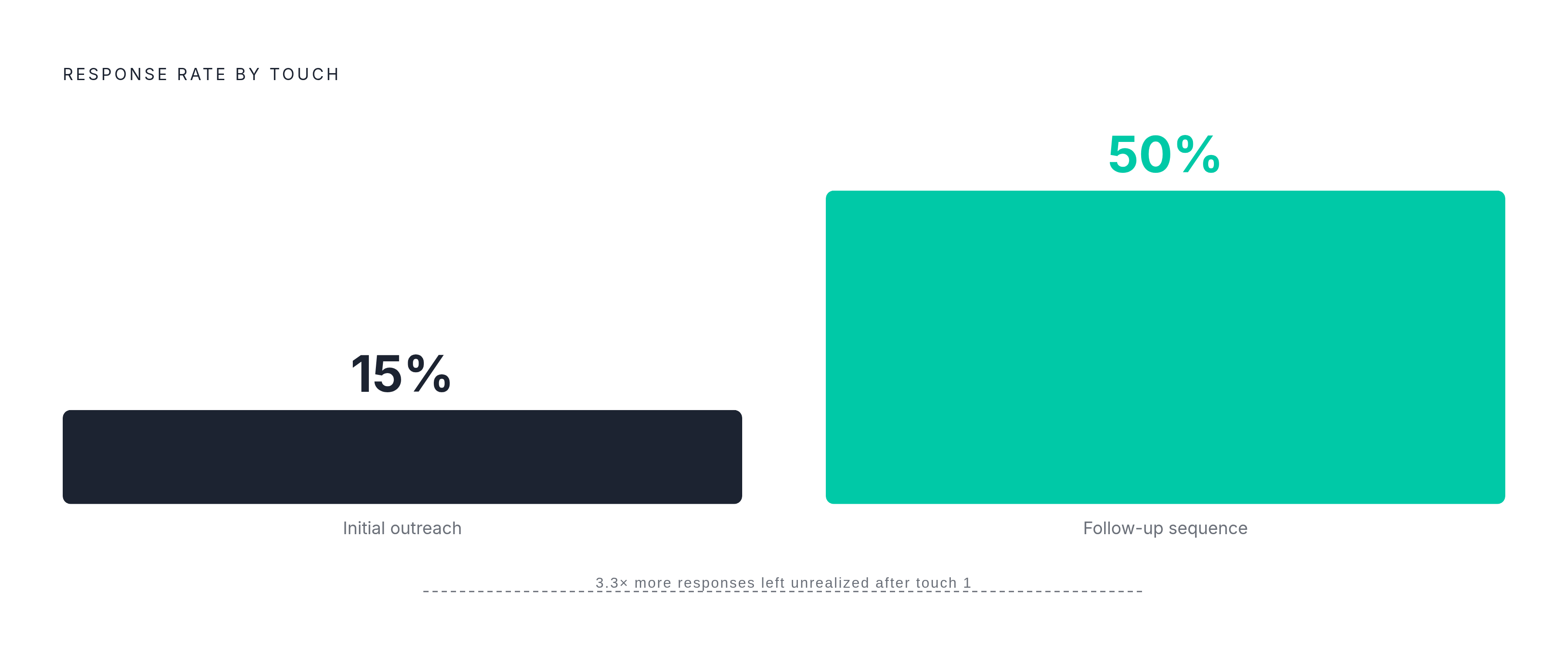
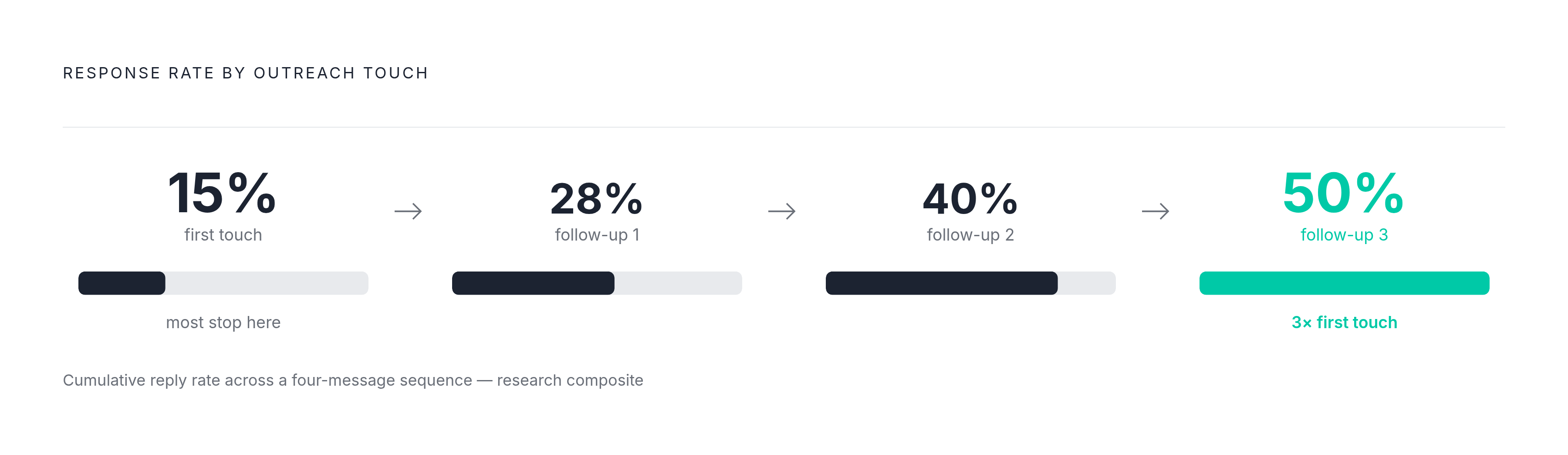
Initial outreach response rates run around 15%. Follow-up response rates can reach 50%. Most of the response potential in any outreach sequence lives beyond the first touch, which means abandoning a candidate after one message leaves most of the available value unrealized. Silence is not always rejection. Sometimes it's timing, a crunch week, a conversation with a manager that just started, a situation the candidate isn't ready to name yet.
The research-supported sweet spot for sequence length is four steps. Timing matters — weekdays between noon and 2 p.m. and between 5 p.m. and 7 p.m. perform well for North American and European candidates. Follow-ups spaced only a day or two apart signal desperation and erode whatever trust the initial message established.
Each follow-up must add something new — a piece of information the candidate didn't have, a relevant company development, a different angle on the role's technical scope rather than its business framing. The message that says only "just following up" communicates that the sender has nothing further to offer and is persisting on volume alone. That message is worse than silence. It confirms the candidate's suspicion that the outreach wasn't substantive to begin with.
The final message in a sequence should include an explicit opt-out, something to the effect of "If the timing isn't right, no need to reply. I won't follow up further." This does a specific thing: it gives the candidate a clean exit, reduces the psychological cost of having ignored the prior messages, and keeps the relationship intact for a future moment when their situation has changed. A sequence that ends cleanly keeps the door open. One that trails off into silence does not.
Where AI Fits Into the Outreach Process, and Where It Breaks It
AI-assisted messages achieve a 40% higher acceptance rate compared to standard messaging, per LinkedIn Talent Solutions 2024 data. Companies using AI-assisted messaging are 9% more likely to make quality hires, and companies running skills-based searches, which AI tools help construct with more precision, are 12% more likely to make a quality hire. These numbers compound over the course of a real sourcing operation, and they are real enough that ignoring AI in technical recruiting is no longer a defensible position.
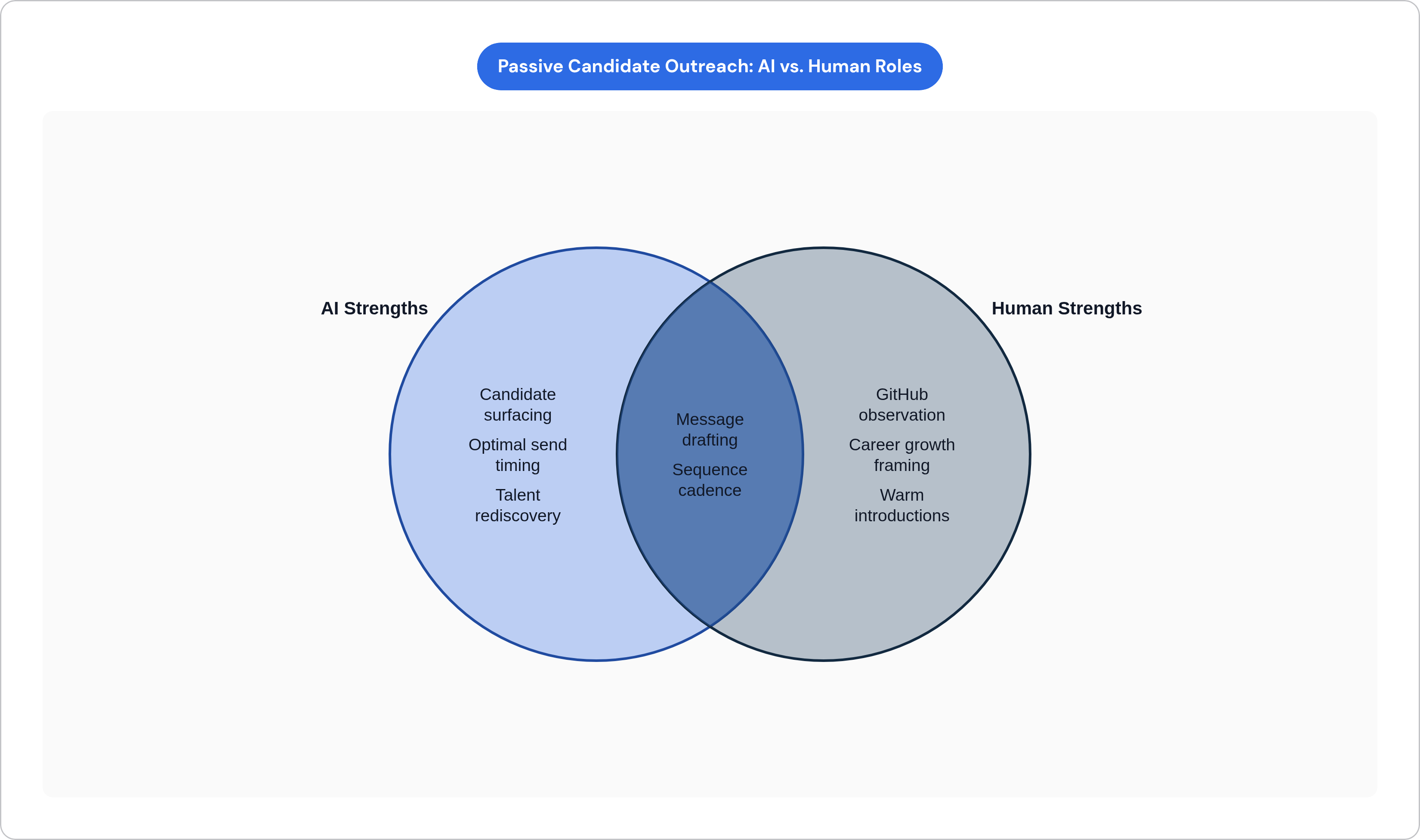
Where AI genuinely earns its place is in the labor-intensive stages before the message is written — surfacing candidates from non-obvious sources by analyzing skills signals across platforms, identifying optimal send windows and sequence cadence, drafting message frameworks that a recruiter then personalizes. Talent rediscovery is a particularly underutilized application. Re-engagement rates with past candidates rose from 29.1% in 2021 to 44.0% in 2024, per available benchmarks, and AI tools make it practical to re-surface people at moments when their tenure at a company suggests they're open to a conversation, rather than relying on a recruiter to manually track that timing across hundreds of past contacts.
Where AI breaks the process is where it's handed full authorship and deployed at volume without meaningful review. Engineers have developed real pattern recognition for AI-generated outreach. Fully AI-generated messages sent at scale reproduce the spray-and-pray dynamic that drove candidate resentment to its highest recorded levels, and they are charmed by nothing on display. Scaling bad outreach faster does not improve results; it accelerates the accumulation of resentment that makes the next genuine message harder to land, whoever sends it. I've watched this happen in hiring cycles where the pipeline looked active on paper and was functionally dead.
The right frame is a division of labor — AI handles research and drafting, and a human decides whether this particular message earns this particular person's attention. That decision requires actual knowledge of what the candidate cares about, which requires someone to have looked. No tool replaces that step, and pretending otherwise is how you end up with a sourcing function that moves fast and produces nothing.
Applying These Principles When Sourcing for Distributed or Nearshore Engineering Teams
Everything above applies with higher stakes when recruiting engineers across time zones and geographies. The passive candidate evaluating a distributed or nearshore role isn't only weighing the role itself. They're weighing the gap between what a message promises and what a distributed engagement actually looks like day to day. Engineers who have worked in distributed settings before have often been burned by that gap. Some carry the skepticism for years, and they bring it to every first message they receive.
The questions that need to be preempted are concrete — whether timezone overlap is real or nominal, whether collaboration happens in real time or by catching up to async decisions after the fact, whether this is a genuine team integration or a body-shop arrangement where the engineer is isolated from the product and the people building it. Leaving these questions unanswered is a damaging omission. Candidates will assume the worst, because the worst is what many of them have already experienced.
Specificity about the engagement model functions the same way that GitHub-reference personalization does: it signals that the sender understands what the candidate actually cares about. Describing direct team integration, access to senior engineers, a defined scope of work, and real ownership of technical decisions isn't overselling the role. It is answering the questions that would otherwise prevent the candidate from responding at all.
Referrals carry even more weight in cross-border contexts. A warm introduction through a shared connection in a regional technical community represents something a cold message cannot replicate regardless of how well it's crafted — a trusted third-party signal that the opportunity is legitimate and the company is worth the risk of a conversation.
In this context, the outreach message is doing more than recruiting. It is the first evidence a candidate has about how this team actually communicates, whether it respects the professional judgment of the engineers it's trying to reach, and whether the clarity and specificity on the page reflect how the team actually operates. Candidates who have been around long enough know that the way a company recruits and the way it runs are usually the same thing. That observation is accurate, and worth keeping in mind.