Internal Recruitment Versus External Sourcing for Technical Teams
Timing and cost decide whether to hire permanently or bring in outside experts.
Here's the thing nobody wants to say out loud in a budget meeting: hiring an engineer and renting one aren't opposite strategies, they're two settings on the same dial, and most technical leaders only know how to turn it one way. They default to internal hiring, then reach for a staffing partner only after the req has sat open for ten weeks and the VP is asking questions. That's not a strategy. That's a symptom.
I've sat on both sides of this, running internal searches that dragged into a fourth month and standing up augmented teams in three weeks flat. The market data backs up what that whiplash taught me. Demand for software engineers has outpaced supply for years, and nothing in current hiring data suggests the gap closes on its own. A specialized technical role, filled through a conventional process, takes close to two months on average, longer for anything senior or niche. ManpowerGroup's 2024 Talent Shortage Survey put the share of employers struggling to find the talent they need at a level not seen in decades. That's not a bad quarter. That's the floor now.
What makes it stranger is the two trends pulling in opposite directions at once. Job postings are dropping degree requirements at a steady clip, which tells you the industry is quietly rewriting what "qualified" even means. Meanwhile new-hire rates in the U.S. have fallen back to levels last seen in the early pandemic, so companies are pulling back on headcount even as the skills gap widens under them. Put those two facts next to each other and internal recruitment starts looking less like the safe default and more like a bottleneck people have agreed not to name. External sourcing deserves a seat at the table before the search stalls, not after.
What internal recruitment actually costs when you account for what it takes
Everyone budgets for the visible line items: job board fees, recruiter hours, the six people who sat in on final rounds, salary, benefits. Fine. None of that is where the real money leaks out.
Start with time-to-productivity. A new hire needs months to reach full output, longer if the role is senior or the codebase is gnarly, and that's before anyone accounts for the ramp time of whoever's mentoring them. Then there's the cost of a bad hire, and the number most people quote, a fraction of first-year salary from Department of Labor estimates, actually understates it. It doesn't touch the morale hit when a team absorbs someone who isn't working out, and it definitely doesn't touch the technical debt that person leaves behind on the way out the door. Then pipeline attrition: a large share of candidates who clear the resume screen get cut in the first technical round, and that's rarely because good engineers don't exist. It's because whatever filtered them upstream wasn't actually testing for the thing that matters.
There's a fourth cost that's easy to miss because it never shows up on an invoice. Internal hiring locks in fixed headcount. When the project winds down, that headcount doesn't wind down with it. Somebody still owns that person's next six months.
None of this makes internal hiring a bad call, and I'd be lying if I said otherwise. It buys cultural depth that only comes from years in the building, knowledge that doesn't walk out with a contract's end date, capability that compounds instead of resetting every time an engagement wraps. That matters more than any spreadsheet captures, in the right context. But the full cost gets underestimated routinely enough that it stacks the comparison against external sourcing before anyone's actually run the numbers.
How external sourcing models differ from each other — and why the differences matter
External sourcing isn't a single lever. It's a spread of models, and they differ sharply in cost, in how much hand-holding they need, and in who keeps control of the work.
Staff augmentation sits at one end: vetted engineers drop into your team, run your processes, report to your leads. You keep the architecture calls; the augmented engineer is just more capacity inside a system you already own. Managed outsourcing sits at the other end, where the vendor owns delivery and you own the spec. That fits bounded, well-scoped work where outcome accountability matters more than daily coordination.
Then geography cuts across both models and rewrites the math for each. Onshore keeps everyone in the same country, near-zero time zone drag, highest price tag, and it earns that price when compliance sensitivity or in-person work genuinely demands it. Offshore gets you the steepest discount and the widest time gap, and it works fine on large, stable projects with requirements locked down and strong internal product leadership already steering. It falls apart on anything iterative, because iterative work means requirements shift daily, and a ten-hour gap doesn't leave room for that kind of back-and-forth.
Nearshore sits in the middle. For a U.S. company, that's usually Latin America. The overlap is close enough for live collaboration, and the rate still drops meaningfully against onshore. Worth being blunt about why offshore actually breaks down where nearshore doesn't: a ten-to-twelve-hour gap turns a two-minute clarifying question into a next-day answer, so requirement gaps don't surface until they're already baked into shipped code. Then rework piles up, the timeline slips, and the savings that justified going offshore in the first place get eaten by the cost of fixing what got built wrong. Nearshore's advantage isn't really the smaller time gap. It's what that overlap makes possible: real standups, real sprint reviews, the kind of live debugging session offshore teams structurally can't replicate no matter how good the engineers are.
The conditions under which internal recruitment is the right call
Internal hiring pays for itself when the work never ends, the role sits at the center of the product, and the knowledge someone builds needs to stay in the building rather than leave with a contractor at engagement's end.
A few markers make the case cleanly. The capability gap has to be permanent, not tied to one project; hiring a full-timer for a temporary need just delays the actual decision. Some roles need deep context that only builds slowly, data science running on proprietary models, platform work on architecture nobody wrote a manual for, security roles where institutional memory is itself a layer of defense. Retention becomes the real strategic goal here, since every departure from a core role drains context that took quarters to rebuild in the first place. And in regulated industries, clearance and employment status can make internal hiring non-negotiable regardless of what it costs.
What internal recruitment cannot do is bend the calendar. It can't compress a two-month average fill time down to six weeks because a launch date got moved up. It can't manufacture a skill set that doesn't exist in the local labor pool. It can't flex back down once a workload spike passes, and that's the failure mode worth watching for: treating internal hiring as the automatic first move, then calling in outside help only once the search is already months overdue. By then the team was behind before a single augmented engineer even opened their laptop.
The conditions under which external sourcing — particularly staff augmentation — is the sharper tool
Staff augmentation earns its keep when the deadline is fixed, the skill gap is narrow, and the workload has a visible finish line. In my experience those three show up together more often than most leaders expect going in.
A funding milestone or launch date that isn't moving, stacked against a backlog growing faster than the internal team can chew through it, is the clearest tell. So is a demand spike: seasonal load, a new product line, a migration that needs to happen once and then never again. Hiring permanent headcount for any of that just creates a role somebody has to manage or eliminate once the spike passes. Augmentation scales down without a layoff attached to it. A narrow, specialized skill, an old framework nobody on staff has touched in years, something compliance-flavored, is another strong signal, especially when training an internal engineer to cover it would take longer than the project itself. And organizations stuck mid-search for a permanent hire often need exactly this kind of bridge just to keep the lights on.
Duration matters here too. Staff augmentation fits engagements running from a few months out to roughly two years. Past that mark, a permanent hire usually wins on cost, and pretending otherwise just kicks a decision the calendar has already made for you.
The real edge over internal hiring is speed. A well-vetted augmented engineer, dropped into a team that did its onboarding homework, starts contributing in weeks, not months. That speed isn't automatic, though. It depends on the partner actually mapping your tech stack and coding conventions before day one, not discovering the gaps three standups in. It depends on that engineer running your code review process and your toolchain, functioning as part of the team instead of alongside it. And it depends on vetting that goes past technical chops into remote communication habits and whether someone can push through a blocked task without a manager hovering. Most remote placements that go sideways trace back to exactly that: a communication gap, or someone who can't move without being told to.
A disciplined nearshore augmentation model draws on a talent pool spanning a broad range of technologies, with engineers screened for English fluency and remote-work readiness, working inside U.S. hours. The speed only holds up because the vetting behind it is strict enough to back the claim.
How AI tools are changing what "the right engineer" means in either model
Most developers now reach for an AI coding assistant without thinking twice, and that number keeps climbing. AI fluency stopped being a resume differentiator a while back. It's closer to table stakes now, the way Git was fifteen years ago.
What's underneath that adoption curve is messier than the vendor decks suggest. AI tools clearly push output up: more tickets closed, more code merged. But a controlled study from METR found the tooling actually slowed experienced developers down inside mature codebases, because the overhead of prompting, reviewing, and fixing what came out ate more time than it saved on complex systems. Faros AI and DORA found something in the same neighborhood: heavier AI usage correlated with meaningfully longer pull request review times. Output climbed. So did the bottleneck sitting right behind it.
What that actually means is the work is shifting toward review and judgment. The engineers producing real value now are the ones who can look at what a model spits out and tell whether it's right, not just the ones who can write a fast prompt. For internal hiring, that means AI fluency belongs inside the technical interview itself, tested directly, not assumed because someone listed a tool on their resume. The real question isn't whether a candidate used AI to write the code. It's whether they can still explain every line of it.
Same standard, external sourcing. A serious augmentation partner tests for AI judgment as part of the core technical bar, not a bonus checkbox, because an engineer who can't spot a confident-sounding AI mistake is adding risk to your codebase, not speed. That risk gets sharper in distributed teams specifically: IBM's 2025 research tied unsanctioned "shadow AI," tools adopted without IT's knowledge, to a meaningful jump in the cost of data breaches. Whatever the governance rule is around AI tool use, it has to apply the same way to the person on payroll and the person on contract.
A working decision framework for matching the sourcing model to the moment
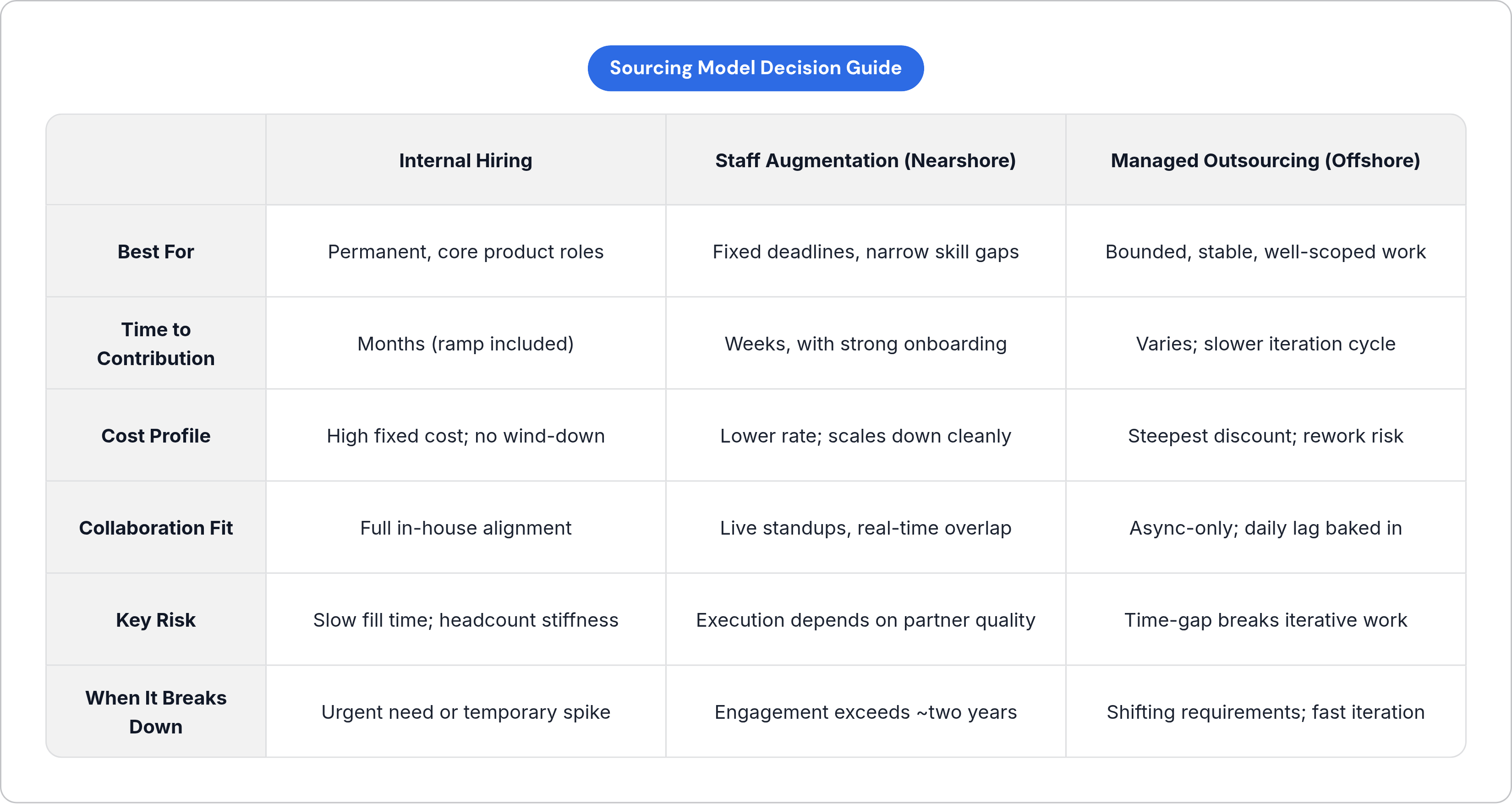
Four things actually drive this decision: how urgent the need is, how long the work runs, how narrow the skill gap actually is, and how much room the organization needs to scale back down later.
Internal hiring wins when the role is permanent and central to the product, when a multi-month fill time won't jeopardize delivery, when keeping institutional knowledge in-house is a real long-term goal rather than a nice sentiment, and when compliance or clearance rules make employment status non-negotiable.
Staff augmentation wins when the deadline is fixed and shorter than a normal hiring cycle can accommodate, when the work has a clear end date that doesn't justify a permanent seat, when the skill gap is narrow enough that a specialist solves it faster than any generalist hire could, and when the organization needs to scale down later without eating restructuring costs.
Nearshore specifically earns its place when the work needs live collaboration to hold sprint pace, when cost matters but an offshore time gap would wreck the project's rhythm, and when requirements are still moving, because fast back-and-forth is what keeps the build honest to what the client actually wants.
None of this is fixed forever, either. A team that brings in augmented engineers to hit a launch date can revisit a permanent hire once the shape of the ongoing work becomes clear. And hybrid setups deserve their own mention here: internal engineers hold architecture and product direction, augmented engineers add delivery capacity around them, and that combination lets an org move fast without betting its whole team structure on how quickly one hiring cycle happens to go.
What separates a sourcing decision that works from one that just sounds reasonable
Choosing the right model isn't the hard part. Most of these decisions live or die on execution, not on the initial call.
For internal hiring, the usual failure is a screen that isn't technical enough, early enough. Weak non-technical filters let unqualified people through the first couple rounds, the rejection rate in the technical interview spikes, and weeks of cycle time burn that never needed to burn. For staff augmentation, the failure rhymes but looks different: a vendor treating the whole thing like a placement transaction instead of a technical partnership. A partner that skips mapping your stack before the engineer starts, skips screening for remote communication, and can't point to engineers who've actually worked in an environment like yours, is a staffing agency wearing a different name tag.
A handful of signals actually predict how someone performs, in either model. Practical coding exercises that show how a person thinks through a problem, not whether they've memorized syntax, are one. How someone handles being stuck with nobody around to unblock them is another, and it predicts remote performance better than most standard interview loops ever will. Code review history, open-source work, references from people who actually managed them on a distributed team round it out.
For augmented and distributed teams, retention through the life of the engagement, not just a clean placement, is the real quality signal. A partner whose engineers stay engaged, ramp fast, and leave the codebase better than they found it is proving the entire point of this framework. The sourcing model sets the conditions. Execution decides what actually happens inside them. Technical leaders who understand both halves tend to run teams that deliver. The ones who only understand the first half usually find out the hard way, right around when the project's already late.