University and Campus Recruiting Programs
Employers are concentrating campus recruiting at fewer schools with deeper presence.

The school list is the first and most consequential decision a campus program makes. It sets the ceiling on everything that follows, and no amount of recruiter effort later recovers a bad call here.
The variables driving school selection are specific: program strength in relevant disciplines, geographic proximity to office locations, historical yield of accepted and retained hires, demographic composition of the student body, and the cost of sustaining meaningful presence on that campus. These factors rarely align. A school with excellent engineering output might be a twelve-hour flight from the nearest office. A nearby program might have historically sent candidates who looked strong on paper and left within eighteen months. Weighing those tradeoffs requires actual data from prior cycles, which is part of why new campus programs underperform for two or three years while that evidence accumulates. I've watched capable recruiters spin their wheels at schools where the company had no genuine footprint, generating resume volume that looked productive until the retention numbers came in.
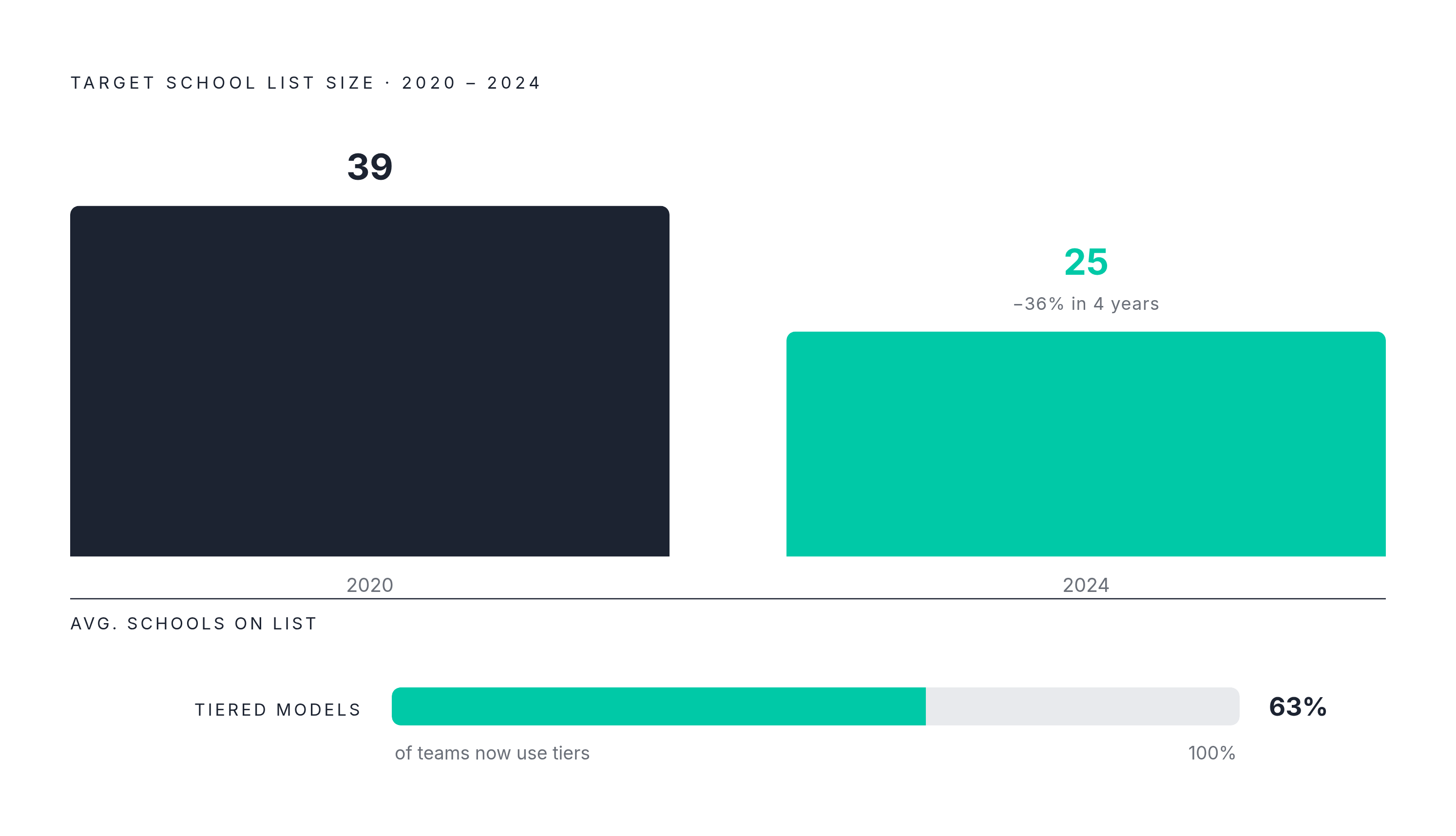
The dominant trend in recent years has been compression. Per Veris Insights' 2025 research, the average employer target school list fell from 39 schools in 2020 to 25 in 2024, a 36% reduction in four years. This isn't cost-cutting. It's a belated recognition that shallow presence at forty schools produces worse outcomes than deep presence at twenty-five. A company that is genuinely known on a campus, whose engineers have spoken in courses, whose alumni work in the career center, whose name appears on student club sponsorship banners, converts candidates at a materially higher rate than a company that shows up once a year at a fall fair and expects students to care.
The tiered model formalizes this logic. Veris Insights' 2025 data indicates that 63% of university recruiting teams now organize their school lists into tiers. Tier 1 schools receive the highest investment: on-campus staff or dedicated recruiting partners, research and capstone sponsorships, ambassador programs staffed by recent hires. Tier 2 schools receive moderate engagement, career fairs and virtual information sessions, with select club partnerships. Tier 3 schools are covered through digital presence and resume sourcing only. The tiering isn't permanent. It gets recalibrated annually against yield data from the previous cycle, meaning a school can move in either direction depending on what the numbers actually show.
Skills demand is reshaping school lists too. Companies prioritizing AI, data science, cloud infrastructure, and cybersecurity are concentrating their presence at universities with strong STEM output. LinkedIn's 2025 Emerging Jobs Report identifies AI expertise, cloud computing, cybersecurity, and data analytics as the most in-demand skills in the current labor market. A flagship state university with a strong applied computing program can outperform a more prestigious institution where the relevant department is smaller and faculty connections are harder to develop. Prestige rankings are a lazy proxy for what the data actually says.
School selection belongs in a conversation between talent acquisition leadership, business unit heads, and finance. Not in an HR coordinator's spreadsheet.
Building employer brand presence on campus before recruiting season opens
At any school where a company lacks genuine recognition, strong candidates either don't notice the open roles or the wrong candidates apply. Students pursue companies they've encountered, heard about from peers, or been recommended by faculty. A company with no footprint on a campus before September is already behind employers who spent the prior twelve months building one. This is obvious in retrospect. It's consistently ignored in practice.
The tactics that work aren't complicated, but they require sustained commitment over time. Engineers and product managers delivering guest lectures or technical workshops in computer science and business courses put actual employees in front of students months before any application opens. Sponsoring capstone projects, where the company defines a real problem and students solve it for academic credit, creates multi-semester touchpoints with high-potential students right in their discipline. Student club partnerships, for which Veris Insights' 2024 data shows 69% of employers planned to increase investment, provide recurring access to self-selected, motivated students already organizing around professional interests.
Campus ambassador programs deserve specific attention. A recent hire from the target school who maintains relationships with former professors, attends career center events, and surfaces strong candidates is doing something a recruiter traveling in from out of town cannot replicate. That hire already has social trust in place. Their credibility with peers is the company's most efficient brand asset on that campus, and it costs a fraction of what the recruiter trip costs. The limitation is that it requires genuine selection and ongoing support. Ambassadors who feel disconnected from the company go through the motions, and students notice quickly when someone is performing a role rather than inhabiting it.
Employer brand is the accumulated reputation formed through every interaction a student, faculty member, or career services professional has had with the company's people. A single engineer who gives a compelling lecture and stays afterward to answer real questions moves the needle more than a polished booth display. Relationships with faculty and career center staff, built over years rather than recruiting seasons, open referral pipelines and event placements that no cold outreach budget can access. The employers who understand this hold a compounding advantage, and competitors who parachute in during September cannot close that gap quickly, no matter how aggressively they try.
The recruiting calendar and why timing governs everything
Campus recruiting is unusual among talent acquisition functions in that its timeline is set by institutions, not employers. The academic calendar is non-negotiable. Missing key windows doesn't mean a delayed hire; it typically means no hire from that school in that cycle.
NACE's guidance is clear: active sourcing and career fair participation should begin nine to twelve months before the intended start date. For a class starting in June, that means being on campus and in students' awareness by the preceding September. For large technology firms hiring software engineers, the window compresses further. Internship and full-time roles at major tech companies are typically posted in late summer or early fall for the following summer's start, earlier than most non-tech employers have even begun their internal requisition process. The consequence is predictable: top candidates at target schools have committed to competing offers before slower-moving employers have finished internal approvals. I've seen this play out enough times that it stopped surprising me, though I still find it remarkable that the lesson doesn't stick organizationally.
Within the academic year, career fairs follow a seasonal logic worth understanding precisely. Fall fairs are the primary sourcing moment for summer internships and the following year's full-time class. The strongest candidates are available, uncommitted, and actively exploring. Spring fairs are backfill; the most competitive students are typically already in process or have already accepted. Organizations that over-rely on spring events are recruiting from a diminished pool and often don't realize it until they look carefully at who they've actually hired.
The hybrid model, combining virtual and in-person events, became the operational standard in 2024 and is now simply how campus recruiting works. Virtual events extend geographic reach and reduce per-candidate cost. In-person events carry higher conversion, particularly for the candidates an employer most wants, because face-to-face interaction accelerates the trust and relationship-building the entire campus model depends on. The mature approach uses both formats deliberately, with in-person investment concentrated at Tier 1 schools and for high-priority candidate segments.
Organizations operating global talent pipelines need to account for international recruiting calendars explicitly. In India, campus placement at engineering colleges follows a structured season governed by institutional schedules, not employer preference. The country's top IT firms, including TCS, Infosys, and Wipro, hire tens of thousands of graduates annually through this cycle, drawing from a pool of more than 1.5 million engineering graduates per year according to AICTE data. For companies building global early-career pipelines, understanding and operating within those local calendars is a prerequisite. It's not an adaptation; it's the baseline.
How the internship pipeline functions as a recruiting and evaluation engine
The internship is the most important mechanism in campus recruiting, and it is routinely underestimated. Not cheap labor, and not goodwill outreach. It is a multi-week structured evaluation of a candidate under actual working conditions, during which the candidate is simultaneously conducting a rigorous evaluation of the employer. Both parties are making a consequential decision, often one that shapes the next several years of a career. That mutual weight is precisely what makes program design matter so much, and why a poorly structured internship is worse than no internship at all. It generates noise instead of signal.
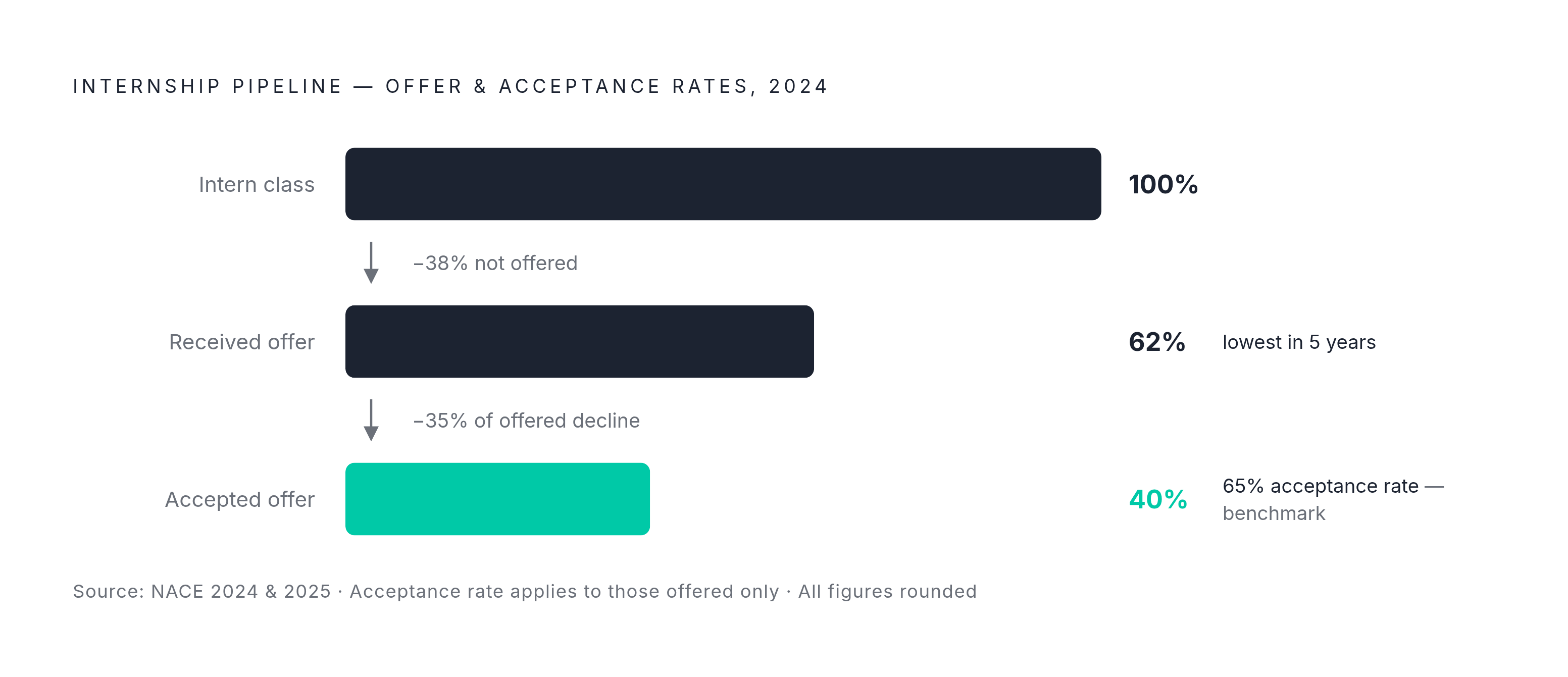
The conversion data validates the investment. Per NACE's 2024 figures, 65% of interns who receive a return offer accept it. An intern who converts has already been vetted through real work, onboarded into the team's culture, and socialized into the organization. Their trajectory and potential are known quantities to the managers they will work alongside. That makes them dramatically lower-risk than an external hire whose only evidence is interview performance, and it's worth saying plainly: a strong intern-to-full-time pipeline is one of the few genuine advantages a campus program builds over time.
A well-designed internship program has specific structural characteristics. The intern should have a defined project with a real deliverable, not a series of ad hoc tasks assembled week to week. There should be a named manager responsible for day-to-day direction and a separate mentor, because these two roles serve different functions and conflating them degrades both. Structured evaluations at midpoint and end-of-term, scored against documented criteria rather than gut impression, produce defensible decisions and protect the program from managerial inconsistency. Cohort events allow interns to build peer relationships and develop a ground-level read on culture, which matters for offer acceptance later. And there must be a clear, communicated timeline for return offer decisions. Uncertainty at that stage is a retention leak, entirely self-inflicted, and entirely avoidable.
The offer rate signal from NACE's 2025 Internship and Co-op Report is worth examining closely: employers extended full-time offers to 62% of their 2024 intern class, the lowest offer rate in five years. This reflects employers applying more selective conversion criteria rather than extending offers to everyone who completes the program. That selectivity is appropriate, but it demands program design rigorous enough to surface genuine differentiation. A program where every intern looks equivalent at the end has failed its evaluation function.
Co-op programs, semester-length rotations typically structured across two or three terms, offer a longer evaluation window and stronger cultural integration. The coordination cost is higher, but the depth of information available to both parties at the conclusion of a co-op exceeds what any summer internship can provide. For roles where cultural fit and judgment matter as much as technical skill, that additional time is worth the overhead.
The cost structure of campus hiring and where the money actually goes
Campus hiring isn't inexpensive, and organizations that approach it as a low-cost alternative to experienced hiring are operating on a flawed premise. The investment is different in character, not lower in magnitude.
NACE's 2025 Recruiting Benchmarks place the average cost per campus hire in the United States at approximately $6,275, above the all-hire average of $4,700 reported by SHRM's 2025 data. The median annual campus recruiting budget runs roughly $114,000 per year per NACE's 2025 figures. Budget flows toward career fair fees and recruiter travel, event hosting and catering, employer branding materials, recruiter time allocated to campus activities, internship program overhead including manager time and programming costs, and sign-on incentives. That last category is easy to undercount. Manager time isn't invoiced anywhere; it just disappears from the work hours of your most experienced people, silently.
Cost per hire is a useful operational metric, but it isn't the right optimization target. Organizations that cut school presence to reduce travel costs, thin out program investment to reduce overhead, and then wonder why intern-to-offer conversion declines and early attrition climbs are treating a symptom while missing the cause entirely. The financially honest metric is cost per retained hire, accounting for what the program actually cost to produce someone still contributing eighteen months after start.
The retention data reframes the investment case. Research from the UK Institute of Student Employers indicates that well-run campus programs retain graduates for over four years on average, substantially longer than the job-hopping narrative surrounding early-career hiring would suggest. Against that tenure, a $6,275 campus hire amortizes over a very different timeframe than the $25,000 to $50,000 recruiting fee associated with a mid-career external hire who may need three to six months to reach full productivity. The campus model is expensive in the year it runs and inexpensive over the career it initiates. That math rarely surfaces in a single-cycle budget review, which is precisely why programs get cut when they shouldn't be. It's a visibility problem masquerading as a value problem.
Screening, assessment, and where AI tools fit into candidate evaluation
Large campus programs receive application volumes that make manual review operationally infeasible. A company attending twenty-five target schools, maintaining a digital presence, and running a structured internship program can receive thousands of applications per cycle. Some form of prioritization infrastructure isn't optional.
The standard screening architecture builds in layers. Resume and GPA filters are blunt and fast; they reduce volume but miss substantial signal. Technical assessments — coding challenges, case problems, skills evaluations administered early in the process — add a layer of demonstrated competency before any recruiter time is committed. Structured phone or video screens, using standardized question sets scored against a rubric, impose consistency that unstructured conversations cannot provide. Final rounds, whether conducted on campus, at an office, or virtually, combine behavioral and technical evaluation with multiple interviewers to diversify the assessment.
AI screening tools have entered this infrastructure quickly. They're used for resume ranking, interview scheduling, early-stage application filtering, and increasingly for pattern-matching between candidate profiles and historical hire data. The efficiency gains are real. So is the risk, and it is documented specifically enough that ignoring it is indefensible.
A 2024 study from the University of Washington tested three large language models across more than three million resume-to-job comparisons and found that these systems favored white-associated names 85% of the time, and never, in any comparison tested, favored Black male-associated names over white male names. That isn't a theoretical bias concern or a regulatory abstraction. It is a measured failure mode in systems that were not designed and audited for hiring use. Deploying these tools without safeguards doesn't accelerate recruiting; it automates discrimination at scale, invisibly, which is the more troubling part.
The practical response requires structural preconditions: PII masking before AI-assisted scoring, regular bias audits of output distributions, and mandatory human review at any gatekeeping stage. Regulatory pressure from multiple jurisdictions is already moving in this direction. Organizations implementing these practices now aren't ahead of the curve so much as they're avoiding a foreseeable reckoning.
The broader principle holds regardless of tooling. AI screening manages volume. It does not evaluate early-career candidates, whose resumes contain limited track record and whose primary signal is potential rather than demonstrated output. That judgment remains a human function, and outsourcing it to a ranking algorithm is a category error that produces worse hires and real legal exposure.
Converting offers and closing the candidates you want most
An intern who completed the program, received strong performance feedback, and holds a return offer can still decline. This happens regularly and, with enough experience, becomes predictable. At schools where your company recruits, every competing employer recruits too. Competing offers arrive in the same window. Students talk to each other constantly and specifically about compensation, timelines, and offer terms. The offer extension isn't the end of the process; it's the beginning of the close.
Acceptance is determined by a specific set of factors, and compensation competitiveness is foundational among them. Base salary, signing bonus, and benefits must hold up against what peer employers are offering, and students at target schools have good information about what those numbers look like. Speed matters as much as amount. A candidate managing two competing timelines will rationally commit to the offer with a clear deadline and a clear answer, not to the employer still working through internal approvals two weeks after the program ends. The form of the offer communication matters too: a personalized call from the manager an intern worked with for twelve weeks signals organizational investment in a way that a generic digital offer letter doesn't, full stop.
Ambiguity kills conversions. Candidates who are uncertain about role definition, team placement, or work location at offer stage decline more frequently than those who have clarity on all three. Exploding offers, which impose artificially compressed acceptance deadlines, create urgency but damage employer reputation on campuses where word travels quickly. The candidates you want most are also the ones with the most options. Pressure tactics work on candidates without alternatives, which is precisely the population you don't want to attract.
The six months between October acceptance and June start date represent a specific vulnerability most programs underestimate. A student who accepted in the fall can be recruited again, change their mind, or receive an attractive offer from a firm that moved slowly through its fall process. Structured check-ins during that period, pre-onboarding materials, introductions to the incoming cohort, and genuine contact from the actual team they will join reduce reneges. The program doesn't end at acceptance. Any team that treats the offer signature as the finish line will have a rude introduction to spring.
Metrics that reveal whether a campus program is actually working
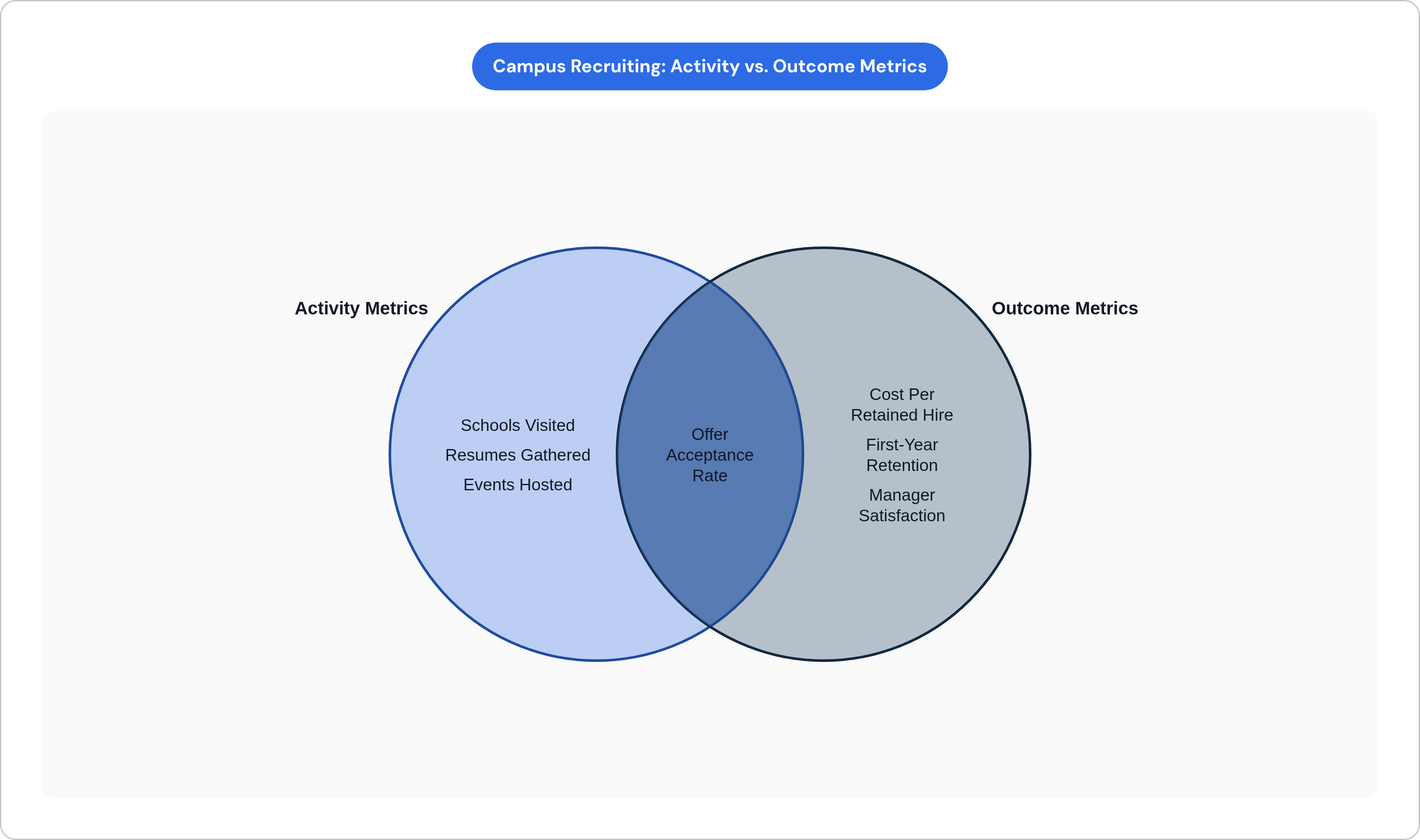
Activity metrics are what most programs measure because they're easy to collect: schools visited, resumes gathered, events hosted, applications received. These numbers describe program effort, not program quality. A program that collected ten thousand resumes and retained twelve people at the eighteen-month mark isn't performing well. It's performing busily.
The outcome metrics that reveal program health are more specific, and they require deliberate collection. Intern-to-full-time offer rate and offer acceptance rate, measured together, indicate both how selective the evaluation is and how attractive the employer is to candidates who have experienced it firsthand. The 65% intern offer acceptance rate from NACE's 2024 data serves as a program-level benchmark; programs running substantially below that number have a compensation gap, a slow process, or a weak internship experience creating the delta, and these causes are distinguishable with the right exit data. Time-to-offer from application measures process efficiency and directly correlates with conversion in competitive cycles. First-year retention rate of campus hires indicates whether the program is selecting for genuine fit or just filling seats. Cost per retained hire, not cost per hire, is the financially honest version of ROI.
Hiring manager satisfaction scores, measuring whether campus hires perform at expected levels once in role, close a feedback loop that many recruiting teams leave conspicuously open. If managers are consistently disappointed in campus hire quality, the sourcing, screening, or evaluation process has a structural failure somewhere. That failure is invisible without the data, and yet it is among the most common reasons campus programs quietly lose internal support over time without anyone quite being able to say why.
School-level yield analysis, tracking which schools in the target list produce accepted offers and retained employees, drives the tiering decisions for the following cycle. This is the mechanism by which program investment becomes self-correcting over time. Diversity metrics within the intern class and full-time conversion population, measured against the student population at target schools, are both an equity imperative and a quality control measure given the documented bias risks in AI-assisted screening.
Programs that can answer "what percentage of our campus hires from two years ago are still here?" have the data to make defensible investment decisions. Programs that cannot answer that question are operating without feedback. Without feedback, there is no system, only activity.
How organizations sustain campus programs as year-round systems rather than seasonal campaigns
The seasonal-campaign failure mode follows a recognizable pattern. An organization activates campus recruiting in September, attends career fairs through October, interviews through November, extends offers in December, and then goes dark until the following September. School relationships go cold. Career center contacts move on. Campus ambassadors lose their connection to the program and drift. The following September, the organization starts over from a shallower foundation than it had twelve months before. This cycle produces inconsistent pipelines, declining school relationships, and lower-quality intern classes that compound quietly year over year, usually until something forces an accounting. By then, the damage takes years to reverse.
The year-round model distributes effort across the full calendar and ties each quarter's activities to the next. While an intern cohort is active, evaluations are running, return offer decisions are being made, and relationships with career center staff and faculty are being actively maintained. After the internship class concludes, the team conducts a program debrief, runs school-level yield analysis, revises the target list for the coming year, and begins producing and distributing employer brand content before the next recruiting season opens. When recruiting season begins again, campus ambassadors are activated and current, career fairs are attended by staff who already have relationships on those campuses, and assessments are deployed into a candidate pool with some existing familiarity with the company. After offers are extended, candidate nurturing begins immediately, and the pre-start communication cadence runs through to the first day.
The most important asset in a mature campus program is institutional knowledge, and it compounds in ways that are hard to quantify until you've watched a competitor try to catch up. A recruiter who has built genuine relationships with a computer science faculty over three years has access to informal referrals, early candidate introductions, and program placements that no first-year competitor can replicate. That access isn't purchased; it's earned through consistent presence and through delivering on commitments made to the school. It is also not transferable on short notice. Organizations that pause and restart campus recruiting after budget cycles don't return to where they left off. They return to the beginning, which is a meaningful and entirely avoidable cost.
The programs that consistently produce high-quality early-career hires and retain them aren't running a more creative campaign each September. They're running a better-engineered system every month of the year. The distance between those two approaches shows up clearly in the metrics, usually around year three, and by then it's not a gap that closes in a single cycle.