Boolean Search Techniques for Recruiters
Precision sourcing cuts through talent shortage noise with Boolean logic, not guesswork.

Boolean search applies formal logical operators to a query and returns only results that satisfy the exact conditions you specify. No interpretation layer, no semantic inference, no probabilistic match. The query says what it means, and the index returns what the query asks for. That determinism is the point, and in a market where ManpowerGroup's 2024 Talent Shortage Survey of more than 40,000 employers across 41 countries found 74% reporting difficulty filling roles, precision isn't an abstraction. It is the thing separating a genuine pipeline from a pile of loosely relevant profiles.
The origin is mathematical. George Boole formalized binary logic in the 19th century; information retrieval systems adopted it because it maps naturally onto indexed databases. The underlying structure hasn't changed because the underlying need hasn't changed. When you need profiles containing a specific skill, excluding a specific seniority level, and matching one of several acceptable job titles, you need logic, not inference.
The persistence of Boolean alongside newer AI-driven tools isn't nostalgia. A 2024 LinkedIn Global Recruiting Trends report found that 73% of recruiters use Boolean search regularly, with 58% calling it critical for roles requiring specific technical skills. AI sourcing tools interpret intent, which works well when the objective is a large, roughly relevant pool. It fails when the requirement is exact: a particular framework, a specific clearance level, a combination of two rare competencies that can't be approximated by semantic neighbors. For those searches, Boolean isn't the legacy option. It is the only option that actually works.
The developer shortage is projected to reach 4.3 million globally. In a market of genuine scarcity, the gap between a keyword match and a qualified candidate is precisely where sourcing skill lives. Surfacing volume is easy. Surfacing the right person is the discipline.
The six operators that cover nearly every technical search you'll build
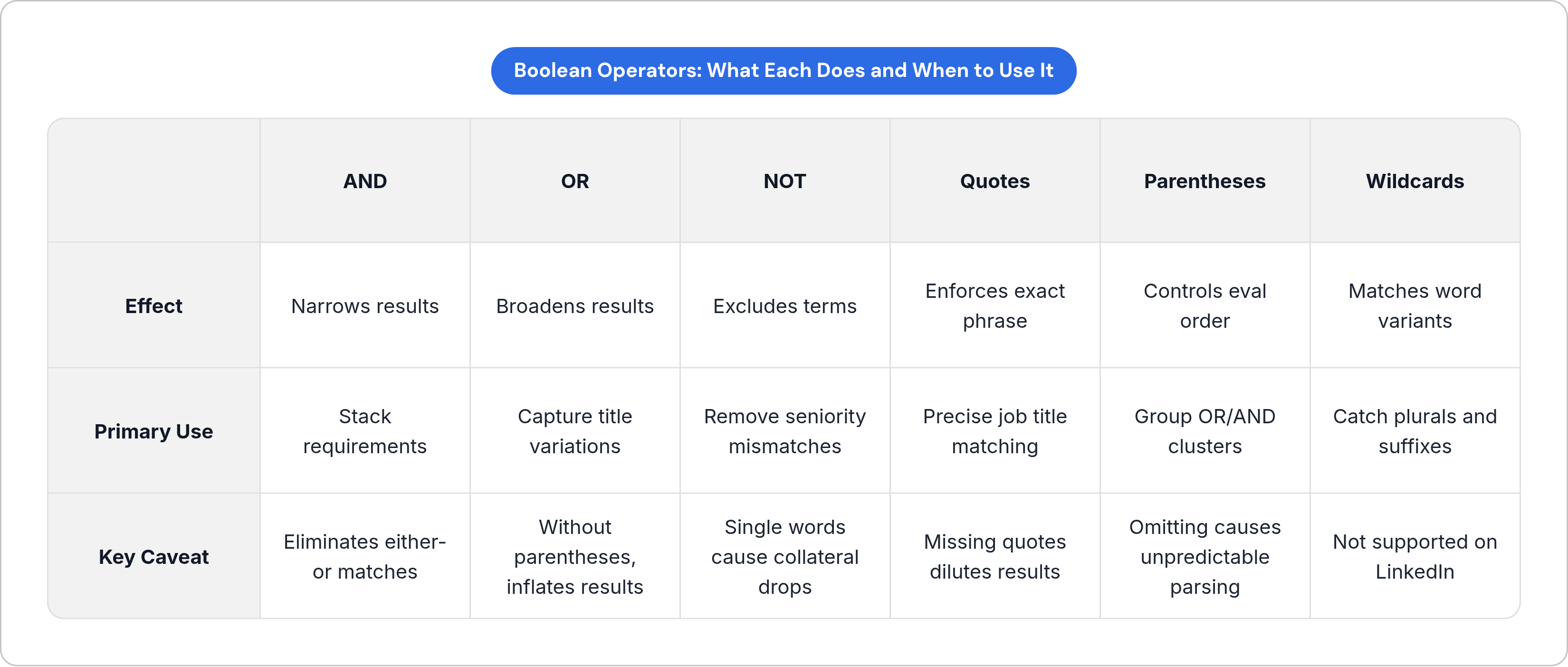
Every Boolean string, regardless of complexity, assembles from a small set of building blocks. Six operators cover the vast majority of technical sourcing work. Get these right first.
AND narrows results by requiring both terms to appear. "Python AND Django" returns only candidates who mention both; it eliminates everyone who lists one without the other. This is the primary mechanism for stacking requirements.
OR broadens results by accepting either term. It's indispensable for capturing the inconsistency that plagues technical role nomenclature. "Software Engineer" OR "Software Developer" OR "SWE" acknowledges that the same job carries different titles across companies, geographies, and professional generations. Omitting OR forces a false choice between completeness and precision. You'll miss real people.
NOT excludes terms. "engineer NOT manager" filters out engineering managers and directors when the role requires an individual contributor. But overusing NOT on single words creates collateral damage, which the next section addresses directly.
Quotation marks enforce exact phrase matching. "machine learning engineer" as a quoted phrase and machine learning engineer as three loose keywords produce meaningfully different result sets. Without quotes, a platform returns any profile containing those three words in any position, which dilutes results substantially. Quotes are among the highest-leverage characters in any Boolean string.
Parentheses control evaluation order. This matters because AND and OR interact in ways that aren't always intuitive. The string React OR Angular AND AWS OR Docker doesn't parse the way most recruiters intend. Written correctly: (React OR Angular) AND (AWS OR Docker). The parentheses establish that the platform should first find profiles matching either front-end framework, then narrow that set to profiles also matching either cloud or containerization tool. Without parentheses, platform parsing behavior varies and produces results that are genuinely unpredictable.
Wildcards match word variations from a root stem. "develop*" returns developer, developers, development, developing. They catch abbreviations, plurals, and gerunds without requiring individual enumeration. The critical caveat: LinkedIn doesn't support wildcards. Every term variation must be spelled out explicitly there. Knowing this before building a string saves real time, because the string will fail silently, with no error message, just quietly wrong results.
The most common beginner error is overusing OR without parentheses, producing a flat string that inflates result counts with loosely related profiles. That defeats the purpose of building the string at all.
Advanced operators that add precision most recruiters don't use
Beyond the six core operators, a smaller set of techniques separates adequate Boolean work from genuinely precise sourcing. Most recruiters know these exist. Far fewer use them consistently.
Proximity operators return results where two terms appear within a specified word distance of each other. The syntax varies by platform but typically follows the form "Software Developer" AROUND(5) "Machine Learning". The practical value is real: this finds profiles where those terms appear near each other in actual context, inside a job description or project summary, rather than simply anywhere on the page. A candidate who lists every current buzzword in a skills section is different from one whose project descriptions situate those skills together in coherent work. Proximity operators help distinguish the two, but they require careful calibration because setting the window too tight will drop legitimate candidates.
The minus sign as NOT is a syntax distinction that trips up experienced practitioners when they switch between tools. Google and several other platforms use the minus sign for exclusion rather than the word NOT. They're not interchangeable. A string written for LinkedIn Recruiter with NOT will behave differently on a Google X-ray search, where "-" is the correct exclusion syntax: site:linkedin.com "data engineer" "Apache Kafka" -"junior" -"intern". Treating these as equivalent causes string failures that produce no error, just quietly wrong output.
Refined wildcard strategy matters more in technical recruiting than in most other domains because the technology landscape moves fast. Framework versions, tool variations, and evolving nomenclature mean that a recruiter who lists five specific tools will miss a sixth that the most current practitioners use. Where wildcards are supported, anchoring to a root stem catches variations automatically. Where they're not, building a comprehensive OR list requires active maintenance as terminology shifts. There's no set-it-and-forget-it version of this.
The NOT trap deserves specific attention. Using NOT on a single common word excludes everyone whose profile contains that word in any context. "NOT manager" will strip profiles where the word appears in a phrase like "strong stakeholder manager" or "project management." The more defensible approach targets specific role combinations: NOT ("Engineering Manager" OR "Director of Engineering" OR "VP of Engineering"). This removes the profiles that represent an actual mismatch while preserving the ones that don't.
How platform differences change what your Boolean string can do
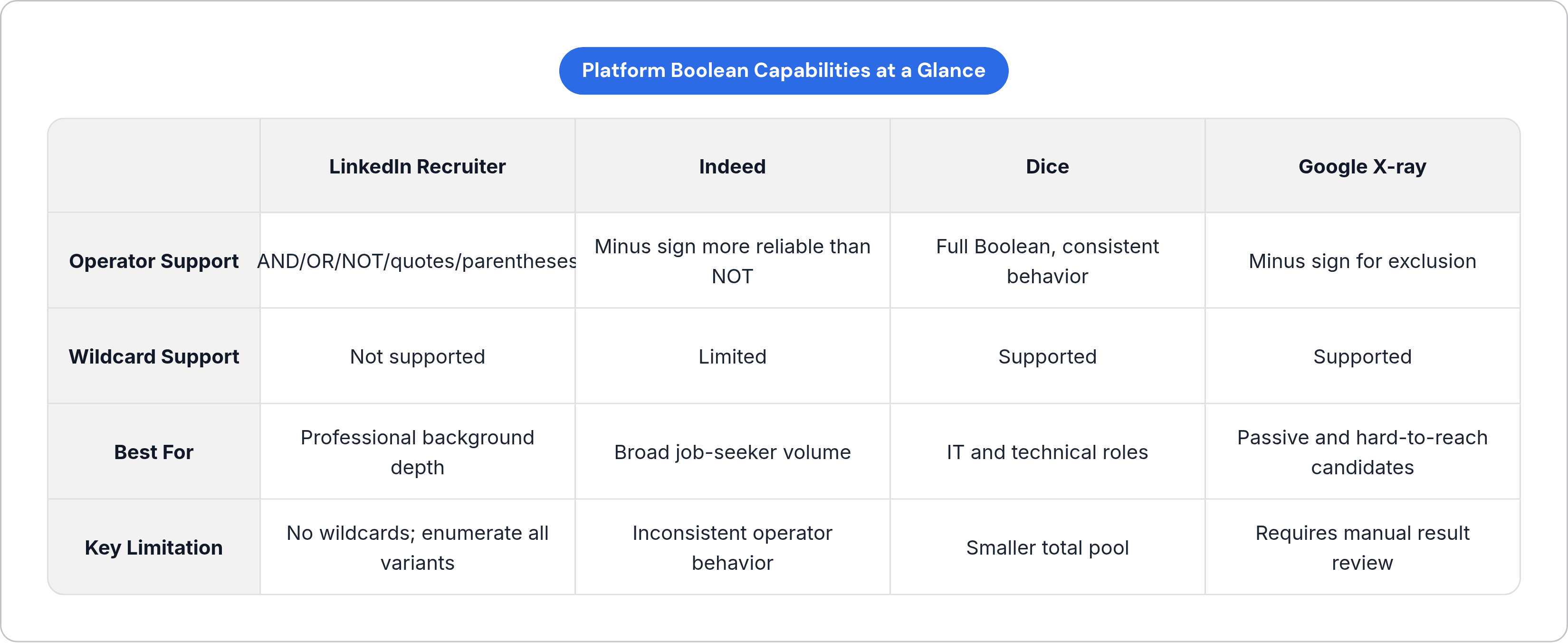
A Boolean string isn't portable. Syntax that works precisely on one platform will produce incorrect or degraded results on another. This is one of the most consequential practical facts in sourcing, and it's consistently underestimated, including by recruiters who have been doing this for years.
LinkedIn Recruiter supports AND, OR, NOT, quotes, and parentheses natively, but not wildcards. Every term variation must be enumerated explicitly. LinkedIn's strength is the density and structure of its profile data: employment history, skills endorsements, education, and tenure information are all searchable and well-indexed. For professional background searches, it remains the dominant platform, and the lack of wildcard support is the price you pay for that depth.
Indeed has less consistent operator behavior. NOT is unreliable there; the minus sign performs exclusions more dependably. Quote-wrapped phrases are essential for job title accuracy on Indeed, because loose keyword matching on title fields significantly widens results beyond intent. I've run the same conceptual search on both platforms and received result sets that shared almost no overlap, which should tell you something about how seriously to take platform-specific behavior.
Dice is purpose-built for IT and technical sourcing, and that specificity shows. Full Boolean syntax behaves more consistently there than on general job boards. For technical roles in software development, cybersecurity, and infrastructure, Dice's index skews toward the population a technical recruiter is actually trying to reach.
Google X-ray search, using the site: operator, is the highest-ceiling sourcing method available without a paid license. The basic form: site:linkedin.com/in/ "software engineer" "Kubernetes" "San Francisco". This surfaces public LinkedIn profiles, GitHub repositories, personal portfolio sites, conference speaker pages, and university research profiles that are invisible to within-platform searches. The candidate who hasn't logged into LinkedIn in two years but maintains an active GitHub and has spoken at PyCon is reachable via X-ray and invisible everywhere else.
GitHub-specific search rewards recruiters willing to operate inside the platform's own interface. Language:, location:, and followers: qualifiers combine with keywords and offer a form of precision that resume databases can't replicate, because they index demonstrated activity rather than self-reported credentials. The search language:python location:london followers:>50 finds active Python contributors in London with meaningful community presence. For roles where output quality matters as much as listed credentials, this is a qualitatively different signal.
ATS and CRM database Boolean is underused relative to its value. Silver medalists, candidates who interviewed well for a prior role but weren't hired, sit in most ATS databases largely dormant. A well-constructed Boolean string run against a company's own historical data resurfaces those candidates at a fraction of the cost of sourcing new ones. Many modern ATS platforms parse resume content and accept Boolean strings in their internal search interface; capabilities vary significantly by vendor, and knowing the specific platform's limits is prerequisite to using it well.
Building a Boolean string from scratch for a technical role
The construction process is sequential and iterative. Each layer addresses a different sourcing problem, and the order matters.
Start with the job title layer. List every title variation the target candidate will plausibly use. For a full-stack role: "Full Stack Developer" OR "Software Engineer" OR "Web Developer" OR "Full-Stack Engineer". This isn't padding. It reflects genuine variation in how the same job is titled across companies, regions, and time periods. Missing a common variation means missing a segment of the qualified population.
Add the required skills layer with AND. Connect the title group to the technical requirements. (React OR Angular OR Vue) AND (AWS OR GCP OR Azure) narrows to candidates who appear in the title layer and have relevant front-end and cloud experience. Keep each skills cluster in its own parenthetical group. Mixing them without parentheses is where strings start to behave unpredictably.
Apply exclusions with NOT. Proactively remove profiles that the job description explicitly doesn't need. For an individual contributor role: NOT ("Engineering Manager" OR "Director of Engineering" OR "VP of Engineering"). Use specific combinations rather than single words, for the reasons described in the previous section.
A complete string for a mid-level full-stack role:
("Full Stack Developer" OR "Software Engineer" OR "Full-Stack Engineer") AND (React OR Angular OR Vue) AND (AWS OR Docker OR GCP) AND NOT ("Engineering Manager" OR "Director" OR "VP")
Test and iterate. Run the string and review the first 10 to 20 results manually. Too few results means the OR layers are too narrow or a NOT exclusion is removing qualified candidates. Too many irrelevant results means adding AND terms, wrapping titles in quotes, or adding targeted NOT exclusions. This review isn't optional. It is how the string becomes reliable.
Document strings that work. A library of tested base strings for common technical roles shortens every subsequent search. The initial investment in building and validating a string is real; the marginal cost of reusing it is negligible. This is one of the few places in recruiting where prior work directly subsidizes future work.
X-ray search as a sourcing layer for candidates who don't surface on job boards
The technically strongest candidates are frequently the least visible ones. They're not refreshing their LinkedIn profile, not applying to postings, and not responding to InMail. They are maintaining public GitHub repositories, contributing to open-source projects, writing technical blogs, or listed as speakers at professional conferences. All of it is publicly indexed by Google.
X-ray search exploits that indexing. By combining Google's site: operator with Boolean logic, a recruiter can search any domain with the same precision available inside a paid sourcing platform.
A LinkedIn X-ray search: site:linkedin.com/in/ "machine learning engineer" "PyTorch" "remote". This returns public LinkedIn profiles matching those criteria without requiring a LinkedIn Recruiter license. Beyond cost savings, it's also a fast way to validate string logic before running it inside a paid tool, because the results are visible immediately and the feedback loop is short.
A GitHub X-ray search: site:github.com "data scientist" AND (TensorFlow OR PyTorch) AND NOT "entry-level". This finds active contributors whose code is public. A GitHub profile with active repositories in the relevant domain is demonstrated skill, not self-reported skill. That distinction matters for roles where the actual work product is the primary evaluative criterion.
The ecosystem of X-ray targets extends beyond LinkedIn and GitHub. Conference speaker pages, university research lab sites, Stack Overflow profiles, and personal portfolio domains are all searchable via the site: operator. These pools are smaller and require more manual review, but they have a meaningful competitive property: most other recruiters aren't searching them. The candidate reachable only via X-ray into a conference speaker archive isn't receiving ten InMails a week. That is the point.
Where AI sourcing tools fit and where Boolean still outperforms them
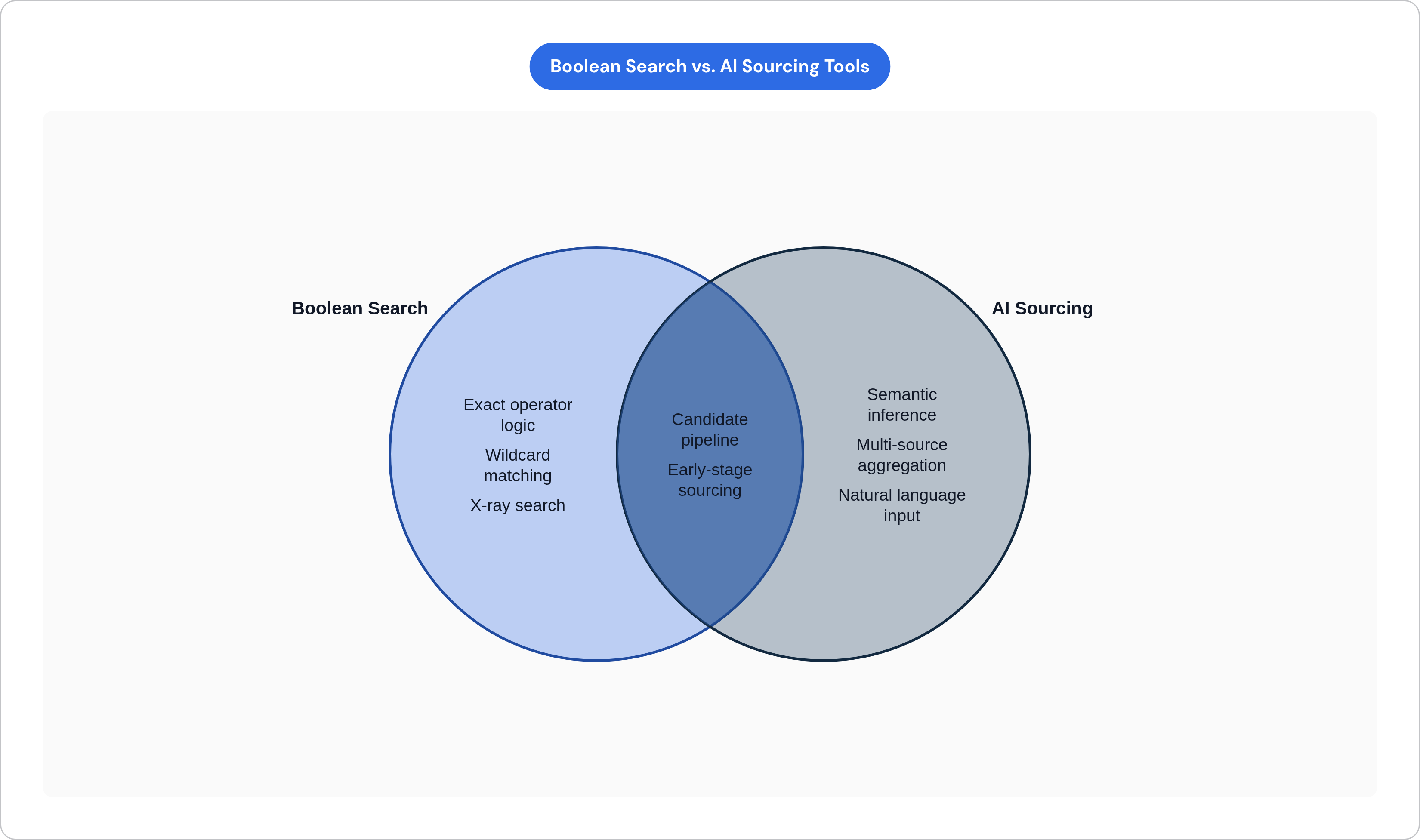
AI adoption in recruiting climbed from 26% to 43% in a single year, per SHRM's 2025 Talent Trends data, and the acceleration is genuine. The professional obligation is understanding where AI applies and where it doesn't, because treating AI sourcing as interchangeable with Boolean produces specific and consequential failures.
AI sourcing tools handle semantic understanding well. They interpret the intent behind natural language descriptions and map them to candidate profiles without requiring operator syntax. They aggregate across multiple data sources, building fuller pictures of candidates whose individual profiles are incomplete or outdated. For broad, early-stage sourcing where the objective is a large relevant pool, AI is faster and requires less configuration than Boolean.
The failure modes are specific to technical hiring. When the requirement is exact, a specific framework version, a particular certification, a combination of two uncommon skills, AI will semantically expand where the recruiter needs precision. The model optimizes for relevance as it understands it; that understanding is neither auditable nor consistent. I've watched AI-driven tools surface candidates for a Kubernetes role who had never worked in container orchestration but had adjacent infrastructure experience that the model interpreted as close enough. Close enough is sometimes fine. For roles where it's not, that is a real problem.
Exclusion logic presents a second failure mode. Removing a specific seniority level, location, or credential set is reliable in Boolean and unpredictable in AI-driven results. The recruiter who needs to exclude candidates without active security clearances needs that exclusion to work every time, not most of the time.
Auditability is the third dimension. A Boolean string is transparent. Every condition it encodes is legible. When a search produces unexpected results, the string can be read and diagnosed. AI outputs are often opaque in ways that make diagnosis difficult, which matters both for improving sourcing practice and for explaining sourcing decisions to a hiring manager who wants to know why certain candidates were included or excluded.
The productive workflow integrates both. Use natural language AI prompts to generate initial candidate pools or to suggest Boolean string structures for unfamiliar roles. Then apply Boolean to filter and verify. Emerging tools that convert natural language queries into Boolean syntax have particular value here: they lower the construction barrier for recruiters building fluency and allow experienced practitioners to generate first drafts quickly and refine from there. The recruiter still needs to evaluate and edit the string, and that evaluation requires Boolean literacy. The underlying skill retains its value as the tools change around it.
LinkedIn recruitment data indicates that teams using Boolean techniques cut time-to-hire by 34% and identify relevant candidates 67% faster. Those are efficiency numbers. The quality argument runs deeper than speed.
Putting the skill to work: what Boolean mastery actually changes for a recruiter
A library of well-tested base strings for common technical roles shortens setup time on every subsequent search. The accumulated knowledge of what works on which platform for which role type isn't easily replicated by a recruiter starting without it. LinkedIn recruitment data puts the candidate quality improvement from Boolean techniques at 25% over keyword-only approaches, and that number reflects downstream hire quality, not just pipeline volume.
The structural shift is more significant than the efficiency gains. A recruiter who understands Boolean operates differently in a constrained market. Rather than competing for the same active-candidate pool as every other recruiter with access to the same platform, the skilled Boolean practitioner goes where candidates actually are: GitHub repositories, passive LinkedIn profiles, X-ray-reachable portfolio sites. Those pools contain candidates who are both technically strong and not yet in contact with anyone. That overlap of genuine qualification and low outreach competition is where real sourcing advantage is built, not in minor improvements to the same searches everyone else is running.
For technical recruiting specifically, the ability to read a job description and immediately construct a precise string, accounting for title variations, skill synonyms, and relevant exclusions, represents a different operating level than keyword searching. It means engaging with the actual specificity of the role rather than delegating that judgment to a job board's relevance algorithm.
Boolean literacy also makes AI tools more valuable, not less. A recruiter who understands the underlying logic can evaluate AI-generated strings, identify semantic expansions that compromise precision, and edit the output into something defensible. Accepting an AI-generated string without that capacity is a categorically different risk than reviewing one you can actually read.
The 74% of employers struggling to fill roles are, in large part, competing in the same visible candidate pool: job boards, active applicants, LinkedIn profiles that surface on default platform searches. Boolean, particularly combined with X-ray sourcing into less-trafficked pools, reaches candidates that pool doesn't contain. In a market of genuine scarcity, that access isn't marginal. It is the difference between finding the person and not finding them.