Global Talent Shortages in High-Demand Sectors
Skills become obsolete faster than institutions can train workers to replace them.

The paradox is real, and the numbers confirm it. The global workforce is larger than it has ever been, and yet ManpowerGroup reported in 2025 that 75% of employers worldwide struggle to find qualified talent, nearly double the 36% who said the same in 2014. More workers, sharper scarcity. The explanation isn't mysterious. The scale of it is.
Skills decay faster than institutions can respond. Technical competencies become obsolete in roughly 2.5 years, per Tecla's research, while a traditional engineering degree takes four or more years to complete. By the time a university graduates an engineer trained on a particular stack, the stack has shifted. This isn't a criticism of universities. Accreditation cycles, curriculum committees, and budget approvals all exist to ensure quality, and they do. The cost is speed. That lag used to mean semesters. Now it means capability generations.
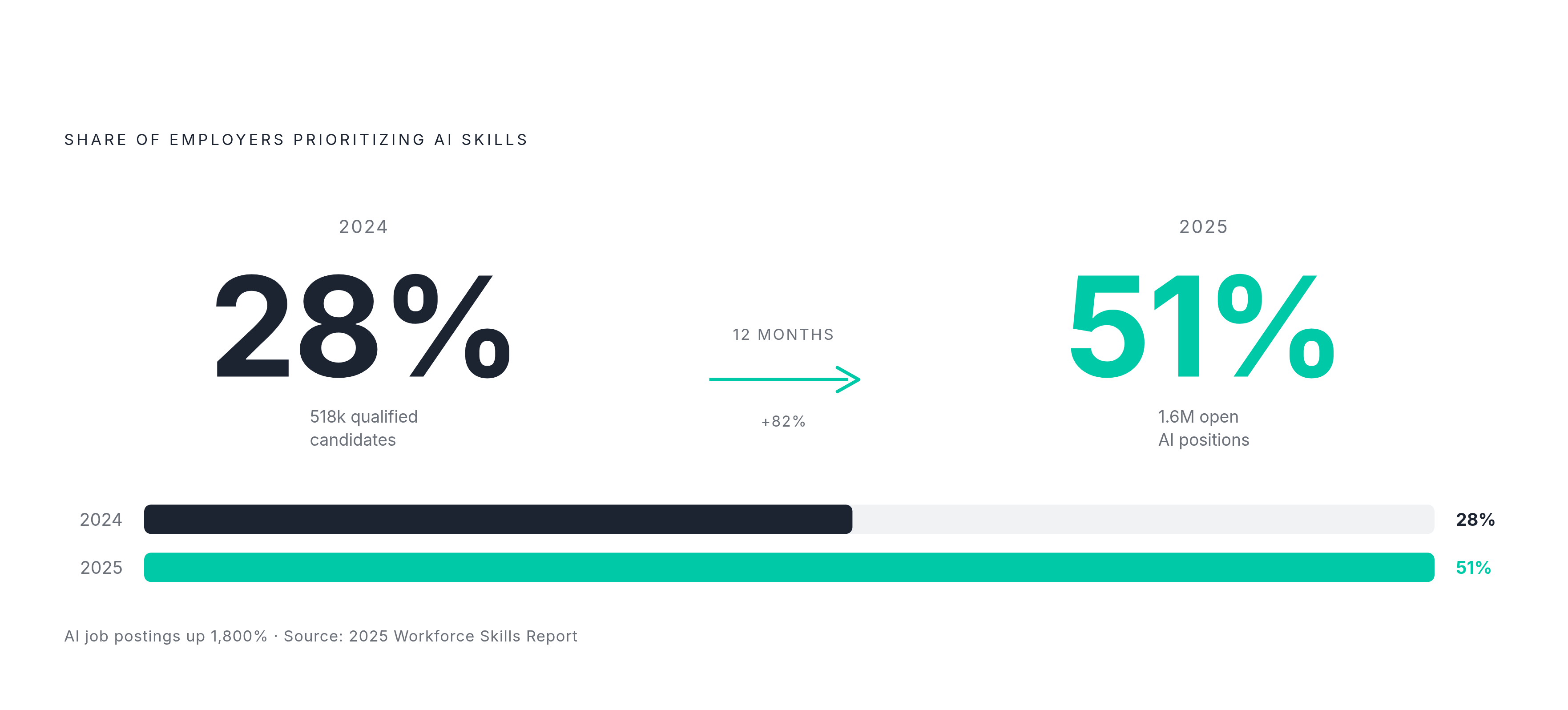
Nash Squared found that AI has become the fastest-growing skill category in over 16 years. The share of employers prioritizing AI skills jumped from 28% to 51% between 2024 and 2025, in a single year. The pipeline produces qualified workers calibrated to a labor market that no longer exists by the time they graduate.
Workforce instability compounds everything. Nearly 47% of tech workers plan to voluntarily change jobs within six months, and roughly 45% report receiving no formal training in the preceding six months. Applauz's 2025 research puts replacement cost for a single employee at between half and four times that person's annual salary. At those numbers, attrition isn't a human resources inconvenience. It's a persistent drag on the balance sheet that most organizations are underreporting.
Remote work adds a self-inflicted dimension. When 82% of tech professionals prefer hybrid or remote arrangements, any employer mandating full office attendance has quietly disqualified itself from most of the available market. That's structural scarcity made worse by a policy choice, which is a different kind of problem.
Demand is being redefined faster than supply-side institutions can follow. Nothing on the horizon closes that gap automatically.
Where the Tech Talent Gap Bites Hardest and What It Costs
IDC projects $5.5 trillion in organizational losses from IT talent shortages by 2026. That number represents real things: delayed product cycles, compromised security posture, abandoned initiatives, and teams perpetually operating below capacity. It is not an abstraction.
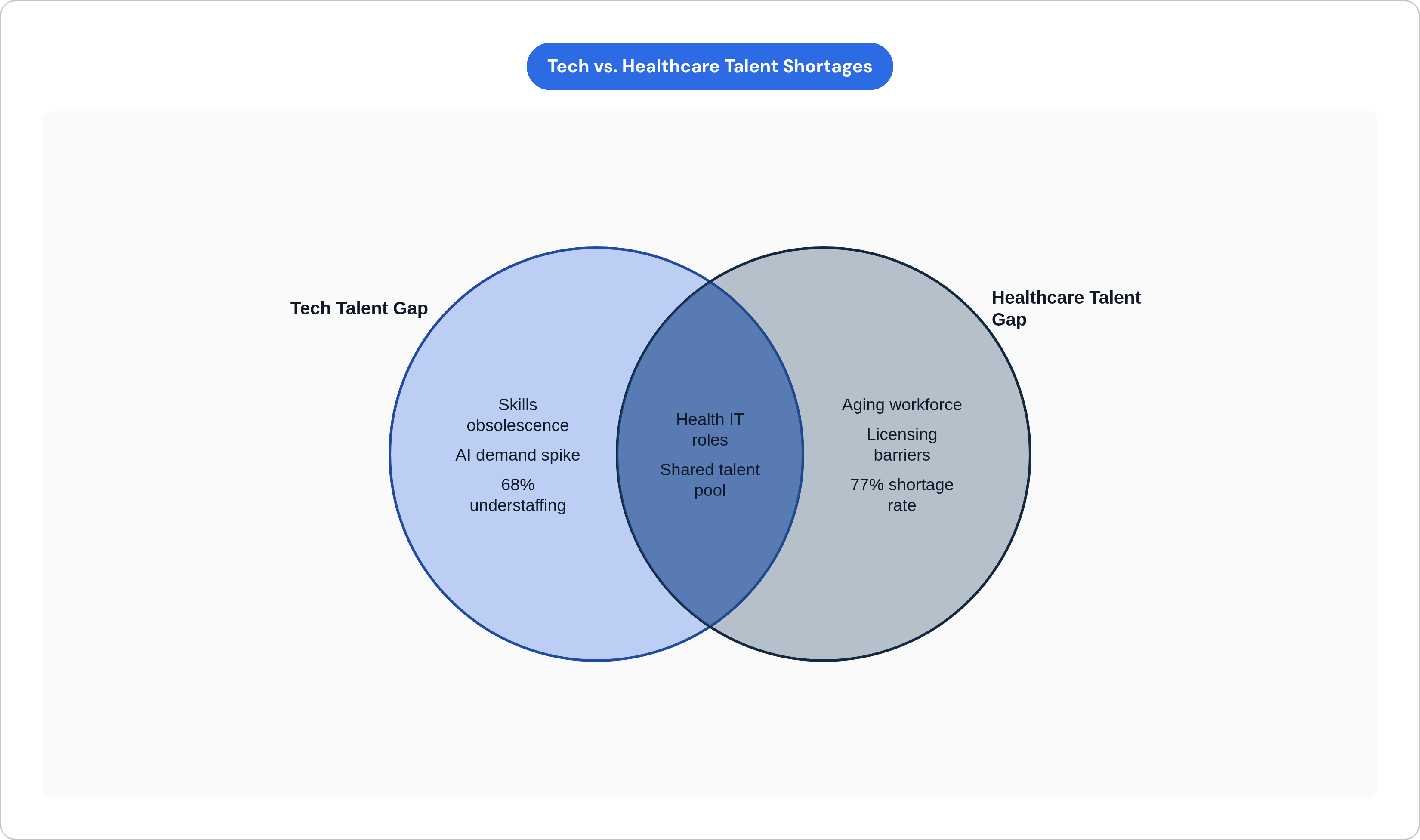
The shortages within tech are uneven, and the unevenness has operational consequences. AI and machine learning engineering report 68% understaffing; cybersecurity and compliance sit at 65%, per the Linux Foundation's 2025 Tech Talent Report. U.S. job postings mentioning AI have spiked 1,800%, and globally there are approximately 1.6 million open AI positions against only 518,000 qualified candidates. A hiring manager who believes standard sourcing channels will surface the right person at that ratio is working from a broken assumption.
The longer horizon reinforces the urgency. The global shortage of software engineers is projected to reach 85.2 million by 2030, per U.S. Labor Department estimates, with near-term figures already approaching 4 million by 2025. The average technical position currently takes 66 days to fill. Multiply that across a full product roadmap and the cost compounds in ways most organizations don't fully absorb until they're living inside them.
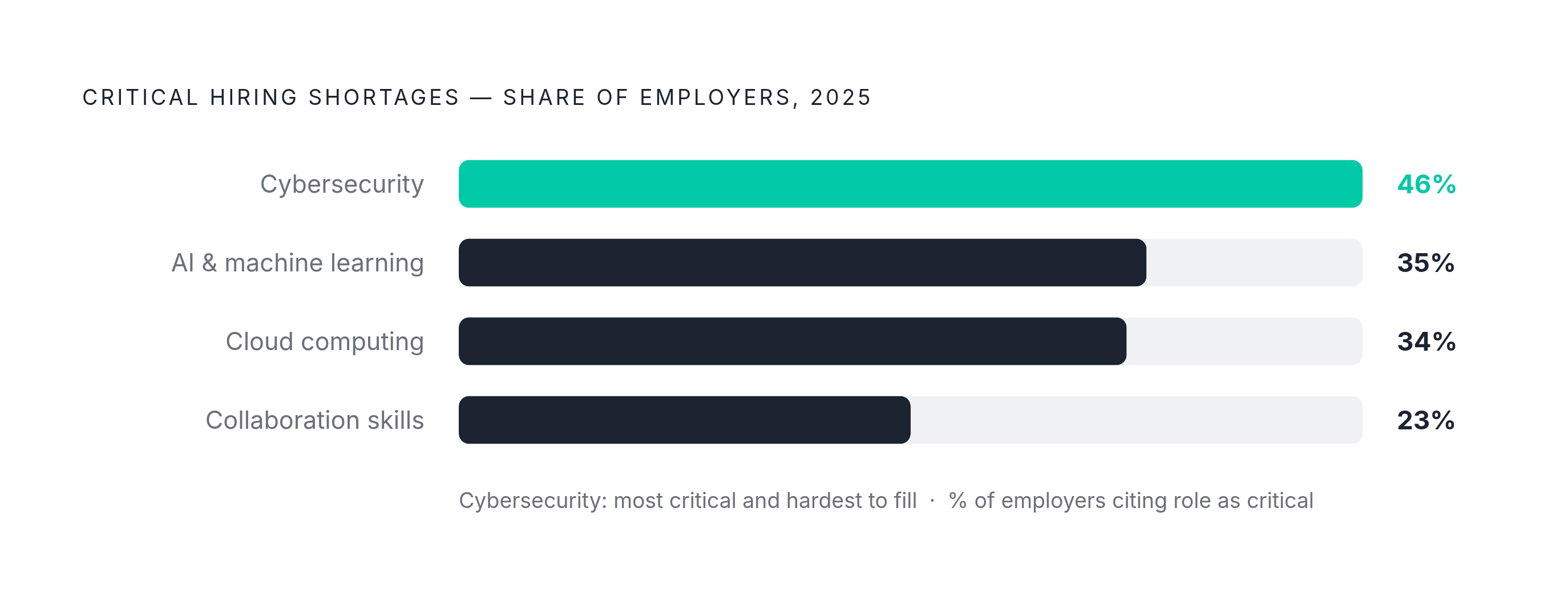
For anyone deciding where to concentrate sourcing pressure, the 2025 priority stack is worth internalizing: cybersecurity leads at 46%, followed by AI at 35%, cloud computing at 34%, and collaboration skills at 23%. These are the roles most critical to business continuity. They are also the hardest to find. That combination should drive sourcing strategy, not just hiring timelines.
The Healthcare Talent Crisis and Why It Cannot Be Solved with Reskilling Alone
Healthcare is its own category of hard. ManpowerGroup's 2025 rankings place Healthcare and Life Sciences first across all sectors, with a 77% shortage rate, edging out even IT. The structural cause, however, differs from what's driving the tech gap, and conflating them produces bad strategy.
Healthcare shortages aren't primarily about skills obsolescence or AI-driven demand spikes. An aging clinical workforce is exiting faster than new workers can complete credentialing, while simultaneously an aging patient population increases the volume of care required. Supply contracts as demand expands, and no single organizational failure explains it. This is a demographic problem operating on timescales that no hiring budget can compress.
The credentialing constraint is categorical in a way tech's isn't. A hospital system cannot solve a nursing shortage by intensively retraining administrative staff. Licensure requirements, specialization timelines, and regulatory frameworks impose minimum multi-year pathway lengths that no amount of urgency or salary escalation can shorten. The timeline for domestic supply recovery in clinical roles runs in decades, not hiring cycles. Acknowledging that isn't defeatism; it's the precondition for building a strategy that works.
The fastest-growing hiring category in healthcare now sits at the intersection of clinical knowledge and technical competency: electronic health record systems, health data engineering, and telehealth infrastructure. Here, the healthcare shortage and the tech shortage converge on the same candidate pool, meaning healthcare organizations compete directly against technology companies for talent that neither sector produces in sufficient volume.
Geography sharpens the problem. Germany at 86%, Israel at 85%, and Portugal at 84% carry the highest overall shortage rates; they also carry acute demographic aging burdens. The shortage is worst precisely where it is structurally hardest to fix. Healthcare organizations in these markets cannot solve the problem by outbidding technology employers. Qualified candidates aren't present in sufficient numbers regardless of the offered rate.
Why Domestic Pipelines Cannot Close These Gaps on Their Own
Skills decay in 2.5 years. Universities take four or more to produce engineers. AI skills demand nearly doubled in a single year. No domestic pipeline running at historical production rates closes a gap accelerating at that velocity.
The highest-shortage countries are also high-cost, high-wage labor markets. Raising domestic salaries in Germany, Israel, or Portugal doesn't conjure additional qualified candidates. It inflates hiring costs while leaving the underlying supply problem untouched. That distinction matters because a lot of organizations treat compensation escalation as a supply solution, and it isn't.
The attrition loop makes it worse. With nearly 47% of tech workers planning to change jobs within six months, organizations are spending substantial capital to acquire talent that doesn't stay long enough to deliver the outcomes that justified the search. A team that fills its headcount only to turn over six months later isn't recovering. It's funding a treadmill.
Compliance and data governance add a layer that's easy to underestimate. A meaningful share of enterprises cite security and regulatory restrictions as limiting factors on distributed sourcing, and they're right to. Geographic diversification cannot be treated as simple cost arbitrage. It requires vendor vetting, contractual accountability, and data governance frameworks with the same rigor applied to any enterprise risk decision.
The realistic path involves sourcing from geographies where qualified talent actually exists, where pipelines are actively growing, and where working conditions, including timezone compatibility, language fluency, and cultural alignment, allow distributed engineers to function as genuine team members rather than remote vendors managed at arm's length.
What Latin America Offers That Other Talent Geographies Do Not
The core advantage Latin America offers North American employers isn't the rate, though the rate matters. It's integration.
Nearshore developers in Latin America work overlapping hours with U.S. teams in real time. This is categorically different from offshore arrangements running across 12-hour asynchronous gaps, where a morning question becomes an evening message becomes a next-morning response. That cycle, repeated across months of development work, does something insidious. It doesn't merely slow velocity; it degrades the cross-functional trust that high-performing engineering teams depend on. Problems stay siloed because surfacing them across a time gap carries a cost that feels too high in the moment. By the time the issue is visible, it's expensive.
Rate context belongs in the analysis. Latin America nearshore rates run from approximately $23 to $90 per hour depending on seniority and role, per Accelerance's 2025 guide, with junior developers from $29 to $44 per hour, mid-level engineers from $50 to $60, and seniors from $60 to $74. Against U.S. onshore mid-level engineers earning between $125,143 and $191,700 annually, the cost differential is real. Nearshore models also eliminate most of the coordination friction that quietly consumes apparent savings in deep offshore arrangements: communication delays, rework cycles, and project management overhead that reclaim a surprising share of the margin.
English proficiency and cultural alignment are the two factors that most reliably determine whether a distributed engineer functions as a genuine team member or an external vendor. For U.S.-based teams, Latin America scores consistently higher on both dimensions than comparable offshore markets, a function of geographic proximity, educational overlap, and sustained exposure to North American professional culture.
For AI-specific development, timezone compatibility isn't incidental. AI work demands rapid iteration, real-time model evaluation, and review cycles that require people to be awake and available simultaneously. That workflow doesn't survive a 12-hour async gap; it degrades into something closer to waterfall by default.
BairesDev operates this model at enterprise scale, drawing from a vetted pool of thousands of engineers across more than 100 technologies, with a selection process targeting the top 1% of available talent. That selectivity matters considerably in a market where the global pool of engineers claiming AI and ML expertise vastly exceeds the pool that actually possesses it.
How to Build a Sourcing Strategy That Maps to Where Specific Gaps Are Sharpest
Before sourcing anything, identify which gap you're actually closing. A cybersecurity compliance gap, a healthcare IT gap, and an AI engineering gap carry different risk profiles, different urgency timelines, and different candidate pool geographies. Treating them as equivalent will cause a strategy to underperform across all three simultaneously.
Staff augmentation has become a mainstream delivery model. Nearly 72% of global organizations used it for software, cloud, AI and ML, and cybersecurity work in 2025, and organizations using augmentation platforms report a 41% reduction in hiring time relative to a baseline that already sits at 66 days for the average technical role. Those are meaningful numbers in a market where the average position sits open for over two months.
Integration discipline is where distributed engagements most commonly break down, and the causes are usually upstream of the engineer. Timezone overlap determines whether a distributed team member participates in live decisions or receives summaries afterward. The difference sounds minor until you've watched the same person consistently work from incomplete context for three months and then tried to understand why output quality is lagging. It's almost never the engineer's fault.
Onboarding structure sets the trajectory more than most organizations acknowledge. Access and tools in the first week, codebase orientation by week two, a first genuine contribution by weeks three to four. An onboarding buddy in the same timezone accelerates that ramp, not as a cultural gesture, but as a practical mechanism for knowledge transfer that doesn't depend entirely on asynchronous documentation.
Vetting rigor is most critical precisely where the shortages are sharpest. With 1.6 million open AI positions against 518,000 qualified candidates, a substantial share of applicants in that category is misrepresenting capability. Sourcing through a partner with rigorous pre-vetting, as BairesDev applies through its top-1% selection model, reduces that exposure and compresses the due diligence burden that would otherwise fall on the hiring organization.
Contract structures are shifting as well. The U.S. market is moving toward outcome-based agreements tied to project milestones rather than hourly billing, reflecting organizational interest in accountability over headcount. That structure maps well to the distributed, project-organized engagements that nearshore models are built around.
The talent shortage isn't one problem. It's a cluster of distinct gaps with different causes, different geographies, and different timelines. Organizations that stop waiting for domestic pipelines to recover, source from where supply actually exists, and integrate with the operational discipline the work demands are the ones that keep moving.