Phone Screen Interview Questions for Technical Roles
Phone screens separate candidates who talk about technical work from those who can actually do it.

Most hiring teams treat the phone screen as a scheduling formality, a box to check before the "real" interview starts. That's backwards, and it's costing companies good hires while letting weak ones slip through to expensive panel interviews.
The phone screen reaches more candidates than any other stage in the funnel, costs the least time per candidate of any stage, and sets the frame for the entire loop that follows. Get it wrong, and you either burn hours of senior engineering time on a candidate who can talk about distributed systems but can't reason about one, or you screen out someone strong because the questions never gave them a chance to show what they actually know. Both mistakes are expensive. A weak candidate who makes it to a full loop costs you panel hours, delays the hiring decision, and sets false expectations that surface later, usually during onboarding, when it's much harder to walk back. A strong candidate screened out too early is a cost you never see, which makes it easier to ignore and more dangerous to repeat.
The problem has gotten harder, not easier. Resumes are polished by AI tools now, GitHub profiles get curated for effect, and take-home assessments get gamed with enough regularity that the signal a recruiter used to get from paper alone is worth less than it was five years ago. So the phone screen has to do more work than it used to. Its job is narrow but hard: in thirty to forty-five minutes, separate the candidates who can articulate technical work from the ones who can actually do it. This piece maps the question categories and evaluation signals that make that separation reliable.
What a phone screen can and cannot evaluate — and why that shapes every question you ask
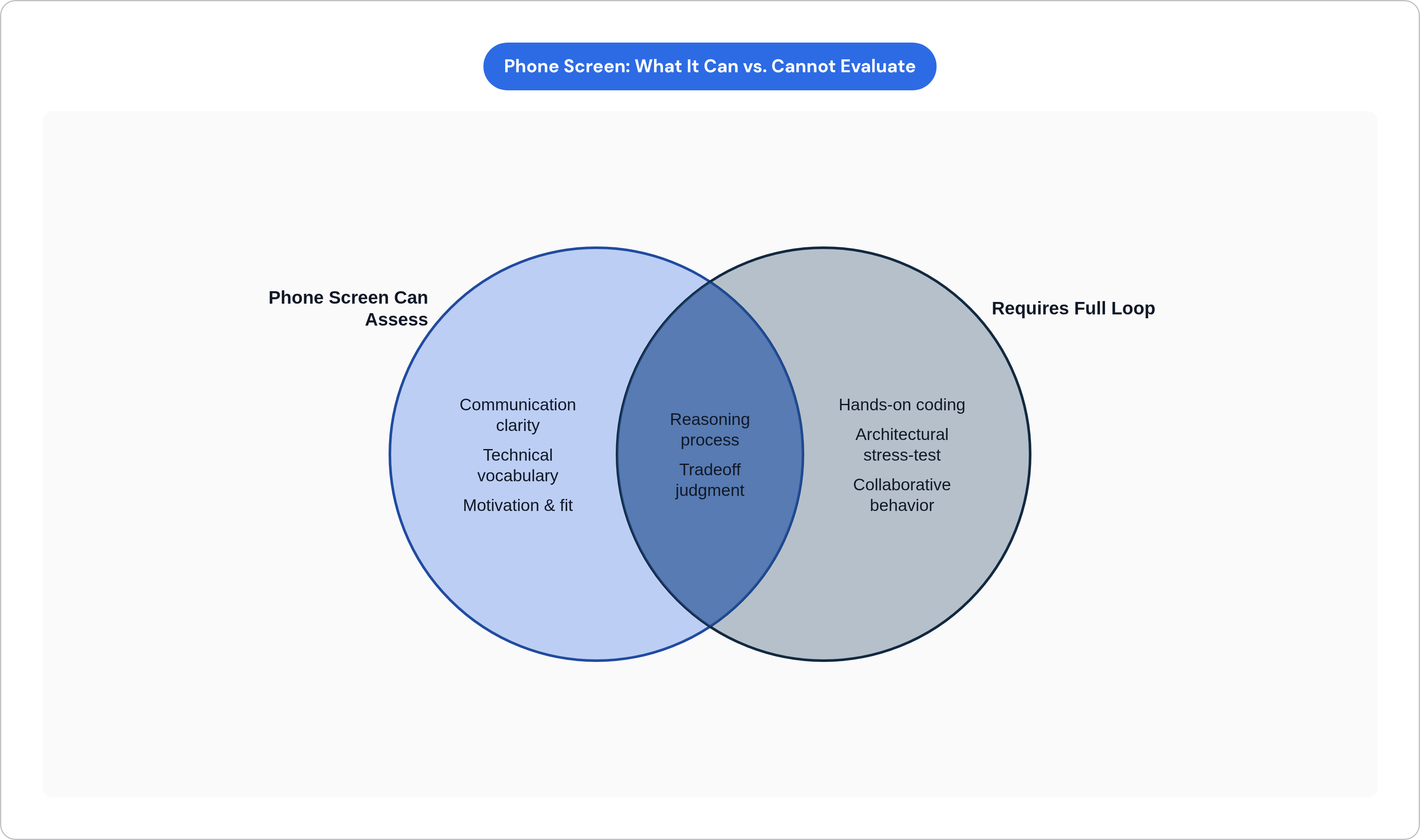
A phone screen is a filter, not a verdict. Its purpose is to narrow the field, not to produce a definitive ranking of someone's technical depth. Confusing the two is where most screening processes go wrong.
Here's what a phone screen can assess well. Communication clarity: can the candidate explain what they built, why they built it that way, and to whom they'd explain it differently. Signal-to-noise ratio: do their answers stay specific and grounded, or do they drift into vague generalities the moment you ask a follow-up. Baseline technical vocabulary: do they use the right terms in the right context without being fed the words first. Motivation and fit: is there a real reason they want this role, or is this one of forty applications sent out this week. And red flags that would waste a panel's time later: gaps between what's on the resume and what they can describe, inconsistencies in the story, or communication that breaks down even under the low pressure of a phone call.
Here's what it cannot assess reliably. Hands-on coding ability is off the table; there's no IDE, no compiler, no shared screen in a standard phone screen, so anything that looks like a coding evaluation on a call is theater. Architectural judgment can surface in conversation, but you cannot stress-test it the way a whiteboard session or a system design interview can. And collaborative behavior, how someone actually pairs, reviews code, or handles a disagreement in the moment, simply doesn't show up on a thirty-minute call with a stranger.
The implication is straightforward: phone screen questions should be built to produce evidence that a full loop is worth scheduling. They are not a rehearsal for the full loop, and treating them as one creates a specific, common failure. Interviewers ask a deep algorithmic or system design question on the phone screen, then ask the same question again in the technical interview two weeks later. The candidate has now had two attempts at the same problem, with time to think between them, and looks sharper than they are. The screen taught the answer. Whatever signal that second interview was supposed to produce is contaminated before it starts.
One more consideration that gets overlooked: format matters. A video call lets you read engagement, whether someone is looking things up off-screen, whether they're present in the conversation or reciting from a doc. A phone call strips that away. Neither format is wrong, but mixing them across candidates for the same role makes comparison unfair. Pick one and hold it constant.
Background and experience questions that surface real technical depth
These questions sound like small talk. Asked well, they're technical probes disguised as warm-up conversation, and they do more diagnostic work than most interviewers give them credit for.
The goal is to move a candidate off resume recitation and onto specific, defensible claims about their own work. "Walk me through the most technically complex project you've shipped in the last two years" sounds soft, but listen for how specifically they describe the problem, not just the solution they landed on. Anyone can describe a solution in retrospect; describing the actual problem, with its constraints and false starts, is harder to fake. Follow with "what was the hardest engineering decision on that project, and what alternatives did you consider." This surfaces the reasoning process, not just the outcome, and it's much harder to answer with a rehearsed line.
Two more questions do a lot of work here. "What would you do differently if you built it again" filters out candidates who haven't actually thought hard about their own work; if there's nothing they'd change, that's usually not modesty, it's a lack of reflection. And "what part of that project are you least proud of" tests candor directly. Senior candidates who can name a real weakness in their own work, without over-apologizing or deflecting, are showing you something valuable: self-awareness under a mildly uncomfortable question.
Listen for pronoun use. "I" versus "we" tells you whether someone can separate their own contribution from the team's, and candidates who can't make that distinction usually can't tell you what they'd do differently either. Listen for specificity: exact technologies named, actual tradeoffs described, real constraints mentioned, as opposed to phrases like "we used microservices" or "we scaled it," which mean almost nothing on their own. And listen for ownership. Does the candidate describe themselves making decisions, or executing someone else's plan without much involvement in how it got made?
Red flags cluster around a few patterns: an inability to describe the same project at two levels of abstraction, the high-level version and the technical-detail version; heavy reliance on buzzwords with no mechanics behind them; and no clear personal contribution anywhere in the story. Calibrate by seniority. A junior candidate describing individual feature work clearly is doing fine. A senior candidate should be able to talk about how their decisions rippled out to the broader system or the team around them; if they can't, the seniority on the resume doesn't match what's on the call.
Technical knowledge questions that test understanding, not memorization
There's a meaningful gap between reciting the definition of a design pattern and knowing when to reach for it, and phone screens routinely fail to tell the two apart.
Good questions probe understanding rather than recall. "How would you explain [a core concept in their stack] to a non-technical stakeholder" reveals depth precisely because simplifying something well requires actually understanding it, not just being able to name it. "When would you choose Technology A over Technology B, and what would change that decision" tests judgment, not familiarity; plenty of candidates know both technologies and still can't reason about when one beats the other. And "what's a common mistake teams make with [a framework they listed on their resume]" works because candidates who've only read the documentation have never seen the failure modes, while candidates who've actually shipped with the tool usually have a specific story ready.
Calibrate by role. Backend engineers should be able to talk through data modeling choices, API design tradeoffs, and concurrency. Frontend engineers should have a real point of view on state management, rendering tradeoffs, and accessibility as a design constraint rather than an afterthought. DevOps and platform engineers should talk about observability as a philosophy, not a tool list, plus the failure modes they've actually hit in CI/CD pipelines. Data engineers should be able to speak to pipeline reliability, schema evolution, and the batch-versus-streaming tradeoff with some texture to it.
Avoid trivia. Questions with a single Googleable answer, like asking for the time complexity of a hash table lookup, reward memorization and punish the candidate who reasons out loud and second-guesses themselves along the way, which is often the more thoughtful engineer. The phone screen version of a technical question should stay open-ended enough to show you how someone thinks. Whether they memorized the textbook answer is close to irrelevant.
One addition worth building into every technical screen now: ask how the candidate actually uses AI coding tools in their day-to-day work. Not whether they've heard of them, whether they've built a real workflow around them. The answer tells you whether they treat AI assistance as a genuine part of how they build software or as a novelty they tried once. In 2026, that distinction is as diagnostic as any question about a specific framework.
Problem-solving questions that show how a candidate works through ambiguity
Background questions and knowledge questions can be rehearsed. A candidate who's done five phone screens this month has probably refined their "tell me about your most complex project" answer to a polish. Problem-solving questions, asked live, are much harder to script your way through.
The phone screen version of a problem-solving question is not a full algorithm exercise; it's a constrained prompt meant to reveal reasoning and communication under a little bit of pressure. Underspecified scenarios work well: "you've inherited a service that's degrading in production, what's your first move." Listen for whether they structure the uncertainty before jumping to a fix, because jumping straight to a fix on an underspecified problem is itself a signal, and not a good one. Tradeoff scenarios work too: "you have a week to either refactor a critical module or ship a requested feature, how do you make that call." This surfaces prioritization philosophy and whether the candidate thinks about stakeholders at all. Estimation questions, used sparingly, can also help; the point isn't the number they land on, it's whether they can organize their thinking out loud in a way you can follow.
Strong candidates tend to do the same handful of things. They ask clarifying questions before proposing anything. They name their assumptions explicitly rather than burying them. They propose a direction and then immediately poke holes in it themselves, identifying where it could break before you have to ask. And they treat the exercise as a conversation, inviting correction rather than defending a position to the death.
Weak candidates tend to do the opposite. They jump to a solution before the problem is even scoped. They answer an underspecified prompt with total confidence and never flag the ambiguity sitting right in front of them. And they stop the moment they reach an answer, rather than interrogating whether that answer actually holds up.
The evaluator's job here isn't to grade the answer, which frankly doesn't matter that much. It's to watch the process and write down what you see in real time, not from memory after the call ends.
Behavioral questions for technical roles and why most interviewers ask them wrong
"Tell me about a time you worked in a team" is a generic question, and it produces generic answers. That's not a coincidence; that's the question doing exactly what it was built to do, which is nothing.
Behavioral questions in technical interviews need to be anchored in engineering-specific situations: a code review conflict, a technical debt decision, a production incident, a disagreement with a tech lead. That specificity is what forces a real answer instead of a rehearsed platitude.
A few questions carry a lot of weight here. "Describe a time you disagreed with a technical decision your team was moving toward, what did you do" tells you how someone handles being overruled and whether they can disagree productively instead of either caving instantly or digging in past the point of usefulness. "Tell me about a production incident you were involved in, what was your role, and what changed afterward" surfaces accountability and systems thinking at the same time; candidates who only describe the fire and never the follow-up usually haven't internalized the lesson. "Have you had to push back on a feature request because of a technical constraint, how did you frame that conversation" reveals whether someone can bridge engineering thinking and product thinking, which matters more as seniority increases. And "describe a time you onboarded into an unfamiliar codebase, what was your approach" matters a great deal for anyone joining mid-project, which is common for augmented engineers and contractors.
Use the STAR structure, Situation, Task, Action, Result, as a check rather than a rigid rubric. Candidates who can't land on a specific result or outcome are often describing a composite memory, or worse, a story they heard secondhand and adopted as their own. For distributed or remote-first roles, add one more: "how do you communicate a technical blocker when you can't tap someone on the shoulder." Remote communication discipline is an engineering skill in its own right, not a soft add-on, and it deserves to be tested directly. In staff augmentation and nearshore engagements specifically, where engineers collaborate across time zones with teams they didn't hire onto, these behavioral questions carry outsized weight. Overlapping working hours alone don't solve collaboration. Communication habits do.
Motivation and culture questions that reveal whether the role is a real match
Technical skill gets a candidate through the door, but it isn't sufficient on its own. A strong engineer dropped into the wrong role, or the wrong stage of company, or the wrong team culture, tends to create churn rather than value, and that churn is expensive regardless of how good the code is.
Mis-hires at the senior level are costly even when the person is fully qualified on paper. Misaligned expectations around autonomy, growth trajectory, or team culture drive a meaningful share of early attrition, and none of that shows up in a technical evaluation. It shows up here, if you ask the right questions.
"What does your ideal engineering environment look like, team size, autonomy, process" tells you whether their stated preference actually matches what your team looks like day to day. "What are you hoping to work on that you haven't had the opportunity to yet" exposes what they're growing toward, and whether this role is a step in that direction or a detour from it. "Why are you looking now" isn't a trick question; it's a direct one, and the honest answer tells you whether someone is running toward something specific or away from something they'd rather not name. And "how do you prefer to receive feedback on your code" reveals ego, openness, and how much real code review experience they've actually had.
Listen for specificity about your company and role, as opposed to answers generic enough to apply to any posting on any job board. Listen for realistic self-awareness, someone who knows what conditions let them do their best work, rather than the reflexive "I'm flexible" that tells you nothing. And treat it as a real red flag when a candidate has no questions of their own about the role, the team, or the technical environment at this point in the process. For augmented or contract roles in particular, ask directly about their experience integrating into an existing team mid-sprint. Not every strong engineer thrives dropped into someone else's codebase and someone else's rhythm, regardless of how good they are technically.
How to structure a phone screen so the questions actually produce comparable data
Good questions asked inconsistently don't produce a reliable filter. Consistency across candidates is what turns a good question into usable data.
Use the same core question set for every candidate applying to the same role. Variation between interviewers, one asking about production incidents, another skipping straight to system design, makes candidates impossible to compare fairly against each other. Define what a strong answer to each question actually looks like before the screen starts, not after you've already talked to three candidates and are trying to remember which one impressed you more. And score in real time on something simple, strong signal, mixed signal, weak signal, rather than trusting memory after the call ends, because memory after five screens in a week is not reliable.
On timing: a thirty-to-forty-five-minute screen splits roughly into five minutes of context-setting, twenty to twenty-five minutes of structured questions across background, technical, and problem-solving, ten minutes of behavioral questions, and five minutes reserved for the candidate's own questions. Skipping that last five minutes is a mistake plenty of interviewers make under time pressure. What a candidate chooses to ask is itself a data point, and cutting it out throws away signal for no good reason.
The interviewer's job is to ask, listen, and take notes. Resist the urge to teach, correct, or nudge someone toward the answer you were hoping for; the screen is measuring the candidate, not your ability to coach them there. If more than one interviewer is on the call, designate a single primary asker ahead of time. Candidates give fragmented, weaker answers when two people are trading off questions mid-conversation, and it's an easy problem to avoid.
Run a debrief, fifteen minutes, with a shared scorecard, right after the call while it's fresh. This keeps the loudest voice in the room from overriding a quieter but legitimate concern that someone else noticed and almost didn't mention. And document the reason behind every "no." This protects against bias creeping in unnoticed, improves calibration across interviewers over time, and, maybe most usefully, lets you spot a pattern when your pipeline keeps producing weak candidates at the exact same stage.
Adapting the phone screen for distributed and augmented team contexts
A phone screen built for a co-located team sitting in the same office will miss the exact signals that matter most once the engineer is working across time zones or dropped into a client team mid-project. That's not a minor gap; it's the difference between a screen that predicts success and one that doesn't.
Communication clarity matters even more in this context, and it means something slightly different than it does for an in-office hire. It's not just about explaining technical work clearly on a call. It's about surfacing a blocker asynchronously before it becomes a two-day delay, writing a Slack message precise enough that no one needs a follow-up meeting to understand it, and documenting a decision without being asked to. Integration speed matters just as much: can this person read an unfamiliar codebase, orient themselves without hand-holding, and start contributing on a timeline that a distributed team, often already stretched thin, can actually absorb.
These aren't add-on nice-to-haves bolted onto a standard phone screen. For roles built around staff augmentation or nearshore collaboration, where the engineer joins a team they didn't build and a codebase they didn't design, these signals are close to the whole point of the screen. A candidate who's technically excellent but has never had to work this way, without daily in-person contact, without the ability to walk over and ask a quick question, is walking into a role that looks nothing like their past experience. The phone screen is the cheapest place in the entire hiring process to find that out before it becomes a problem three weeks into a project.