Workforce Aging and Multigenerational Talent Pools
Retaining engineers across four generations requires understanding what each cohort actually values.

Multiple generations clock in at the same companies right now, often on the same engineering teams: Boomers, Gen X, Millennials, and Gen Z, an unusually wide generational span to manage within a single workforce. For engineering leaders, this is the defining structural fact of the next ten years, and the teams that plan around it keep their institutional memory intact. Teams that don't tend to lose it in pieces, usually without noticing until the damage is already done.
Start with the numbers, because they show why this moment differs from ordinary turnover. The Bureau of Labor Statistics projects that adults 65 and older will make up 8.6% of the U.S. labor force by 2032, accounting for 57% of all labor force growth over that decade. One in four U.S. workers was already 55 or older in 2024, up from 21.7% ten years prior. Deloitte's 2025 workforce study, meanwhile, puts Millennials and Gen Z at roughly 74% of the global workforce by 2030. So the workforce ages at the top, swells at the bottom, and the middle, the part that usually absorbs the pressure, keeps thinning out.
Engineering teams feel this more than most functions do. It is now common to find engineers on the same team whose careers began decades apart, one shaped by physical infrastructure and another who has only ever worked in cloud-native, AI-assisted environments. That gap is just a fact of the modern technology workforce now, and the rest of this piece is about building around it proactively, before it costs you someone.
What each generation actually wants from work, and why the differences matter for engineering teams
Generational differences at work aren't personality quirks. They're patterns shaped by when a group entered the labor market and what that market taught them to expect. iHire's 2025 survey found generational differences in workplace priorities are real and consequential, with younger workers, older workers, and those in between often placing different things at the top of their lists.
Here's what that means in practice: a retention plan built around one generation's priorities pushes the others out the door. Free snacks and an open floor plan won't hold a Gen X engineer worried about stability, and unlimited PTO means little to a Boomer who wants flexible hours more than a bigger pile of unused days off. Korn Ferry's Workforce 2025 survey found close to 70% of respondents said the values a company promotes are extremely important to them, a number that held steady across age groups. Values alignment carries more weight across generations than any specific perk, a distinction most HR decks tend to overlook.
Urgency shows up clearly in EY's 2024 Work Reimagined Survey. Thirty-eight percent of respondents said they were likely to quit within a year, up four points from the year before, a rise the survey does not attribute to any single group. Communication expectations also vary across generations, adding another layer of friction when a single management style is applied uniformly across the team. Get this baseline wrong, and no team structure holds up across five different definitions of what a good job even looks like.
The retention asymmetry hiding in plain sight: older engineers stay, younger ones leave
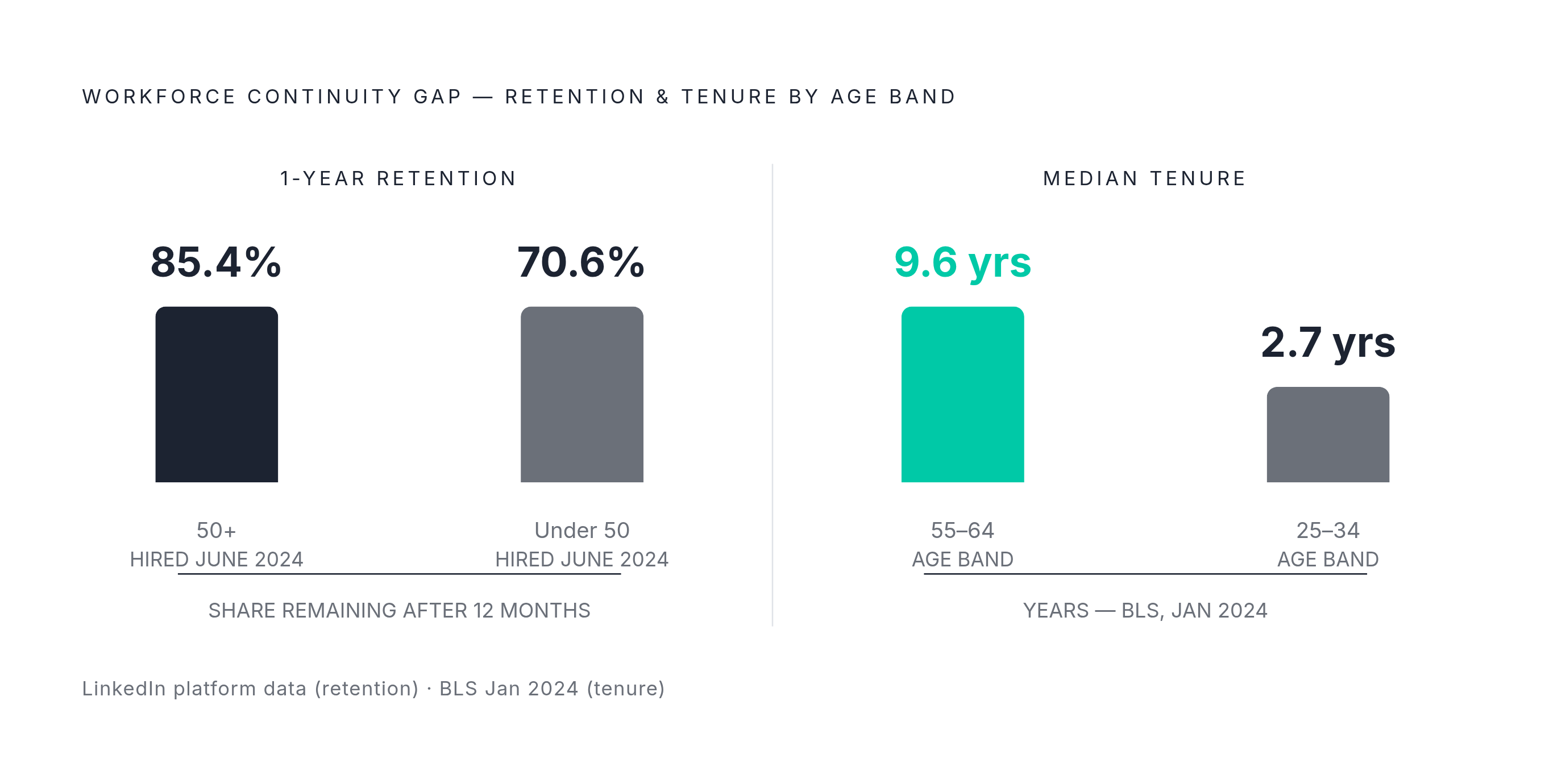
LinkedIn's platform data on hiring cohorts turns up a number worth sitting with. Of workers 50 and older hired in June 2024, 85.4% were still with the same employer a year later. Among younger hires, that figure dropped to 70.6%. BLS tenure data tells a similar story from a different angle: median tenure for workers 55 to 64 sat at 9.6 years as of January 2024, against 2.7 years for workers 25 to 34.
Read only the surface numbers and this looks like good news for the older cohort, since stability is generally desirable. Look closer and the picture turns uncomfortable fast. High retention among senior engineers doesn't mean the knowledge risk is low; it means the risk is concentrated and sudden. When the 9.6-year engineer finally leaves, a decade of undocumented context leaves with them all at once, not gradually, and there's rarely a clean way to catch it on the way out.
The younger cohort's churn reflects a repeated, measurable failure to deliver on growth, autonomy, and the values alignment Korn Ferry says matters to nearly everyone. Treat high senior retention and high junior turnover as two separate HR problems and you'll miss what's actually going on. They're the same continuity problem, visible from opposite ends of the tenure curve.
Age discrimination flows in both directions, and it is degrading team performance
Bias at work doesn't move in one direction. In iHire's 2025 survey of 1,645 U.S. workers, 36.8% of Baby Boomers and 39.7% of Gen Z workers said they'd been treated differently because of their age, either on the job or during a job search. Gen X and Millennials reported much lower rates, 28.1% and 28.6%. The two cohorts on either end of the age range absorb most of the damage.
In tech hiring, phrases like "culture fit" and "energy" often work as coded filters for age: too senior and slow, or too junior and unproven. I've watched a hiring manager pass on a candidate for being "not quite the right stage of career," which meant nothing on paper and everything in practice. That filtering carries a real cost to team performance, alongside its ethical cost. A team narrowed artificially to one age band loses the complementary strengths a wider range provides: the systems depth that comes from debugging the same production incident three different ways over fifteen years, paired with the speed of someone who hasn't yet learned all the reasons a new approach is supposed to fail. This is a team-quality problem, and it belongs to the engineering leaders making hiring and staffing calls, not just the recruiters running the top of the funnel.
The technical skills half-life problem and why it hits every generation differently
The estimated half-life of a technical skill has fallen to roughly 2.5 years, meaning an engineer's skills at career start can go stale several times over before that same engineer ever retires. This shows up differently depending on age, and more than anything, on how much training an employer actually bothers to give.
The 2024 Workplace Training Report, via SHRM, found more than half of older workers received no technology training from their employer in the past year, compared to 27% of younger workers. That gap looks damning on its own, until you set it against more recent numbers. LinkedIn Learning found the age gap in technology-related learning narrowed from 31.1% to 10.7% between 2022 and 2025, a fast close on what used to be a wide spread. Microsoft's 2024 Work Trend Index found 73% of Boomers already use AI tools in daily work, roughly matching adoption among younger generations.
Put together, this says something most employers still get wrong. The assumption that older engineers resist new tools doesn't hold up well against this data, and acting on it anyway is expensive: it leads straight to training exclusion, which speeds up the very obsolescence employers worried about, which then feeds the sudden, concentrated exit described above. The training gap traces back to employer supply far more than learner demand. AI fluency is the clearest test case right now, the place where old generational assumptions are getting disproved fastest, and the organizations paying attention are already ahead of the ones who aren't.
Why institutional knowledge walks out the door before anyone realizes it was there
Institutional knowledge in an engineering org isn't one thing. Some of it is explicit: documented architecture, runbooks, the stuff you can grep for. Some of it is tacit, the reasoning behind a decision, what got tried and abandoned along the way. And some of it is relational: who to call when something breaks, how to navigate the three stakeholders who all think they own the same system.
The tacit and relational layers almost never survive a senior engineer's departure intact. They live in memory, not in any system anyone can query later. Combine that with the tenure asymmetry above and the risk compounds fast: when the 9.6-year engineer walks, years of undocumented context leave with them, and the 2.7-year engineer left holding the system often doesn't even know what's now missing.
Most engineering orgs still treat knowledge transfer as something that happens during offboarding: a two-week handoff doc written under deadline pressure by someone already mentally checked out. Making it an ongoing practice, rather than a one-time exit ritual, changes the outcome considerably.
Here's what actually disappears when this goes wrong. The reasoning behind a legacy system's architecture. The context for a client-specific customization nobody currently on the team remembers agreeing to. Informal escalation paths that exist only in one person's head, and the unwritten rules that quietly keep the same incident from recurring. As the Boomer cohort exits over the coming decade, organizations without active knowledge infrastructure face this loss in waves. Each wave looks like a surprise. None of them are.
Building knowledge infrastructure that survives generational turnover
Knowledge infrastructure isn't documentation for its own sake. It's the systems and habits that make tacit knowledge available to people who weren't in the room when a decision got made, which, by definition, is most of the team most of the time.
A handful of mechanisms actually work in engineering settings. Architecture decision records that capture not just what got decided but why, and which alternatives got rejected and for what reason, so the next engineer doesn't reopen a debate that already happened three years ago. Structured pair programming across generational lines, done on purpose instead of by accident of scheduling, gives senior engineers a reason to narrate their thinking out loud while junior engineers surface assumptions the seniors stopped questioning a decade back. Rotating internal tech talks across tenure levels forces senior engineers to say out loud what they know and gives junior engineers visibility they'd otherwise never get. Runbook ownership assigned to whoever sits closest to a given system, with a review cycle on the actual calendar rather than left to memory, keeps documentation from going stale the moment its author changes teams.
Mentorship works best running both directions. Senior engineers pass along depth; junior engineers pass along fluency with current tooling, AI tools included. Reverse mentorship keeps senior engineers current on where the field has moved, which keeps them engaged and keeps their institutional memory in the building instead of walking out the door from sheer boredom.
Timing matters more than most teams admit. Knowledge transfer that starts the week someone announces they're leaving is almost always too late, because context started decaying the moment the decision got made in that person's head, long before anyone announced anything. Distributed and nearshore teams add a wrinkle worth naming directly: their knowledge infrastructure has to be explicit and asynchronous by design, since it can't lean on the hallway conversation that never happens when people work six time zones apart. That's exactly where timezone-aligned partners hold an edge over distant offshore arrangements, where handoff friction just piles onto knowledge loss that was already the risk to begin with.
How to onboard emerging talent without breaking continuity
The common failure is familiar to anyone who has managed a team: drop a junior engineer into an undocumented codebase and hope they absorb it by osmosis. Nobody absorbs what nobody wrote down. Onboarding quality on a multigenerational team is really just a downstream function of knowledge infrastructure quality, and teams that did the work above onboard faster, with far less disruption to everyone else on the roster.
Team composition deserves treatment as a design decision, not something that falls out of whoever happened to apply that quarter. An all-senior team tends toward over-engineering and analysis paralysis, since nobody's actual job is just to move execution forward. An all-junior team racks up technical debt fast, with no one setting architectural direction before the debt compounds. A deliberate mix, seniors setting direction and reviewing, mid-level engineers executing, juniors contributing under real mentorship instead of token supervision, beats either extreme on delivery outcomes.
Gen Z engineers bring a specific profile worth naming plainly: strong fluency with AI tools, high expectations for autonomy, and often a real gap in the systems-thinking depth that only comes from years of getting paged at 2 a.m. for a production incident nobody fully understands yet. The integration challenge here centers less on skill level and more on context: getting a new engineer to understand why the system works the way it does, not just how to operate it day to day. Bringing in experienced engineers from outside, particularly ones who've worked across several codebases and team cultures, shortens that context-building phase considerably and hands a junior-heavy team the architectural mentorship it's otherwise missing.
What multigenerational team design looks like in practice for distributed and nearshore engineering organizations
Distance makes the generational challenge harder, not easier. Physical separation strips out the informal channels, the desk conversations and the lunch-table debugging sessions, through which institutional knowledge normally leaks from one person to another without anyone scheduling it. On a distributed team, deliberate design carries far more weight, to the point of becoming the whole job.
Nearshore staff augmentation fits this problem for a few concrete reasons. Timezone alignment allows the real-time collaboration, paired programming, live code review, shared standups, that cross-generational mentorship actually depends on, and none of that works across a twelve-hour gap no matter how good the async docs are. Careful vetting that screens for AI fluency and architectural judgment, not just years listed on a resume, lets a company bring in exactly the generational gap it's missing, whether that's senior depth, mid-level execution capacity, or sheer scale at the junior level. Flexible engagement terms let a company shift team composition as its generational mix shifts too, adding senior coverage during a knowledge-transfer crunch and execution capacity when a delivery deadline is bearing down.
Fractional leadership addresses a narrower version of the same gap. An organization that has lost senior engineers to retirement can bring in a fractional architect or engineering lead to hold strategic continuity together while it builds permanent succession internally, rather than losing months to an open leadership seat. Latin America's engineering talent pool matters here specifically because it spans experience levels, established architects working alongside recent graduates, which gives nearshore partners the generational range to match whatever gap a given client team is dealing with.
Team design should be generationally intentional, every time, on purpose; that's the plain fact sitting underneath everything above, even if it's easy to lose sight of when a sprint is on fire. Map the knowledge and execution needs of each project phase to the right mix of experience levels, then staff to that map instead of filling a headcount number because a req happens to be open. A staffing partner who has worked inside a client's codebase and team dynamics across several years, who has watched that team's generational transitions happen in real time rather than read about them in a report, makes recommendations a transactional vendor simply can't match.