Upskilling Existing Engineers Versus Hiring for Emerging Tech Stacks
Upskilling now costs less than hiring, but speed and depth of need determine which actually works.

The math changed fast, and most engineering leaders haven't caught up to it. Pluralsight's Tech Skills Report found that 89% of organizations now say hiring costs more than upskilling for IT roles, up from 49% the year before, and that's a market waking up fast.
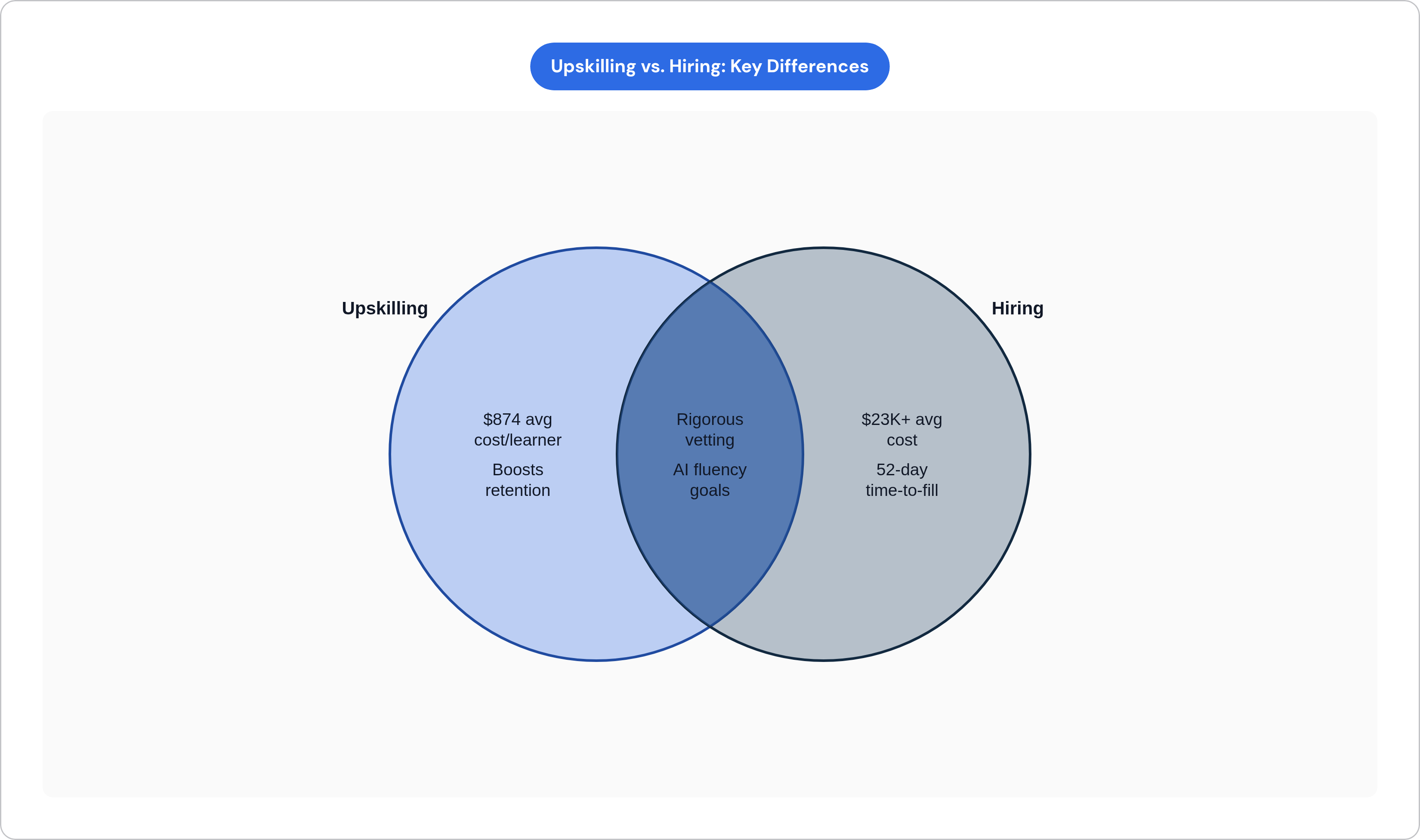
Look at the hiring side of the ledger. Pluralsight's 2024 Technical Skills report put the average cost of hiring a tech professional above $23,000, and salary hasn't even entered the picture yet. Average time to fill a technical role runs 52 days, and that clock stops at offer acceptance, not at the point where the new hire actually knows where the bodies are buried in your codebase. The share of U.S. companies paying $5,000 or more per hire jumped from 49% to 86% in a single year. Additional recruitment costs for harder-to-fill roles push that number higher still.
Upskilling looks like a bargain next to that. The average U.S. organization spent $874 per learner on training in 2025, though IT-specific technical training runs higher than that blended figure suggests. Even so, 73% of companies paid less than the $5,000 hiring threshold to upskill existing staff, so for most organizations, at most skill levels, upskilling is just cheaper.
Cheaper doesn't always mean better, though, and I've watched teams learn that the hard way. The cost advantage assumes the skill can be learned fast enough to matter before the business need moves on without you, and that assumption breaks more often than the spreadsheets admit. Hiring cost is front-loaded and easy to see coming, while upskilling cost is spread across months, competes directly with an engineer's delivery workload, and gets underestimated for exactly that reason. Cost is one axis, and speed and depth of capability are the other two, which is where the real decision actually gets made.
When upskilling is the stronger path
Upskilling wins when the gap sits right next to what the team already knows. A Python data engineer picking up a new orchestration framework is a different animal from that same engineer trying to become a distributed systems specialist from a standing start. Adjacency keeps the learning curve inside the delivery timeline instead of blowing through it.
It also wins when the skill in question is turning into table stakes rather than a specialty. AI tool fluency is the obvious case right now: baseline literacy every engineer needs, the same way git and unit testing quietly became assumed knowledge a decade ago. Nobody hires externally for those anymore, and nobody should have to hire externally for prompt-level AI competence in five years either.
There's a retention case here too, and it's not soft. Engineers who get invested in tend to stay, because training signals the company sees a future for them specifically, not just for the role. That matters more on distributed teams, where cultural continuity is harder to hold onto in the first place. An engineer who already knows the codebase, the product's ugly edge cases, and how the team actually makes decisions brings something a new hire spends months earning. That knowledge doesn't show up on a resume; it shows up in how fast an incident gets resolved at 2am.
Gartner's research points to a majority of engineers needing to upskill by 2027 for the most widespread emerging demands, AI integration and cloud-native practices chief among them. For those two categories specifically, upskilling isn't optional, but closer to an operating requirement, whatever hiring decisions happen alongside it.
Still, the limits are real. Skill shelf-life in niche technical areas is short, often inside that same two-year window before something else takes over as the must-have, which means a training investment can go stale faster than anyone budgeted for. Upskilling has a ceiling too: some capabilities take years of dedicated specialization to build, and pretending a bootcamp closes that gap sets a team up to fail quietly, six months down the line, when the work finally exposes the shortfall. The most common failure mode is simple timing, where the business need shows up before the learning curve closes, and no amount of training budget fixes a mismatch like that.
When hiring is the stronger path
Hiring earns its premium when the gap is genuinely deep, the kind where real proficiency takes years rather than a few months of focused study. Machine learning architecture, blockchain protocol design, advanced security engineering: a motivated generalist doesn't close that distance on a sprint timeline, and pretending otherwise wastes everyone's quarter.
Timeline pressure changes the math too. If a launch or a regulatory deadline sits eight weeks out, a 52-day hiring process, slow as that sounds, can still beat a multi-month upskilling push if the internal team doesn't have spare bandwidth to learn on top of shipping. Cost of delay has to enter the calculation here, not just cost of hire.
Hiring also makes sense when the technology is entirely new to the organization, with no adjacent expertise anywhere on the team to build from, and when the need looks permanent and central to the roadmap rather than a temporary spike. The market has already told us where this applies most: the share of U.S. tech managers prioritizing hiring for AI engineering roles roughly doubled between 2023 and 2024. Some specializations are simply moving faster than internal teams can grow into them.
The premium is justified in specific circumstances, not as a general rule. A specialized hire can shift a product's trajectory in a window a trained generalist can't match, and an outside hire brings a read on architectural decisions the existing team may be too close to the problem to see clearly.
That said, hiring has constraints that get glossed over constantly. Time-to-fill plus ramp-up means the speed advantage is smaller than it looks; an engineer who starts on day one is not productive on day one, no matter how the offer letter reads. And hiring for every emerging stack that shows up on the roadmap doesn't scale, because technology moves faster than headcount ever will.
What AI tools have changed about this calculation
AI coding tools have already redefined what "capable" means for one engineer. Most developers now use, or plan to use, AI coding assistants, and daily use is fast becoming the default rather than the exception. An experienced engineer with real AI tool fluency covers ground that used to require bringing in a specialist. That raises the ceiling for the whole team, not just for the early adopters who got excited about Copilot first.
Here's where it gets complicated, though. AI tools save real time on routine work, week over week, no argument there, but volume isn't quality: pull requests with AI-coauthored code show meaningfully more issues on review — roughly 1.7 times more — and code churn has risen alongside it. At least one randomized controlled study found something almost backwards: developers using AI tools on their own repositories actually took longer to finish tasks than developers working without them, despite believing they'd sped up. The bottleneck didn't disappear; it moved. When code generation speeds up but review process stays the same, the backlog just shows up at the merge stage instead of the writing stage.
For the upskill-versus-hire question, this cuts one specific way. AI fluency is now something to upskill every engineer toward, because it's foundational, not exceptional. For the genuinely deep specializations, ML model design, agentic system architecture, hiring still applies. AI tools don't close that gap; they mostly make the adjacent, easier work faster, which can trick a team into thinking the hard part got easier too.
The senior engineer's job has shifted alongside all this, toward validation, architectural judgment, and accountability for what actually ships. Those are depth skills you can't shortcut with a better prompt, and that shift is exactly why retaining and investing in experienced engineers matters more now, not less. Treating them as interchangeable with whoever generates the most code fastest is a mistake that shows up in production eventually.
One more line item belongs in this conversation: tooling cost. Agentic AI tool spend can run into the hundreds of dollars per engineer per month before seat licenses even get counted, and that's not trivial, so it belongs in the upskilling-versus-hiring comparison directly, not buried in some separate software line.
Staff augmentation as a third path when neither upskilling nor hiring fits the timeline
People confuse staff augmentation with outsourcing constantly, and the difference is worth stating plainly, because it changes how you should think about accountability. Augmentation means external engineers join your team: they sit in your standups, use your tools, follow your practices, report into your structure. Outsourcing hands the scope of work to a vendor who manages its own team and delivers a result on its own terms. These are different accountability models entirely, and confusing them leads to bad decisions on both sides of the arrangement.
Augmentation fits when the gap is real but bounded, tied to a specific project or sprint window instead of a permanent need that would justify a full hire. It fits when mission-critical work can't wait out a long onboarding process, or when the emerging need is a capability spike, an AI/ML feature here, a blockchain pilot there, rather than a lasting shift in the architecture. When the timeline's too tight for upskilling but the long-term need is too uncertain to justify a permanent hire, augmentation is the option that actually fits the shape of the problem.
What makes augmentation work has less to do with the engineers themselves than with how well they get integrated. Access to tools, documentation, and project context needs to be ready before day one, not assembled scrambling on day one. A direct line between the augmented specialist and the internal project owner matters as much as raw technical skill, because this is a team extension, and treating it like a vendor handoff is where most augmentation arrangements quietly go wrong. The vetting bar for augmented engineers should match the bar for permanent hires exactly, and speed of placement is never a good enough reason to lower it.
Timezone alignment deserves its own mention here. It determines whether an augmented engineer can actually participate in real-time collaboration or ends up working in asynchronous isolation, and that difference shows up directly in delivery quality and rework. Latin America's engineering talent pool covers stacks that augmentation requests commonly target, including AI/ML, cloud-native infrastructure, and DevOps. Once recruiting cost, ramp-up time, and benefits overhead get factored into an honest comparison, a nearshore augmented engineer holds up well against a domestic permanent hire on total cost.
Building a vetting standard that works for both paths
Hiring has shifted toward skills over credentials, and that shift changes what a good evaluation actually needs to measure. Degree requirements are giving ground to demonstrated ability: problem-solving under real constraints, learning velocity, hands-on assessment against actual work rather than a resume line. For emerging tech stacks specifically, the capacity to learn quickly often predicts performance better than current knowledge of the stack does, since the stack is going to change again in two years regardless of who you hired for it today.
A serious vetting process covers ground a resume simply can't reach. Technical assessment needs to test whether a candidate can reason about trade-offs and validate AI-generated output, with ownership of production quality mattering more than raw output volume. Communication and the ability to work autonomously carry just as much weight for distributed and augmented roles, because an engineer who surfaces a blocker two days late costs the team more than one who works a little slower but flags problems the moment they appear. Cultural fit, how someone actually works alongside other people day to day, rounds this out, and it's the piece most often skipped when everyone's in a hurry to fill the seat.
AI complicates hiring in a way worth naming directly. It can surface candidates efficiently and speed up the top of the funnel, but telling genuine depth apart from well-packaged surface knowledge still takes a human evaluator who actually knows the domain. Deepfake and AI-assisted interview fraud has become a real concern in remote hiring, real enough that in-person or live verification steps are increasingly being adopted for distributed roles rather than treated as optional.
The same rigor belongs in upskilling decisions, and it gets skipped constantly. Before committing budget and time to an upskilling path, assess learning velocity directly, not aspirationally. Some engineers close a given gap in weeks, while others won't close it before the business need has already moved on, and no training budget rescues that outcome after the fact. The bar for "can this engineer upskill into this stack" should be exactly as rigorous as the bar for "should we hire for it."
A practical decision framework for engineering leaders
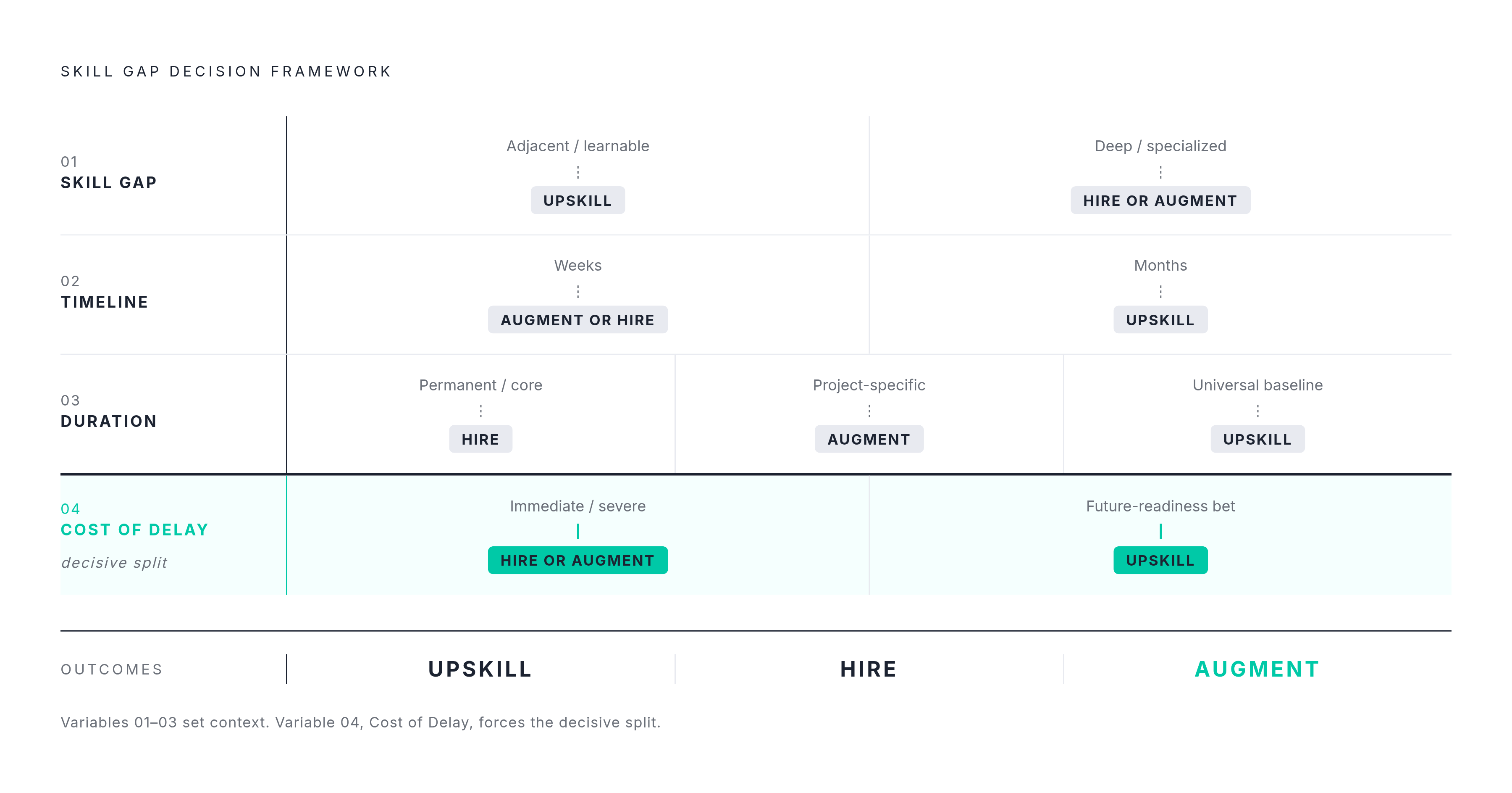
Four variables decide which path wins, and running through them in order beats defaulting to whatever the team did last time.
Depth of the skill gap comes first: adjacent and learnable favors upskilling, deep and specialized favors hiring or augmentation. Timeline comes second: weeks favors augmentation or hiring, months gives upskilling room to actually compete. Duration of need comes third: permanent and central to the roadmap favors hiring, bounded or project-specific favors augmentation, and universal baseline skills (AI fluency being the standing example right now) favor upskilling no matter what the other three variables say. Cost of delay closes the list: when the impact of the gap is immediate and severe, speed beats cost, and hiring or augmentation wins; when the gap is a future-readiness bet rather than an emergency, upskilling's retention and culture advantages compound in a way the other two paths just don't offer.
The most common mistake isn't picking the wrong path. It's treating these three as sequential alternatives instead of parallel tools that most organizations need running at the same time: upskill the whole team on AI fluency, hire for the one or two specializations that are genuinely deep, and augment for the project-specific spikes. Different tools, different problems, same organization, same quarter.
The Linux Foundation found that a large share of tech organizations already prioritize upskilling and cross-skilling ahead of hiring. Pluralsight's number, 89% now saying hiring costs more than upskilling, up from 49% a year before, tells you the market hasn't settled into anything stable yet, and it's still moving. The leaders who treat this as a live decision, revisited stack by stack, gap by gap, will stay ahead of where their talent needs actually go. Those who pick a default once and stop thinking about it will spend the next few years negotiating from behind.