AI Adoption in Talent Acquisition
Most AI in hiring stops at resumes and job posts, leaving deeper value on the table.

Strip away the headline adoption figures and a narrower reality emerges. The two dominant use cases for AI in talent acquisition are concentrated and tactical. 66% of AI-adopting organizations apply it to job descriptions, and 44% use it for resume screening, per Aptitude Research and iCIMS. Both are entry points. They address the front door of the hiring process and leave the rest of the house untouched.
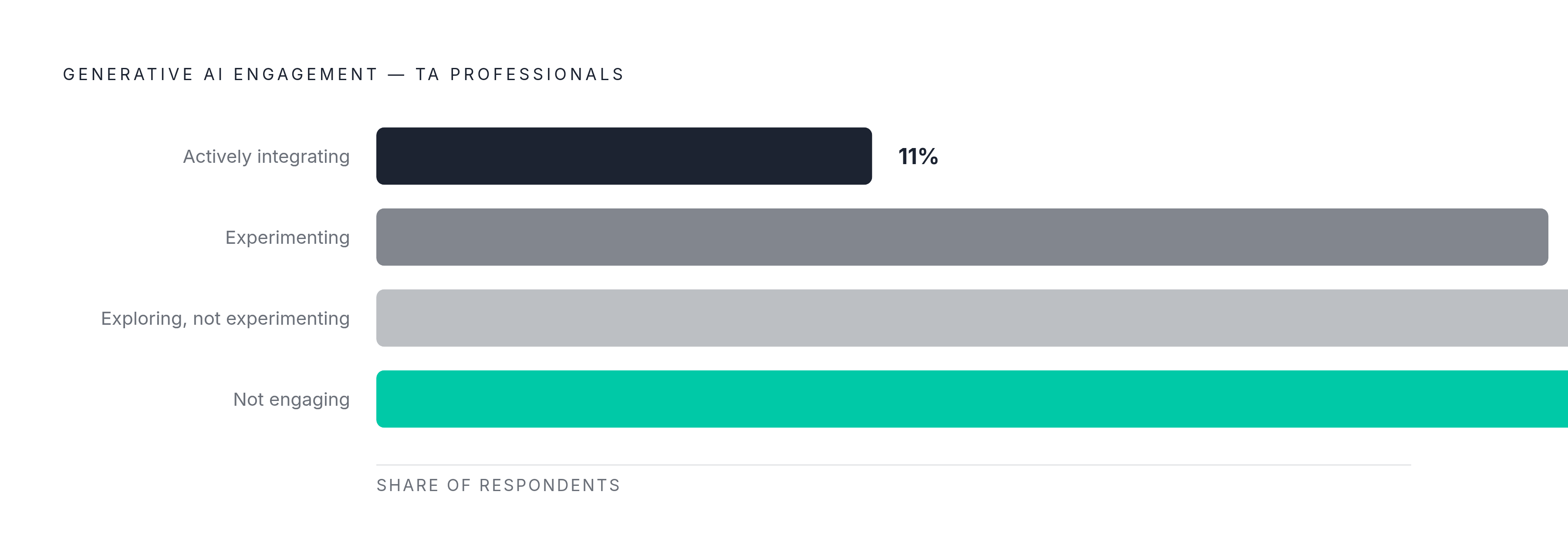
Only 18% of TA functions report using AI broadly across hiring processes. LinkedIn's Future of Recruiting 2025 study adds texture. Only 11% of TA professionals are actively integrating generative AI tools, 26% are experimenting, 31% are exploring without experimenting, and 32% aren't engaging at all. The distribution runs almost perfectly counter to what "broad adoption" implies.
A definitional problem compounds the structural one. Fifty-eight percent of TA teams can't distinguish AI from automation, per Aptitude Research and iCIMS. That confusion is operational, not semantic. Teams can't evaluate what they can't accurately describe, and 45% of TA functions lack a governance framework entirely. Even where tools exist, no one formally owns the outputs, no one audits the criteria, and no one can say with any confidence what the stack is actually producing.
Tactical deployment means AI writes the job post, screens the resume, then stops. Strategic integration means AI is woven into sourcing, scheduling, assessment, candidate experience, and workflow redesign simultaneously, each stage informing the next. Most TA functions have the former. Most believe they have the latter.
Where AI Is Delivering Measurable Results When Deployed With Workflow Depth
The results, where they exist, are real and worth taking seriously on their own terms. Generative AI-enabled TA professionals save approximately one full workday per week, roughly 20% weekly time savings, per LinkedIn's Future of Recruiting 2025 report. Josh Bersin's 2025 talent acquisition research finds AI-enabled TA delivers two to three times faster time-to-hire when adopted at workflow depth rather than surface-level deployment. Industry-wide, average time-to-fill improved from 67.7 days in 2024 to 63.5 days in 2025, per Employ Inc.'s benchmarking data across 6,640 organizations.
SHRM's AI in HR study found organizations using AI-powered recruitment tools report 31% faster hiring times and a 50% improvement in quality-of-hire metrics. These figures reflect something specific. AI embedded in a redesigned process, not AI deployed as a standalone feature dropped into an unchanged one.
Scheduling is an underappreciated, high-ROI application. Interview coordination consumes recruiter hours disproportionately relative to its strategic value. Forty-one percent of TA teams piloted AI scheduling tools in 2025, and teams that fully rolled them out report dramatic reductions in coordination time. Recovered hours, when deliberately redirected, compound across the pipeline.
AI sourcing expands reach in ways manual methods structurally can't. Semantic search surfaces meaningfully more relevant profiles than traditional Boolean queries and reduces false-positive rates. A significant share of viable mid- and junior-level candidates come from sources that keyword-matching ATS tools miss entirely. The common thread in high-performing applications isn't the tools themselves; it's how deeply those tools are woven into the surrounding workflow.
Why Most Organizations Fail to Convert AI Investment Into Realized Value
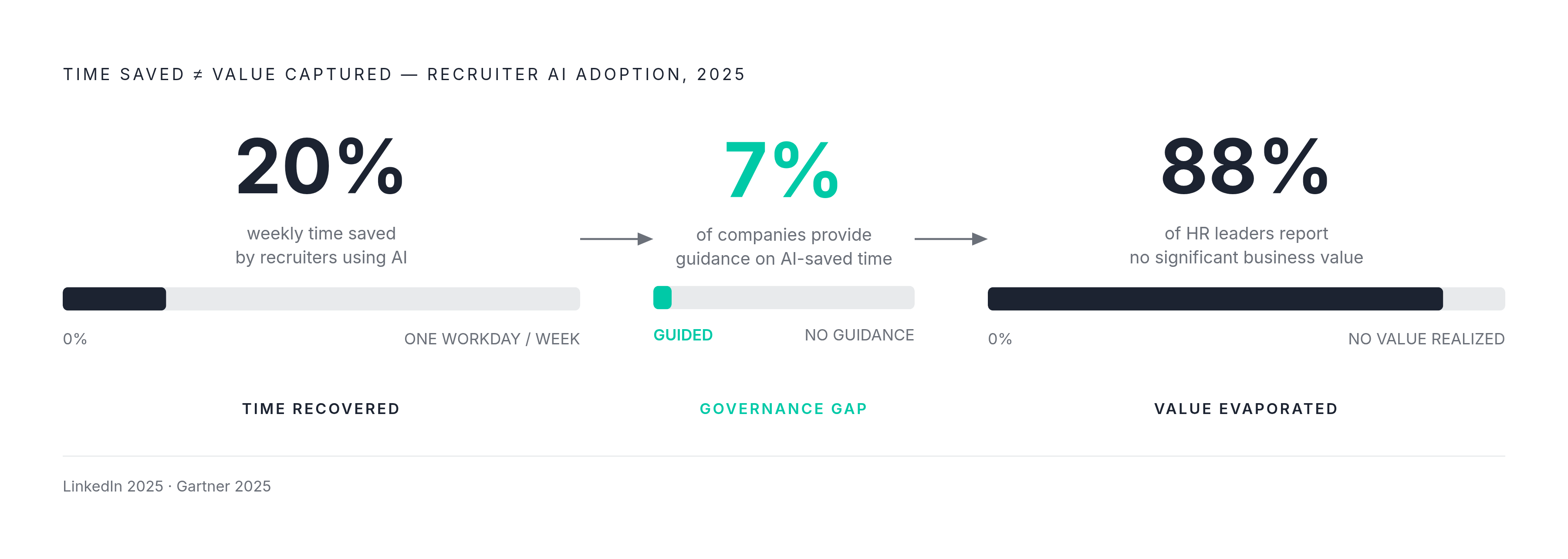
The headline figure from Gartner's October 2025 survey deserves direct examination. Eighty-eight percent of HR leaders say their teams haven't realized significant business value from AI. That sits in direct tension with adoption rates, and only 6% of firms qualify as McKinsey AI high performers. Most organizations are invested, active, and underwhelmed.
The time-savings paradox explains much of the failure. Per Gartner, only 7% of companies give guidance on how to use AI-saved time. Every recruiter I've spoken with fills recovered hours with the same activities AI was supposed to replace. An hour saved is only valuable if it's redirected toward higher-judgment work, deeper candidate engagement, more rigorous evaluation, and relationship-building that no algorithm can replicate. Without deliberate workflow redesign, efficiency gains evaporate before anyone measures them.
This isn't a technology problem. It's a workflow redesign and change management problem. Organizations purchase the tool, skip the redesign, and then measure their disappointment in vague terms.
Budget and headcount trends sharpen the picture. Fifty-nine percent of organizations report increasing TA tech budgets while only 24% expect to add recruiters. They're replacing human capacity without building the process infrastructure to support the transition. The governance gap makes this worse. 45% of TA functions operate with no formal ownership, no accountability, and no criteria for evaluating what the tools are actually doing. Capital flows in. Value does not flow out.
How Agentic AI Changes the Scope of What TA Automation Can Do
Agentic AI represents a qualitative shift, not an incremental upgrade. Conventional AI assists a recruiter step by step, with the human initiating each action. Agentic AI executes multi-step workflows autonomously. An autonomous agent runs sourcing overnight against a job description, drafts personalized outreach, sequences across email, LinkedIn, and SMS, and books interviews against the recruiter's calendar, without human initiation at each step. The recruiter reviews outputs rather than generating them.
That's a fundamentally different relationship between human and tool. Per Gartner, a large majority of HR leaders plan to deploy agentic AI by mid-2026. Aptitude Research and iCIMS finds that 46% of firms are already using or planning agentic AI specifically for talent acquisition. Stanford HAI's 2026 AI Index documents agentic AI job postings growing at an extraordinary rate year over year, a leading indicator that the labor market is already pricing this transition in.
The implications for organizations at shallow adoption are direct and uncomfortable. Every TA team I know that hasn't built governance for basic AI use isn't ready to hand autonomous decision sequences to agentic systems. The value gap will widen. Organizations with workflow depth will compound their advantages; surface-level adopters risk being disrupted by their own tools rather than by their competitors.
Agentic AI also raises the stakes on every governance and bias concern that already existed. Scale without governance isn't an efficiency gain. It's a liability that surfaces only after it has already done damage.
The Bias, Fraud, and Trust Problems That Accompany Scaled AI Adoption
AI adoption at scale has introduced a reciprocal problem. The same generative tools that make recruiters more productive also make it easier for candidates to produce polished, AI-generated applications at volume. Distinguishing signal from noise has become harder as a direct consequence, and the problem is structural rather than incidental.
Fraud has moved from theoretical to practiced. Talent teams are now dealing with synthetic résumés, AI-assisted assessments, and in some cases deepfake interview participation. The credentialing problem is real, growing, and not yet solved by the same tools that generated it. Screening queues in 2025 look nothing like they did three years ago, not in volume alone, but in the sustained effort required to determine whether what a recruiter is looking at is even authentic.
On bias, the evidence is mixed and conditional. AI tools can reduce hiring bias across gender and race when properly monitored. Without governance, AI systems trained on historical hiring data encode and amplify the patterns they were nominally designed to correct, and without ongoing auditing, no one's watching that happen.
The trust deficit extends beyond the organization itself. Candidates are forming opinions about employers that use AI-driven hiring, and transparency about how AI is used in screening is increasingly expected. Organizations deploying these systems without communicating their use aren't just risking compliance exposure; they're eroding candidate trust before a single human conversation has taken place. The next wave of TA AI isn't primarily about more tools. It's about whether candidates and internal stakeholders trust what those tools are doing and why.
How Skills-Based Hiring and AI Assessment Are Reshaping What Recruiters Are Actually Evaluating
Seventy percent of employers now use skills-based hiring, up from 65% the prior year, per NACE data. The shift away from credentials as proxies for capability toward demonstrated competency as the primary evaluative criterion is real and accelerating. AI is the structural enabler making that shift operationally feasible at scale.
Skills-inference tools, structured assessments, and semantic profile matching make it possible to evaluate capability at a volume where human review alone would inevitably revert to proxies like GPA or degree pedigree. Credential screening persisted for so long because it was fast, even when it wasn't accurate. AI makes skills-based evaluation fast and more accurate simultaneously, removing the core operational justification for credential-first filtering.
LinkedIn's Future of Recruiting 2025 found that companies conducting the most skills-based searches are meaningfully more likely to make quality hires. AI tools are surfacing qualified candidates who would have been filtered out by credential-first screening, expanding the viable talent pool beyond traditional pipelines. For technical roles, this is especially consequential. Open-source contribution signals, structured skill testing, and portfolio-level evidence are becoming more legible to AI-assisted screening than they ever were to keyword-matching ATS tools. Pedigree hasn't disappeared, but the direction of travel is clear and accelerates with each hiring cycle.
What This Means for Hiring Technical Talent Across Distributed and Nearshore Teams
The same AI-driven sourcing tools that expand domestic talent pools are making global and nearshore talent more discoverable. Semantic search doesn't respect national borders the way keyword ATS tools did. A candidate in a secondary city in Latin America or Eastern Europe who holds exactly the skills a job description requires is now findable in ways that would have required deliberate, resource-intensive manual effort only a few years ago.
Demand for AI specialists has grown 40% since 2023, per labor market data. The supply of qualified engineers in any single geography can't keep pace with that rate of need. Distributed and nearshore hiring isn't a fallback position; for organizations that take technical hiring seriously, it's increasingly the primary strategy.
AI-assisted vetting and structured skills assessments are reducing the friction of evaluating engineers across time zones. Assessment quality no longer requires co-location. More consistent evaluation methodology across distributed hiring pipelines means organizations can hold quality standards steady regardless of where a candidate sits.
For organizations augmenting engineering teams with nearshore talent, AI adoption in TA translates to faster identification of candidates who meet skills-based criteria, greater ability to scale hiring up or down in response to project demand, and a structural fit with staff augmentation models that require flexibility over rigidity.
The vetting problem doesn't disappear with AI; it gets reframed. AI surfaces more candidates faster, but evaluating engineering judgment, collaboration quality, and cultural fit at depth still requires human expertise and a rigorous assessment framework. BairesDev's nearshore engineering vetting process uses AI-assisted assessment across multiple sequential stages covering sourcing, technical evaluation, and cultural fit, rather than concentrating evaluation in a single bottleneck. The organizations capturing the most value are combining AI-driven sourcing speed with human-led evaluation depth, not substituting one for the other.
The Organizational Conditions That Separate AI Value Capture From AI Theater
AI in talent acquisition is widely deployed but rarely integrated. The tools exist. The will to redesign the systems around them is what most organizations lack, and that gap is a decision, not an accident.
What separates the 6% of McKinsey AI high performers from the 88% reporting no significant business value isn't access to better tools. High performers treat AI as a system embedded in a redesigned process rather than a feature layered onto an unchanged one. That distinction sounds simple. It's organizationally difficult, which is precisely why most organizations avoid it.
Governance must precede tooling. A framework defining who owns AI outputs, how they're audited, and what criteria define success should be established before any additional tools enter the stack. Workflow redesign must be explicit, with deliberate decisions about where recovered time goes, directed toward higher-judgment candidate engagement rather than more of the same activity at higher velocity. Skills-based evaluation infrastructure must be in place before scaling, because AI sourcing is only as good as the assessment criteria it feeds into. Every organization I know that hasn't built structured skills frameworks can't evaluate what AI surfaces. Bias monitoring must be treated as an ongoing operation rather than a one-time audit; the data AI learns from changes, and the patterns it encodes shift with it.
The practical sequence is to audit depth before adding breadth. Identify one workflow where AI is already present, redesign it end to end, measure the outcome, then expand. Agentic AI is arriving regardless of organizational readiness, per Gartner's 82% deployment projection by mid-2026. Organizations that close the governance and redesign gap now will compound their advantages as those systems mature. Those that don't will find themselves managing increasingly autonomous tools built on unexamined foundations. That's a choice, even when it doesn't feel like one.