Where to Find SRE and Platform Engineers When the Job Boards Run Dry
Finding SRE and platform engineers requires meeting them in communities, not job boards.
SRE and platform engineer job postings sit open for months because the search methods built for other engineering roles don't work here. Job boards surface active candidates searching under a title that half the industry doesn't use consistently, while the people who actually fit the role aren't looking at boards. More than 58,000 active DevOps and SRE postings sit open in the US right now, yet DevOps and SRE shortages still touch a significant share of enterprises. The postings exist. They just don't convert.
Part of that comes down to naming. Meta calls the role Production Engineer. Other companies fold senior reliability work into "platform engineering" or "infrastructure engineering" titles that describe a different job depending on who's writing the posting. A hiring manager searching for "SRE" and a candidate who's spent six years doing exactly that work under a different label will never find each other through keyword matching. Platform engineering compounds the problem because the title itself is young: the discipline formalized recently enough that plenty of practitioners with the right skills never picked up the label, even as a large majority of big software organizations now run dedicated platform teams. Demand outpaced the vocabulary.
What these roles require, and why the skill profile narrows the candidate pool sharply
SRE work sits at an intersection that used to be three separate jobs. Software engineering, systems and networking, and the instinct to stay calm and methodical during an incident used to belong to three different people on three different teams. Now one person is expected to hold all three, often on-call, often at 2 a.m.
The tooling makes that concrete. A working SRE candidate pool today needs real proficiency in Kubernetes, Terraform, Prometheus and Grafana for monitoring, OpenTelemetry for tracing, and a paging tool like PagerDuty for incident response. Asking for fluency across all five shrinks the pool fast, because most engineers are genuinely strong in two or three of those and merely competent in the rest.
Platform engineers carry a fourth requirement that SRE work doesn't demand in the same way: product thinking. A platform engineer is building the infrastructure that other engineers use. This involves gathering feedback from internal developers, designing self-service tooling, and treating the platform itself as a product with users and a roadmap. The skill markers overlap with DevOps: Kubernetes, Terraform, CI/CD pipelines, developer portals, security governance baked into the pipeline rather than bolted on after. What separates a platform engineer from a DevOps engineer isn't the tool list, it's the product management sensibility layered on top of it. That's a rarer combination than the job description usually admits.
Compensation reality in 2026
Money is where a lot of searches quietly fail before they even start. SRE base salary in the US in 2026 runs from roughly $100,000 to $265,000, a spread wide enough to be almost meaningless on its own. Mid-level SREs are $130,000 to $175,000. Senior SREs are $160,000 to $210,000, before equity or bonus enters the picture. Platform engineers run $128,000 to $205,000 at base, with senior and staff hires at AI labs and large public companies clearing $260,000 to $385,000 in total comp.
Those ranges conflict depending on where you look, and that's not a data error, it's a measurement problem. Some aggregators report base salary only. Others report total comp, folding in equity and bonus. Reading one source without checking what it's actually measuring can make the numbers at the top end appear to differ by six figures. A hiring team that only consults one source either prices itself out of the market internally, or shows up to the offer stage with a number that insults a senior candidate's intelligence.
The cost of that mistake isn't abstract. Twenty-seven platform engineer searches run between Q3 2025 and Q1 2026 got written against a 2023 DevOps compensation band, a band that never accounted for the product-thinking premium platform roles now command. Candidates walked. The searches that didn't collapse outright got rescued only by paying a premium to reopen negotiations, which costs more in time and goodwill than pricing the role correctly the first time would have.
Where SRE and platform engineers spend their professional attention
Job boards are a passive channel, and the strongest SRE and platform candidates, the ones already doing good work at stable companies, aren't browsing them. They surface through community, reputation, and word of mouth instead. Recruiting has to go find them where they already spend their time rather than waiting for an application.
That time concentrates in a handful of specific places. The Cloud Native Computing Foundation, KubeCon, and PlatformCon are the named venues where this population gathers professionally, in person and online, to talk shop and see what everyone else is building. Daily.dev draws engineers who are actively learning and publishing rather than passively scrolling, which signals stronger engagement than a stale resume sitting on a job board and helps hiring teams identify candidates who are genuinely active in the field.
Open-source contribution records are another layer that shows real signal. An engineer maintaining or contributing to reliability tooling, an internal developer platform framework, or an observability project is demonstrating the exact competencies a hiring team is trying to verify through interviews, and that record is sitting in public on GitHub for anyone who bothers to look. Structured learning communities matter for a similar reason: platforms running SRE certification programs attract engineers who are deliberately investing in the discipline before anyone's paying them more to do it. Recruiters who show up inside those communities reach motivated candidates before those candidates ever open a job board.
Staff augmentation as a sourcing channel for hard-to-fill reliability roles
Not every reliability need calls for a permanent hire, and treating augmentation as a lesser substitute for direct hiring misreads what it's actually for. Direct hire makes sense for steady-state production ownership, where institutional memory about why a system is built the way it is matters more with each passing year. Contract or augmented talent makes sense for a defined push: a cloud migration, standing up an observability stack from scratch, a platform launch with a known end date.
If the work is urgent, specialized, and bounded, augmentation usually beats permanent hiring. If it's ongoing and central to the business, it usually doesn't.
The shape of augmentation itself has shifted too. Complex initiatives increasingly get staffed with skill pods rather than single augmented hires, small cross-functional units combining engineering, analytics, QA, and DevOps that deploy together as a unit instead of getting assembled one contractor at a time. And the value math inside augmentation has changed with the rise of engineers fluent in modern development tooling: an engineer who's genuinely fluent with this kind of tooling delivers materially more output under an augmentation contract than a traditional engineer would, and the methodology that engineer brings tends to stay embedded in the team's practice after the contract ends. That resets what augmentation is worth, because the return isn't just the hours billed, and it's the practice that outlives the engagement.
Nearshore engineering pipelines as a specific answer to senior SRE and platform talent scarcity
Timezone alignment isn't a nice-to-have for SRE work, it's close to a hard requirement. On-call responsibility touches more than 90% of SRE roles, and incident response depends on real-time back-and-forth. Nearshore teams based in a nearby region typically operate within zero to three hours of the client's working hours. Offshore teams typically run an eight to twelve hour offset, which turns a five-minute exchange on a team messaging tool during an incident into a half-day wait.
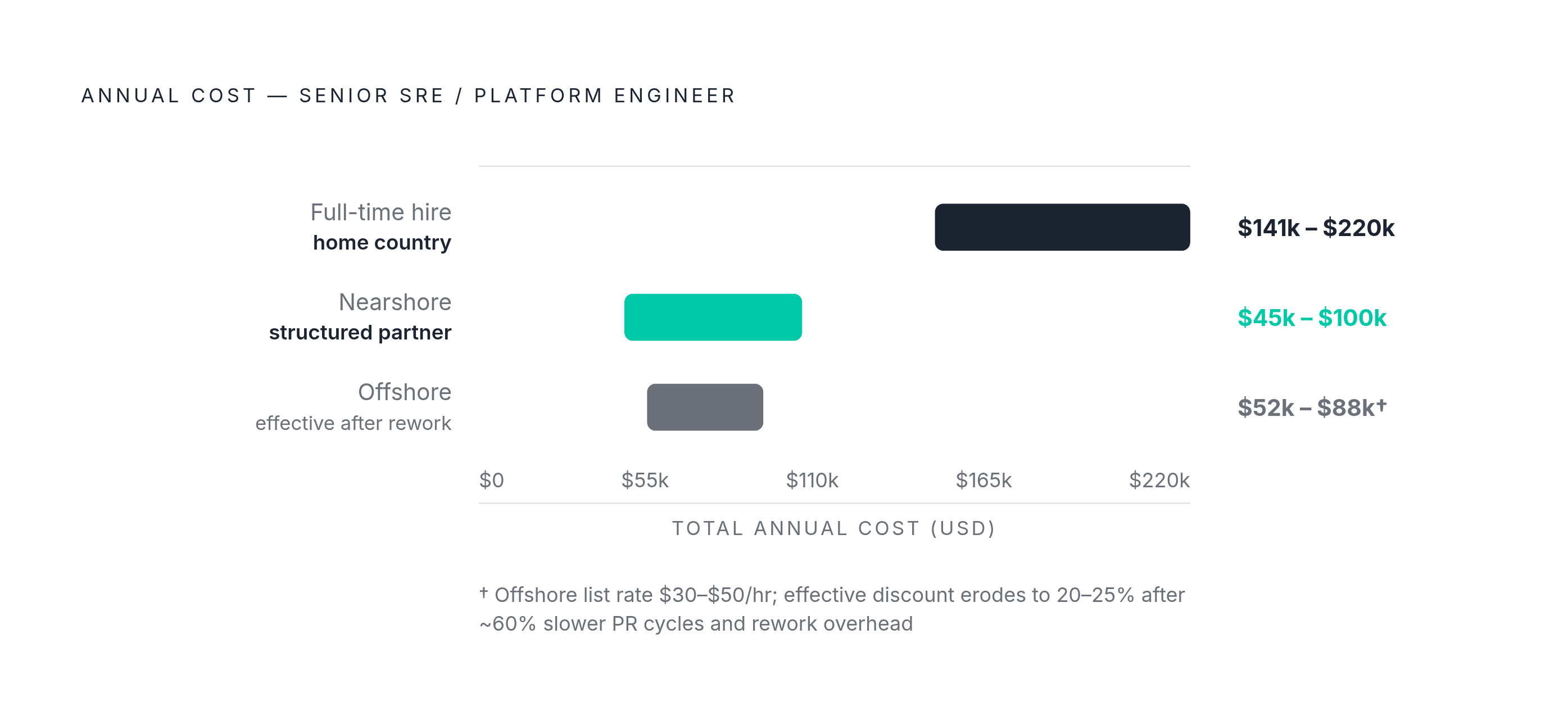
The cost comparison looks different once that offset gets priced in. Nearshore hourly rates run $65 to $95 an hour, higher on paper than offshore rates of $30 to $50 an hour. But the offshore discount that looks like 50% on a spreadsheet tends to shrink to 20% or 25% once total cost of ownership gets factored in: faster pull request cycles (roughly 60% faster in practice), less rework from miscommunication, and no overnight management overhead babysitting a shift nobody on the core team is awake for.
Running the same comparison against full-time hiring widens the gap further. A senior engineer in DevSecOps or cloud engineering working in the client's home country costs $141,000 to $220,000 in total annual compensation. A nearshore equivalent sourced through a structured partner runs $45,000 to $100,000, with no benefits overhead layered on top. That's a structural difference in cost of living and market rate.
Access to the right engineers is required for any of that to matter, though. The scarcity driving this entire piece doesn't disappear just because a company decides to hire nearshore, and a rate card alone won't fix a sourcing bottleneck. What actually closes the gap is a partner that has already vetted candidates rigorously for reliability experience specifically, not general backend or full-stack skill. Rate arbitrage without a vetted pipeline behind it just relocates the same search problem to a different geography.
Building a repeatable sourcing system rather than running a series of one-off searches
Most of the panic around a hard-to-fill reliability role comes from a single root cause: there was no pipeline before the seat opened. Treating every vacancy as a fresh sourcing problem guarantees a scramble every time, because community trust, partner relationships, and candidate awareness don't build in the two weeks after a resignation letter lands.
Community presence has to happen before there's a role to fill, not after. Showing up at KubeCon, at CNCF meetups, at PlatformCon, consistently and without an immediate ask attached, means a company is a known quantity by the time it actually needs to hire. Candidates respond to organizations they recognize far more readily than to a cold outreach message from a company they've never heard of.
The same logic applies to augmentation and nearshore partners. The relationships that work best span years, not single engagements, because a partner who already understands a company's technical bar and culture can fill a reliability role faster than any search that starts from zero. And for the gap between "the seat is empty" and "the right permanent hire is in place," fractional reliability leadership, fractional CTOs, fractional architects, fractional engineering leads, is a fast-growing model for a reason: it covers the immediate need, assesses what the team actually requires, and defines the hire profile with far more precision than a rushed job posting ever could. That reduces the single most expensive mistake in this entire domain: hiring the wrong shape of engineer under pressure, then repeating the search six months later.