Contract and Freelance Talent Sourcing Channels
Five sourcing channels offer different trade-offs between control, vetting rigor, and true cost.

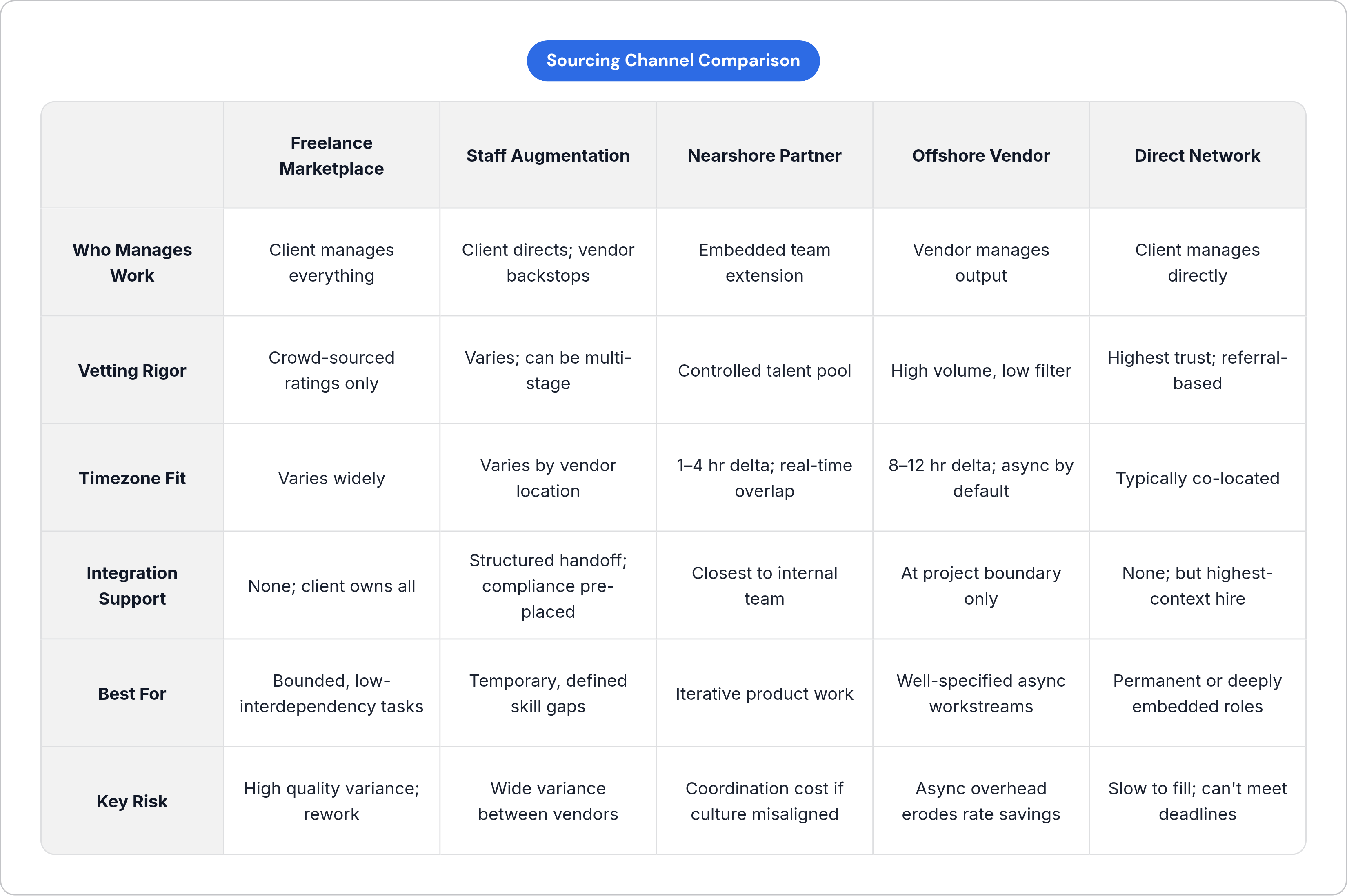
Five channel types define the practical landscape. Freelance marketplaces like Upwork, Toptal, and Fiverr are self-serve, rate-transparent, and wildly variable in quality; the buyer absorbs essentially all vetting burden. Staff augmentation firms pre-vet talent, handle compliance and payroll, and place engineers the client then directs day-to-day. Nearshore development partners are geography-anchored, timezone-aligned, and typically structured as embedded team extensions. Offshore development vendors compete primarily on cost, operate project- or team-based models, and are asynchronous by default. Direct professional networks (LinkedIn, referrals, alumni pipelines) represent the highest-trust sourcing mechanism available, the slowest to fill, and carry no intermediary cost.
The structural distinction that matters most isn't price. The more consequential question is who controls the work versus who supplies the people. In staff augmentation, the client manages the person; the vendor supplies and backstops them. In outsourced or managed-service arrangements, the vendor manages both the person and the output. On a freelance marketplace, the client manages everything; the platform is a directory with escrow.
These are different answers to a foundational question about how much control the buyer wants and how much sourcing risk they're willing to carry.
What Freelance Marketplaces Actually Deliver — and Where They Break Down
Marketplaces optimize for speed of access and rate transparency, and within that mandate they genuinely deliver. Time-to-post is fast. Portfolios, ratings, and prior client reviews are visible before any commitment. For small, well-specified, low-interdependency work (a landing page redesign, a data migration script, a one-time security audit) the marketplace model is efficient in ways other channels can't match on turnaround.
The breakdown comes when buyers extend that model to work it was never designed to support. Vetting on a marketplace is crowd-sourced rather than rigorous. Ratings reflect prior clients' satisfaction, not technical depth. Quality variance is high enough that a buyer without strong internal engineering judgment has no reliable mechanism to distinguish a strong candidate from a passable one before the work begins. I've seen this play out more than once: a team chooses a well-reviewed contractor on price, the work delivers, and six months later no one can maintain what was built because the architecture decisions were unintelligible to everyone who didn't write them.
There's no integration support. Onboarding, tooling access, compliance scaffolding, and knowledge transfer all fall on the client. IP ownership, NDAs, and data security require client-side legal diligence that many buyers skip — not out of negligence, but because no one flagged the risk until something went wrong.
A low hourly rate combined with rework cycles, re-hiring friction, and senior-engineer management overhead erodes apparent savings faster than most buyers anticipate. Every team I've seen treat the rate card as the primary decision variable ends up rebuilding the work.
How Staff Augmentation Differs from Just Hiring a Contractor
The core distinction isn't contractual; it's operational. A staff augmentation firm pre-vets, places, and backstops the engineer. The client still directs the work every day. What the vendor absorbs is substantial: sourcing pipeline, technical screening, compliance, payroll, benefits administration, and replacement risk. What the client retains is equally substantial: sprint planning, code review, architecture decisions, team culture.
The IT staff augmentation sector was estimated at roughly $150.5 billion in 2024 and is projected toward $390 billion by 2032, per Grand View Research. That growth reflects something real. Every engineering leader I've spoken with has discovered that carrying permanent headcount through demand cycles they can't predict is expensive in ways that don't show up cleanly on a balance sheet. Three to twenty-four months is the practical sweet spot for augmentation engagements, long enough to deliver meaningful throughput, short enough to avoid the institutional dependency that makes unwinding an augmented role genuinely complicated.
Augmentation fits specific, temporary skill gaps well: a machine learning engineer for a model-training phase, a DevOps specialist during a cloud migration, bridge capacity while internal hiring catches up. It's a poor fit for roles where institutional knowledge is the primary asset. Highly regulated environments requiring cleared, citizen-only, or background-screened staff also narrow the viable vendor pool dramatically, and buyers often don't discover that constraint until they're already mid-search.
Vetting depth, replacement policy, security practices, and domain experience are what separate a strategic augmentation partner from a resume pipeline with a markup attached.
The Geography Dimension: How Timezone Shapes Collaboration Quality
Timezone delta is the most underestimated variable in the sourcing decision. It appears administrative until it isn't.
For US-based teams, nearshore Latin America presents a one-to-four hour delta: real-time overlap across most of the working day, no requirement for either side to shift outside normal hours. Offshore locations in South and Southeast Asia present an eight-to-twelve hour delta. Synchronous collaboration at that distance requires someone on one side to work outside normal hours, which in practice imposes a handoff model whether the team planned for it or not.
The handoff model isn't automatically a failure. For well-specified, independent workstreams (QA automation, overnight test runs, data pipeline maintenance) follow-the-sun can genuinely shorten cycle times. Where it fails is iterative product development, ambiguous or evolving requirements, and any work where a question unanswered for twelve hours costs a full day's output. That's not a workflow problem. It's a physics problem.
Cultural alignment compounds the timezone effect in ways that language proficiency alone doesn't capture. Teams that share business context, communication norms, and decision-making style lose less to misinterpretation per interaction. Individually, these losses are small. Accumulated across hundreds of handoffs over a six-month engagement, they become a measurable drag on delivery. Latin America is showing regional growth among nearshore destinations, with a projected 12.7% compound annual growth rate from 2025 to 2030 per Statista market forecasts, reflecting where talent supply and delivery infrastructure are both expanding to meet demand.
Reading the Real Cost of Each Channel, Not the Rate Card
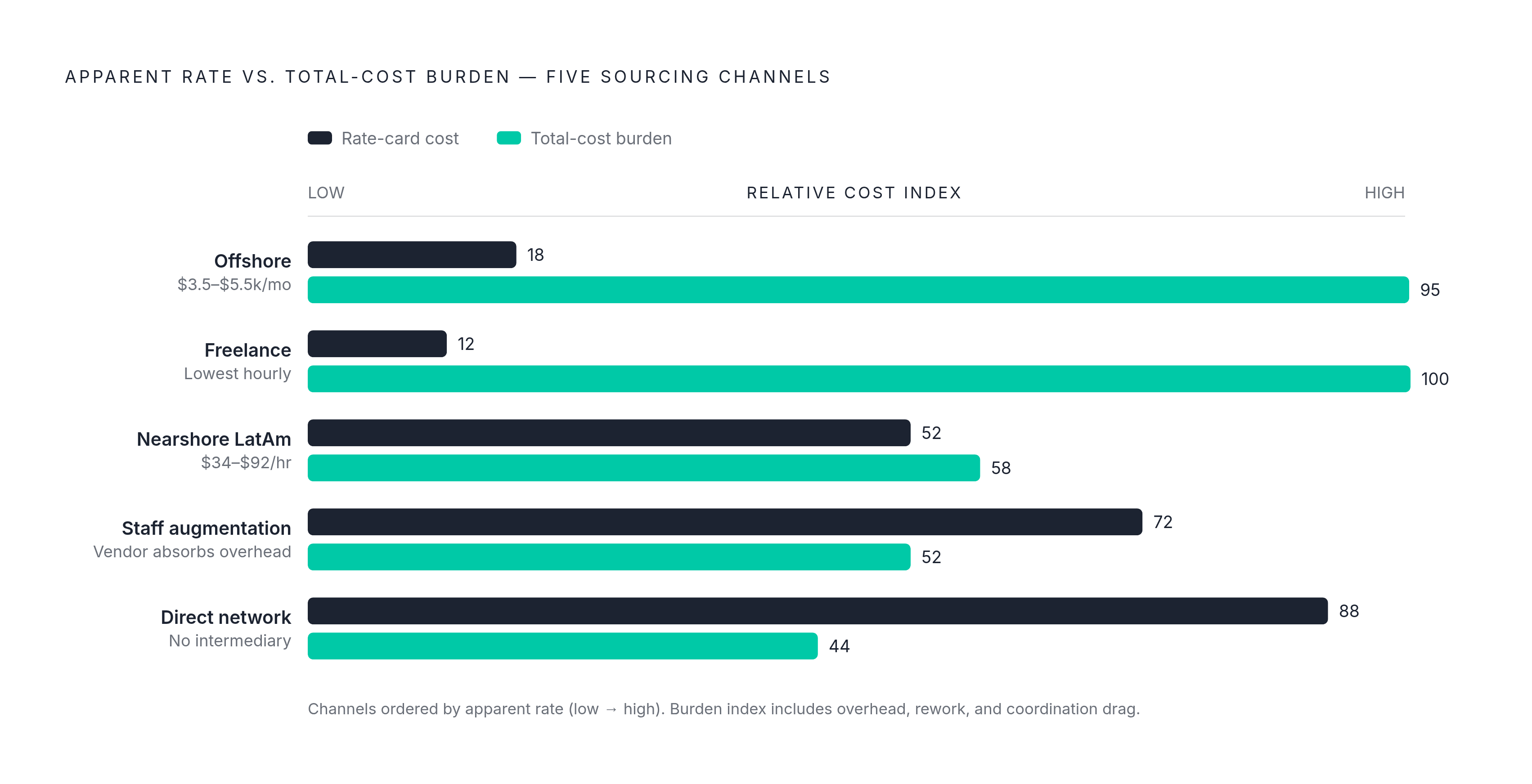
A 2021 McKinsey & Company analysis of large IT projects found that cost overruns of 20 to 30% or more are common when organizations underestimate coordination and rework costs in offshore initiatives. That figure should give pause to anyone building a sourcing business case on rate arbitrage alone.
The rate card misses the actual cost drivers: rework volume tied to communication quality, senior management time spent coordinating rather than building, time-to-productivity lost to onboarding friction, attrition and replacement cost, and the compliance and security scaffolding the client must construct when the channel doesn't provide it. Each channel has a different profile on these dimensions, and ignoring them produces budget surprises that feel sudden but were entirely visible in advance.
Freelance marketplaces carry the lowest apparent rate and the highest buyer-side overhead and quality variance; total cost is genuinely unpredictable without strong internal sourcing capability. Staff augmentation from a vetted firm carries a higher rate, but the vendor absorbs sourcing and compliance overhead; Gartner research suggests properly modeled augmentation can lower operating costs by around 30% versus a fully loaded permanent hire. Nearshore partners in Latin America show rates typically between $34 and $92 per hour per Accelerance's 2024 Global Outsourcing Guide, 30 to 50% below US onshore rates, with real-time timezone overlap that reduces rework and management drag. Offshore vendors in Asia-Pacific average $3,500 to $5,500 per month per 2024 industry benchmarks; the rate advantage is real but erodes with async overhead, rework cycles, and coordination cost. Direct network sourcing carries no intermediary cost but is constrained entirely by sourcing time; the right hire through a referral is often the highest-quality outcome at the lowest long-run cost, but it can't be manufactured on a deadline.
A $60-per-hour engineer with 95% first-time code quality and real-time communication will frequently cost less in delivered outcomes than a $25-per-hour junior in a distant timezone carrying 40% rework. What's hard isn't the arithmetic. What's hard is doing it before selecting a channel rather than after absorbing the consequences of skipping it.
Quality Control and Vetting: Where Channels Diverge Most Sharply
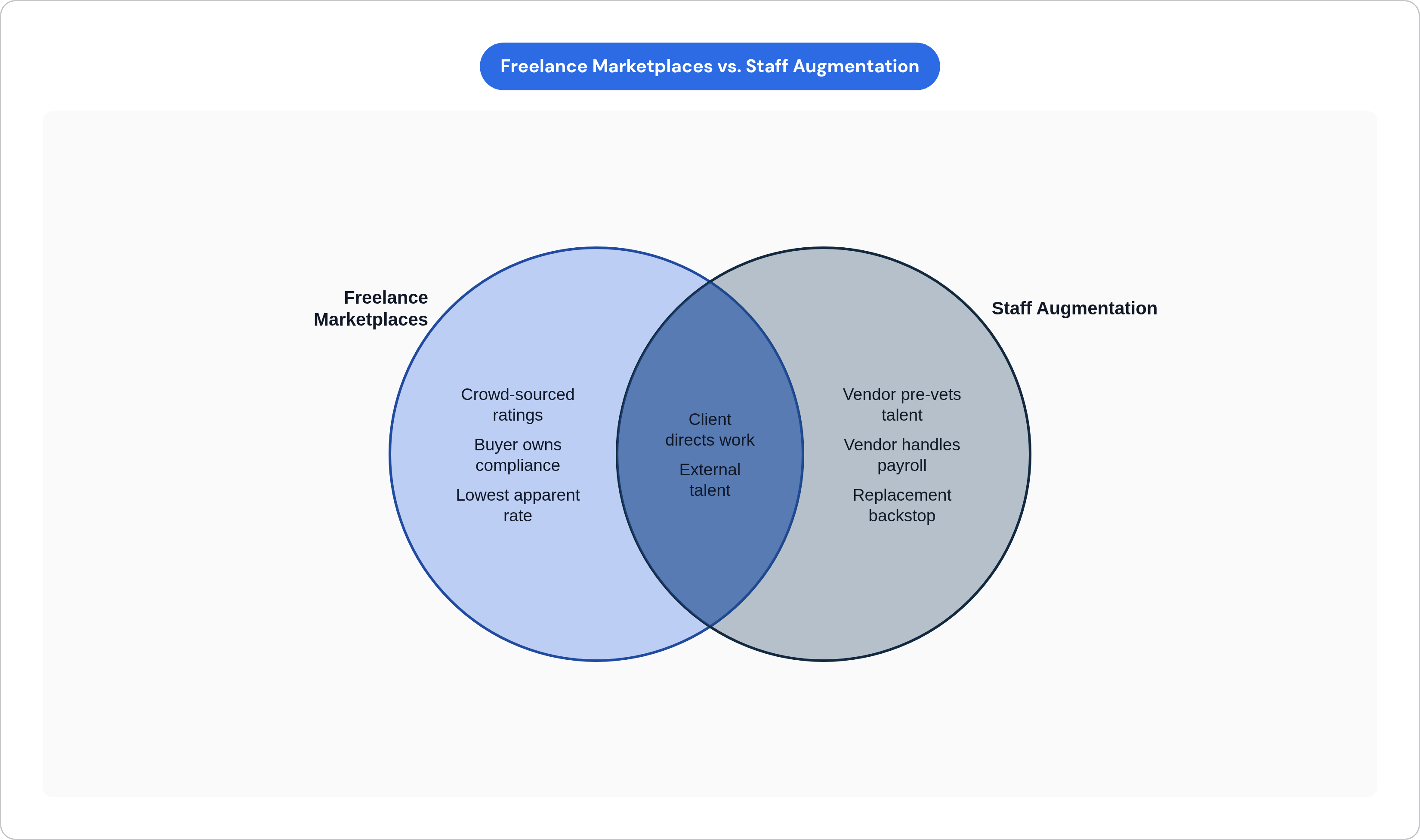
Quality control isn't a feature of the individual engineer. It's a function of who vets them and how, and the channels differ so dramatically on this dimension that comparing them on rate alone misses what the choice is actually about.
Freelance marketplaces rely on ratings and portfolios; there's no standardized technical bar, and the buyer interprets signals without ground truth. Staff augmentation firms vary widely, from those running rigorous multi-stage technical screens to those operating as resume pipelines with light filtering. That variance is why treating augmentation firms as interchangeable is a persistent and costly mistake. The vendor selection decision is a direct proxy for vetting quality. Buyers who don't interrogate the screening process before signing an agreement are outsourcing their standards along with the work.
A 2022 ManpowerGroup Talent Shortage survey found 76% of employers worldwide reported difficulty securing skilled tech talent. Scarcity has a consequence that rarely gets stated plainly: the supply surfaced by low-friction channels includes candidates that higher-filter channels have already screened out. The pool at the bottom of the funnel is different from the pool at the top, and the sorting mechanism is the vetting process, not the job description.
Rigorous vetting screens for technical depth across the relevant stack, problem-solving under constraint, communication clarity, and fit with the client team's working style. A vendor that offers structured replacement when a placement doesn't work out is demonstrating confidence in its own process. A platform that leaves re-sourcing entirely to the buyer is showing you exactly where it places the risk.
AI is now embedded in many talent platforms' screening workflows, accelerating candidate surfacing without guaranteeing the human judgment that complex engineering roles require.
Demand for Specialists Is Changing Which Channels Can Actually Deliver
The demand mix has shifted materially. Cloud, data engineering, and AI roles now constitute a larger share of new external development requests than in prior years. Demand for AI specialists increased 40% since 2023 per LinkedIn's 2024 Jobs on the Rise report, and supply hasn't kept pace.
Specialist hiring exposes the limits of high-volume, low-filter channels in ways that generalist hiring doesn't. This is a distinction that catches buyers off guard. Freelance marketplaces have deep pools of generalist developers; specialist depth is thinner and harder to verify without domain expertise on the buyer side. High-volume offshore vendors optimized for ten-person team delivery often lack bench depth in narrow specializations. When you're looking for a principal-level ML infrastructure engineer or a data platform architect with a specific cloud-native background, a directory with 200,000 profiles isn't inherently more useful than a curated bench of thirty vetted specialists. Volume and depth are different things, and conflating them in a specialist search produces a long sourcing process with a weak outcome.
Staff augmentation firms and nearshore partners with domain-specific talent pools are better positioned for specialist fills because they match against a known bench rather than re-source from scratch. A specialist placed through a channel with no domain vetting capability carries the right job title with the wrong depth, and that gap stays invisible until the work starts.
The emerging standard for technology teams sourcing specialist capacity is a hybrid model: internal or nearshore leadership paired with augmented specialist roles, rather than routing all specialist needs through a single channel regardless of fit.
Integration and Onboarding as the Channel Variable Buyers Routinely Ignore
Speed-to-productivity is the metric that matters after placement. Time-to-hire is the metric that feels like it matters before. They're not the same thing, and optimizing for the latter at the expense of the former is a common and expensive error.
A 2024 GitHub survey of developer productivity found that onboarding time for developers using AI tools daily was cut from 91 days to 49 days. Even under favorable conditions, that's the scale of the integration cost: calendar time, management attention, delayed output. Channels differ dramatically in how much of that burden they share with the buyer.
A freelance marketplace placement leaves the client to own everything — tooling access, documentation, ramp structure, compliance. A staff augmentation firm with a strong operational model provides a structured handoff, handles compliance pre-placement, and offers a replacement backstop if fit is wrong. A nearshore embedded partner functions closest to an internal team member in terms of daily integration: real-time availability, shared sprint cadence, ongoing account management from the vendor side. An offshore project team integrates at the project boundary, not at the person level; handoff friction recurs at every deliverable edge.
When an engagement ends without proper knowledge transfer, institutional context leaves with the contractor. This happens quietly. There's no single moment when it becomes obvious; it surfaces weeks later, when someone needs to extend the work and realizes no one on the team can explain the decisions that shaped it. A 2017 PMI Pulse of the Profession report found that a substantial share of project failures was attributable to misalignment between business and project objectives, a problem that begins at onboarding and compounds steadily in channels that provide no integration structure. Communication quality, which PMI research links directly to improved project success rates, is shaped by timezone overlap, shared tooling, and onboarding depth. All of which vary by channel and none of which appear on a rate card.
Matching Channel to Context: The Decision Framework
No channel wins universally. The right choice is a function of four variables in combination, and the discipline is in being clear-eyed about where each one sits before committing to a sourcing path.
Work type comes first. Is the engagement well-specified and bounded, or iterative and evolving? Bounded, low-interdependency work can route to a marketplace or offshore vendor with manageable risk. Iterative product work embedded in an existing team requires real-time collaboration, shared context, and reliable communication, which points toward nearshore augmentation or a direct network hire. Getting this wrong at the start doesn't announce itself immediately; it surfaces two months in, when velocity stalls and no one can quite explain why.
Time horizon comes second. Engagements under three months favor channels optimized for speed-to-fill: marketplaces and augmentation firms with available bench. Engagements from three months to two years favor staff augmentation or nearshore partners, where integration investment pays back over time. Permanent, deeply embedded roles don't belong in augmentation at all; they belong in internal recruiting, and conflating the two produces predictable attrition.
Quality threshold is the third variable. Work that's customer-facing, architecturally consequential, or difficult to audit after delivery demands a channel with genuine vetting rigor: a vetted augmentation firm, a nearshore partner with a controlled talent pool, or a direct network referral. A marketplace, regardless of how individual profiles look, isn't built for this.
The fourth variable is total cost tolerance for uncertainty. Buyers with strong internal sourcing capability, legal infrastructure, and senior bandwidth to manage coordination can absorb the variability of a marketplace or an offshore vendor. Buyers without those resources shouldn't accept a channel that transfers all that burden to them, regardless of what the rate card says.
Establish channel fit first. The cost structure follows from that choice. Every startup I know that reversed the order — led with the rate, then retrofitted the channel — found out the hard way that spreadsheet savings rarely survive contact with execution.