Compensation Transparency Laws and Hiring
Remote hiring triggers overlapping state pay laws with conflicting disclosure rules.

Remote work turned geography from a hiring filter into a legal variable. A role posted as remote-eligible doesn't sit in one jurisdiction; it sits in every state where a candidate plausibly applies. Illinois, Minnesota, New Jersey, Vermont, Massachusetts, and others can all be triggered by a single posting, each carrying its own thresholds, timing rules, and disclosure scope.
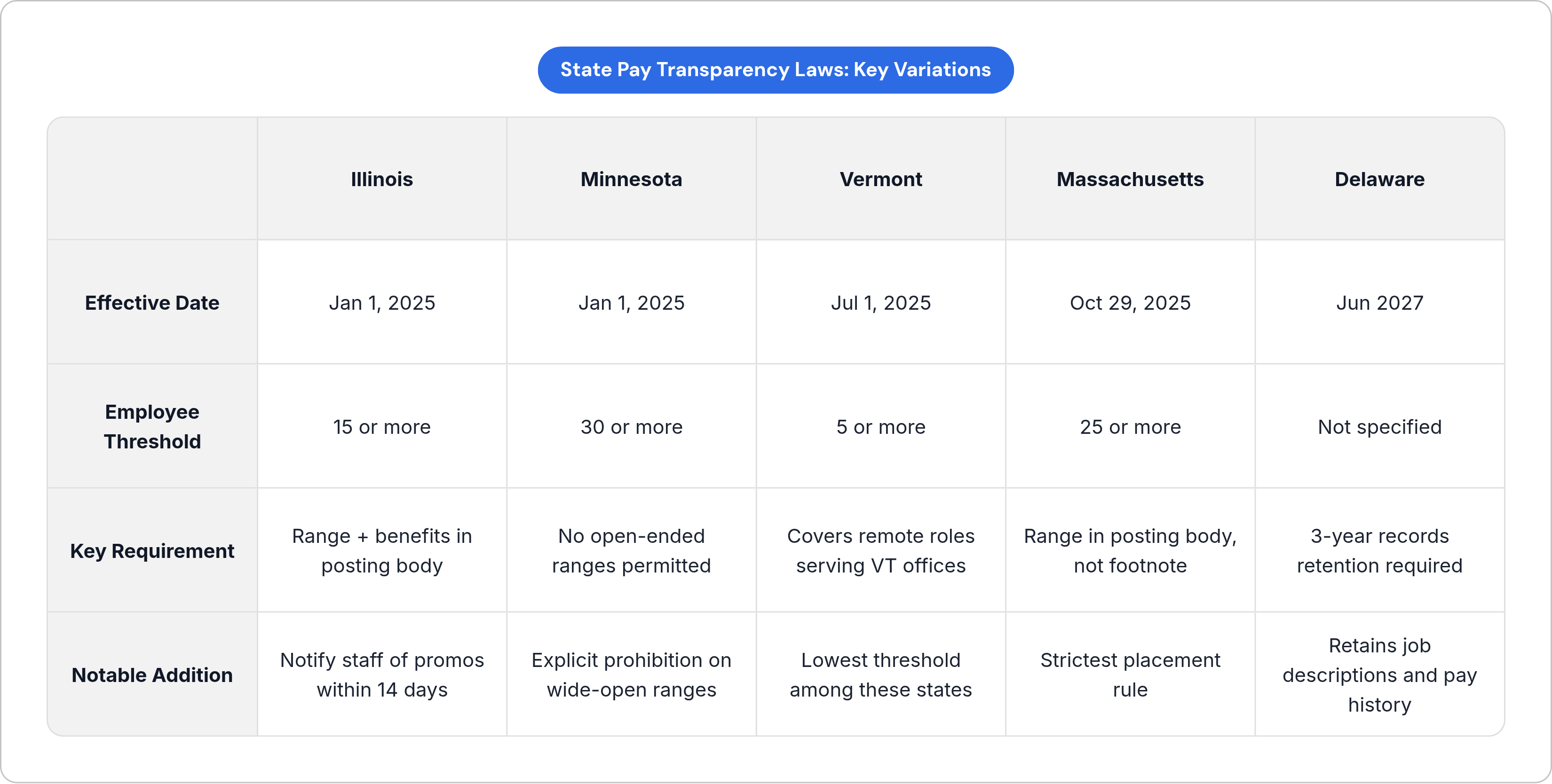
The variation runs deeper than most legal teams initially expect. Illinois, effective January 1, 2025, requires employers with 15 or more employees to include pay scale and a general benefits description in the posting body, and to notify current employees of promotional opportunities within 14 days of any external posting. Minnesota, also effective January 1, 2025, covers employers with 30 or more employees and explicitly prohibits open-ended ranges. Vermont, effective July 1, 2025, applies to employers with as few as five employees and extends to remote roles primarily serving Vermont-based offices. Massachusetts, effective October 29, 2025, requires 25 or more employees and mandates that the range appear in the posting body itself, not a footnote. Delaware, signed in 2025 and effective June 2027, adds a records retention requirement of at least three years, covering job descriptions, salary ranges, and the pay history of whoever is ultimately hired. Employee-size thresholds run from one in Rhode Island to 50 in Hawaii.
A posting fully compliant in Illinois will fall short in Vermont. That fact alone forces a practical response: identify every state where the role can be performed, then apply the broadest applicable standard across all of them. Ungainly, but it's the only clean path given the absence of a comprehensive federal standard.
The operational implications follow from that. Documenting pay bands before any posting goes live. Placing the range in the posting body rather than an attachment. Auditing job board listings on a recurring basis. Training recruiters on what they will and will not discuss about compensation during interviews. Retaining records for the multi-year periods certain states now require. None of this is optional, and none of it is trivial to operationalize at scale.
Engineering and technical roles bear a disproportionate share of this burden because they are the most likely to be posted as remote-eligible, pulling applicants from many states simultaneously. The rescission of the federal Pay Transparency Nondiscrimination Provision for federal contractors under Executive Order 14173, signed January 20, 2025, removed the one federal-level mechanism that had nudged contractors toward disclosure. State law is now the primary compliance surface. It is still expanding.
How Posting a Salary Range Changes Who Applies and How They Negotiate
The application pool changes when candidates know the range before they apply. Candidates who arrive with compensation expectations already calibrated to the posting are more genuinely interested and more appropriately qualified, because the range has done real filtering work before the recruiter picks up the phone. That sounds obvious in retrospect. It took most of the hiring managers I've worked alongside longer than they'd admit to actually internalize it.
The wage effects extend beyond new hires. A 2025 NBER Working Paper by Arnold, Quach, and Taska found that Colorado's transparency policy produced a 3.6 percent average increase in posted salaries after taking effect. That pressure doesn't stay external for long. Once ranges are visible to candidates, existing employees begin comparing their own compensation against them, and the internal equity pressure that follows extends well beyond any single hire.
Range width matters in ways that aren't evenly distributed across candidates. A Cornell University School of Industrial and Labor Relations study found that broad salary ranges discourage women from applying and influence negotiation behavior; narrower, more precise ranges are associated with less negotiation disparity. Publishing the criteria used to determine where within a range an offer lands, whether based on years of relevant experience, specific technical skills, or location, reduces these effects and produces more equitable outcomes. The transparency, it turns out, has to go all the way down.
Research consistently shows that roughly half of candidates don't negotiate at all. A well-structured range gives those candidates the context they need to engage from an informed position rather than from uncertainty about what the number even is.
For engineering hiring specifically, a defined range paired with clear placement criteria signals something experienced engineers notice immediately, that the organization has actually thought about what the work is worth. Engineers read compensation discipline as organizational credibility. They're evaluating how a company reasons, not just what number it names.
What Salary Ranges Reveal About How Companies Have Been Budgeting for Engineering Talent
Publishing a range requires knowing the range. That requirement is more disruptive than most organizations anticipate, and the disruption is almost always revealing.
I've seen this play out across engineering organizations at different stages. Without documented pay bands, compensation gets managed reactively: individual hiring managers negotiate separately for the same title, offers reflect whoever was available in the market that quarter, and the resulting pay dispersion stays invisible as long as no one has to write a number in a job posting. The moment a posting goes live with a specific range, that dispersion surfaces. There's no version of this where the organization doesn't discover something it would have preferred not to know.
The remediation work is substantial. Auditing existing engineering compensation against stated bands. Identifying compression problems where recent hires are at market while tenured engineers have slipped below it. Deciding whether to level up incumbents or narrow future offers. Both choices carry direct budget implications, and neither is comfortable.
Engineering titles compound the problem. A "senior engineer" band at one company will overlap with a "staff engineer" band at another. I've sat in enough debrief calls after ranges went public, watching the interview friction that followed when internal leveling and the posted band were describing two different jobs, to say with some confidence this isn't a theoretical risk. It's a predictable one. Market benchmarking becomes harder in this environment but also more necessary, because a company posting ranges without first anchoring to a consistent leveling framework will produce confusion internally and misalignment with candidates externally.
A coherent compensation architecture is not purely a compliance cost. It reduces attrition risk by eliminating the information asymmetry that leads engineers to discover, only after accepting an offer elsewhere, that their current employer had been paying below market for some time. The engineers who leave usually knew their market value before anyone in leadership did.
The Strategic Hiring Advantage Available to Companies That Publish Ranges Well
In a market where many employers still post vague or absent compensation information, a well-constructed, honest range is a genuine differentiator. Not because it signals generosity, but because it signals that the organization has done the internal work to know what the role is worth.
The speed benefit is concrete. Candidates who self-select based on a visible range arrive at the interview stage already aligned on compensation. Offer-stage fall-through decreases. Time-to-hire shortens. The conversations that do happen are about capability and fit rather than closing an expectation gap that have been resolved before the first screen.
Retention follows the same logic. Engineers who understand where they sit within a band, and what the criteria for advancement look like, are less likely to benchmark their compensation by interviewing elsewhere. Transparency reduces the information asymmetry that drives attrition, and it does so before the exit interview, which is the only moment it actually matters.
What separates companies that capture this advantage from those that don't is specificity. A range of $80,000 to $200,000 tells a candidate nothing meaningful. A range of $145,000 to $175,000 accompanied by the criteria that determine placement within it signals that the organization has thought carefully about what the role requires and why a candidate at the upper end merits it. Candidates notice the difference. They also notice discrepancies between posted ranges and actual offers, and they share that information through Glassdoor, Levels.fyi, and direct conversation with other engineers. The reputational feedback from those channels moves faster than most hiring managers expect, and it compounds in both directions.
How Transparency Laws Interact with Distributed and Nearshore Engineering Teams
Transparency laws govern the posting and the hiring process, not where engineers ultimately sit. Still, the intersection of these laws with distributed team structures creates operational complexity that most companies are still working through.
A U.S. company posting a remote role that nearshore engineers will fill must still comply with the transparency laws of every state where a U.S.-based candidate can apply. The posting triggers the obligation regardless of where the intended hire is located. At the same time, the internal equity pressure created by published bands naturally raises questions about how augmented engineers are compensated relative to direct hires performing equivalent work. These questions don't have simple answers, and pretending otherwise is how organizations get into trouble.
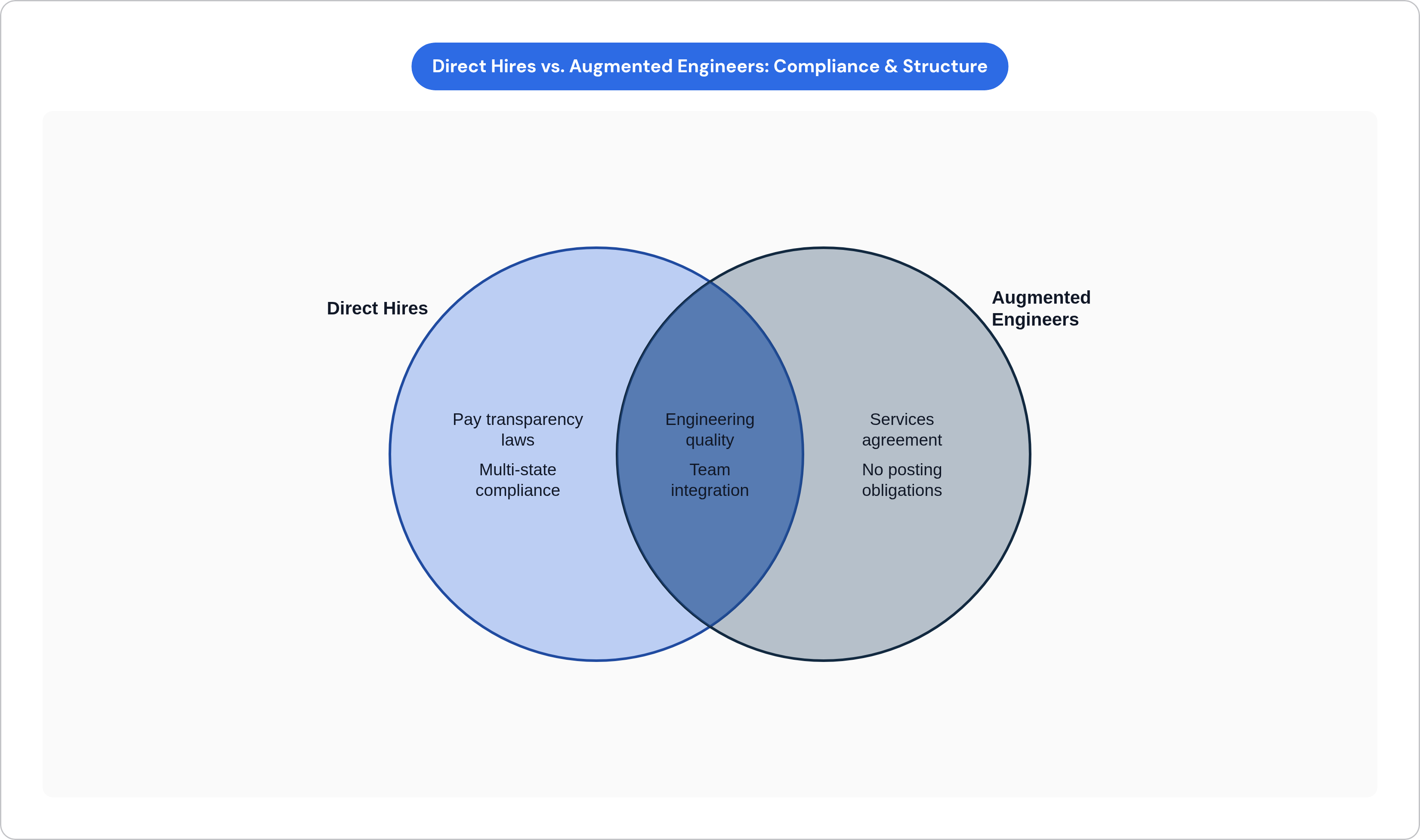
Nearshore staff augmentation sidesteps a meaningful portion of this complexity. Augmented engineers placed by a staff augmentation partner aren't direct employees; they're placed under a services agreement. Compensation for that portion of the team is handled by the augmentation partner and is not subject to job posting disclosure obligations. The multi-state compliance surface for that layer of the team effectively collapses.
For companies building hybrid engineering squads, direct hires for core product roles and augmented engineers for scaling capacity, the transparency laws apply to the direct-hire layer. The augmented layer is governed by the services contract. Knowing which portions of the team create posting obligations and which don't is a real operational consideration as the compliance landscape continues to develop.
The timezone alignment of nearshore Latin American engineers with U.S. teams makes this model workable at the sprint level. Engineers who overlap with U.S. working hours can participate in daily standups, code reviews, and planning sessions without the asynchronous penalties that make more distant offshore models difficult to integrate into a functioning team rhythm. Proximity in time, it turns out, matters nearly as much as proximity in skill.
What Engineering Hiring Looks Like When Compensation Architecture and Team Structure Are Built Together
The organizations navigating this environment well aren't treating pay transparency and team structure as separate workstreams. They're building them together, because the two are structurally connected. I've watched enough companies treat them separately to have a clear picture of what that choice costs: misaligned offers, internal equity disputes, and attrition that was preventable.
Compensation bands for every engineering level get established before any external posting goes live. Team structure is then mapped to the band structure, distinguishing which roles are direct hires with posted ranges, which are augmented capacity that doesn't require public disclosure, and which represent future headcount plannable against existing bands. The sequence matters. Organizations that try to run it in reverse, posting ranges before the bands are real, create problems they spend months unwinding.
The augmented layer serves a specific function in this architecture: speed and flexibility. When demand spikes, vetted engineers can be onboarded without the months-long direct-hire cycle and the compensation visibility and negotiation that cycle now entails. The band discipline maintained for direct hires is not disrupted, because the augmented layer operates under a different contractual framework.
Vetting quality matters more, not less, in a transparent compensation environment. When ranges are public, the hiring conversation shifts from "what will you accept" to "why does this candidate merit the upper half of the range." That question requires genuine signal about engineering quality. It applies equally to augmented engineers placed into a team. The work is visible; the code ships or it doesn't.
Engineering team structure isn't a one-time decision. It shifts as the product evolves, as the compliance landscape moves, as the talent market changes. The discipline required to maintain coherent compensation bands over time is, in practice, the same discipline required to build a high-performing engineering team: clear criteria, consistent application, and a willingness to surface information that's uncomfortable. The companies that figure this out early aren't operating from a theoretical advantage. They're simply not paying the costs that their competitors are still accumulating.