Knowledge Transfer Protocols When Augmented Engineers Roll Off a Project
Build knowledge distribution into delivery from day one, not exit day.
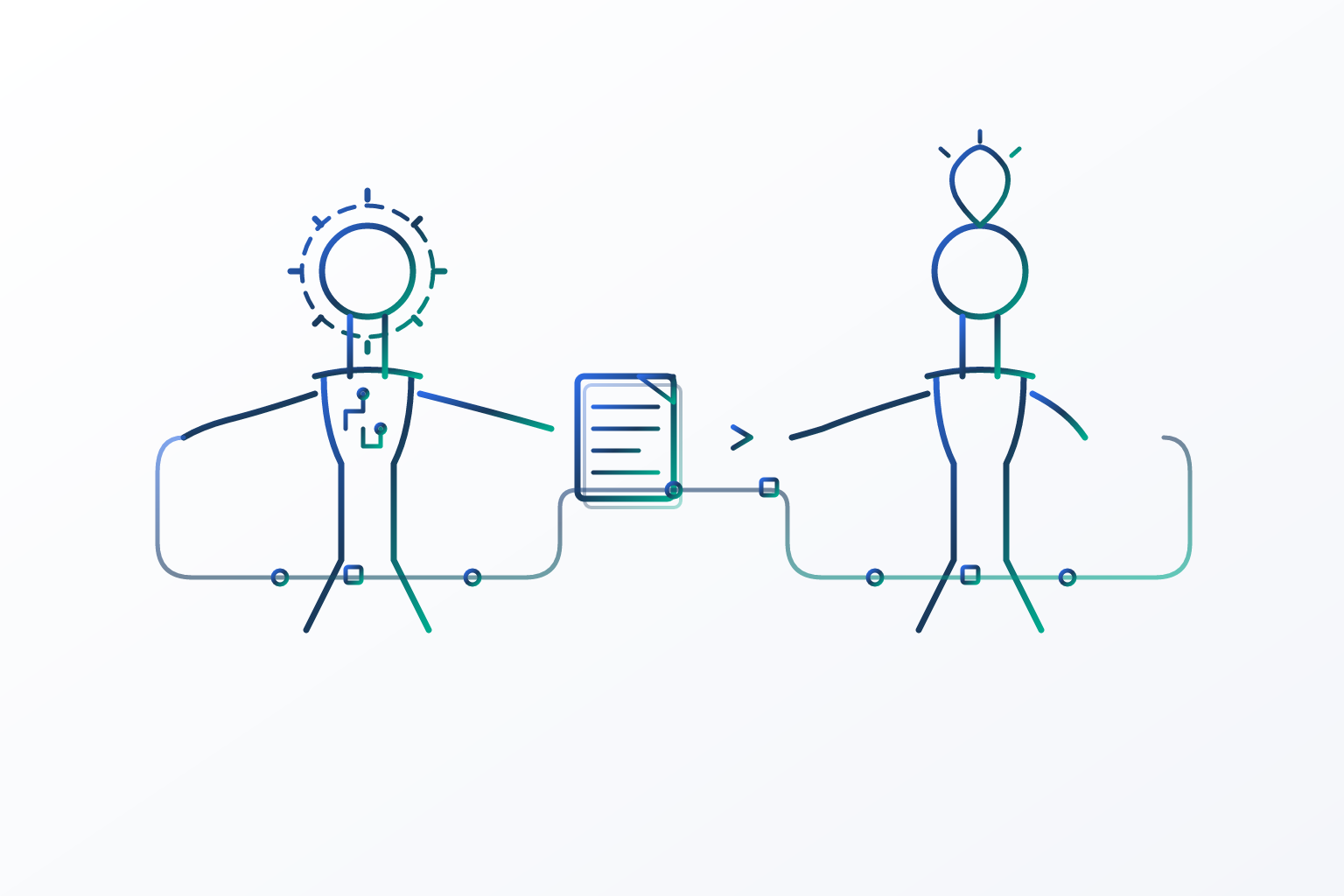
Knowledge transfer when augmented engineers roll off a project depends less on the exit checklist than on how the engagement began. Protocols work when documentation, shared context, and permanent ownership are part of day-to-day engineering work. The final weeks then test whether that design worked, rather than attempt to reconstruct an engagement’s worth of knowledge before access disappears.
Why knowledge transfer fails at roll-off — and where the real cause sits
Every augmented engineer accumulates context about how services interact, why architectural decisions were made, and where undocumented workarounds live. Shipped code does not explain all of it. When the engineer leaves, the people who depended on that understanding may struggle to change or operate systems they formally own. An offboarding checklist can identify missing documents, but it cannot substitute for the shared understanding that should have developed during delivery.
The structural failure is planning for arrival without designing for departure. Teams leave questions of who knows what, access, and IP ownership until exit, even though the decisions that shape them take effect much earlier. Scope creep makes the gap harder to see. A narrow assignment expands until an augmented engineer becomes the de facto owner of an unplanned function, without a corresponding change in internal ownership or documentation. By roll-off, the loss is not simply an absent explanation but an operating responsibility that nobody else is prepared to assume.
How knowledge siloes form during an engagement, not at its end
Knowledge siloes are a predictable result of engagement structure. A small out-of-scope request makes someone the point person for a system, and subsequent work reinforces that position. The ownership shift may never become explicit. Because the responsibility was not planned, its documentation and backup ownership can remain undefined. In a long-running engagement, that quiet dependency can grow until an augmented engineer owns a critical system that no internal team member can take over.
Separation from the core team deepens that dependency. Separate standups, separate tools, and different definitions of done get in the way of sharing institutional context between augmented engineers and permanent staff. The augmented engineer learns the system by doing the work, while permanent staff lack the reasons behind its changes. When departure approaches, the team discovers that task completion and shared knowledge were never equivalent.
When several engineers arrive together, they take up senior staff’s time and teach one another before they know enough to tell a sound explanation from partial understanding. That partial understanding can become tribal knowledge that diverges from the architecture. The bus factor exposes the resulting concentration. No system should be owned by fewer than two engineers, and a system with only one owner signals that the team is not ready for the next cohort. If that owner is departing, roll-off exposes a single point of failure.
Engagement design decisions that prevent knowledge loss before it starts
The response is to build knowledge distribution into delivery from the first sprint. Adding engineers in pairs rather than onboarding a larger cohort limits the absorption burden on senior staff and reduces the opportunity for partial understanding to propagate. This supports productive onboarding as well as eventual handover. Engineers enter with access to established context instead of relying mainly on one another’s interpretations.
Permanent ownership should begin at ticket level. Every system an augmented engineer touches needs a named internal owner from the moment work begins. This keeps responsibility connected to changes as they happen. ConsultAdd recommends keeping augmented engineers a minority on any single team and assigning each a named in-house reviewer with time set aside. That reviewer provides quality control while also distributing knowledge, so review is not merely approval of an external engineer’s output.
ConsultAdd advises against putting augmented engineers in security owner or engineering manager roles and says tech lead or architect roles are only rarely a good fit for augmentation. Architecture, security ownership, and people management therefore remain with permanent staff. This preserves institutional responsibility where decisions have the broadest consequences. Augmented engineers can contribute to delivery without becoming the sole holders of the reasoning that governs the team or its systems.
These practices reinforce one another over the engagement. Staggered onboarding gives internal staff time to share context, named reviewers keep them sharing it, and permanent owners stay involved as scope changes. Documentation then records an understanding that is already distributed. It is not asked to create that understanding after the fact. Under this design, knowledge transfer is part of how work gets accepted.
What the contract must specify on day one to make roll-off recoverable
Delivery pressure can displace even sensible engineering practices unless the engagement makes them explicit obligations. The contract should enumerate documentation deliverables, including updated runbooks for anything built or changed and recorded walkthroughs of complex areas. It should also require open pull requests and tickets to be closed or reassigned. These defined outputs establish what “reasonable handover” requires before exit day. Their scope should reflect the work the engineer has actually taken on.
The definition of done gives those obligations a place in daily delivery. Teams should require runbooks and Architecture Decision Records as work is completed, rather than ask for them when an engineer is about to leave. This changes when the explanation must exist. Architectural reasoning is recorded as part of the change, while operational guidance develops with the system it describes.
IP ownership and access revocation also belong in the contract from the start. ConsultAdd specifies revoking access on the last day, confirming IP and final timesheets that day, and checking seven days after exit that no accounts, tokens, or keys remain active. The audit does not postpone the revocation deadline. Uvik’s Staff Augmentation Standard places security and IP risk under Rule 10 in the Contract phase, addressing uncontrolled production access and unclear ownership before an engineer enters the codebase. A partner that makes these terms standard supports the protocol before delivery pressure can test it.
The 30-day managed ramp-down that turns roll-off into a planned event
A managed 30-day ramp-down begins by confirming each departing engineer’s end date, identifying every system they touch, and naming the permanent owners. An engineer may have taken on work beyond the original assignment, and the final system map must show that added work. Any ownership gap needs resolution early enough for the permanent owner to pair with the departing engineer. Without an owner in place, no one in the later handover sessions is responsible for putting what they learn to use.
Several weeks before an engineer leaves, the team changes who does which work. Departing engineers stop taking new feature work and spend their time on documentation and pairing, because building more features would add more context to pass on. Permanent owners handle the last few tickets while departing engineers review. Accountability starts moving before the contract ends. Pairing is therefore not simply a conversation about the system, but a change in who performs the work and who provides support.
The later stage tests that change under operational conditions. Permanent owners run deployments and on-call for handed-over systems, with departing engineers on standby. Standby support is not the same as passing the handoff test. Before ramp-down is complete, the internal team should run a release or handle an incident without assistance from the departing engineer. If it cannot, the documentation and transfer remain incomplete, and the earlier pairing must address the exposed gap rather than treating the approaching end date as evidence of readiness.
The team is resolving specific failures of understanding rather than asking broadly whether everyone feels comfortable with the handover. Earlier documentation and ticket ownership make that distinction possible. A permanent owner who has already performed the work can expose what the runbook leaves unclear. A team encountering the system for the first time has far less basis for judging whether the documentation is sufficient.
On the last day, all access is revoked, equipment is collected, and IP and final timesheets are confirmed. These steps come after the internal team has taken over running the systems. Seven days later, the team audits for any accounts, tokens, or keys that remain active. The audit checks that closure was complete. Removing access proves separation from the project, while the earlier quality gate establishes the internal team’s ability to run it.
How AI-native engagements change what needs to be transferred — and what stays in the repo
AI-native engagements introduce another class of transferable artifact beyond shipped code and conventional documentation. Prompts, context packs, and structured project context can live in the repository. Their persistence changes what departure removes. HatchWorks describes AI-native engagements that leave Context Packs in the repo, Plan/Confirm habits in code review, and a track record of governed AI use that internal engineers can follow after the partner leaves. The retained asset is both written context and a method the team has learned to use.
That benefit depends on how the engagement is designed. Context Packs make structured project context a team asset, but AI use alone does not establish that the reasoning behind the work is shared. Knowledge can still concentrate around the engineer who supplies the context and understands how to use it. Repository storage is necessary to this model, but it is not proof of team understanding. The handoff still has to establish that permanent staff can apply what remains.
Participation in key decision-making meetings is especially important here. An augmented engineer who understands why an architectural decision was made can encode that reasoning into transferable artifacts. An engineer who receives only task scope cannot preserve context they were never given. For engagement design, the distinction is between using AI during delivery and deliberately leaving reusable methods behind. AI-native work helps teams pass on knowledge only when they plan together how to share the reasoning, who owns the artifacts, and how internal staff work.
What the partner you choose determines about the knowledge you keep
These protocols depend on a partner model that supports close integration with the internal team. Rigorous vetting, timezone alignment, and shared working practices make review, pairing, and operational handover executable within ordinary delivery. Scheduling overlap is part of that design. NeoWork identifies nearshore as a reasonable balance between cost and overlap, while emphasizing that the right choice depends on how tightly augmented engineers must synchronize with the core team. Knowledge-transfer-intensive work requires that synchronization, regardless of the staffing model’s other merits.
A partner with multi-year client relationships develops familiarity with the client’s codebase, culture, and architecture that can inform the next engineer’s onboarding. Departure need not erase all partner-side understanding. This gives incoming engineers a richer starting point than an isolated placement would provide, while named internal owners remain necessary. Continuity becomes a property of the relationship as well as of the individual handoff.
The partner’s contractual and integration practices show whether that continuity is deliberate. Uvik’s Standard maps the risk of an engineer leaving at month six to specific Contract and Embed phase rules, placing safeguards before the departure rather than leaving enforcement entirely to the client. That is the practical basis for partner selection. An engineering leader should choose a model that supports ongoing documentation, internal ownership, and tested handover as normal delivery obligations.