Sourcing Strategy Differences for Nearshore Versus Domestic Technical Roles
Nearshore hiring requires different sourcing channels and vetting than domestic roles.
Sourcing technical talent domestically versus nearshore requires more than a rate comparison with a currency conversion attached. It requires different channels to find candidates, different vetting standards, different integration plans, and different contract structures, all built around one question: how does this specific geography actually produce and support engineering talent? Treat the decision as a line-item cost swap and the failure shows up later, not in the hiring process but in the hire itself: someone technically capable, plugged into a workflow that was never built for how they actually work.
The U.S. median software developer wage sits at $133,080 per year. Once payroll tax, benefits, and overhead load are applied, total employment cost for that same role runs closer to $166,000 to $186,000. That's the onshore baseline against which every other sourcing decision gets measured. The supply pressure driving companies to look elsewhere is structural, and it isn't fixing itself.
Where candidates are actually found in each model
Domestic sourcing runs through channels everyone already knows: LinkedIn, job boards, referral networks, university recruiting pipelines. These channels have high visibility, which also means high competition; a posting for a senior backend role in Austin or Seattle competes against a dozen similar postings the same week. Employer brand and pay transparency carry real weight here, because domestic candidates have options and know it. Time-to-hire for engineers is a genuinely contested window, and that competition gets fought over constantly.
Nearshore discovery works through a different structure entirely. Regional talent networks, vetted partner pools, GitHub contribution histories, Stack Overflow reputation, and developer communities across Latin America form the actual infrastructure. Open-source contribution records function as a real, checkable signal in nearshore sourcing in a way they rarely do domestically, where a candidate's day job often obscures whatever they've built on the side. Partner networks that maintain pre-vetted pools compress discovery time considerably compared to cold outreach into an unfamiliar market.
The core distinction is this: domestic sourcing is inbound and brand-driven, while nearshore sourcing is network-driven and relationship-driven. A company that runs a post-and-pray domestic playbook in a nearshore market, reactive screening included, ends up looking at the wrong slice of the talent pool entirely. The good candidates were never applying to the job board in the first place, and no amount of budget behind the posting fixes that.
How the talent pool itself differs between geographies
The U.S. engineering pool runs deep, but it's concentrated, both by metro and by specialization. Senior full-stack roles, machine learning positions, and security engineering are brutally competitive, and remote work, while widening the geographic reach of domestic hiring, has also widened the number of companies chasing the same senior candidates.
Latin America's engineering workforce has grown fast over the past several years, producing an expanding cohort of developers across Brazil, Mexico, Argentina, Colombia, and other countries in the region. That pool carries its own characteristics worth naming plainly. English proficiency varies by country and by seniority level, and that's a real filter to build into sourcing, not something to wave away. Strength runs deep in full-stack, mobile, and backend development, with growing capacity in cloud-native infrastructure, data engineering, and DevSecOps.
The structural advantage is time zone overlap: 6 to 8 hours of shared working hours per day with U.S. teams, against roughly 30 minutes of overlapping business hours with a standard offshore team in South or Southeast Asia. That overlap changes how work actually gets done day to day. A blocked engineer in Bogotá can get an answer from a product manager in Chicago the same afternoon, not the next morning, and that single difference reshapes how a sprint moves.
The talent shortage is real on both sides of this equation. Nearshore hiring is attractive partly because it expands the addressable pool, and partly because it cuts the rate. A growing share of companies have been moving from offshore to nearshore markets specifically to get real-time collaboration back. That's a signal about pool quality and collaboration fit as much as a signal about cost, and it's the reason nearshore keeps winning arguments that start out purely about price.
Why vetting criteria diverge by engagement model, not just by role
Most failed remote hires don't fail because the engineer couldn't code. They fail because the hiring process never checked what actually predicts remote performance: whether someone communicates clearly async, whether they self-direct when they hit a blocker with nobody around, whether they can represent their own work in writing when no one's watching them do it live.
Domestic vetting for onsite or hybrid roles can lean partly on in-person cues: team chemistry interviews, shared physical context in the room. Little of that exists in a nearshore engagement, which means nearshore vetting has to go deeper on dimensions domestic processes often treat as secondary. English fluency under technical load matters here, not conversational fluency but the ability to write a precise pull request comment, flag a blocker clearly, and contribute to async documentation without losing precision. Communication style under low supervision matters just as much: how does someone behave as the only person representing their work for several hours, with nobody else in their time zone free to weigh in? A track record with prior distributed teams tends to predict this better than pedigree does. And cultural fit, meaning whether someone's work style actually meshes with the client team, functions as a real retention driver, not a soft afterthought tacked onto the scorecard.
Technical assessments need to shift accordingly. They should reflect real job tasks instead of abstract puzzles; overly long or irrelevant exercises push away strong candidates in both models, but a bad nearshore hire costs more because integration lag compounds the damage. Vetting depth is the actual lever separating a good nearshore hire from a bad one, and a multi-stage process covering technical assessment, communication evaluation, and reference checks against culture fit is standard practice among high-accountability nearshore partners. Skipping a stage to save a week almost never pays off, because the top slice of talent only surfaces through deliberate filtering rather than volume screening.
Rate structures and what total cost of ownership actually measures
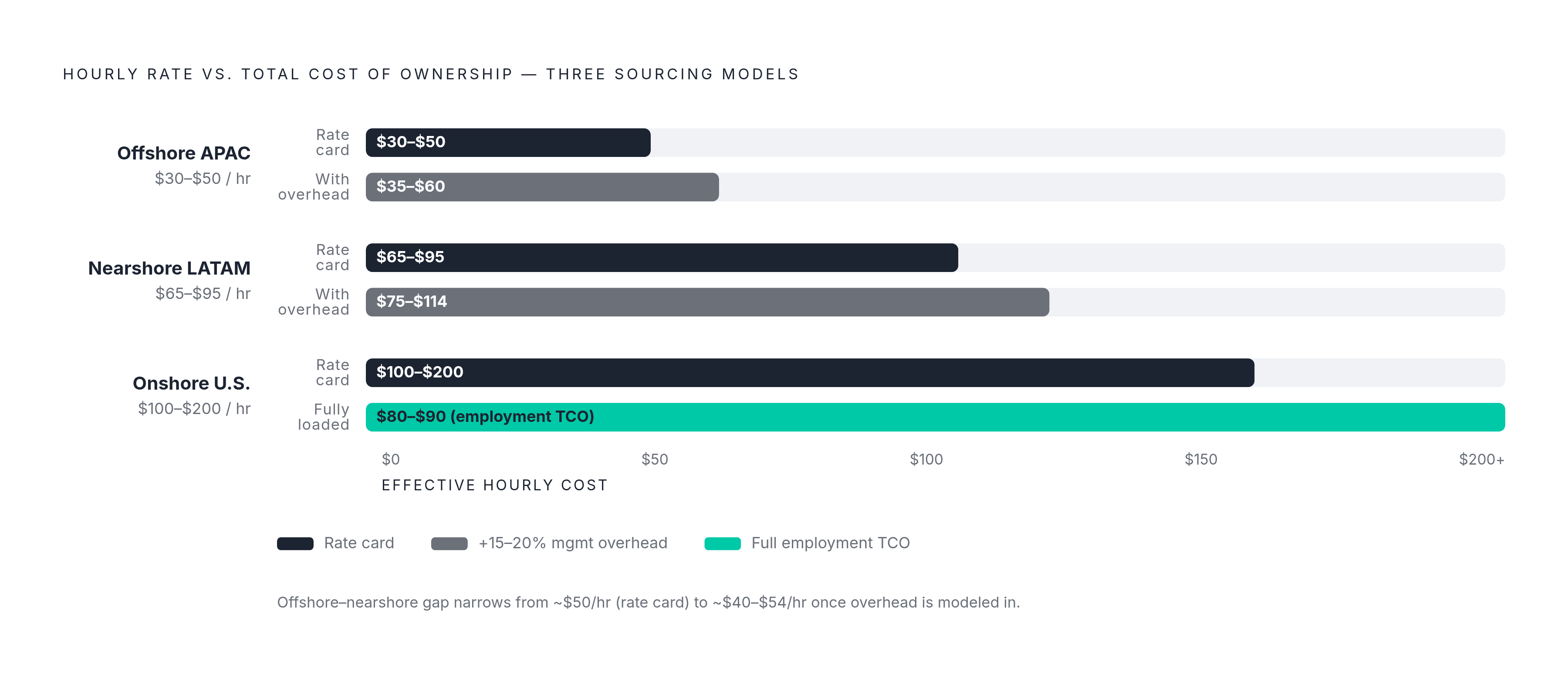
Nearshore LATAM rates typically run $65 to $95 per hour. Offshore rates out of India or Southeast Asia run $30 to $50 per hour. Onshore U.S. development runs $100 to $200 per hour. Lined up like that, the comparison looks simple, and that's exactly the problem: the headline rate only captures part of the actual cost, and treating it as the whole picture is one of the most common mistakes in this decision.
Total cost of ownership includes variables that rarely make it onto the rate card. Recruitment time and cost differ sharply: domestic searches can run several weeks, while nearshore partner pools compress that window considerably, though only after the relationship with the partner has been built out. Attrition matters too; poorly integrated remote hires churn faster, and replacing a mid-senior engineer is expensive under any estimate. Rework and communication overhead carry the heaviest weight of all. An offshore team sharing roughly 30 minutes of overlapping business hours with U.S. Eastern time creates daily coordination drag, waiting on tomorrow's response to today's question. Nearshore's 6 to 8 hours of daily overlap eliminates most of that overnight handoff delay. Managing engagements independently, without a partner handling recruitment and HR overhead, can add 15 to 20% on top of the base rate.
Monthly engagement costs for nearshore LATAM developers run $4,000 to $7,000; offshore APAC averages $3,500 to $5,500. Once overhead gets modeled in, that gap narrows considerably, and nearshore often matches or beats offshore on cost per shipped feature, partly because the friction costs are lower. Anyone still comparing rate cards alone is measuring an incomplete picture. The model worth building is a TCO model answering cost per shipped feature, not cost per hour.
Integration planning as a sourcing requirement, not an onboarding afterthought
Staff augmentation and nearshore engagement both assume the external engineer works inside the client team's existing workflow: standups, CI/CD pipelines, sprint ceremonies, the specific tools already in use. Project outsourcing works differently, with the vendor running its own process and handing over a finished outcome. An augmented engineer reports to the client, follows client process, and gets evaluated against client metrics, which means integration isn't something that happens after sourcing. It's a decision that shapes sourcing from the start, and treating it as a post-hire logistics detail is where most of these engagements go wrong.
A few failure points show up repeatedly. Environment setup delays are one: automating dev environment provisioning before day one determines which candidates ramp productively and which stall out in week one fighting a broken local setup. Expecting an early pull request in the first days is common practice, and it requires candidates comfortable with visible work in progress; not every nearshore candidate is, and that should surface during vetting, not during the first sprint. Tooling fluency in the specific CI/CD stack, project management software, and communication platforms in active use should be an explicit filter during sourcing, not a surprise discovered on day three.
Misalignment between business objectives and project objectives is a recognized driver of project failure, and sourcing for communication style and transparency connects directly to that risk. Integration planning is also a scaling decision. Teams structured as small, autonomous squads, each owning a full product area, tend to ship more reliably in distributed contexts, because cross-team coordination, the main source of friction in async work, gets minimized by design. Before sourcing even begins, the client team needs to define the integration model, the expected overlap hours, the tooling requirements, and the escalation path. Those specifications belong in the sourcing brief itself, not in a Slack channel three weeks into the engagement.
How engagement structure differs between domestic and nearshore hiring
Domestic hiring typically defaults to permanent employment or W-2 contractor arrangements: long recruiting cycles, fixed compensation, real legal obligations around termination. Nearshore engagement structures tend to run more flexible. Staff augmentation contracts allow scaling headcount up or down based on project need, without the recruitment lag of a new domestic search or the friction of a reduction in force. That flexibility is a genuine operational advantage.
Engagement terms need explicit structuring in a way domestic hiring often doesn't require. IP ownership, confidentiality, legal jurisdiction: few of these resolve themselves automatically the way they tend to under standard domestic employment law. Duration norms differ too. Domestic hires are expected to be permanent or long-term by default; nearshore engagements are frequently scoped to a project phase, then extended, and relationships with strong nearshore partners often run well past that original scope.
That structure has direct sourcing implications. Project-scoped engagements should prioritize candidates with fast onboarding ramp and prior experience stepping into mid-stage codebases they didn't build. Open-ended augmentation engagements should weight culture fit and long-term collaboration signals more heavily, since the relationship is expected to run for years, not months.
Shadow AI governance belongs in this conversation too. IBM's 2025 Cost of a Data Breach Report found that unsanctioned AI tool use added an average of $670,000 to breach costs, and distributed teams are harder to monitor for where that kind of tool adoption spreads unofficially. That makes an explicit AI usage policy part of the engagement contract itself, not something left for internal IT to sort out after the fact.
Matching the sourcing model to the actual work type
None of this is a binary choice. Most mature product organizations run a hybrid model: onshore for architecture decisions, regulatory touchpoints, and customer-facing leadership; nearshore for build capacity, QA, and feature development; offshore, in some cases, for stable, well-specified workstreams that don't change week to week.
The variables that decide which model fits which work are fairly consistent. Work that's highly collaborative and changes frequently belongs nearshore, where the 6 to 8 hours of daily overlap functions as the entire point rather than a nice-to-have. Spec-driven, high-volume, low-ambiguity work can still favor offshore on cost, provided the scope genuinely stays stable, which in practice is the exception rather than the rule. IP-sensitive, regulated, or legally complex work belongs onshore, or nearshore with explicit contractual protections built in; offshore introduces jurisdiction complexity that a simple TCO model rarely captures, and that gap tends to surface at the worst possible moment, usually mid-dispute.
AI-augmented teams shift this calculus slightly, though not in the direction some assume. Research on AI-augmented teams suggests that AI tools amplify existing engineering capabilities, magnifying both strengths and dysfunction. A poorly integrated nearshore team with AI tooling bolted on rarely outperforms a well-integrated team without it. The foundation still matters more than whatever sits on top of it, and companies that skip straight to the tooling question have skipped the one that actually determines the outcome.
Sourcing for a hybrid model requires two distinct pipelines running in parallel, with meaningfully different criteria rather than one pipeline stretched thin with a geography filter applied after the fact. The criteria, the channels, the vetting depth, the contract terms: different enough to justify separate processes. The right partner for nearshore sourcing is the one that maintains a consistently vetted pool, can scale a team quickly without dropping quality, and has a track record measured in years, not a single project win. Multi-year engagement continuity is the actual benchmark, and anything shorter is still an experiment.