Feature Flag Strategies for Releases Spanning Distributed Engineering Teams
Treat feature flags as shared infrastructure to coordinate releases across time zones safely.
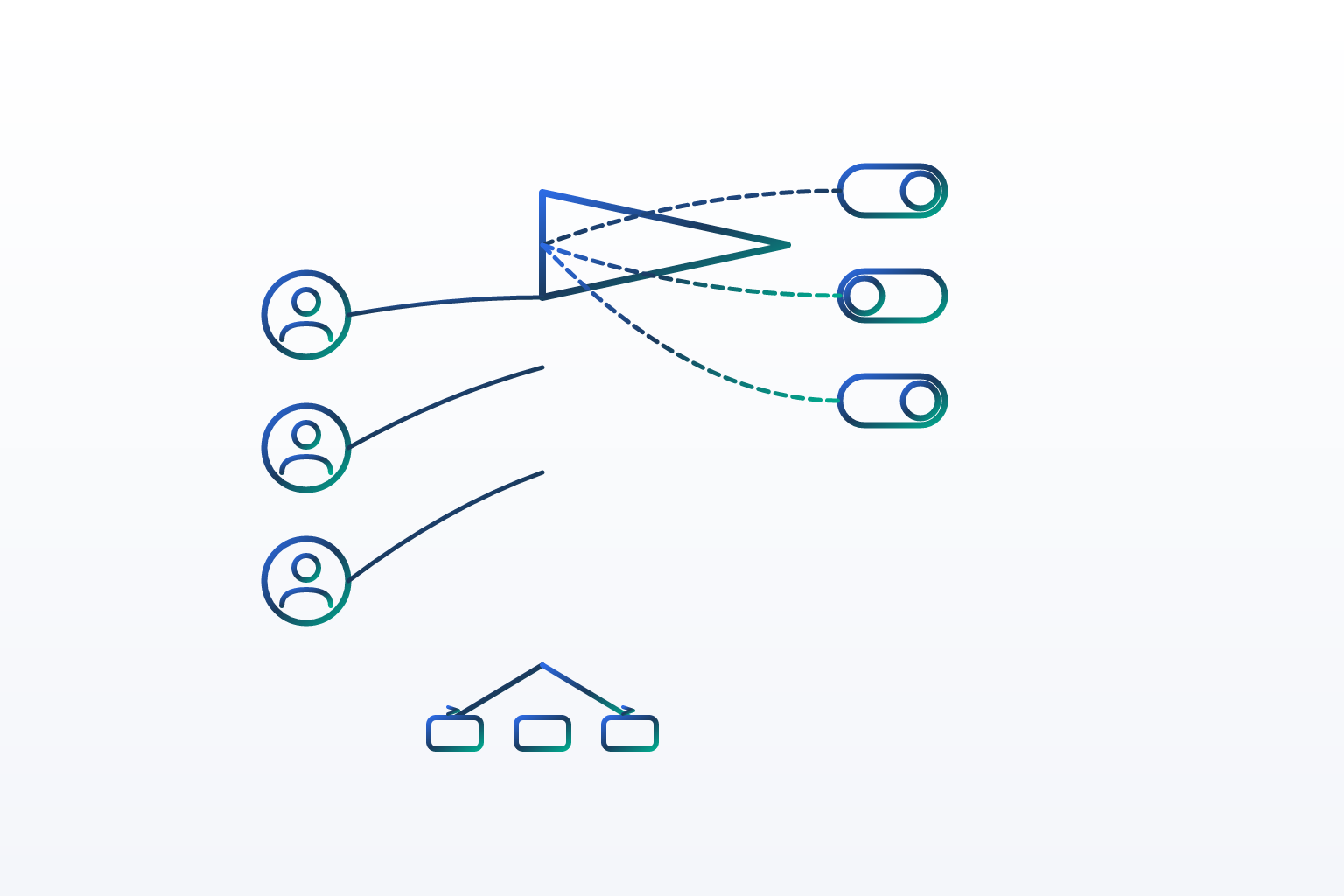
Feature flags can de-risk releases across distributed engineering teams, but only when teams treat them as shared infrastructure. Shared infrastructure requires explicit ownership, a deliberate evaluation architecture, and lifecycle discipline. With these rules in place, teams can deploy on their own while keeping control of how features reach users.
Why distributed engineering teams need a different mental model for feature flags
A release window that requires engineers across time zones to be online turns deployment into a coordination bottleneck. Feature flags separate the arrival of code in production from the decision to expose its behavior. Deployment no longer has to mean simultaneous launch.
That separation fails when engineers in different services and codebases add flags independently, with no shared meaning for their states. A flag understood only by its author becomes a liability when another engineer must change it. GrowthBook's scale guide identifies the inflection point as flags grow beyond tens or hundreds and become critical infrastructure. At that scale, teams need to spell out ownership. The release mechanism needs conventions that survive handoffs between people, services, and working days.
The four toggle types and why conflating them is the root of flag debt
The four types are release, experiment, ops, and permissioning toggles. The toggles do different jobs, so they must have different lifetimes. Release toggles control the introduction of new behavior, experiment toggles support experiments, ops toggles control operational behavior, and permissioning toggles govern entitlement. Treating these as interchangeable lets a temporary release mechanism inherit the lifespan of a lasting permissioning decision.
That confusion is a source of flag debt. A release toggle still present two months after launch is debt by definition, while a permissioning toggle may legitimately outlive its originating team. Teams should put the type in the flag's contract before they write the code. Polarity needs a shared convention as well. Off should mean existing or legacy behavior, and On should mean new behavior, so an on-call engineer at 3am can interpret “turn the flag off” without reconstructing the author's intent.
Where flags get evaluated and why that choice sets the team's rollback speed
Toggle type does not determine where evaluation belongs. The evaluation tier independently sets latency, rollback speed, and consistency constraints. GrowthBook's best practices guide distinguishes local, remote, and edge evaluation. Local evaluation downloads configuration and calculates the variation in the application, reducing per-check latency and allowing continued use of cached configuration when the control plane is unavailable.
Remote evaluation instead keeps rules on a service that returns a decision for each context. It centralizes behavior and protects sensitive logic, but adds a runtime dependency and sends attributes over the network. Edge evaluation places rules at edge nodes to reduce latency and support regional controls. These are architectural trade-offs. Browser and mobile clients remain inspectable, so sensitive rules belong on a trusted server, with only the resulting behavior returned.
Across distributed services, the central risk is evaluation drift. Different SDK versions or language implementations can interpret targeting rules differently, while replicas can hold different configuration versions. Critical systems therefore need server-side evaluation or synchronized local evaluators with strict version pinning. The best practices guide recommends testing cold starts, network loss after initialization, slow or invalid updates, expired caches, replicas with different configurations, and recovery after rollback. A rollback decision is only as useful as the system's ability to apply it consistently.
The rollout patterns that flags enable and the conditions each one requires
Teams need to make decisions before rollout begins to use canary exposure, ring deployment, and kill switches. For a canary, exposure percentage alone does not establish risk coverage. One percent of users may exclude the largest account, an old mobile version, a rare locale, or the highest-load region. Deliberate cohorts must cover those risky environments as well. Baselines for key performance indicators must also precede exposure, or a metric shift cannot be distinguished from noise.
Ring deployment makes that progression explicit through internal employees, beta users, and production segments. Each ring needs a defined promotion gate. When the feature spans services, prerequisite flags prevent a dependent feature from activating before its parent flag is enabled. The governance requirement is therefore more than permission to change a switch. It includes agreement about valid combinations and the conditions under which exposure can expand.
A healthcare application illustrates why deploy and release should remain separate. A team can deploy a new patient data visualization component on Monday, leave it hidden behind a flag, and let QA test in production without exposing it to real users. Deployment does not force the release decision. After launch, a kill switch enables instant rollback if a compliance issue surfaces. That option depends on knowing who may invoke it and which behavior it restores.
Building the governance layer: ownership, naming, schemas, and lifecycle discipline
GrowthBook's best practices guide recommends a short flag contract before the conditional is written. It records the decision or risk controlled, toggle type, owner, environments, safe fallback, production change permissions, rollout metrics, review or removal date, and cleanup issue. Each flag needs an owner at creation. That owner is responsible for cleanup, preventing a temporary mechanism from becoming an orphan that nobody can confidently archive.
The contract also limits what the flag is allowed to become. A release flag that later governs pricing entitlement and incident behavior acquires incompatible lifetimes and becomes difficult to remove. Those are separate decisions. For temporary release flags, the team's definition of done should include removal, so the work does not wait for occasional cleanup sprints. Long-lived permissioning and operational controls retain the review obligations appropriate to their purpose.
Naming makes the contract legible at the point of use. A pattern such as {type}-{team}-{feature}-{context} exposes useful context without requiring a dashboard visit. The best practices guide recommends stable, descriptive keys such as checkout.release.one-page-flow or payments.ops.disable-provider-x. Display names may change, but keys should stay the same. Ticket numbers should not provide the only meaning, and deleted keys should not be reused for unrelated behavior because old telemetry and caches would become ambiguous. Naming belongs in the pull request checklist, where code review can enforce it.
Context deserves the same discipline as an API. A protobuf or JSON Schema should define required attributes such as userId, tenantId, region, and planTier, with enforcement at the gateway. Missing attributes should invoke explicit fallback behavior. The best practices guide also recommends a small domain-facing interface, such as a CheckoutGates type with a useOnePageFlow(accountId) Boolean method. This wrapper maps application context to SDK attributes, applies defaults, records diagnostics, and gives code search one reliable location instead of scattering raw keys and SDK calls across services.
Observability, safe defaults, and the monitoring practices that close the governance loop
A contract describes intended behavior, but observability reveals whether the flag infrastructure follows it. Flag events should flow to observability tools so teams can detect anomalies across services. Defaults must remain visible in application code, where reviewers can assess failure behavior. A dashboard-only default hides that decision from code review. The best practices guide warns that “false” is not universally safe, because it could disable a required maintenance fallback or leave a security control fail-open.
The Off-equals-legacy convention therefore does not replace outcome-based fallback design. Teams should name the intended user and operational outcome and test it without the flag service. Consistency also requires evaluating once per request, job, or interaction and passing the result through that operation. Repeated checks can disagree if configuration or attributes change midway. For multi-step workflows, persisting the assigned variation prevents a checkout from entering treatment UI and finishing with control-side validation.
The best practices guide recommends tests of the evaluation path under configuration and network failures. Monthly chaos scenarios should target degraded networks and cross-system failures, including cold starts, network loss, slow updates, and expired caches. The target is flag infrastructure.
Platform selection criteria for teams that need to govern flags across multiple services
Platform selection follows from those governance requirements. The evaluation architecture must work with the consistency model the team has chosen, including server-side evaluation or synchronized local evaluation with version pinning. SDK breadth is insufficient without consistent interpretation of targeting rules across languages. Lifecycle capabilities should include TTLs, stale-flag detection, and defined lifecycle states. Context validation must reject malformed inputs explicitly rather than hide them behind silent defaults, while auditability requires immutable flag change records suitable for compliance review.
Managed, open-source, and internal systems all need to meet these requirements. LaunchDarkly, Unleash, and GrowthBook are named options to assess against them. GrowthBook is open-source and supports local evaluation after feature definitions load. Unleash's official documentation specifies AGPLv3 for source code from v8.0.0 onwards, Apache 2.0 for earlier versions, and Apache 2.0 for official Docker images. Those distinctions belong in an open-source assessment rather than under a single blanket licensing assumption.
The governance layer remains independent of the product. The best practices guide says its advice applies to managed platforms, open-source systems, and internal services. Even when teams buy a platform, they still need to agree on ownership, context, fallback, and removal. Teams need to assess whether the system supports and enforces those agreements across the team's services.
How distributed team structure affects flag coordination overhead and where nearshore engineering reduces it
Flags remove the need for synchronized release windows, but they do not eliminate coordination. Asynchronous state changes still require shared context, schemas, and ownership conventions. Large time-zone gaps can introduce interpretation drift in governance documents as well as evaluation engines. When an ownership assignment is unclear, a platform alone cannot clear it up. The delivery model determines how quickly the right people can clarify it.
Nearshore teams operating in aligned time zones with shared-language communication reduce that interpretation lag. Ownership assignments, TTL decisions, and flag changes can reach the engineer in charge during the working day, avoiding a delay of eight hours. In a practical hybrid structure, onshore product ownership is in charge of governance policy and ring promotion criteria. Nearshore platform engineers then own flag infrastructure and context schema enforcement. This places the most coordination-intensive governance work within the time-zone overlap.
Latin America's engineering talent pool is relevant to that structure because it includes a large and growing base of developers with distributed-systems experience. Senior engineers operate in the same time zones as North American teams, allowing governance decisions to be worked through synchronously and avoiding a twelve-hour gap. Time-zone alignment shortens the path from an unclear rule to an agreed decision.
The operational checklist: where to start this quarter with flag governance
Teams can begin without a platform migration or rewrite. For an existing codebase, the first step is an audit of active flags, classified by toggle type and assigned to owners. GrowthBook's scale guide recommends setting a TTL for release toggles that have remained open too long and archiving flags that cannot be assigned an owner. This establishes which controls have a legitimate purpose and who must make the next lifecycle decision.
Before the next sprint, the team should place a flag contract template in its wiki and apply it to one high-risk feature. That feature should receive a stable name, an owner, a safe fallback, and a cleanup commitment. The context schema should begin with userId, tenantId, region, and planTier, enforced at the gateway and extended as targeting rules demand. Flag review should become part of pull request templates and CI gates.
Once those rules and checks are in place, the team should stream flag events to observability tools and run monthly chaos scenarios to test evaluation paths. The chosen feature can then demonstrate a complete lifecycle from controlled exposure through removal. That is a concrete starting point for broader adoption. Without that governance, the release control becomes the risk.