Employee Referral Program Design
Referral programs fail by design, not motivation—here's how to fix it.

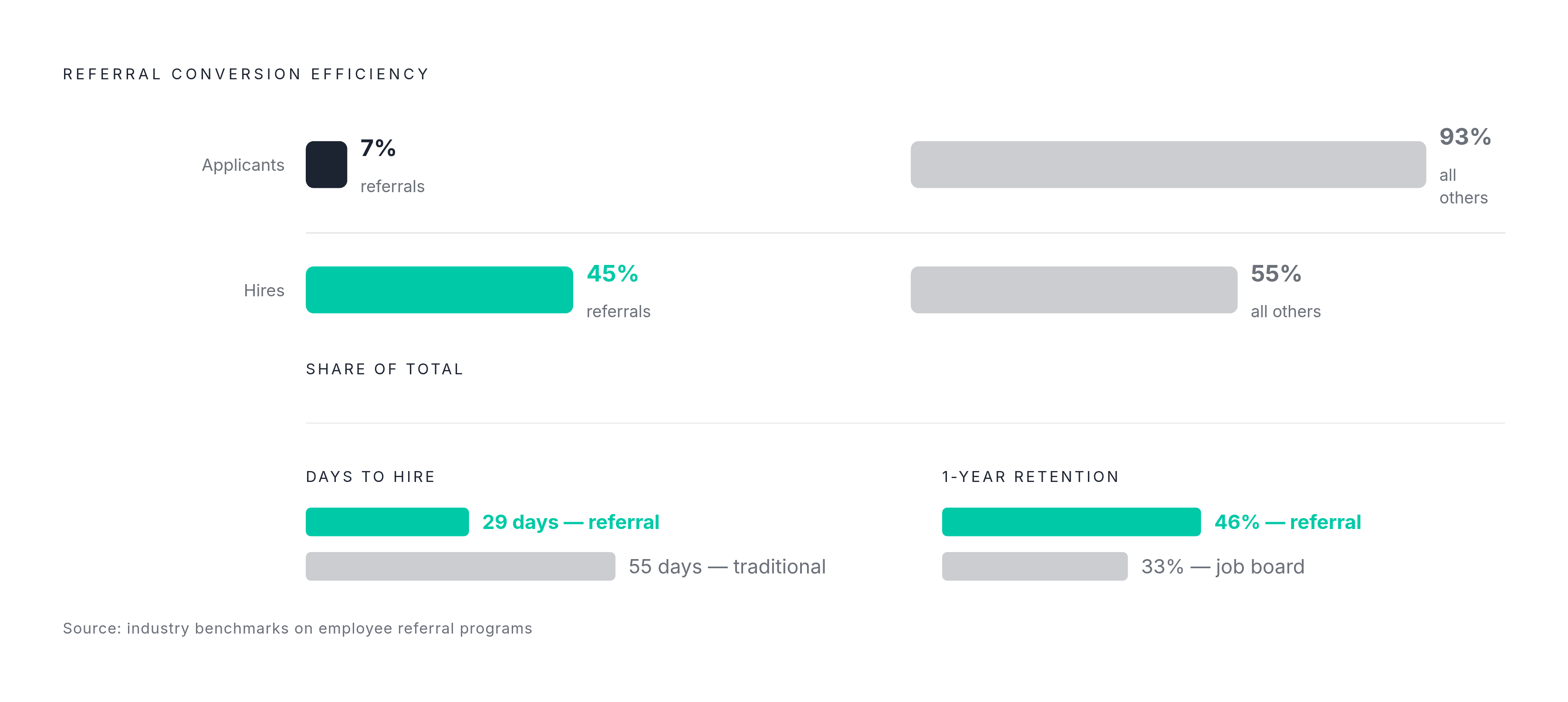
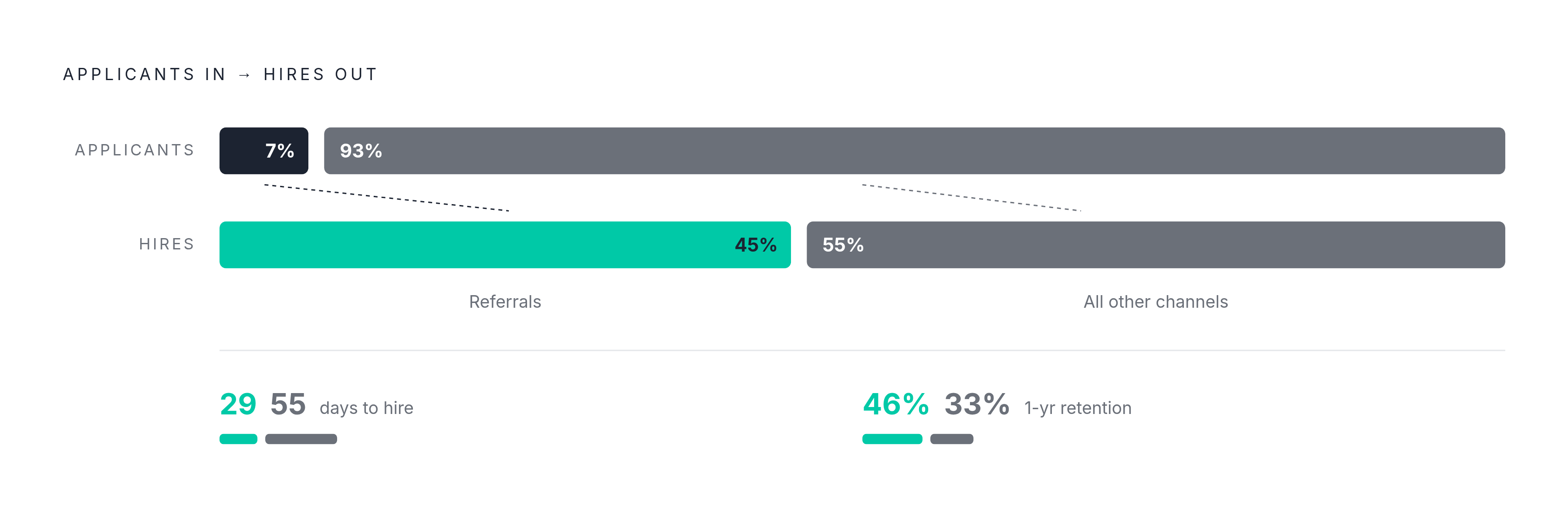
A referral program that runs on autopilot isn't a program. It's a form. Referral hires make up roughly 7% of applicants but account for 45% of all hires, a conversion efficiency no other sourcing channel approaches. Eighty-eight percent of employers rate referrals above every other source for return on investment. These figures require explicit sourcing; the applicant-to-hire conversion statistics are widely cited in talent acquisition literature but should be traced to a primary source such as Jobvite's annual Recruiter Nation reports before being used as established fact. Yet most programs stall after an initial burst of participation and quietly become irrelevant. Not because employees are unmotivated. Because the programs are poorly designed. The decisions that determine whether a referral program becomes a reliable pipeline are made at the design stage, and they concern three structural variables — incentive calibration, submission process design, and the communication infrastructure that keeps the program alive over time.
Referred employees stay at a 46% rate compared to 33% for candidates sourced through job boards, according to data cited in LinkedIn's Global Recruiting Trends reports, and they stay roughly 70% longer than non-referrals overall. Referred candidates are hired in an average of 29 days, compared to 55 days through traditional methods, per figures that appear in multiple industry benchmarking analyses including those published by the Society for Human Resource Management (SHRM). In technical hiring, where an unfilled engineering seat carries a real daily cost, that compression is material.
Referral hires show meaningfully higher job performance than non-referral hires and generate more profit for companies over comparable periods, per research published in the Journal of Labor Economics. Per-hire savings of $3,000 or more appear in multiple SHRM benchmarking analyses, and the reduction in turnover-related expenses compounds those savings across a year of referral-sourced positions. Referred new hires also reach full productivity faster, which matters most in roles where onboarding drag is expensive.
None of these outcomes are automatic. They are the product of programs designed to generate quality referrals, not simply volume.
How Incentive Structure Shapes Referral Quality, Not Just Participation
Only 6% of employees refer candidates solely for financial reward, and 35% do so primarily to help friends and former colleagues, according to survey data published by Deloitte. Intrinsic motivation drives referral behavior. Bonuses function as a signal of organizational seriousness rather than as the primary behavioral trigger. An underpowered bonus communicates that the program is an afterthought. A well-calibrated one communicates that the organization values the referrer's social capital and intends to compensate it appropriately.
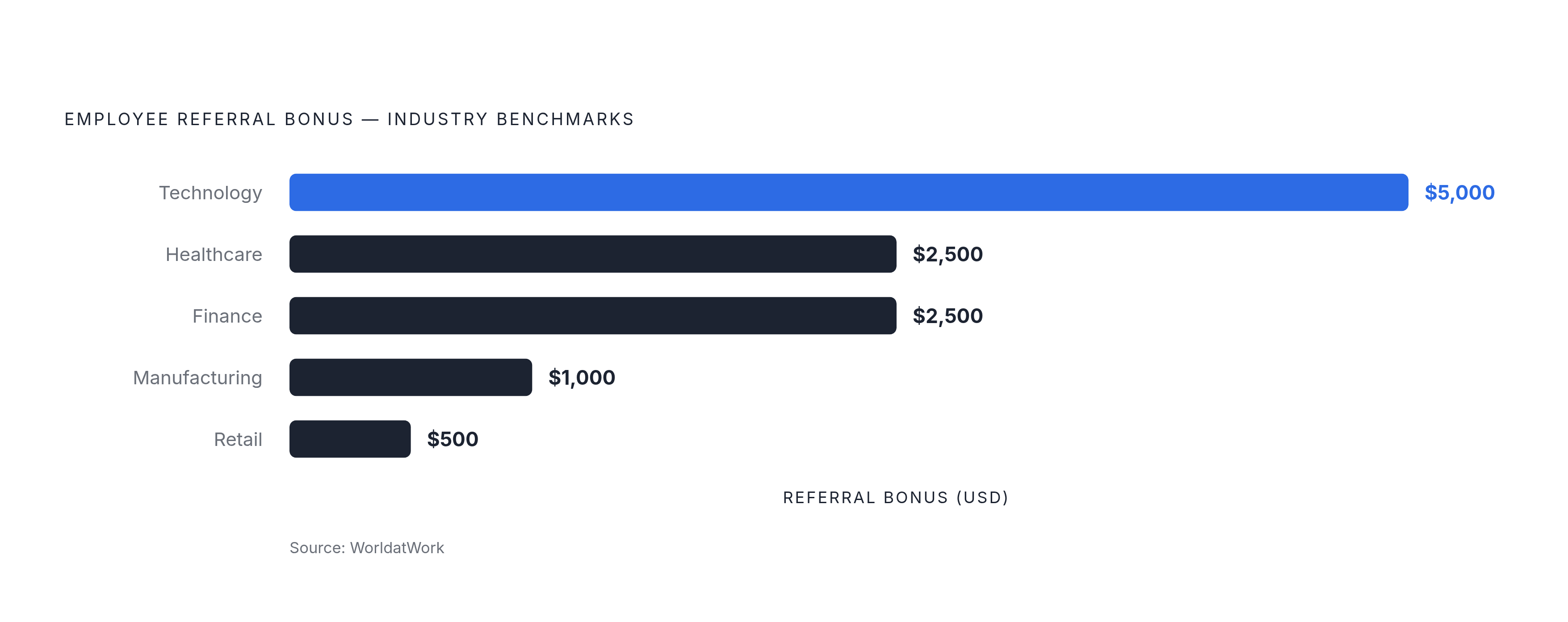
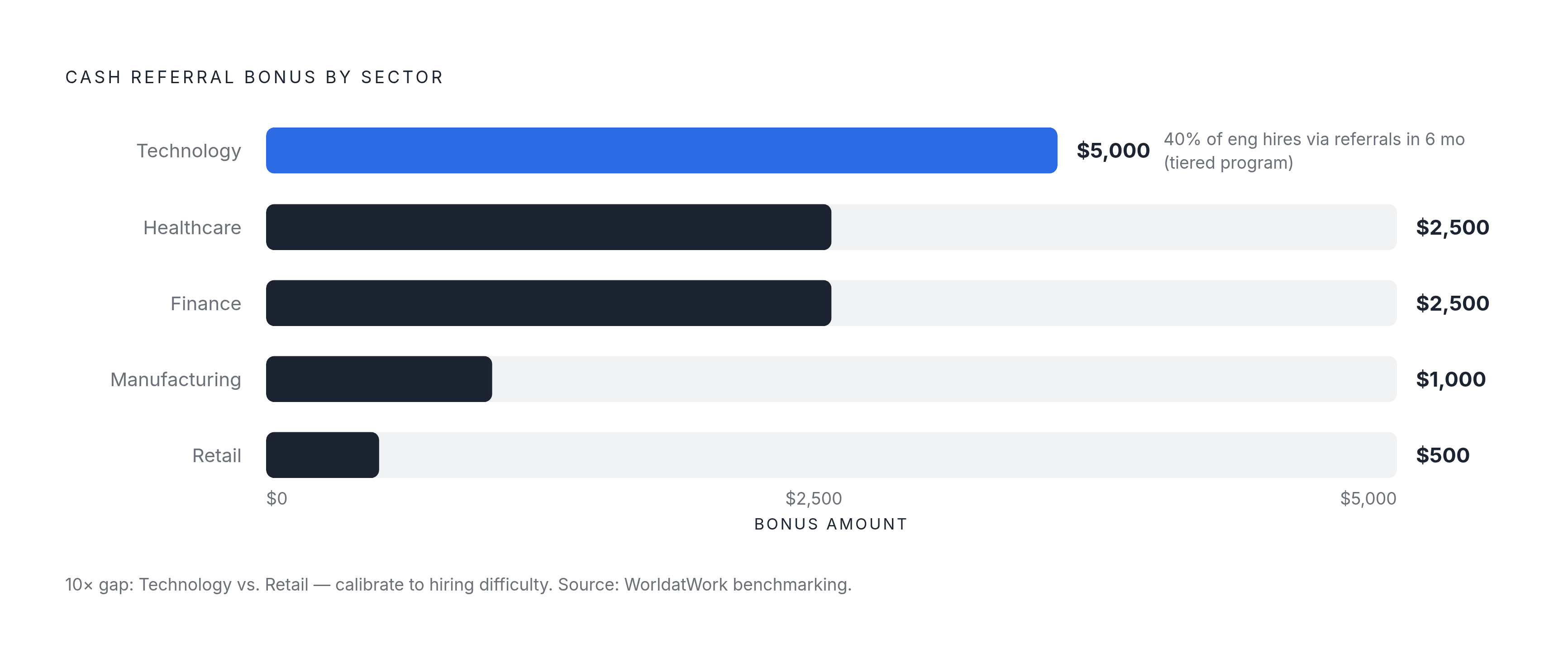
Industry benchmarks for cash bonuses vary substantially by sector. Technology companies average around $5,000 per referral hire; healthcare and finance average closer to $2,500; manufacturing averages $1,000 and retail $500, according to WorldatWork benchmarking data. These differentials track with the cost and difficulty of hiring in each market, which is the correct logic to apply when setting your own numbers.
The calibration risk runs in both directions. A bonus too small to register leaves employees unwilling to spend the social capital a referral requires. Referring someone is a personal endorsement, and people don't spend endorsements cheaply. A bonus set too high creates adverse selection — employees refer unqualified candidates to chase the reward, which increases recruiter burden and degrades program credibility over time. Tiered structures address this by aligning incentive size with actual hiring difficulty. One mid-size technology company that offered substantially higher bonuses for engineering roles than for general positions reported that 40% of its engineering hires came through referrals within six months of launching the tiered structure; the source and methodology behind this figure should be documented before it is cited as a generalizable result.
Non-cash and hybrid designs add meaningful variation. Allowing employees to direct a bonus toward a charity of their choice activates both referral behavior and organizational values simultaneously. One consulting firm combined a cash component with quarterly recognition, priority parking, and project-assignment preference; participation doubled compared to the cash-only baseline. The source and methodology for this comparison should be explicitly cited if used as evidence. Most mature programs split the bonus across two milestones, at hire and at a retention checkpoint, which aligns the referrer's reward with the outcome the program is actually built to produce.
Building a Submission Process Employees Will Actually Use
The submission process is the conversion point. Referral intent that meets friction becomes referral intent abandoned. Every additional required field reduces participation. The operational benchmark is a process completable in under five minutes, accessible from any device.
Submission processes that require a desktop login, a hiring manager's internal job code, and multiple dropdown selections create unnecessary barriers to participation. One retail company increased referral submissions by 300% after reducing its form to four fields — name, phone, role, and relationship type — accessed directly from the company's mobile app. This figure should be attributed to a documented case study or internal analysis before being cited as evidence. An employee who thinks of a referral at a networking event on a Saturday won't return to a desktop login on Monday. The moment passes.
Eligibility rules are a pervasive friction source. Complex role exclusions, tenure requirements, and department restrictions create uncertainty, and employees opt out when they're unsure whether their referral will count. Department-by-department variation in bonus amounts for comparable roles adds a second layer that generates internal resentment when it surfaces. Centralizing the program under uniform rules removes both problems.
Automated referral management produces better ROI than manual spreadsheet-based systems, as analyses from Greenhouse and Lever have reported. Gamification, meaning leaderboards and milestone recognition layered onto the core process, can increase participation without restructuring the submission experience itself. That's a useful lever when participation is soft but the underlying process is sound.
When to Introduce the Program to New Hires and How to Time Ongoing Promotion
The 30-day mark is a commonly cited best-practice window for introducing new hires to the referral program. Before 30 days, new employees lack sufficient context about the role and culture to make credible referrals. Past 30 days, the moment of freshest network activation has already passed. Organizations implementing this timing should evaluate it against their own onboarding data.
Ongoing promotion is the structural commitment most programs fail to maintain. Even well-designed programs go dormant because employees forget about open roles or assume recruiting is fully staffed. The program must resurface repeatedly and through multiple channels to stay behaviorally relevant.
Three audience segments require distinct communication approaches. Active referrers need role-specific updates and pipeline feedback; leaving them in the dark about the people they referred is a reliable way to lose them. Occasional participants respond to targeted reminders tied to specific open positions. Non-participants need social proof and lower-friction entry points before they'll start. One healthcare organization that introduced department-specific channels where HR shared open positions, celebrated referral outcomes, and answered questions in real time reported a 60% increase in referral participation; this figure should be attributed to a documented source or internal analysis before being cited as evidence.
Leaders who actively share open roles and name their own referral behavior signal that the program operates at an organizational level, not as an HR administrative function. Communication cadence across email, intranet posts, team meeting mentions, and success story highlights serves different employee communication styles, and you need all of it running simultaneously to move the needle.
Keeping Referral Networks from Narrowing the Talent Pool
Referrals draw from existing employees' networks. Without deliberate design, those networks reflect the demographics and professional circles of the existing workforce. This is not a theoretical concern; it is the predictable structural consequence of building a sourcing channel on social proximity, documented in research on homophily in professional networks, including work published by sociologist Miller McPherson and colleagues in the Annual Review of Sociology. Every program I've examined that skipped diversity measurement in its referral pipeline found the problem already structurally embedded by the time it ran its first audit, at which point correction becomes genuinely expensive.
The design interventions are concrete. Program messaging should explicitly encourage employees to think beyond their immediate circles. Targeted outreach prompts for roles in underrepresented functions shift referral behavior without mandating it. Tracking referral-hire demographics as a standard program metric, not an annual audit, allows course correction before patterns become entrenched.
The tension is real — referrals work precisely because shared professional context and social trust perform an informal pre-screen, a genuine quality signal supported by research published in Management Science on social referral networks. The goal is to expand who employees think to refer, not to eliminate the trust that makes the channel function. Achieving both requires design choices made at the outset, not corrections applied after the demographics have already calcified.
The Metrics That Reveal Whether the Program Is Working
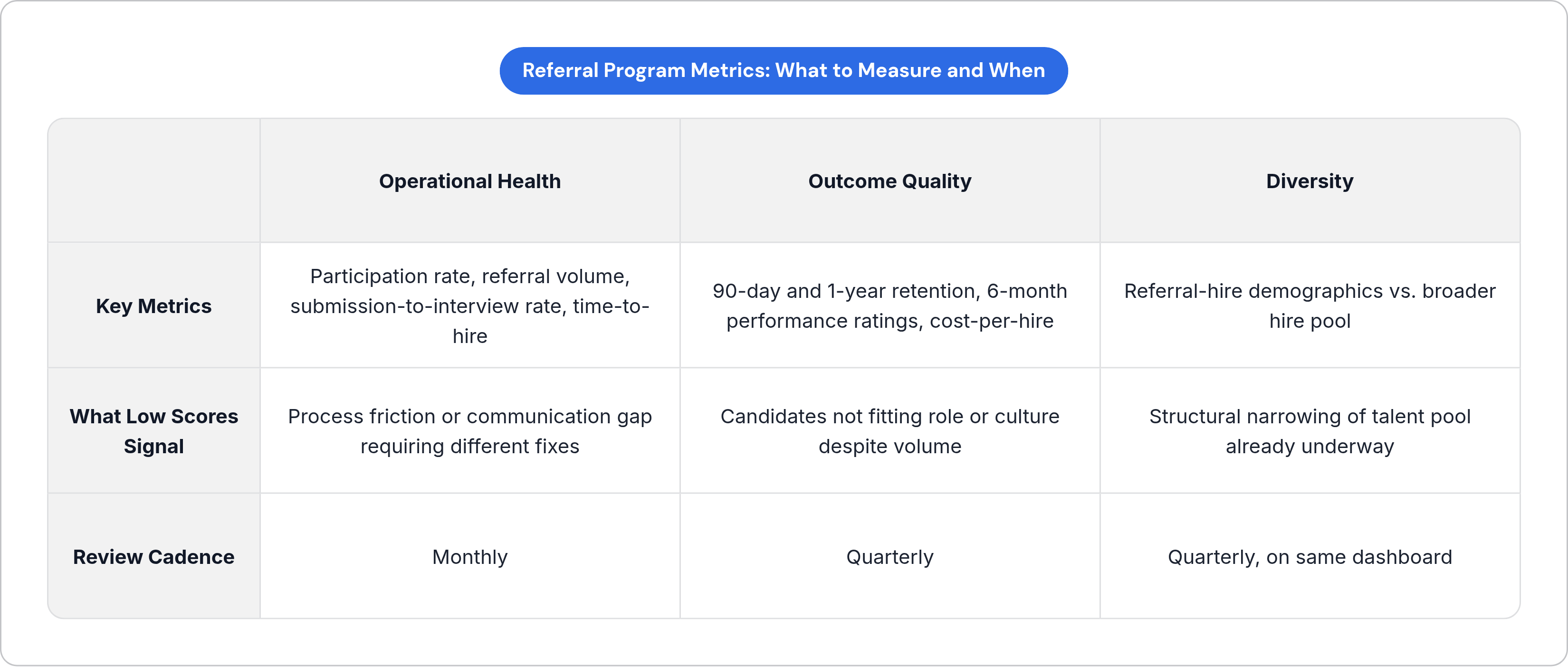
A referral program has two measurement layers. Operational health metrics include participation rate, referral volume, submission-to-interview conversion rate, and time-to-hire for referred versus non-referred candidates. Outcome quality metrics include 90-day and one-year retention of referral hires, performance ratings at six months, and cost-per-hire compared to other sourcing channels.
Low participation despite a cash incentive points to a process friction problem. Low participation despite a streamlined process points to a communication or awareness problem. These require entirely different interventions, and conflating them wastes months.
Retention is the metric that most directly validates program quality. The gap between referral hire retention and job-board hire retention is the benchmark to track, not as a point of pride but as confirmation that the program is generating candidates who actually fit. Cost-per-hire comparison closes the ROI argument — savings per hire, compounded across a year of referral-sourced positions, must be tracked against total program spend including bonus payouts to produce a number worth defending.
Operational metrics warrant monthly review. Outcome metrics warrant quarterly review. Programs assessed annually cannot course-correct before design problems compound into structural ones. Diversity metrics belong on the same dashboard. If referred hires are systematically less diverse than the broader hire pool, that signal needs to surface before the pattern becomes self-reinforcing.
How Referral Programs Function Differently for Technical and Specialized Roles
Technical talent markets are where the referral speed advantage matters most directly. An unfilled senior engineering role isn't simply a productivity gap; it's a drag on delivery timelines, a source of team strain, and a compounding competitive disadvantage. McKinsey & Company's 2023 talent productivity research addresses these costs in the context of technical hiring.
Engineers refer engineers. The referred candidate arrives having already been evaluated by someone who understands the technical requirements, which functions as an informal early-stage screen that job boards cannot replicate. The referrer has staked their professional credibility on the candidate's fit, and that social accountability pre-loads trust into the hiring process before the first interview.
The mid-size technology company case cited earlier reported 40% of engineering hires through referrals within six months, cutting average time-to-hire from 45 to 28 days; the source and methodology for these figures should be documented before they are used as generalizable evidence. Tiered incentive structures are especially defensible in technical hiring because the underlying premise is accurate — a senior distributed systems engineer isn't the same hiring challenge as a junior QA analyst, and the compensation structure should reflect that honestly.
In organizations that use staff augmentation or nearshore teams alongside internal headcount, referral program logic extends to feed both pipelines, internal referrals for permanent roles and partner-sourced networks for augmented positions. The referral channel's core value proposition, social trust as pre-screen, becomes more important as organizational complexity increases.