Remote Work Impact on Talent Supply and Competition
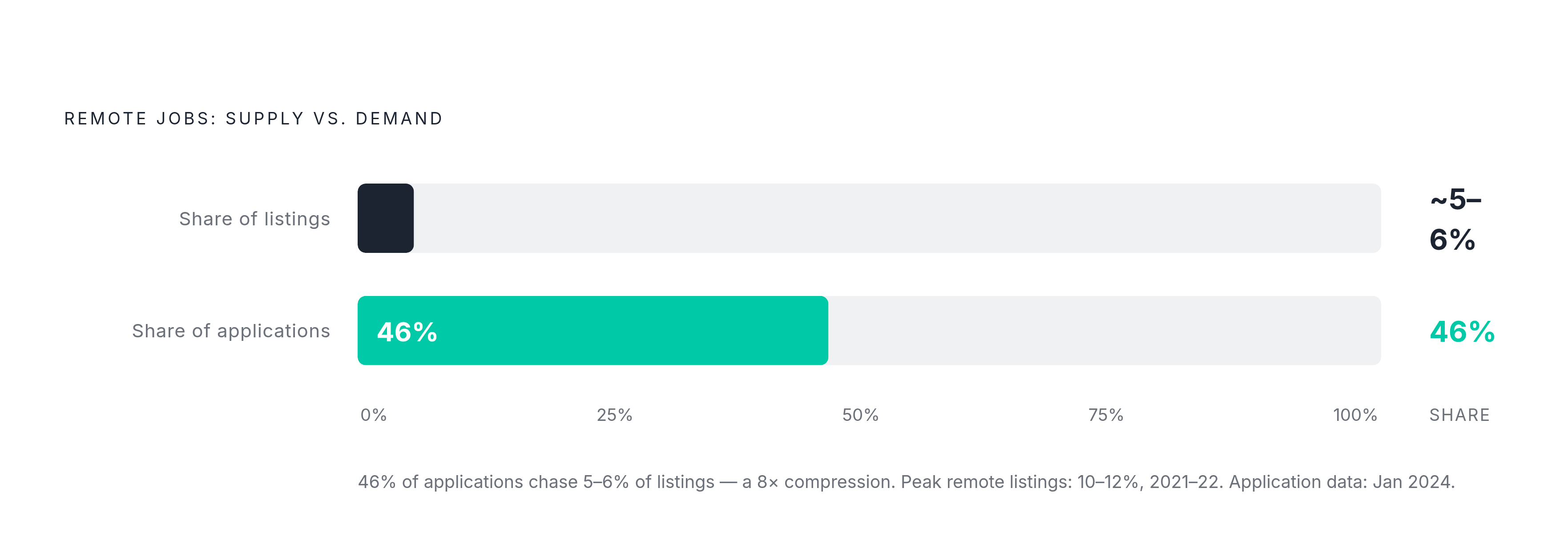
Remote roles attract half of applications but represent only six percent of job postings.

The numbers are uncomfortable. In January 2024, remote roles attracted 46% of all job applications while representing only 10% of listings. Every remote posting draws a global applicant pool, and yet the supply of those postings has contracted. Fully remote listings now represent only 5 to 6% of all job ads, down from 10 to 12% at the 2021 to 2022 peak.
In Q2 2025, 24% of new U.S. job ads were hybrid and 12% fully remote. On-site listings fell from 83% of all postings in early 2023 to 66% by late 2024. Hybrid is now the dominant format. Fully remote represents a smaller share of a much larger expectation, which is a particular kind of pressure: candidates expect it, but the listings offering it are scarce.
Engineering sits at the far end of this distribution. The tech sector leads all industries at roughly 67% remote participation; construction is under 8%, food service under 5%. Remote work is overwhelmingly a knowledge-work phenomenon, which means the geographic restructuring of talent markets lands hardest on companies building digital products. Organizations that refuse to offer it are competing in a shrinking candidate pool. Organizations that do offer it are competing globally, whether they intended to or not.
Roughly 22% of the American workforce does some work remotely as of 2025. Across twenty OECD countries, the share of job postings offering remote or hybrid work more than quadrupled between January 2020 and January 2023, then leveled off. That leveling is a floor, not a retreat. Organizations that deferred the infrastructure investment remote work requires have been caught competing with less capacity than the market now demands.
How AI-Generated Applications Are Distorting the Hiring Signal
The expanded candidate pool brought a compounding problem nobody fully anticipated. AI tooling now produces résumés, cover letters, and skill summaries that are functionally indistinguishable from hand-crafted ones, and candidates applying to remote roles, already the most competitive postings available, are submitting to dozens or hundreds of positions simultaneously using these tools. Volume is up. Signal fidelity is down.
A recruiter working a remote engineering requisition today faces a backlog of nearly identical, high-polish applications with no reliable indicator of genuine fit or actual capability. The tooling is improving, not retreating.
Remote work expanded the accessible talent pool considerably, but AI application inflation has made it measurably harder to find the right candidates within that pool. For engineering roles specifically, this forces technical evaluation to carry more weight than it ever has, because credentials and presentation no longer differentiate. Structured assessment does: live technical problems, portfolio review, interviews designed to probe reasoning under conditions that automated tools can't replicate.
Organizations that have built those filters are operating with a real edge. Those that haven't are reading the same polished résumés everyone else is reading and hoping the hiring instincts hold.
Why the Geographic Expansion of Competition Hits Engineering Teams Hardest
Engineering was already a constrained labor market before 2020. Remote work didn't manufacture the scarcity; it globalized it. A San Francisco startup is now competing with a London scale-up, a Toronto bank, and a Berlin SaaS company for the same senior backend engineer, and none of them require that engineer to relocate. The competitive surface expanded in every direction simultaneously.
The World Economic Forum projects a 25% increase in digital jobs performable remotely, representing 92 million remote workers by 2030. A 2025 Owl Labs study found that 38% of employees would consider quitting if remote flexibility were removed. Engineering talent, which carries the most portable skills and the sharpest awareness of market alternatives, migrates toward employers that protect that flexibility. Every talent market that has attempted to roll back remote has produced observable evidence of this.
That same phenomenon opens access to engineers that locally anchored competitors can't reach. Latin America went from roughly 3% remote work penetration before the pandemic to 30% by 2025, meaning a cohort of technically credentialed engineers who were previously tied to local labor markets, with local salary expectations and local competition among employers, became accessible to North American companies at meaningful scale. Nearly every serious hiring organization understands this opportunity exists. Far fewer have built the infrastructure to do anything with it.
What "Competing Globally for Engineers" Actually Requires Operationally
Accessing global talent and benefiting from global talent aren't the same thing. The distance between them is operational, and it's consistently wider than organizations estimate until they have tried to close it themselves.
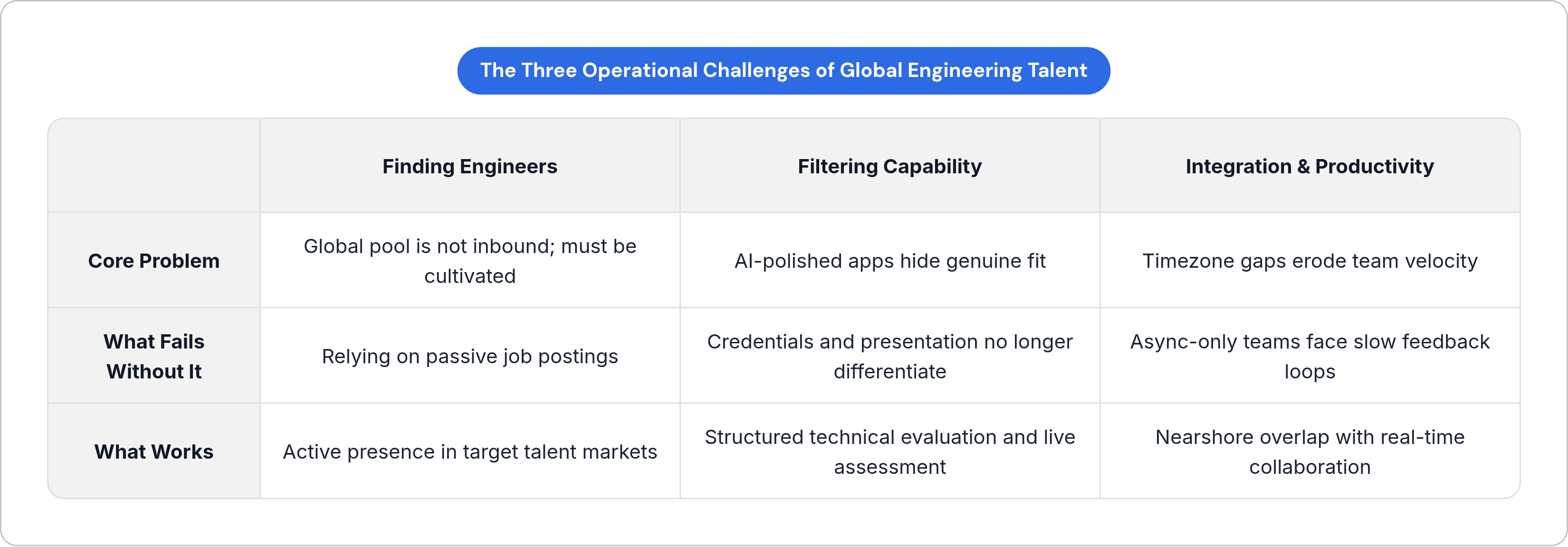
Three distinct problems exist, and they don't yield to the same solution. Finding engineers across geographies before competitors reach them requires active presence in talent markets, not passive job postings; the expanded candidate pool is largely not inbound, it must be cultivated. Filtering genuine capability from polished AI-generated presentation at scale requires structured technical evaluation that can't be gamed by automated application tooling. Making distributed engineers productive within existing teams requires timezone overlap, defined communication norms, and cultural alignment, none of which are guaranteed by technical fit alone.
Timezone alignment deserves more attention than it usually gets, because practitioners consistently underestimate it until they've absorbed the cost. It's not a soft preference. It's an engineering velocity issue. Teams that can't synchronize their working day face longer feedback loops, slower unblocking, and coordination overhead that accumulates quietly and persistently. Stanford's work-from-home research documented a 13% productivity increase among remote workers, and that gain depends on teams that can actually collaborate in real time, not asynchronously across a twelve-hour gap.
Nearshore talent from Latin America addresses the integration problem directly, because LATAM engineers working U.S. Eastern, Central, or Pacific hours eliminate the coordination cost that makes purely offshore models unreliable. Organizations that solve all three challenges turn global competition into global access. Those that solve only one or two remain exposed on the dimensions they haven't addressed, often without realizing it until a project slips.
The Cost Arithmetic of Building vs. Buying Distributed Engineering Capacity
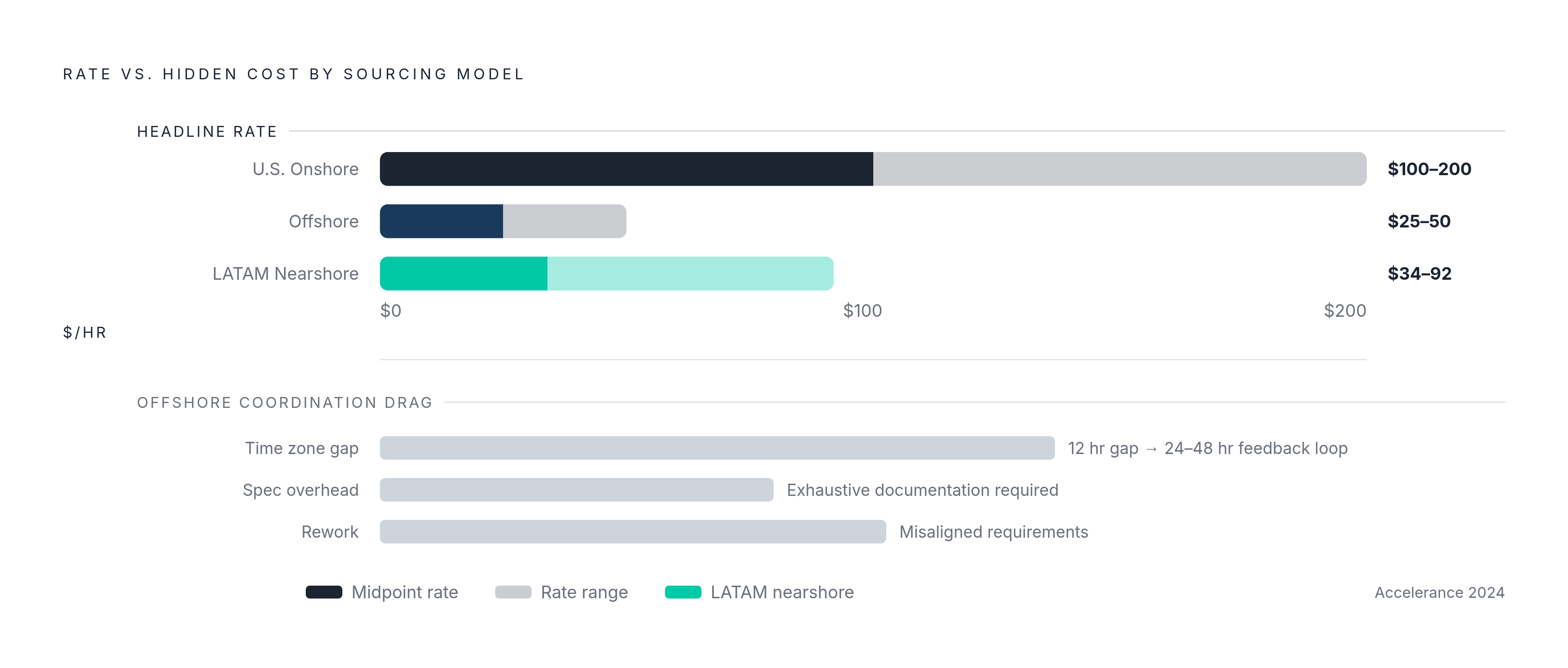
The rate spread is real. U.S. onshore engineering runs $100 to $200 per hour. Offshore talent in India and Southeast Asia runs $25 to $50 per hour. LATAM nearshore, per Accelerance's 2024 Global Software Outsourcing Rates guide, typically falls between $34 and $92 per hour. At the annual level, LATAM entry-level talent is available from around $15,000 per year, with mid-level developers averaging around $63,000, against significantly higher U.S. market rates.
The headline rate, however, is not the total cost, and conflating the two is how organizations end up disappointed with models that looked attractive on paper. Communication delays from time gaps of twelve or more hours stretch feedback loops to 24 to 48 hours. Specification overhead increases substantially when real-time clarification isn't possible. Rework from misaligned requirements erodes a meaningful portion of the initial rate savings. Companies save roughly $11,000 per hybrid or remote employee per year in aggregate, but those savings depend on teams that actually function as integrated units, not on teams that are merely distributed.
Spotify's experience onboarding a Polish engineering team to scale mobile and web capabilities, which cut expenses substantially, illustrates where the value lives: not in the rate itself, but in the rate combined with a team capable of genuine integration. The rate is the floor; the conditions determine whether you get anywhere near it.
The relevant question for decision-makers is what the all-in cost of shipping working software looks like. That calculation consistently favors models with timezone alignment and vetting infrastructure over those that optimize on rate alone.
Why Staff Augmentation Has Become the Default Response to Global Talent Competition
A large majority of global organizations used staff augmentation for software development and related technical work in 2025. The driver isn't exclusively cost. Sixty-one percent of enterprises report unmet internal talent requirements; augmentation fills gaps that internal hiring can't close quickly enough when competition for engineers is running on a global clock.
The composition of augmentation demand reflects where competition is sharpest. Frontend and backend roles represent the largest share of current demand, with AI/ML and cloud roles growing fastest. Remote work infrastructure is what made augmentation scalable at this volume: a majority of new engagements in 2025 supported remote and hybrid augmentation models, which would have been logistically impractical before the pandemic normalized distributed teams.
Augmentation also provides scaling flexibility that full-time hiring can't. A team can expand for a product push and contract after launch without the legal and cultural friction of layoffs, and that optionality matters in a market where product timelines and talent availability are both genuinely volatile.
The risk of augmenting carelessly is identical to the risk of hiring offshore carelessly. Engineers dropped into a team without timezone alignment, onboarding structure, or cultural fit produce the same coordination costs and erode the same rate savings. The market has moved toward partners who deliver vetted, remote-ready engineers with integration infrastructure already in place, because that's what the restructured talent environment demands. The organizations that learned the hard version of this lesson aren't eager to repeat it.
How Latin America's Remote Work Expansion Changed the Accessible Talent Pool
Latin America's remote work shift is one of the most consequential talent-supply developments of the post-pandemic period. Moving from roughly 3% penetration before 2020 to 30% by 2025 crossed a threshold that materially changed what North American companies can realistically access, and most organizations haven't fully reckoned with what that implies for their hiring strategy.
LATAM engineers working in U.S. time zones can join daily standups, unblock colleagues in real time, and participate in the iterative back-and-forth that distributed teams require to stay productive. This matters more than it might appear. The difference between nearshore and offshore isn't a preference; it's the concrete operational gap between a team that functions and a team that struggles against its own coordination costs, despite similar rate profiles on paper.
Engineering education across Brazil, Argentina, Mexico, Colombia, and other regional markets has been growing for over a decade. The available cohort is technically credentialed, increasingly experienced in distributed work, and not thin. Timezone alignment, growing technical depth, a significant rate advantage against U.S. onshore, and cultural familiarity that reduces integration friction all move in the same direction. None of them cancel each other out.
What Separates Companies That Turn Global Talent Access into a Competitive Edge
The restructured talent market is a permanent feature of the environment now. Every engineering organization is competing globally, regardless of whether it's built for that reality.
Companies capturing durable advantage share a few concrete traits. They have sourcing reach into talent markets their competitors aren't watching, which means they're not waiting for applications to arrive. They have vetting depth that cuts through AI-generated noise by testing capability rather than presentation. They have integration infrastructure: timezone-aligned teams, defined onboarding, communication norms that make distributed engineers productive quickly rather than after a quarter of friction.
Organizations without these capabilities are exposed on both sides. They face global poaching of their own engineers while lacking the access to replace or expand capacity globally themselves. That asymmetry widens as the WEF's 25% growth projection for remote digital jobs plays out through 2030.
Building this infrastructure internally is a substantial investment. Sourcing networks require time to develop, vetting pipelines require iteration, and integration playbooks are learned through mistakes that cost real money. Partnering with a firm that has already built it is how most organizations close the gap without absorbing the full cost of that learning curve. Whether an organization builds or buys, the requirement doesn't go away. The companies that treat the post-remote talent market as the permanent condition it is, rather than a disruption still awaiting resolution, will find themselves with engineering capacity precisely when their competitors can't.