Employer Brand Influence on Talent Attraction
Candidates research your brand before applying, and most won't change their minds.

Candidates don't wait to be found. They research. By the time a qualified engineer submits an application, he has already consulted multiple platforms, read employee reviews, scrolled through social content, and formed a settled opinion that no recruiter message will meaningfully revise. According to Glassdoor's Workforce Confidence Index, 81% of candidates conduct employer brand research across at least three separate platforms before applying. The brand has already done most of the filtering work before anyone in the hiring organization gets involved.
Review behavior is particularly decisive. Eighty-two percent of candidates read company reviews before applying, and 38% say a pattern of negative reviews stops them from applying at all. That's not a soft preference. It determines who enters the funnel before a recruiter has sent a single message.
Where candidates conduct that research has shifted quickly. Employer content on TikTok saw a 214% increase in views year-over-year, averaging 1.3 billion monthly impressions globally, per Glassdoor. A company whose brand presence stops at a career site and a LinkedIn page is effectively invisible to a growing share of its target audience, and that invisibility carries a cost. A candidate who finds nothing reads absence as condemnation.
The channel with the highest signal fidelity, consistently, is employees. LinkedIn data shows that employee-shared content delivers roughly twice the click-through rate of brand posts, and companies with socially engaged employees are 58% more likely to attract top talent. A company can write whatever it wants about its own culture. An employee sharing a genuine experience carries different evidentiary weight, and experienced candidates know how to tell them apart.
An unmanaged employer brand is not a blank slate. It is a record compiled from reviews, word of mouth, and employee posts the organization doesn't control. Companies either build the brand deliberately or inherit whatever forms by default, and those two outcomes are not equivalent.
What a Strong Employer Brand Actually Costs to Build — and What Weak Brand Costs to Ignore
The return on employer brand investment is substantial enough to change the budget conversation entirely. According to Universum Global, organizations in the top quartile for employer brand strength reduce total recruitment marketing spend by an average of $1.2 million per year per 1,000 hires. Companies that invest in employer brand see a 50% reduction in cost-per-hire, per Artemis Recruits. These are not marginal efficiencies. They compound across every hiring cycle.
The hidden cost of weak brand runs in the other direction, and it stays hidden because it disaggregates across budget lines. A poor employer reputation pushes organizations into paid sourcing channels, agency fees, and offer sweeteners that wouldn't be necessary if candidates arrived already inclined toward the company. Every lever costs more to pull when the candidate pool is skeptical or stays away entirely. Leadership rarely traces accumulated spend back to its root cause because no single line item reads "reputation deficit." The expense is real; its origin goes unexamined.
Layoff-related brand damage illustrates how fragile this asset is. Glassdoor analysis shows ratings fall after layoff announcements and remain depressed for a year or more, with full recovery often still incomplete at 24 months. More counterintuitively, higher-rated companies absorb a larger initial drop. A company that builds a strong brand and then stops attending to it isn't preserving an asset; it is allowing a depreciating one to erode faster than it otherwise would.
The organizational response is visible in aggregate. Seventy-one percent of large organizations now operate with a formally documented employer brand strategy, up from 57% the prior year, per LinkedIn Global Talent Trends. Those without a documented strategy are paying a premium in sourcing cost and offer failure rate, though few have traced the expense to its source.
The Link Between Employer Brand Strength and First-Year Hire Performance
Application volume is a flawed proxy for hiring success. A brand that generates high volume from poorly matched candidates wastes recruiter time, inflates mis-hire rates, and raises cost-per-hire without improving outcomes. The more consequential question is whether a brand attracts candidates who actually perform once hired.
A joint study by Harvard Business Review Analytic Services and Korn Ferry, conducted across 320 companies and 14 industries, found that organizations with clearly articulated, externally visible employer value propositions attracted candidates with 38% higher average performance ratings in their first year. The same study found that strong EVPs reduced mis-hire rates by 43% compared to companies relying solely on job description-based recruitment. The logic is self-selection: candidates who genuinely understand what a company offers arrive with accurate expectations, and accurate expectations correlate with performance.
LinkedIn data reinforces this. Companies with documented employer brand strategies were 2.8 times more likely to report above-average hiring outcomes. Seventy-one percent of HR managers say employer branding directly affects retention, per Gitnux. Internal clarity produces cleaner external messaging, which attracts candidates whose expectations are grounded in reality.
The quality argument becomes acute in technical roles, where the cost of a mis-hire is almost always larger than the organization believes. A senior engineer who leaves after eight months takes with him the salary replacement cost, but also delayed product timelines, accumulated technical debt, team disruption, and every month the right person wasn't in the seat. None of that appears in a cost-per-hire calculation. The full cost traces back to the moment the wrong candidate was attracted, which is a brand problem, not a recruiting problem.
What Engineers Actually Want — and Whether Most Employer Brands Reflect It
Employer brand is only effective if it signals what the target talent actually values. Most brands default to language so generic it carries no informational weight with experienced engineers: "great culture," "innovative team," "collaborative environment." These phrases appear at every company a senior engineer has ever researched. Generic language doesn't fail to attract engineers so much as it fails to differentiate, which amounts to the same thing.
Randstad's 2025 Employer Brand Research, drawing on responses from hundreds of thousands of people across thousands of companies and 34 markets, establishes what talent actually prioritizes. Competitive salary and benefits remain the foundation, still decisive when trade-offs must be made. Work-life balance has narrowed the gap considerably and is the leading priority among Gen Z engineers, treated not as a differentiator but as a baseline expectation. Forty-five percent of people globally value fair treatment and inclusion, making DEI a trust signal rather than a compliance posture. Thirty percent prioritize flexible work schedules, meaning personalization of work arrangements has crossed from perk to table stakes.
For engineers in scarce specializations — security, data infrastructure, distributed systems — these preferences function as filters rather than wish lists. An engineer with genuinely in-demand skills can afford to be selective, and will be. A brand that fails to signal clearly on the dimensions he cares about loses him before he applies, without his ever explaining why.
The gap most employer brands carry is specific. They describe what the company does and what benefits it offers. They don't describe how engineers actually work, what autonomy looks like day to day, what growth trajectory is realistic, or why the technical problem being solved is worth working on. Those are precisely the signals that differentiate a brand to senior technical talent. The company that articulates those things honestly, and visibly, holds a real advantage over every competitor running interchangeable copy.
Why Distributed and Augmented Teams Face a Distinct Employer Brand Challenge
Employer brand is typically designed around a headquarters culture and a domestic hiring audience. It breaks down, often invisibly, when applied to distributed teams or external engineering partners. The assumptions embedded in the brand — the physical office, regional professional norms, cultural shorthand — don't translate directly to engineers in other markets. A hiring leader who attributes the resulting friction to talent supply problems or partner quality, rather than brand execution, is misreading the failure.
Engineers joining augmented teams evaluate brand differently than direct-hire candidates. They are assessing the client organization's reputation as a place to do meaningful work, the quality of the team they will work alongside, and the stability of the engagement. All of those are brand signals, and all of them are formed through research conducted before the first interview. An organization that projects a strong, coherent employer brand in its home market but has no presence or reputation in the talent's market will struggle to attract top-tier augmented talent, regardless of how strong the domestic brand is.
This is the operational reality in Latin American nearshore markets. Engineers there conduct the same multi-platform research that candidates conduct everywhere. Engineers with in-demand skills have options and are deliberate about how they use them. They choose clients whose reputation and working culture align with their professional standards, and they pass on engagements that fall short. How a client company is perceived in a given talent market, and whether it can be perceived at all, often depends on the reputation of the partner connecting them. A partner that vets client engagements as carefully as it vets engineering candidates helps clients present credibly in markets they couldn't otherwise reach.
Consistency is especially fragile in distributed models. LinkedIn data shows that companies with documented employer brand strategies are 3.1 times more likely to maintain consistent messaging across digital recruitment touchpoints, and those touchpoints multiply across geographies, time zones, and platforms that headquarters teams rarely monitor. Discrepancy between them is corrosive.
The more operationally damaging failure, though, is cultural. A company that treats augmented engineers as interchangeable resources — without onboarding them into mission, team norms, or working context — undermines the very signals that attracted those engineers in the first place. Accelerated churn in augmented teams is frequently a brand execution failure, not a talent supply problem.
Building an Employer Brand That Functions as a Talent Filter, Not Just a Marketing Asset
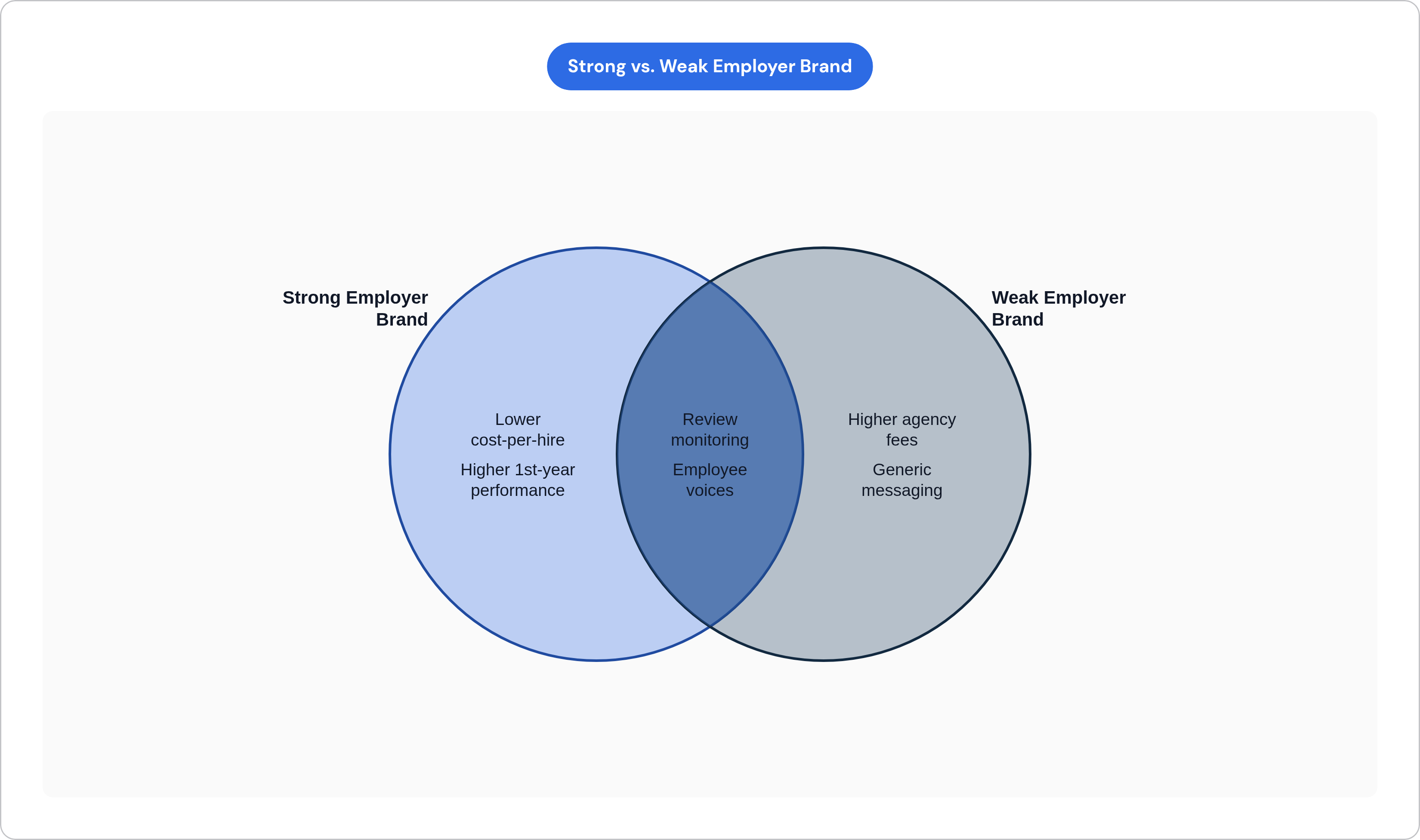
Most employer brand efforts optimize for reach. The right objective is precision: make the company recognizable and compelling to the specific engineers it needs, while filtering out poor-fit candidates before they consume recruiting resources. A brand that accomplishes this is a structural asset. One that generates undifferentiated volume is spending money to create work.
The components are neither complicated nor expensive. They do require specificity, and that is where most organizations stop short.
A functional employer value proposition is honest about what working there actually looks and feels like for an engineer. Not aspirational language, not a perks list, but an accurate description of the work environment, the autonomy available, the growth that's realistic, and the expectations the company holds. Candidates who self-select on the basis of an honest EVP outperform those recruited through generic job descriptions. The Harvard Business Review Analytic Services and Korn Ferry study across 320 companies and 14 industries demonstrates this, and the underlying logic holds independently: alignment at the point of application produces performance after the hire.
Employee voices must function as the primary distribution channel. Because employee-shared content generates roughly twice the click-through of brand posts, the distribution strategy must route through people, not pages. This means making it easy for employees to share authentically: not scripting them, not pressuring them, but removing friction and creating working experiences worth sharing. If those experiences don't exist, no content strategy compensates for their absence. No brand audit will surface that directly, but every retention metric eventually will.
Review management must be a continuous practice, not periodic damage control. Glassdoor ratings affect application rates directly, with 38% of candidates unwilling to apply after reading a pattern of negative reviews. The brand is only as strong as the most recent authentic signal, which means the work has no clean finish line.
Consistency across touchpoints is not a formatting standard; it is an organizational signal. Career site, LinkedIn, review platforms, job descriptions, recruiter communication: each is a brand expression. Discrepancy between them tells candidates the organization doesn't know itself. Companies with documented strategies are 3.1 times more likely to maintain that consistency, per LinkedIn.
For companies deploying external engineering talent, the brand must extend to how augmented engineers are integrated. Culture onboarding, meaningful work assignments, clear feedback loops, access to team context: these are brand expressions for those engineers, regardless of employment structure. The administrative distinction between full-time and augmented staff is real. The brand signal experienced by both groups does not observe it.
Measurement, finally, must connect brand to outcomes rather than proxies. Organic application rate, offer acceptance rate, first-year retention, first-year performance ratings: these reveal whether the brand is functioning as a filter. Glassdoor score and career page traffic describe awareness; they don't describe quality. Optimizing for awareness alone produces a brand that looks healthy in a dashboard and costs money in every metric that actually matters.
With 71% of large organizations now holding a documented employer brand strategy, per LinkedIn Global Talent Trends, the practice is becoming standard. Execution quality varies enormously, and the distance between a documented strategy and one that genuinely filters for fit is where competitive advantage still lives. It is accessible to any organization willing to be specific, honest, and consistent about what it actually offers the engineers it needs.