SLA Design for Distributed Engineering Team Contracts
Distributed SLAs need measurable outcomes, not uptime promises.

Distributed engineering SLAs must define delivery outcomes, account for end-to-end dependencies, and make enforcement part of the operating system of the engagement. An uptime promise alone cannot make teams answer for their work across tools and time zones. Precision requires agreed measurements, obligations matched to each party’s control, and consequences that remain enforceable as the engagement changes.
Why vague uptime language fails distributed engineering contracts
The contractual scope of the uptime number a buyer sees on a pricing page depends on definitions, measurement windows, exclusions, and rules for pausing the clock. Those terms determine what counts as a breach. A headline promise can therefore coexist with delivery problems that never register as contractual failures.
Distributed engineering exposes this gap because code reviews, sprint ceremonies, incident response, and deployment pipelines span time zones and tool boundaries. N-iX’s distributed teams guide identifies team structure as a stronger determinant of delivery speed than tooling or headcount. Undefined communication channels can make decisions invisible to other teams. An uptime clause cannot show when teams fail to coordinate.
A vendor and client using different windows or clock-pause rules can produce technically accurate but incompatible compliance reports. The contract then leaves compliance open to negotiation. Its apparent precision conceals the absence of a shared definition of performance.
What distributed team structure does to the dependency chain underlying any SLA
Delivery depends on more than the system named in the uptime clause. A soft dependency permits reduced functionality, while an asynchronous dependency delays processing without immediately interrupting the user. A redundant dependency allows another service to supply the capability. These distinctions change the effect of failure. They belong in the dependency map before targets are set.
For a journey requiring several independent components, end-to-end availability compounds downward as their availability levels are multiplied. Independence is only a starting assumption, however. Shared cloud regions, identity platforms, networks, or deployment pipelines introduce correlated failures that simple multiplication cannot capture, so production evidence must inform the commitment.
The guide distinguishes functional layers, pod-based cross-functional squads, and regional development hubs. Functional layers create handoff interfaces that can become bottlenecks across time zones, while pods reduce coordination by owning features end-to-end. Regional hubs depend on documentation and explicit handoff protocols to prevent context loss. Model choice is therefore a contract question. Each structure creates a different dependency topology, and the map must change when the team model, vendor landscape, or critical journeys change.
The SLI/SLO/SLA hierarchy and why the internal target must be harder than the external commitment
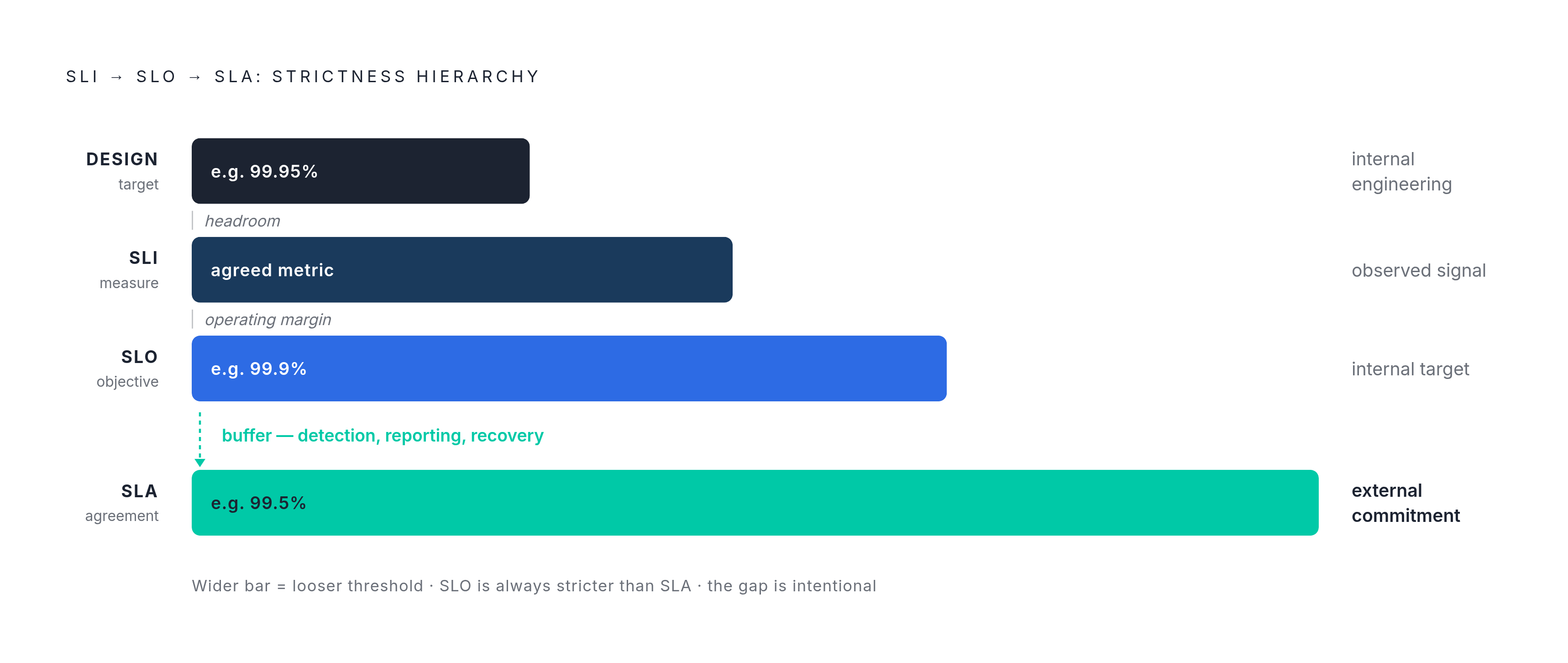
Within the scope of reliability established by a dependency map, three separate layers distinguish observation from obligation. A service level indicator, or SLI, supplies the agreed measurement. A service level objective, or SLO, sets the internal target used to operate and improve the service, while the SLA defines the formal commitment to customers or business stakeholders.
The internal target must be harder than the external commitment. This margin allows for detection delays, reporting differences, unexpected failures, and recovery work before normal operations become a contractual breach. An engineering design target can be tighter still.
The hierarchy connects critical journeys and operating hours to simple indicators and then to a service commitment. Without that separation, teams manage reliability by reacting to problems, with different expectations and repeated fire drills. Separate layers make tradeoffs explicit. They give stakeholders a factual basis for deciding where to invest and when vendor performance requires intervention.
The outcome-based metrics that distributed engineering SLAs should actually contractualize
The DORA framework provides a public benchmark for measuring distributed delivery through deployment frequency, lead time for changes, change failure rate, and mean time to restore, or MTTR. These describe pipeline output. Their contractual role depends on the engagement model. A Delivery model can commit to a low change failure threshold, while a Partner model can use a higher threshold with quarter-over-quarter improvement.
Each metric needs an agreed source and measurement rule. The contract should name the tool, such as Datadog or New Relic where applicable, and state whether it is provider-owned, customer-owned, or independent. Percentiles prevent averages from hiding performance spikes. An API commitment can require response time below a defined threshold for 95% of requests measured monthly, while the overall KPI set should remain small enough to sustain focus.
Security obligations need the same measurable treatment as delivery. Critical CVEs require a short, defined patch window, high-severity vulnerabilities a window measured in days, and medium-severity vulnerabilities a specified number of days. Each obligation needs a verifiable deadline. For nearshore staff augmentation, vendor-controlled outcomes also include qualified shortlist delivery, first sprint start from a signed offer, minimum daily overlap, and a defined free-replacement window when an engineer is not a fit.
Industry-specific calibration — how fintech and healthcare SLAs differ from general engineering contracts
Regulated work needs different thresholds but uses the same rules for measurement. In fintech, stability deserves greater weight because a change that breaks payment processing or bypasses a control is not a routine incident. A payment-critical path therefore needs a narrower change failure threshold than a general application. The contract must express that distinction. A common DORA framework does not imply identical risk tolerance.
Healthcare contracts must spell out HIPAA and PHI requirements, secure virtual desktop environments, and audit trails instead of assuming that providers have them in place. Live patient care systems also need high-availability targets and proportionate outage credits. Recovery needs its own explicit commitment. A defined recovery time objective establishes the restoration obligation for critical systems, while less critical systems do not automatically justify the cost of the highest availability tiers.
Industry terms also need clauses that set a schedule for sunset review. SoundHound AI’s 10-Q filings describe an exclusive cloud hosting agreement entered in August 2021 for a seven-year term and amended in May 2026 to commit additional spend. This example illustrates contractual longevity. It shows why terms written for one business context can govern years later, making review provisions especially important where regulatory obligations shape the agreement.
Tiered consequences, credit structures, and the enforcement mechanisms that change vendor behavior
Defined outcomes become commercial obligations only when missed targets have proportionate consequences. Minor variance can trigger collaborative review without a financial remedy. A material breach should trigger service credits and a documented remediation plan. Sustained or severe underperformance warrants stronger responses, including penalty assessments, executive escalation, or termination rights.
Credit ladders need a close look because those in standard enterprise contracts tend to favor vendors. Moderate downtime usually earns small credits, and only the most severe outages bring remedies with much value. Practitioners should therefore test the ladder’s percentages against real incidents, actual compute costs, and project timelines.
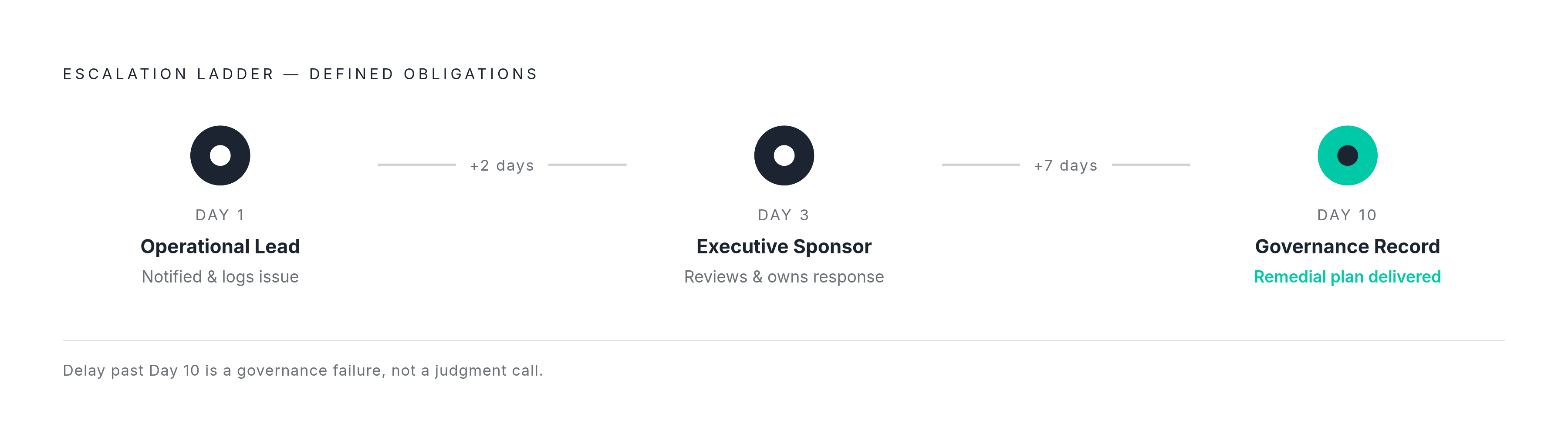
Escalation must also operate on contractual deadlines. Operational lead notification belongs on day one, executive sponsor review by day three, and a remedial action plan by day ten. Each step has its own clock. This structure turns urgency from a subjective judgment into a defined obligation and makes delayed remediation a governance issue in its own right.
Automated monitoring and observability as the enforcement infrastructure for distributed SLAs
Before deployment begins, both parties must agree on the evidence that will support consequences. Continuous automated monitoring supplies that foundation through a single system of record with agreed definitions, windows, and clock-pause rules. Tool selection is therefore a contract requirement. Naming the monitoring source keeps choices about how to build the service from quietly changing how its promise is judged.
Automated reports should also form the basis for credit calculation, so remedies follow the agreed evidence. The reporting cadence belongs in the contract. The contract needs to set a delivery window for monthly reports, and action items from quarterly SLA reviews need to be written down.
AI-native work adds CI/CD gates for generative AI artifacts to the infrastructure used for application telemetry. NIST SP 800-218A, published in July 2024, adds generative-AI-specific practices throughout the software development life cycle. It provides a public framework for applicable security controls. Contracts for AI-augmented development should name the security controls that apply to the work, without requiring every practice for every engagement.
For clients evaluating vendors in 2026, repository access by AI tools also creates immediate data-governance questions. The agreement must identify which AI services are used and whether their enterprise terms exclude training on customer data. It must also specify whether sensitive data can remain inside controlled environments. These are observable contractual conditions.
The outcome-based versus time-and-materials tension and when each contract structure is appropriate
Outcome-based accountability has a limit where the vendor does not control the work. If embedded engineers follow an internal product manager’s sprint tickets and backlog priorities, the client determines key conditions of delivery. Fixed-price scope accountability then becomes structurally misaligned.
For client-directed staff augmentation, time-and-materials can include DORA, onboarding velocity, and knowledge continuity as tracked and reported outputs without penalizing them as fixed-price deliverables. Vendor-directed dedicated teams or end-to-end delivery can instead support contractual DORA targets, change failure thresholds, and milestones. The distinction changes enforcement while measurement remains valuable in both structures. In either structure, the contract can still enforce obligations for hiring, onboarding, replacement, and daily overlap that are under the vendor’s control.
Real-time coordination helps give a dedicated team the control it needs to answer for delivery, while teams with no overlap in working hours cannot credibly promise the same coordination. Geography alone does not establish that capability. A stable nearshore partner with aligned time zones and a strong retention record has a stronger basis for sustained accountability because the operating conditions support the commitment.
Building and maintaining the SLA as a living contract across a multi-year distributed engagement
An accurate SLA can become obsolete when architecture, team structure, or regulatory requirements change. A platform migration or reorganization may invalidate a metric that worked in the first quarter. Review must follow those changes. The dependency map and contractual targets need reassessment when the vendor landscape or critical journeys change, with a material breach triggering formal review as well.
Amendments need the same care as the original agreement. Each should reference the prior version, preserve historical metrics and remedies, and follow the execution formalities of the master agreement. Electronic execution and version control support that continuity. Informal changes otherwise widen the enforcement gap by separating operating practice from the terms that govern it.
AI-augmented engagements need terms that require maintenance beyond static code, including model monitoring, prompt regression testing, and index re-indexing. ML-driven features can degrade as user behavior diverges from training contexts. Maintenance terms must account for that drift. The contract’s review cycle must therefore cover how well delivery is going and whether AI-driven features still meet their purpose.
Stable teams make this governance process more valuable over time. Engineers who stay across review cycles learn more about the client’s architecture and lower onboarding costs at renewal. That continuity supports the quarter-over-quarter improvement expected in a Partner model. For a long-term nearshore engagement, the compounding value comes from retained knowledge working within precise, maintained commitments, so accountability becomes more informed as the relationship matures.