Continuity Risk When Replacing Marketplace Contractors With Nearshore Engineers
A staged handoff plan keeps nearshore transitions from losing knowledge.

Replacing marketplace contractors with nearshore engineers is a continuity problem before it is a staffing change. Institutional knowledge, codebase context, and delivery rhythm are exposed when the outgoing team disengages before its successor can work independently. The transition succeeds when those risks are addressed before departure, then controlled through a staged transfer of ownership and a partner agreement built for retention.
Why marketplace contractors create structural continuity risk, not just delivery inconvenience
Marketplace staffing is optimized for transaction speed. The work can be done as planned while the client still depends on the person who did it. That dependence reflects a model in which finishing an assignment and preserving the knowledge needed to maintain it are separate obligations, with the latter often falling to the client.
Checking whether only one or two people can safely change a system helps diagnose continuity risk. If so, architecture decisions, API contracts, or deployment procedures may live mostly in those engineers’ heads. The code remains when they leave, but its context may not. Each rotation then imposes a ramp-up cost on the client, while the vendor can move on to another placement. This recurring “knowledge transfer tax” erodes the rate advantage before the second year.
First Factory’s 2026 staff augmentation guide places the US hiring cycle for a senior software engineer at three to six months and describes the substantial annual cost of a fully loaded senior US engineer. Companies gain access to capacity without waiting through that hiring cycle, but implicitly accept a continuity trade-off. Moving to nearshore engineers makes an existing risk visible and urgent.
What the transition window actually looks like, and why it is the highest-risk moment in the whole process
Before the transition window opens, outgoing contractors may still deliver work as usual even though so much knowledge sits with them. During the window, they begin disengaging while the incoming engineers are still learning the system. Afterward, the nearshore team must operate without routine access to its predecessors. The overlap is the point of greatest exposure. Knowledge is leaving just as demand for explanation is increasing.
Four sources of risk converge during that period, including undocumented knowledge, inadequate notice, possible vendor-side reassignment, and the incoming team’s ramp-up. A minimum 30-day notice period creates time for transfer, while senior or lead roles may warrant 60 days. Marketplace arrangements rarely include that obligation by default. If several contractors exit together, undocumented tribal knowledge may become irrecoverable.
The incoming team also has its own learning curve. Each engineer gets less done for about four weeks, and the client’s managers must put more time into mentoring. Meanwhile, a nearshore partner’s ability to reassign engineers can weaken the stability of the receiving team. These conditions make the window riskier than either steady state, but its timing is predictable. The practical response is to secure the overlap and define its outputs before disengagement begins.
What to capture before the outgoing contractors disengage, and how to structure the handoff
Documentation should be a deliverable with a deadline. That deadline is the outgoing contractor’s last billable day. The first output is a code ownership map showing which engineers built which systems and where dependencies remain undocumented. It identifies the people whose explanations are still available and the areas where the handoff needs particular attention.
Architecture Decision Records, or ADRs, should then preserve why important decisions were made alongside descriptions of the resulting design. Runbooks should cover the day-to-day work of running the system, including deployment procedures and incident response steps. Connext’s 90-day transition framework identifies the ownership map, ADRs, and runbooks as the three primary outputs of the first 30 days. Its warning is specific. Knowledge gaps left open during that phase can become operational gaps in month four, when the outgoing team is no longer available.
Written records do not capture every operational judgment. Incoming engineers should therefore shadow outgoing contractors on real tickets before taking ownership. This gives tacit knowledge a place in the handoff rather than leaving it to questions asked after departure. To make that overlap dependable, notice periods should be agreed contractually before the transition begins, with longer minimums for senior and lead roles.
Named accounts, least-privilege repository and environment access, and secrets held in a vault make offboarding a security control. The offboarding checklist should revoke access on the day an engineer rolls off. Knowledge transfer and access removal have different purposes, but both need to finish on an agreed schedule.
How to structure the 90 days after the nearshore team takes ownership
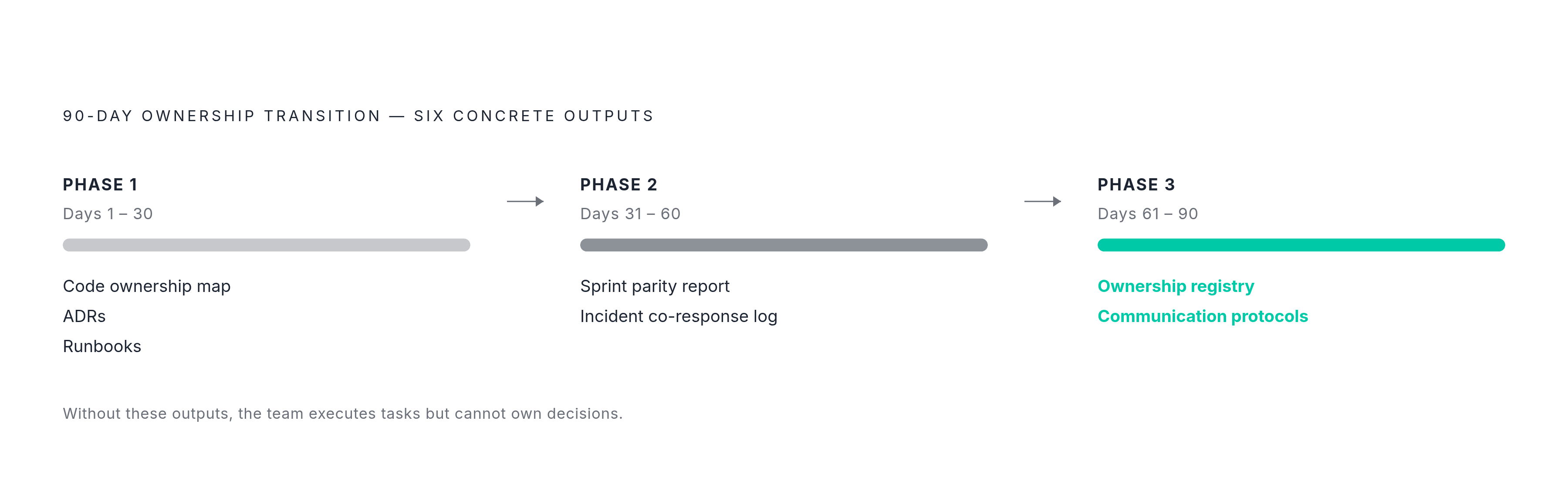
Connext’s 90-day playbook organizes the transition into knowledge capture, parallel execution, and progressive ownership transfer, with specific outputs for each phase. If the first phase starts after the contractors leave, it must use material gathered before they left. It cannot postpone access to the outgoing team. During days 1–30, the code ownership map, ADRs, and runbooks provide the documented basis for the nearshore team’s work.
Days 31–60 focus on parallel execution under supervision. The primary outputs are a sprint parity report and an incident co-response log, which make competency visible before full handoff. At this stage, supervision must come from the remaining engineering organization if the contractors have already disengaged. The distinction is important for planning the overlap. A post-departure framework is not a substitute for shadowing while the outgoing engineers are still available.
Days 61–90 move from assigned work to decision-making authority. An ownership registry and defined communication protocols record that transfer. Without this phase, the team can get a queue of tasks but lack the context to decide how to handle them. Ownership is broader than execution. It includes knowing who can make decisions and how those decisions reach the rest of the organization.
One nearshore engineer may join the team with little extra work, while ten who work partly on their own need clear team structures, communication protocols, and regular check-ins with US-based leads. Yet those practices cannot compensate indefinitely for repeated departures. The partner’s employment model is the strongest predictor of whether the engineer who starts remains at the end of year two, because a contractor-based nearshore model retains the churn risk the transition was meant to reduce.
What to verify in the nearshore partner contract before the transition begins
The partner agreement should establish continuity controls before the first engineer is placed. Employment status comes first because it affects both retention and the intellectual property chain. The relevant distinction is between full-time employees of the partner and independent contractors assembled for the engagement. Geography alone does not resolve that distinction. A nearshore label says little about who employs the engineers or holds their work product.
The IP chain runs from the individual engineer through the employer to the client, and the contract should address each link. Rights that come with employment do not pass to the client on their own. Mexico’s Article 103 of the Ley Federal del Derecho de Autor assigns economic rights to the employer for work created by employees in the course of their duties, while contractor-created work requires express assignment. The practical control is enforceable IP assignment across the jurisdictions involved.
Engineer exclusivity and reassignment rights should also be explicit. The agreement should establish whether the partner can move named engineers to another client mid-engagement. Notice and replacement provisions then address departures and poor fit. The specified minimums should be 30 days for individual contributors and 60 days for senior or lead roles, with a defined replacement SLA, such as a 30-day no-cost replacement. These terms keep the client from having to negotiate again over a staffing problem while under pressure to deliver.
Regulated work adds another contractual boundary. For fintech within PCI scope, healthcare subject to HIPAA, and e-commerce involving PCI or GDPR, the partner’s security posture, audit history, and data handling practices should be specified before transition. Scope-sensitive code can sit in a small, well-isolated service maintained by a tight, named subset of engineers. That arrangement fits a staff augmentation model in which the same engineers remain on the regulated service for years.
How the ParkMobile transition illustrates the full continuity argument in a real case
Lepassar frames continuity as a business risk distinct from cost. ParkMobile’s transition from agency contractors to a dedicated nearshore team illustrates that distinction. The company had relied on third-party agency developers for back-end and platform engineering for years. Each departure took knowledge of its systems out of the organization. The recurring loss was therefore part of the operating model.
The move to a dedicated team addressed that recurring exposure by changing the staffing relationship. The case supports the argument for continuity without establishing every handoff procedure used. It does not document a particular ADR process, shadowing schedule, or notice provision in the material provided. Those controls remain practical recommendations for ParkMobile. The documented comparison is between repeated agency departures and a dedicated nearshore program that earned further investment.
ParkMobile saved $1,066,085 a year compared with US rates. That financial result is significant, but it is not the strongest continuity signal. B2B leadership saw what the team was delivering and expanded the program, including hiring team leads in Colombia. The expansion moved beyond buying additional implementation capacity to investing in leadership. It is the opposite direction from a churn cycle that repeatedly spends effort rebuilding lost context.
What a nearshore partner built for continuity looks like in practice, and how to evaluate one
Full-time employment, enforceable IP assignment, a defined replacement SLA, and a named delivery manager give the work a structure that helps keep the team in place. A published, verifiable retention rate provides evidence beyond a sales claim. Without these features, a partner may get more done while leaving the client to deal with the same loss of knowledge again and again.
Working hours are part of that structure. First Factory’s guide explains that a ten-hour time-zone gap eliminates most of the real-time collaboration a sprint depends on. A LATAM arrangement addresses that constraint when engineers work concurrent hours with the US team, making live coordination part of the operating model. Coverage also affects transition complexity. A partner able to support front-end, back-end, mobile, QA, DevOps, cloud, and AI/ML work can reduce the need to coordinate multiple vendors during the change.
Are the engineers full-time employees or independent contractors, and what period does the published retention rate cover? Can the partner reassign placed engineers, or are they exclusive to the engagement? What replacement SLA applies when someone leaves or turns out to be a poor fit? These questions test whether the service agreement provides for continuity or the client is just expected to count on it.
IP and onboarding deserve equally specific scrutiny. How does the partner handle assignment across the jurisdictions where its engineers work, and how long does it take for a placed engineer to join a sprint after kickoff? AI-augmented engineering can compound value over an engagement, but contractor churn resets knowledge with each rotation. The decisive criterion is therefore whether the partner preserves the people and context on which sustained delivery depends.