Pay Transparency Law Requirements for Engineering Job Postings in CO, NY, CA, and WA
Four states now set strict pay disclosure rules that vague salary language can't satisfy.

Eighteen states plus one additional federal capital jurisdiction. now require some form of pay disclosure in job postings, and as of 2026, that patchwork governs how engineering roles get advertised across the country. No federal statute fills the gap: the Salary Transparency Act stalled out in Congress after its 2023 introduction and sits pending again in the 119th Congress. Until that changes, employers hiring engineers have to satisfy state law directly, and four states in particular, Colorado, New York, California, and Washington, carry the most weight because of how many tech employers have workers there. Engineering hiring makes this especially unforgiving: a single req posted to Indeed, LinkedIn, and Glassdoor at once can trigger obligations in several states simultaneously, whether or not the company has an office in any of them. "Competitive salary" "Competitive salary" and "DOE" fail to satisfy any of the four laws below. That's not a stylistic preference, it's a compliance failure, and the rest of this piece explains why.
Colorado's broadest coverage rules for engineering postings
A state's Equal Pay for Equal Work Act, codified at a state statutory code. § 8-5-101 et seq., took effect January 1, 2021, and got a substantial rewrite through Senate Bill 23-105, effective January 1, 2024. The threshold for coverage is about as low as it gets: one employee working in Colorado is enough to bring an employer under the statute. No 15-person cutoff, no revenue test, nothing.
That low bar combines with an aggressive remote-work rule. Colorado's law reaches any position that could be performed in Colorado, regardless of where the company is headquartered. A fully remote senior engineering role posted nationally, with no geographic restriction in the listing, is almost certainly in scope, because nothing stops a Colorado resident from applying.
Out-of-state employers with no physical presence in Colorado and fewer than 15 remote Colorado employees get a limited accommodation: they only have to provide notice of remote job opportunities, not... Out-of-state employers with no physical presence in Colorado and fewer than 15 remote Colorado employees get a limited accommodation: they only have to provide notice of remote job opportunities, not every job opportunity company-wide, and that relief runs until July 1, 2029. Even under that exemption, though, the compensation disclosure requirement still applies to the postings that do get made. Colorado also stands alone among these four in requiring an application deadline on the posting itself, a detail that trips up teams used to open-ended reqs.
New York: the state law, the NYC layer, and the remote-reporting-line rule
New York's Labor Law Section 194-B took effect September 17, 2023, and it sets the coverage threshold at four or more employees, which is considerably lower than California's or Washington's 15-employee line. That matters for engineering specifically, since a lot of small, well-funded startups run lean five- or six-person eng teams and would otherwise assume they're too small to be covered anywhere.
New York's substantive requirements go further than a bare number range. Postings need the minimum and maximum annual salary or hourly rate the employer, in good faith, believes it will pay, and the range must reflect a genuine good-faith estimate. If the role includes commission-based pay, that structure should be disclosed in the posting. New York also has additional posting requirements beyond the salary range itself. Other compensation and benefits are meant to sit in a separate section of the listing, encouraged rather than strictly mandated, but kept distinct from the salary range disclosure itself.
Scope-wise, the law reaches any job to be performed at least in part within New York State. A hybrid engineering role with occasional New York office days counts, even if most of the work happens elsewhere.
California's SB 1162 requirements and the 2026 amendment's changes
California's SB 1162 took effect January 1, 2023, and applies to employers with 15 or more employees. The core requirement is the "pay scale," the salary or hourly wage range the employer reasonably expects to pay for the position. The law's reach extends beyond employers physically headquartered in California, mirroring the logic Colorado and Washington use.
The 2026 change affects how "pay scale" must be defined in job postings, requiring a good-faith estimate of the range the employer reasonably expects to pay. Senate Bill 642, signed October 8, 2025 and effective January 1, 2026, tightened the definition of "pay scale" to mean a good-faith estimate of the range the employer reasonably expects to pay for the position upon hire. That sounds like a small wording tweak, but it closes a real loophole: before SB 642, some employers were posting deliberately wide bands (say, a range spanning from an entry-level salary to a much higher figure for a single listing) that technically disclosed a number without disclosing anything useful. The amended standard makes that practice harder to defend, because it ties the range explicitly to what the employer expects to pay the person it actually hires, not a hypothetical range across levels.
Washington: what the 2023 law requires and the 2025 grace-period amendment
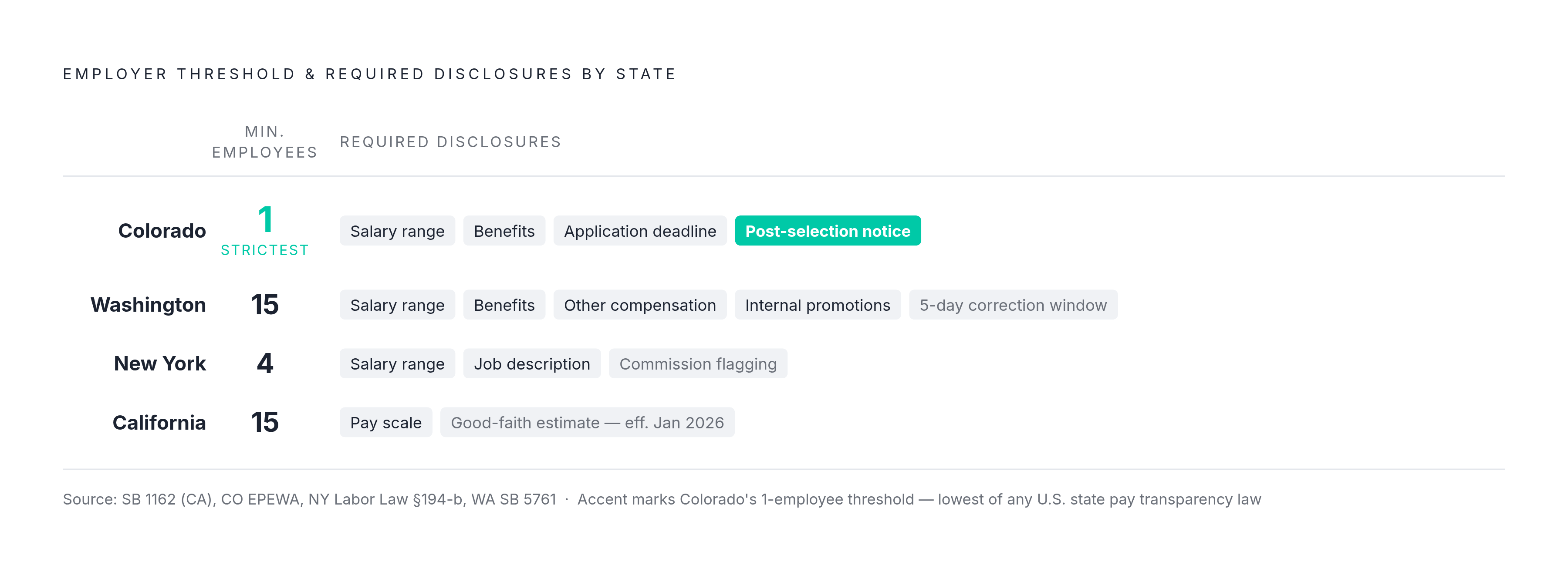
Washington's pay transparency law also took effect January 1, 2023, and covers employers with 15 or more employees under any of three conditions: at least one Washington-based employee, or recruiting for a job that could be filled by someone based in Washington. That third clause is the one that catches out-of-state employers off guard, since a company with zero Washington employees can still be covered simply by posting a remote role visible to Washington candidates.
Washington's disclosure list runs longer than the others. Postings need the wage scale or salary range, a general description of all benefits offered, and a description of other compensation like bonuses or commissions. The law also extends to internal transfers and promotions, not just external hires. Engineering orgs need to apply the same rules to an internal senior-to-staff promotion posting that they'd apply to an external senior engineer req.
The 2025 amendment added something the other three states don't have: a five-business-day grace period to correct a non-compliant posting before it counts as a violation. That's a meaningful procedural cushion, though it's a cure for mistakes, not a license to skip disclosure and fix it only if someone complains.
Where the four laws overlap and diverge
All four states agree on the fundamentals. Every one of them requires a real salary or wage range in the posting, none of them accept "competitive salary" as a substitute, and all four demand that the range reflect a good-faith expectation rather than a defensively wide band. All four also reach remote roles that could be performed by someone physically located in the state, regardless of where the employer's headquarters sits, and all four extend coverage to internal transfers and promotions in some form, even though the specifics of internal notice differ state to state.
The divergence appears in the details, and for a multi-state engineering employer, those details determine compliance. Coverage thresholds range from Colorado's single employee up to the 15-employee floor shared by California and Washington, with New York sitting in between at four. Benefits disclosure is mandatory in Colorado and Washington, while New York and California take different approaches to that element. Colorado alone requires an application deadline on the posting. New York alone requires attaching a formal job description where one exists. New York alone requires flagging commission-based pay explicitly, though Washington's "other compensation" requirement covers similar ground in practice. Colorado also requires post-selection notices to employees, a wrinkle that has nothing to do with the posting itself but trips up compliance teams who stop tracking obligations at the offer stage.
Salary history bans complicate things further. Salary history rules vary across jurisdictions, so compliance teams need to check each state on its own rather than assuming one state's rule generalizes.
Penalties vary widely enough to matter for risk planning. Colorado's range runs from $500 to $20,000 per violation under the updated statute. California's civil penalties reach up to $10,000. Washington also carries civil penalties for non-compliance. New York's penalties vary, and the steeper end of the range applies under a municipal human rights law specifically, which is a separate, additional layer for anyone hiring into that city proper.
None of this stays theoretical for long once a company hires remote engineers nationally. A business headquartered outside all four states can post one senior engineering role, open to any applicant nationwide. location, and trip Colorado's law because one Colorado resident applies, trip New York's because the reporting line runs through a New York office, trip California's because the listing doesn't exclude California applicants, and trip Washington's because the job board algorithm surfaces the listing to Washington candidates. All four sets of rules apply to the same posting at once. The practical fix isn't picking the "easiest" state to comply with, it's building to the strictest overlap of all four: Colorado's deadline requirement, New York's job description attachment, Colorado's and Washington's benefits disclosure, and California's pay scale standard, combined into one posting.
Building a compliant engineering job posting across all four states
A posting built to satisfy all four states at once needs a specific set of elements, and none of them are optional extras. Starting a real salary range requires stating both a minimum and a maximum, with no open-ended phrasing and no "starting at" with nothing on the top end. Add a general description of benefits, health coverage, retirement matching, PTO policy, since Colorado and Washington require it outright and it costs nothing to include everywhere else. Add a general description of variable compensation, bonuses, commissions, equity grants, which Colorado and Washington mandate and which, when it flags commission structures specifically, also satisfies New York's separate requirement on that point.
Include an application deadline. Colorado requires it, and putting a date on a posting in New York, California, or Washington doesn't cost anything or create risk in any of those states. If a formal job description already exists for the role, attach it to the posting rather than summarizing it, since New York requires this and there's no reason to maintain two separate versions of the same req depending on which state board it's headed to. Include clear instructions for how to apply, which Colorado requires and which is standard practice regardless.
Before publishing a remote engineering role, figure out which states' residents are actually eligible to apply. If the listing is open nationally, or open to any of these four states specifically, the full compliant template applies. That includes internal postings: engineering orgs frequently run external recruiting and internal mobility through separate systems, and all four states extend their requirements to promotions and transfers, so an internal-only posting for a staff engineer promotion needs the same range disclosure as an external req for the same title.
One calibration point deserves emphasis on its own. A salary range spanning junior through staff engineer pay for a single posting titled "Software Engineer" will not satisfy the good-faith standard in any of these four states, and California's 2026 amendment makes that especially explicit. The range needs to reflect the actual band for the specific level being hired, tied to the job that's actually open, using the specific level's pay band rather than a company-wide ladder collapsed into one number. Get that piece right, and the rest of the compliance work across Colorado, New York, California, and Washington becomes a matter of assembling elements that are already sitting in the requisition, not a legal research project every time a new role goes live.
Sources
- Colorado Pay Transparency Law Requirements for 2026
- INFO #9A Transparency in Pay and Job Opportunities: The Colorado EPEWA Part 2 5.29.24
- 2024 Update: Colorado’s Equal Pay for Equal Work Act - Essential Compliance Guide for Employers
- Colorado Pay Transparency Amendments Go Live January 1, 2024, Requiring Application Deadlines and Post-Selection Notices | Littler
- sixfifty.com
- dol.ny.gov
- local-attorneys.com
- trusaic.com