Evaluating a Vendor Platform Technical Vetting Process Without Live Interviews
Replace live vendor interviews with triangulated evidence from platforms, reviews, and work samples.
Live interviews feel like due diligence, which is exactly why they are dangerous as the primary signal for evaluating a vendor's technical vetting process. The conversation is compelling, the engineers seem sharp, and the confidence of the sales team fills the room. What that hour actually measures is presentation skill, not the system that selects, tests, and filters engineers before they ever reach a client. The evaluation work has to happen through other channels if the conclusion is going to survive scrutiny.
Why live interviews fail as the primary vendor vetting signal
A live interview with a vendor is an evaluation of sales capability, not engineering reality. The person across the table, or on the screen, is selected precisely because they perform well in conversations. The object of evaluation, the pipeline that finds and qualifies engineers, remains invisible in a one-hour conversation.
Vendor marketing materials compound the problem because they are designed to suppress failure modes. A vendor will not volunteer that its project failure rate climbs on smaller engagements, or that its domain-specific staffing depth is thin in exactly the area a client needs. These are the details that determine whether an engagement succeeds, and they are systematically absent from both the marketing deck and the sales call. A decision-maker who relies on live interviews is measuring the vendor's skill at controlling what it reveals, not the quality of its engineering pipeline.
The practical consequence is that live interviews create false confidence. They produce a warm impression that feels like evidence, which makes it harder to ask the questions that would actually distinguish a rigorous vendor from a well-dressed one. The alternative is not to abandon evaluation but to move it to channels where the vendor's claims can be tested against independent, structural evidence.
What a layered vetting methodology actually replaces
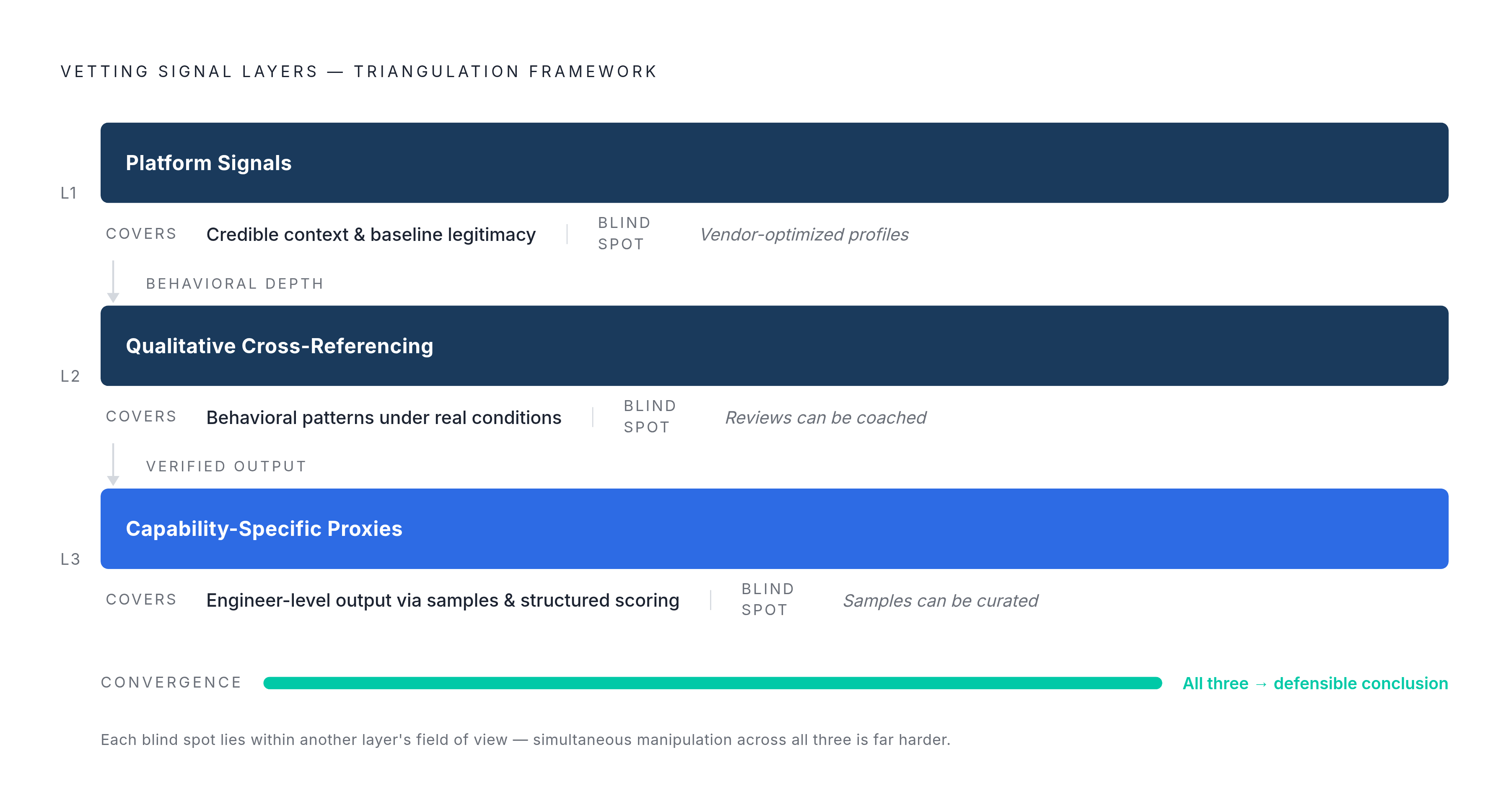
A defensible vendor evaluation without live interviews requires three distinct signal layers, each addressing what the others structurally cannot see. The first is platform signals, what the vendor's listed discovery profile reveals about its track record and the rigor of its process claims. The second is qualitative cross-referencing: independent client testimony that shows you the communication patterns, project management behavior, and execution quality no platform badge captures. The third is capability-specific proxies, so work samples, async technical screens, and structured scoring outputs can show you engineer-level ability without a live session.
These layers are not interchangeable. Platform signals answer whether a vendor exists in a credible context. Qualitative cross-referencing shows you how the vendor behaved when a project went sideways or a scope change arrived. Capability proxies answer whether the engineers can actually do the work. A strong result in one layer cannot compensate for a hole in another, because each layer fails in a different direction. Platform badges can be optimized, reviews can be coached, and work samples can be curated, but it is far harder to manipulate all three consistently.
The methodology functions as a triangulation system. Each signal layer has a known weak point, and the structure of the evaluation is designed so that one layer's blind spot is covered by another's field of view. That is why the framework replaces live interviews rather than merely adding to them: the point is not to gather more impressions but to assemble evidence that can be traced, documented, and defended after the decision is made.
Reading platform signals: what vendor discovery surfaces and what it hides
If you know the structural limit of each major discovery platform, you avoid over-weighting weak evidence. AWS Marketplace Professional Services listings are useful when a vendor's work is tightly coupled to AWS infrastructure. The listing requires engagement with AWS partner programs, so you get a baseline of commercial legitimacy, but that legitimacy says nothing about engineering quality outside a cloud-specific context. If you are evaluating general software development or staff augmentation capability, treat an AWS listing as nearly irrelevant.
The same logic applies across the ecosystem platforms. Microsoft Azure Marketplace Consulting Services, through AppSource consulting offers, mirrors the AWS model for Azure-aligned workloads. Salesforce AppExchange Consultants listings follow the same pattern in the CRM domain. Certification and review data is Salesforce-domain-specific, a strong signal for implementation or extension work and a weak signal for custom software development unrelated to the platform.
G2 Managed IT Services Providers listings operate differently, so they require different caution. The platform aggregates user ratings across broad IT services categories, and the category definitions are loose enough that very different vendors land in the same bucket. Signal strength depends on review volume and recency. G2 serves as a starting point for shortlisting across a wide field, never as a primary quality signal, because its ratings measure satisfaction rather than engineering rigor.
The shared limitation binds all of these platforms. Every signal at this layer is controlled or influenced by the vendor being evaluated. None of these signals provide the independent qualitative depth that the next layer supplies, and treating them as evidence of engineering quality is a category error.
Qualitative cross-referencing: how verified client reviews compensate for platform limits
Verified client reviews, when collected through a structured interview process rather than self-submitted ratings, surface the failure modes and communication patterns that vendor materials are designed to hide. The most useful place to read for these signals is Clutch, where reviews follow a structured format that rewards specificity. What to read for is not the star rating but the behavior it describes: communication style under pressure, how the vendor handled scope changes, whether the technical team required close management or worked autonomously, and what the client would do differently. These dimensions predict engagement quality better than a rating score because they reflect behavior rather than satisfaction. The cross-reference pattern matters as much as any individual review. A pattern of strong performance with one client profile does not transfer to another, and five-star reviews from large enterprises tell a startup very little about how the vendor will handle a two-month engagement with shifting priorities.
Thin or absent review history is itself a signal. A vendor operating at meaningful scale for multiple years should have an auditable client record somewhere, and the absence of verified reviews on a platform like Clutch raises a question that deserves an answer. Reviews that include specific friction points, named technologies, and recoverable problems are harder to manufacture, and they are correspondingly more credible as evidence.
What a vendor's own vetting process should look like, and how to read it without attending it
A vendor's published or described vetting process is only credible when its stages map to known high-validity screening methods. A credible multi-stage framework includes an async screen with a short video and code sample, a technical screen with live coding, a system design round, a domain deep dive with a tech lead or principal, and a hiring manager behavioral review. Each stage measures something distinct, and a vendor who describes only one or two stages, or who cannot articulate what each stage measures, is signaling low process rigor.
The system design stage deserves particular attention. Structured scorecards are the most reliable bias mitigation tool available in screening. A vendor that cannot describe its scoring rubric is likely producing inconsistent output, even if the output occasionally happens to be good.
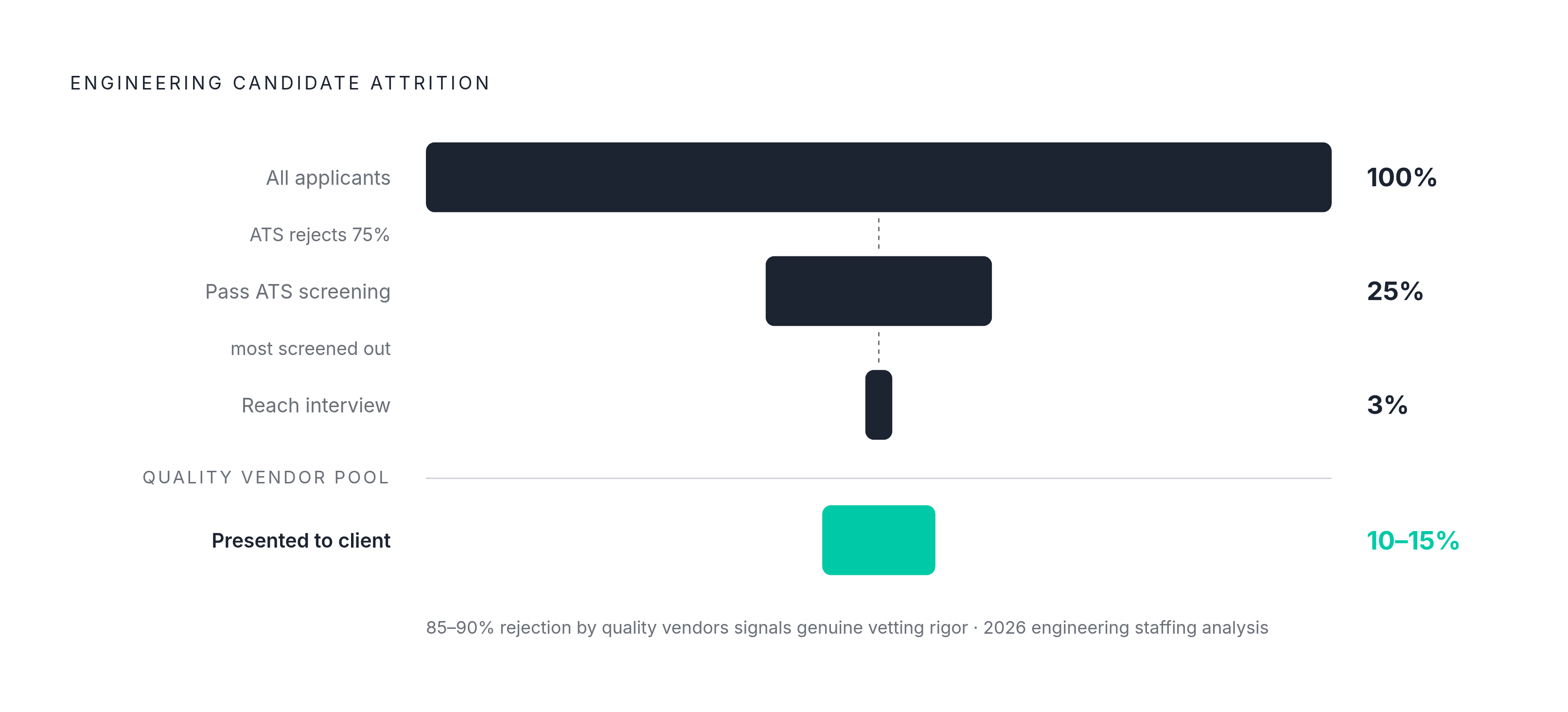
Acceptance rate is a proxy for rigor. Quality providers reject 85 to 90 percent of applicants before presenting candidates, per a 2026 analysis of engineering staffing pipelines. None of this requires attending a session. It requires a vendor willing to document what it claims to do.
The deepfake and proxy risk that automated vetting creates, and how vendors should be mitigating it
Automated technical screens are the easiest point in a vetting pipeline to defeat, and a vendor that relies on them exclusively without a verification layer is accepting a meaningful integrity risk. The deepfake and proxy candidate problem is active in engineering hiring. The screen measures outputs, and a proxy engineered to produce the right outputs passes the screen.
This is not a reason to avoid automated vetting. It is a reason to evaluate whether the vendor has designed around a known vulnerability. A well-designed vendor process includes a live verification step before any candidate is presented to a client, even a single brief human-led session, to confirm identity and that basic competency matches the automated results. The mitigation does not need to be elaborate, but it does need to exist somewhere between the automated screen and the client introduction.
Evaluating a vendor's mitigation without attending their sessions is straightforward. Ask directly whether automated screen results are ever verified by a human interviewer before a candidate is presented, and ask what identity verification steps are in place. The roles where a proxy candidate is most valuable to a fraudster are the same roles a vendor is being hired to fill, making the vulnerability a core concern rather than a tail risk.
Capability-specific proxies: what work samples and async outputs reveal that no interview score can
Work samples and structured async technical outputs are among the highest-validity predictors of engineering performance available, and a vendor operating at quality should be able to produce them on request. Revelo's 2026 framework positions system design interviews as the highest-signal stage for mid-to-senior engineering capability, with paired live coding and domain deep dives as the most reliable signal for mid-level roles. These methods earn their validity specifically because they reduce interviewer variance and make candidates directly comparable. The same logic extends to artifacts the vendor can provide without scheduling a session.
What to request as a capability proxy is specific. Where an AI interview agent was used in the vendor's pipeline, ask for the structured scoring report: this surfaces the rubric, the dimensions scored, and the result without requiring attendance. These artifacts reveal what no interview score can show, namely architectural reasoning, code style and convention consistency, how the engineer handles ambiguity in a written prompt, and whether their output matches the seniority level the vendor claims.
The signal-to-noise problem in screening makes these structured artifacts more valuable, not less. The problem is severe enough that approximately 3 percent of candidates advance to interviews after ATS screening, and ATS systems reject 75 percent of candidates before a human interview. A vendor-provided artifact that emerged from a controlled, structured screen carries more weight than anything a candidate assembled for public display, because the conditions of its production are known and constrained.
How timezone and communication alignment affect what the vetting signals actually predict
Even a technically rigorous vetting process produces misleading predictions when the resulting team cannot collaborate in real time with the client's engineering leads. Staff augmentation specifically, as opposed to outsourced project delivery, requires the client's tech lead to review code and set priorities on a daily basis. That model only works when there is meaningful timezone overlap.
The implication for vetting is that a vendor's capability signals are only predictive for a specific client if the vendor's talent pool sits in a timezone that allows the integration model to function. Nearshore delivery, Latin America for US-based companies, preserves the real-time collaboration that makes augmented teams productive. That is a structural advantage that capability scores alone cannot capture, and it matters as much as any technical signal.
Evaluating this dimension without a live session requires a few direct questions. The answers either align the vetting signals with the integration model the engagement requires, or they reveal that the strong capability evidence is pointed at a team that cannot actually collaborate with the client. Both outcomes are useful to know before signing.
Assembling the layers into a decision: what a defensible conclusion looks like
A defensible vendor selection without live interviews requires that all three signal layers converge on the same conclusion. Convergence across layers is more reliable than a strong result in any single one, because each layer fails in a different direction. Platform signals establish credible context and baseline legitimacy. Qualitative cross-referencing confirms behavioral patterns under real project conditions. Capability proxies verify that engineer-level output matches the seniority and skill claims. If any layer produces a significant negative signal, whether absent review history, a vetting process that cannot survive scrutiny, or artifacts that do not match claimed seniority, that signal should be treated as disqualifying rather than averaged away.
What defensible means in practice is that a procurement lead, a legal reviewer, or a board member could trace the decision back to documented, independently sourced evidence at each layer. The practical output of this process is a shortlist of two or three vendors where the evidence converges positively, and a documented reason for eliminating the others. That artifact protects the decision-maker if a selected vendor underperforms, because the reasoning behind the choice survives the failure.
Integration is the final variable. Even a vendor that passes all three layers only delivers value if the augmented engineers are absorbed into the client's actual workflow: the same standup, sprint planning, retrospective, code review, and definition of done as internal engineers. The evaluation methodology is complete only when the first real piece of collaborative work succeeds, and that success depends on the client's willingness to treat augmented engineers as part of the team that builds the product.