Human-in-the-Loop Vetting for Senior Engineering Roles
Skilled interviewers can spot judgment gaps that automated screens miss in senior hires.

AI coding assistants and a deepening talent shortage have combined to produce a new kind of hiring risk: candidates who clear every automated screen but lack the judgment a senior title is supposed to guarantee. AI now absorbs the work that used to separate juniors from seniors: boilerplate, CRUD operations, routine bug triage. That means a junior engineer who prompts well can produce output that, at the surface level a resume screen or automated coding test actually sees, looks no different from senior work.
Engineers interviewing for senior roles at Microsoft, Amazon, Coinbase, and Salesforce have carried the same resume and the same years of experience into different rooms and walked out with an offer at one company and a rejection at another. Senior hiring was never a simple test of competence; it is a test of fit between a candidate's judgment and what a specific company values, and decoding that fit takes a human in the room, not a script. Staffing firm KORE1 puts the AI and ML talent gap at 3.2 open roles for every qualified candidate, and the global shortfall in tech talent is projected to reach tens of millions of unfilled jobs by 2030. That scarcity pushes hiring teams to move fast, and speed is precisely the condition under which screening shortcuts start to look reasonable, right up until they produce a mis-hire nobody can afford.
What AI screening tools can and cannot evaluate in a senior candidate
Automated screening tools do a genuinely good job at the task they were built for, and the task they were built for stops well short of judging seniority. They filter for syntax competency, catch outright resume fabrications, score LeetCode-style problems consistently, and flag keyword gaps, all of which earns its keep at the top of the funnel, where volume is high and the bar only needs to separate the unqualified from everyone else.
What these tools cannot do is evaluate the reasoning behind a trade-off, detect whether a candidate has actual scar tissue from recovering a production system at 2 a.m., or press on a behavioral claim until it either holds up or falls apart. Revelo's 2026 technical interview framework found that system design interviews correlate more strongly with real-world senior performance than any other stage, because they expose how a candidate handles ambiguity, breaks down a complex problem, and reasons under pressure, none of which an algorithm puzzle can surface. The gaming problem compounds this: Revelo's 2026 network data shows engineers already use AI on 89% of build tasks, which means AI-polished resumes, curated GitHub histories, and assisted coding assessments have made stage-one filters easier for weak candidates to pass and more of a formality for strong ones to clear. Senior interviews have also picked up a sixth axis that did not exist a few years ago: the capacity to manage an AI-augmented team, layered on top of the traditional five of people leadership, technical judgment, project execution, cross-functional influence, and culture fit. No automated tool currently evaluates that sixth axis with any reliability. None of this makes automation the wrong tool. It makes automation the wrong tool past a certain point in the funnel, and that point arrives earlier for senior roles than most hiring processes have adjusted for.
The specific signals that only a skilled human interviewer can extract
A skilled human conversation is required to surface trade-off reasoning in system design, ownership under adversity, and judgment in AI leadership, the three signals of genuine seniority. Each one predicts job performance in a way no scorecard alone can fully capture.
System design conversations do more than evaluate a candidate; they rank candidates, because the strongest ones demonstrate cost awareness, a plan for handling failure, a sense of how a system evolves under load, and the unmistakable texture of real production experience. They reason like the person who will own the pager, not like someone sketching boxes and arrows for an audience. Stripe's interview pattern illustrates this well: start with a simple problem, then layer in constraints around scale, concurrency, and memory, forcing the candidate to reason dynamically rather than recite a memorized architecture. That dynamic quality is what an automated assessment cannot replicate, because the next question has to depend on the last answer. A human interviewer can also ask why a candidate made a given trade-off rather than simply confirming that a trade-off was made, and that single follow-up question is where a weaker candidate's answer starts to thin out.
Ownership under adversity, the second signal, is visible more often in its absence than in its presence. A candidate with substantial years of experience who claims never to have had a conflict, never missed a deadline, and never disagreed with management is not describing a smooth career; they are describing a lack of ownership, and that pattern only becomes visible in a probing behavioral conversation. What interviewers actually want are stories: a conflict that had to be resolved, a trade-off that was genuinely difficult, a failure that had to be recovered from, a moment of influence without formal authority, comfort sitting inside ambiguity rather than resolving it prematurely. None of that can be scored by a rubric working alone; it requires a human doing the interpreting. Revelo's framework notes that structured scorecards remain the most reliable tool for reducing bias, since having every interviewer evaluate the same dimensions against the same definitions cuts down on affinity bias and prestige bias, but the scorecard only functions because a trained human is filling it out.
The third signal, AI leadership judgment, is the newest and the least understood. AI functions as a multiplier on whatever judgment already exists, not as an equalizer: it codes as well as the person driving it, so a junior engineer with AI becomes a faster junior engineer, while a senior engineer with AI compounds an advantage that was already there. The claim that teams with senior engineers guiding AI shipped significantly more features with fewer regressions does not hold up against Meta's own Engineering Blog; the actual data on Meta's AI teams, reported by LeadDev, showed incidents increasing rather than decreasing. That outcome underscores the real point: the multiplier effect depends entirely on the quality of the human judgment directing it, and a team guided by weak judgment will ship faster into more failure, not less. Assessing whether a candidate can lead an AI-augmented team requires redesigning workflows, setting guardrails, and spotting where work is quietly stalling behind a dashboard that looks fine, and it takes an interviewer who has done that work directly.
Why thoroughness and speed are in genuine tension
The most serious objection to rigorous human-in-the-loop vetting is not that it produces worse judgments but that it takes too long, and the candidates best equipped to pass a rigorous process are also the ones fielding competing offers. Thoroughness and speed pull against each other by nature: a careful process costs time, and lost time costs the best candidates on the list, so starting from a cold pipeline forces a choice between the two.
Revelo's 2026 framework sets a practical ceiling here: a well-structured five-stage process should close within a week or two, because strong candidates tend to accept offers quickly once a first conversation happens, and a slower competitor will take them first. The resolution is to decouple sourcing from vetting, so that baseline screening is already finished before a candidate ever reaches a client's interview loop, freeing the human-led stages to focus entirely on the signals that separate senior judgment from a well-credentialed junior who has not yet been tested.
Regional pre-vetted talent pipelines are the clearest working example of this fix. Senior engineers based in LATAM and Eastern Europe are available at meaningful savings compared with US onshore rates, but that cost advantage only solves the supply gap when the pipeline feeding it has already been vetted; an unvetted nearshore or offshore candidate is exposed to the exact same screening failures as any other candidate arriving through a cold pipeline. A nearshore arrangement with working hours that overlap a client's own day allows the real-time back-and-forth that rigorous human vetting depends on; an asynchronous offshore arrangement adds latency to every debrief cycle, slowing the process the framework is trying to speed up.
The governance layer forming around human oversight in high-stakes AI-assisted decisions
Human oversight of AI-assisted decisions is moving from a best practice into a design requirement across industries, and that shift raises the cost of treating it as optional in hiring specifically. Analysis of human-in-the-loop trends running through 2030 points to explainability and regulatory compliance as the two forces hardening this requirement: the EU AI Act already mandates human oversight and interpretable output for high-risk AI applications, and NIST's AI Risk Management Framework names opaque decision-making as a serious operational risk. A 2026 Deloitte Tech Trends report put the underlying paradox this way: "The more complexity is added, the more vital human workers become." Skilled human oversight becomes more important as the systems it governs grow more capable, not less.
Organizations are building structures around this logic rather than leaving it to individual judgment calls. Gartner finds that most mature organizations have already created dedicated AI oversight roles, specifically to keep AI deployment accountable to a human. That same governance logic extends naturally to an AI-assisted hiring stack making decisions about who joins an engineering team. The emerging "human-on-the-loop" model, where a human supervises an AI system continuously and keeps the authority to intervene the way a pilot monitors an autopilot system, is the direction high-stakes workflows are moving generally. Vetting a senior engineer is precisely the kind of high-stakes decision this architecture exists to govern. Organizations that build human judgment into their vetting process at the points where it matters most are not adding friction against the industry's direction. They are building toward exactly where compliance and explainability standards are already headed.
A Human-in-the-Loop Vetting Framework for Senior Engineering Roles
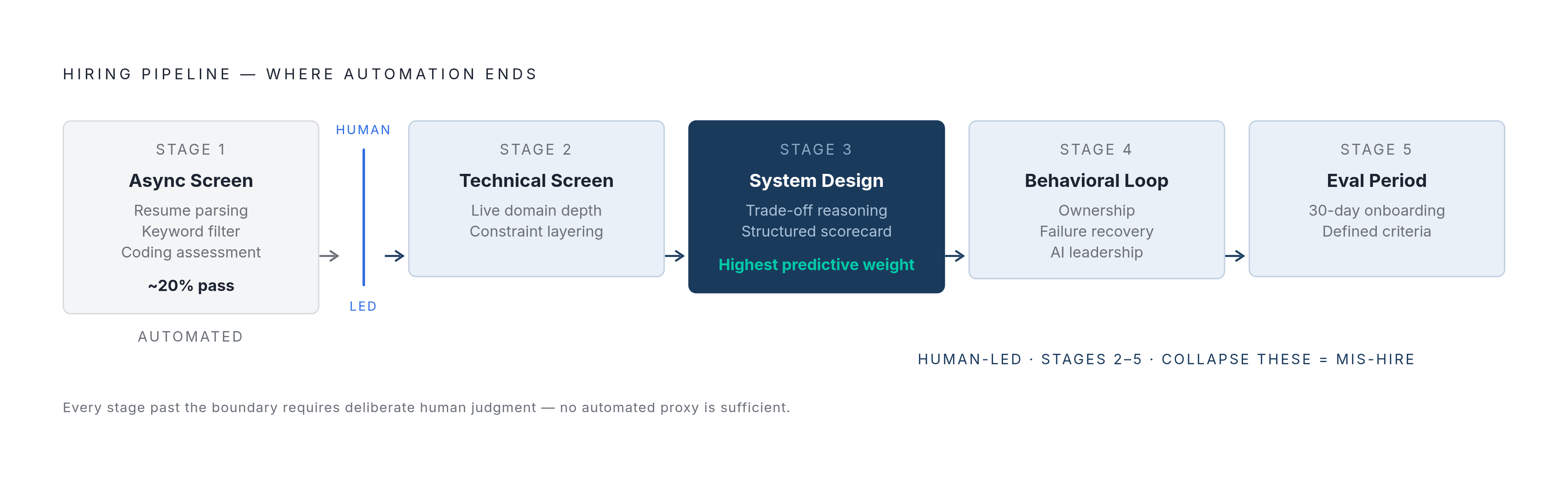
A workable framework places automation where it belongs, at the volume stages, and reserves human judgment for every stage where the signals that actually separate candidates begin to appear.
Stage one is the async screen, and it is the one stage automation is suited for. Resume parsing, keyword filtering, and asynchronous coding assessments belong here, since the task at this stage is a high-volume, low-signal, binary pass or fail that doesn't need human interpretation yet. Revelo's framework puts a realistic pass rate at roughly a fifth of applicants; a rate significantly higher than that is a sign the bar at this stage has been set too low.
Stage two is a human-led technical screen, a live conversation focused on domain depth and reasoning under constraint rather than algorithm speed. This is where the Stripe-style pattern of adding constraints mid-conversation belongs, since it forces the candidate to reason dynamically rather than recite memorized answers. Coding still matters at the senior level, but the evaluation criteria shift toward clean code, edge-case handling, readability, API thinking, and low-level design reasoning carried out while coding, all of which require a human assessing in real time.
Stage three is system design, and it carries the highest predictive weight in the entire process. A human interviewer probes not just the design itself but the reasoning behind each trade-off: cost awareness, failure handling, how the system is meant to evolve, and whether the candidate's answers carry the texture of real production experience. A structured scorecard is required here, with every interviewer evaluating the same dimensions against the same definitions, which is what keeps affinity bias and prestige bias from creeping into an otherwise subjective conversation.
Stage four is the behavioral loop. Ownership, conflict resolution, failure recovery, and influence without authority all get evaluated through probing follow-up that only a trained interviewer can conduct. The absence of hard stories is itself information, and a skilled interviewer recognizes that pattern where automated sentiment scoring simply cannot.
This stage tests how a candidate would actually lead an AI-augmented team: redesigning a workflow, setting guardrails on its use, and identifying where automation creates new bottlenecks rather than eliminating them. Gartner projects that most of the engineering workforce will need upskilling for AI collaboration through 2027, so a senior hire who cannot lead that transition is already behind the role before day one.
None of these stages function without decision architecture around them. Clear decision rights at each debrief cycle keep a process from drifting past three weeks, and a well-run five-stage process should complete within a matter of business days. Blind resume screening at the top of the funnel, structured scorecards running through every stage, and calibration sessions whenever pass rates drift significantly in either direction all keep the process honest. For staff augmentation engagements specifically, a thirty-day structured evaluation period with defined performance criteria extends this same human-in-the-loop logic into the onboarding phase itself, before anyone commits to a longer-term arrangement.
What it costs organizations when they collapse the framework
Most mis-hires at the senior level do not trace back to bad sourcing. They trace back to a predictable set of shortcuts taken inside the vetting stages themselves, each with a recognizable pattern and a real cost attached.
The most common failure is over-indexing on algorithm puzzles. A candidate can clear that bar cleanly and still have never reasoned through a production trade-off, never led a difficult conversation with a stakeholder, and never directed an AI tool toward a goal more ambitious than finishing a ticket. Collapsing the system design stage into a shorter conversation, or skipping the behavioral loop under time pressure, removes exactly the two stages that carry the highest predictive weight for senior performance. Skipping the AI leadership evaluation entirely, because it is the newest stage and the easiest to treat as optional, leaves an organization unable to tell whether a candidate can actually run a team that leans on AI for a meaningful share of its output, rather than merely use it personally.
The cost of these shortcuts is not abstract. It appears on a balance sheet the same way any other mis-hire does, in the recruiting spend, the onboarding time, and the lost productivity that follow a senior hire who turns out not to have the judgment the title implied. A hiring process built to move fast at the expense of the stages that matter most does not actually solve the scarcity described at the start. It just moves the cost of that scarcity downstream, to the quarter when the mis-hire becomes visible to everyone the engineering team answers to.
Sources
- Future of Human-in-the-Loop AI (2026) - Emerging Trends & Hybrid Automation Insights
- Senior Engineer Interviews in 2025–2026: What Actually Decides Your Offer (A Real, Unfiltered Series)
- How to Vet Software Engineers: The Technical Interview Framework for 2026
- Engineering Manager Interview in 2026: The Full Rubric (6 Axes, FAANG & Scale-ups)