Disparate Impact Testing Methods for Engineering Hiring Funnels
Detect bias at each stage of your engineering hiring funnel, not just the final outcome.
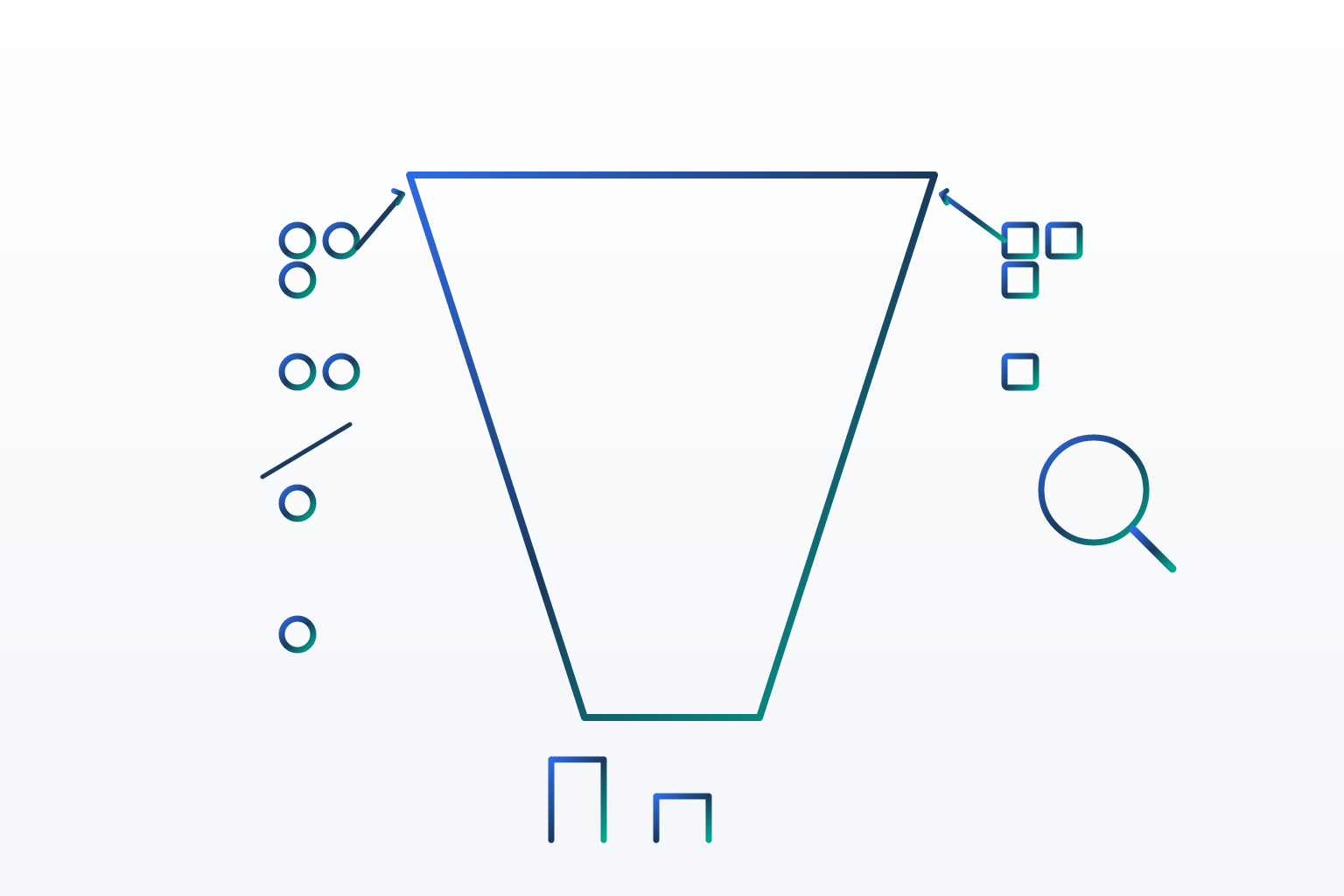
Engineering hiring is not a generic employment screening problem. Engineering funnels run long, have many stages, and rely on tools, so disparity can enter at many points before any human sees a candidate. The testing methods that detect and correct that bias must match each stage where it can enter, from keyword filters to AI-driven ranking models. This article walks through the core approaches and how to apply them together.
Why engineering hiring funnels are a distinct legal and technical problem
A typical engineering funnel runs through keyword filtering of résumés, GPA and school-prestige thresholds, automated ranking, technical screens, and final-round interviews. Under Title VII and the Uniform Guidelines on Employee Selection Procedures (UGESP, 1978), each of these gates is a separate selection procedure. Each one can carry its own liability.
That structural fact separates engineering hiring from most other employment contexts. In a shorter funnel, a single review point concentrates the risk. A small disparity at résumé review, another at the automated rank, and another at the technical screen can compound into a large aggregate gap even when no single gate looks alarming in isolation.
A newer and underexamined pathway is the sourcing pool itself. If you recruit from a single referral network, university list, or professional community, the demographic mix narrows before any screening tool runs. By the time the first filter executes, the applicant population may already be skewed in ways that downstream testing cannot detect from funnel-internal data alone.
The legal responsibility compounds the technical challenge. If you delegate to a third-party ATS or AI screening product, statutory liability does not transfer. The engineering team does not escape the problem by buying software. It inherits the problem the software encodes.
How disparate impact enters engineering funnels at each stage
The mechanisms of disparate impact in engineering hiring follow three documented pathways: biased training data that reflects historical discrimination, proxy variables that correlate with protected characteristics, and feedback loops that perpetuate existing workforce composition. These mechanisms do not distribute evenly across the funnel. Each stage offers a different surface for them to operate on.
Résumé filtering is the most direct case. Keyword filters, GPA cutoffs, and top-school lists all carry well-documented disparate impact risk because they are facially neutral requirements that exclude applicants at rates that differ by protected class. The announcement changed. The filter did not.
Automated scoring and ranking introduces a different failure mode. Thresholding is a particular pressure point. A small change in cutoff scores or top-candidate ranking order can reshape selection-rate gaps dramatically across protected groups.
Technical interviews carry their own documented risks. Screens like competitive coding challenges carry an underexamined disparate impact risk because the willingness-to-grind proxy they measure may not be demographically neutral. Untrained interviewers are a primary vehicle for affinity bias and halo effects, both documented disparate impact mechanisms.
AI-powered screening tools cut across all of these stages. The Mobley v. A federal judge ruled that Workday must face class-action claims alleging its AI screening software discriminated against Black applicants, women, and older workers, so it is the first broad algorithmic-hiring class action to proceed. The direction of litigation is now visible.
The legal baseline: what the four-fifths rule actually measures and where it falls short
The four-fifths rule is the federal triage instrument, not a verdict. It identifies which selection procedures warrant investigation, not whether discrimination occurred. Understanding that distinction is the foundation of any serious compliance program.
As codified in the Uniform Guidelines on Employee Selection Procedures (UGESP, 1978), a selection rate for any protected group that is less than four-fifths of the rate for the highest-selecting group is regarded by federal enforcement agencies as evidence of adverse impact. Divide each other group's rate by that highest rate. Any ratio below 0.80 flags adverse impact for investigation.
Once adverse impact is flagged, the employer faces three options. It can demonstrate that the selection procedure is job-related and consistent with business necessity. It can identify an equally valid alternative that produces less adverse impact. Or it can modify the procedure. There is no fourth option that involves ignoring the result.
The rule's limits matter as much as its mechanics, particularly in engineering contexts. The four-fifths rule is a ratio applied to aggregate outcomes. The ratio is a screen, not a defense.
Supplementing the four-fifths rule with statistical significance tests
Statistical significance testing tells you whether an observed gap in selection rates is a real disparity or just chance variation. A ratio below 0.80 could be a meaningful signal. It could also be noise from a small sample. The legal position differs sharply between the two cases.
An employer whose selection procedure produces a ratio just below 0.80 with a non-significant test is in a very different legal position than one with a ratio well below 0.80 and a highly significant result. Courts evaluate both. The ratio establishes that a threshold was crossed. The test establishes whether the crossing is worth taking seriously.
Choosing between the two main tests depends on the data conditions. The Z-test for proportions applies to large samples, generally at least 30 applicants per group, and produces a p-value indicating whether the difference in selection rates exceeds what chance would predict. Fisher's Exact Test applies to small samples where at least one expected cell count is below 5. It requires no normality assumption but is computationally more intensive. Engineering hiring pipelines with niche role categories often fall into the small-sample regime, so Fisher's Exact Test is the appropriate default for many stage-level analyses.
Effect-size analysis adds a third layer. The correction prevents flagging spurious disparities when many comparisons are run at once. It is a refinement, but for teams running automated audits it is the difference between a report that finds real problems and one that drowns in false positives.
Per-stage funnel analysis: the step most teams skip
A hiring funnel can produce a tolerable aggregate four-fifths ratio while one gate creates a serious and legally actionable disparity. Aggregate measurement alone will not find it. This is the most common failure mode in practice: teams check the overall hire rate, see an acceptable number, and stop.
The correct method is to analyze each gate in sequence, application review, automated rank or phone screen, hiring-manager interview, technical assessment, and offer, computing group-specific selection rates at each transition rather than only at the beginning and end of the funnel. A stage-level gap can violate the law even if the overall four-fifths ratio is met. The stage-level result governs liability for that selection procedure, regardless of what the aggregate shows.
Implementation requires disciplined record-keeping. Where data is thin at a given stage, Fisher's Exact Test is the appropriate choice. Flag any stage where a gap appears even if the aggregate funnel ratio passes.
Record-keeping is a compliance requirement, not just a good practice. The absence of data is itself an exposure. Fairness must be evaluated as a deployment property across the full hiring workflow, from sourcing through selection, not only as an aggregate accuracy check before launch.
Counterfactual auditing: testing individual decisions rather than group averages
Counterfactual auditing moves the unit of analysis from group selection rates to individual decisions. It asks whether a specific applicant's outcome would have changed if their protected-characteristic signals had been different. This is the most technically sophisticated method in the stack, and it is particularly suited to auditing AI-driven screening tools where the decision logic is opaque.
A general, reusable methodology for counterfactual bias testing in application-tracking systems uses a chain of task-specialized LLM agents to synthesize identity-neutral base résumés and inject controlled demographic treatments across five protected-characteristic axes: sex and gender, age, place of residence, language, and disability signal. The result is a correspondence-audit-style matrix of base candidates and bias variants that can be run at the rate AI-driven pipelines are retrained and redeployed. The method scores each applicant against a job description using a semantic ranking model, then measures the score shift and rank change when only the demographic treatment varies. Decisions where the shift crosses a decision threshold get flagged as biased.
The nine-metric fairness suite the methodology computes spans three families. For counterfactual metrics, look at score delta, mean absolute rank change, and flip rate. For group-fairness metrics, look at top-K retention and the four-fifths rule or impact ratio. Merit-aware metrics include Recall@K, nDCG@K, equal opportunity, and equalized odds. Together they connect individual-level findings to the group-level metrics regulators and courts recognize in a compliance-grade audit report.
What counterfactual auditing reveals is precisely what group-level testing misses. The aggregate masks the mechanism. Mean absolute rank change can surface bias that score-delta and top-K retention miss, because where a candidate ranks matters even when their score stays below a threshold.
The critical limitation is the most counterintuitive finding. The LLM-agent approach automates résumé synthesis while preserving controlled variation. It finds more, faster, but it does not fix everything.
Why a model that passes pre-launch validation can produce disparate impact in production
A hiring model's fairness in validation does not guarantee fairness in production. The conditions that determine outcomes shift after launch in ways the test set cannot anticipate. Every team that has run a thorough audit knows the scenario: the model passed every test. Then production behaves differently.
Offline testing typically uses historical records and simplified assumptions. Four specific post-launch mechanisms produce disparate impact. Feedback loops are the first. When the model learns from past hires, it reinforces features correlated with prior selection, school prestige, geography, referral origin, that were demographically skewed to begin with. Distribution drift is the second. The applicant pool changes as labor markets move and job requirements evolve, and a model tuned on one population degrades in fairness even while accuracy metrics stay stable. Threshold changes are the third. A small adjustment to cutoff scores or ranking rules, often made for cost or speed reasons, can reshape selection-rate gaps dramatically across protected groups. Human override patterns are the fourth. When recruiters override model outputs inconsistently, the human layer can amplify bias that was not visible in offline evaluation.
If teams chase cost savings, they push toward speed, narrower screening, or cheaper sourcing channels, and candidate reach shrinks. Expect more information requests about the statistical impact of your screening policies. The monitoring record itself becomes evidence, and the absence of monitoring is its own exposure.
The current enforcement environment: where federal pullback meets persistent private liability
The federal enforcement posture has changed, but the underlying law has not. Practical liability for employers using AI screening tools has shifted toward private litigation and state-level enforcement, but it has not disappeared. That shift is the single most important fact about the 2026 compliance landscape.
The changes at the federal level are specific and documented. In 2025, after Andrea Lucas became Acting Chair, the EEOC removed its AI technical-assistance documents from its website early that year. In June 2026 the agency formally rescinded its prior Strategic Enforcement Plan, replacing it with a new National Enforcement Plan. The AI and Algorithmic Fairness Initiative the agency launched in October 2021 has effectively wound down.
What did not change matters more. Title VII's disparate-impact provisions are codified by statute and remain fully enforceable. Mobley v. In 2026 a federal judge ruled that Workday must face discrimination claims alleging its AI-powered screening software discriminated against Black applicants, older workers, and disabled applicants, though full class certification remained pending as of 2026. It is the first broad algorithmic-hiring class action to proceed.
Enforcement in 2026 and beyond is looking at algorithmic screening tools that use protected-class-correlated data, vendor compliance accountability, and intersectional discrimination theories. State law creates a parallel compliance layer. Many state agencies have adopted guidance that mirrors or exceeds EEOC standards, so one charge can trigger federal and state investigations at the same time under worksharing agreements.
The strategic implication is direct. The testing methods described in this article are not compliance theater for a federal agency that has stepped back. They are the evidence base for defending against private plaintiffs and state regulators who have not.
Applying the methods together: a stage-by-stage testing framework for engineering teams
No single testing method is sufficient on its own. The four-fifths rule, significance testing, per-stage funnel analysis, and counterfactual auditing address different failure modes and must work as a layered system. Each has a specific position in the funnel.
Stage one is résumé and keyword filtering. Audit the keyword list and credential requirements for proxies that correlate with protected characteristics. Degree requirements, school names, and gap-flagging logic are the primary targets. If your sample is thin, use Fisher's Exact Test, not the Z-test.
Stage two is automated scoring and ranking. If you test across multiple demographic variants at once, apply a false-discovery-rate correction. Repeat this audit every time the model is retrained or redeployed, not just at launch.
Stage three is technical interviews and assessments. Compute stage-level selection rates by protected group for each interview round separately. Do not fold them into the aggregate funnel. Track how each interviewer decides, so you can catch inconsistent override behavior that amplifies bias from the model.
Stage four is ongoing production monitoring. Set selection-rate monitoring by protected class as a live control function, not a periodic audit. Maintain stage-level selection records continuously, because the absence of records is itself an enforcement liability.
Teams that lack the internal infrastructure to run this stack consistently are candidates for augmenting with engineers who combine AI fluency with compliance-grade testing expertise. The ability to build, audit, and monitor automated selection systems is now a baseline engineering competency, not a specialized niche. The funnel has become part of the system, and the system is now the team's responsibility.
Sources
- Counterfactual Bias Testing for Application Tracking System
- Why can a hiring model look fair in testing but still create disparate impact in production?
- Disparate Impact - an overview
- AI for hiring in context: a perspective on overcoming the unique challenges of employment research to mitigate disparate impact