Candidate Re-Engagement Campaigns for Lapsed Technical Applicants
Lapsed technical candidates convert three times faster than cold sourcing.

Most engineering organizations sort lapsed applicants into the same bucket as candidates who never engaged at all, and that sorting is wrong. A lapsed candidate already cleared the hardest filter in the whole funnel: they chose to apply. The market makes this misclassification especially costly right now. A majority of employers say they can't fill full-time roles, yet nearly half of all applicants got ghosted by employers in 2025, a rate that's climbed for three straight years and is now a three-year high. Companies are short-staffed and simultaneously burning the exact relationships that would solve the shortage.
The fix is sitting inside the applicant tracking system already. Sourced hires rediscovered from a company's own ATS have grown substantially as a share of total hires between 2021 and 2024, making reactivation close to the highest-return recruiting move available, yet most teams still skip it in favor of net-new sourcing. That's a significant inefficiency. It's turning down a database of pre-qualified people to go pay for cold outreach instead.
Ghosting has a cost beyond the individual candidate, too. Resentment among tech candidates hit the highest level on record in 2024, and that resentment doesn't stay contained to one inbox. It moves through peer networks and Glassdoor, eroding the employer brand that makes future sourcing possible. Every ghosted applicant is a small, compounding tax on the employer brand that future sourcing depends on. Treating the lapsed pool as cold carries a cost that shows up as next year's sourcing expense, not just a missed hire. It's next year's sourcing cost, too.
How fast a lapsed candidate becomes an unreachable one
Pipeline decay in technical recruiting runs on a clock measured in days, not months, and most teams are still operating as if they have quarters to work with. Candidates get lost in that mismatch because nobody accounted for how fast the window closes.
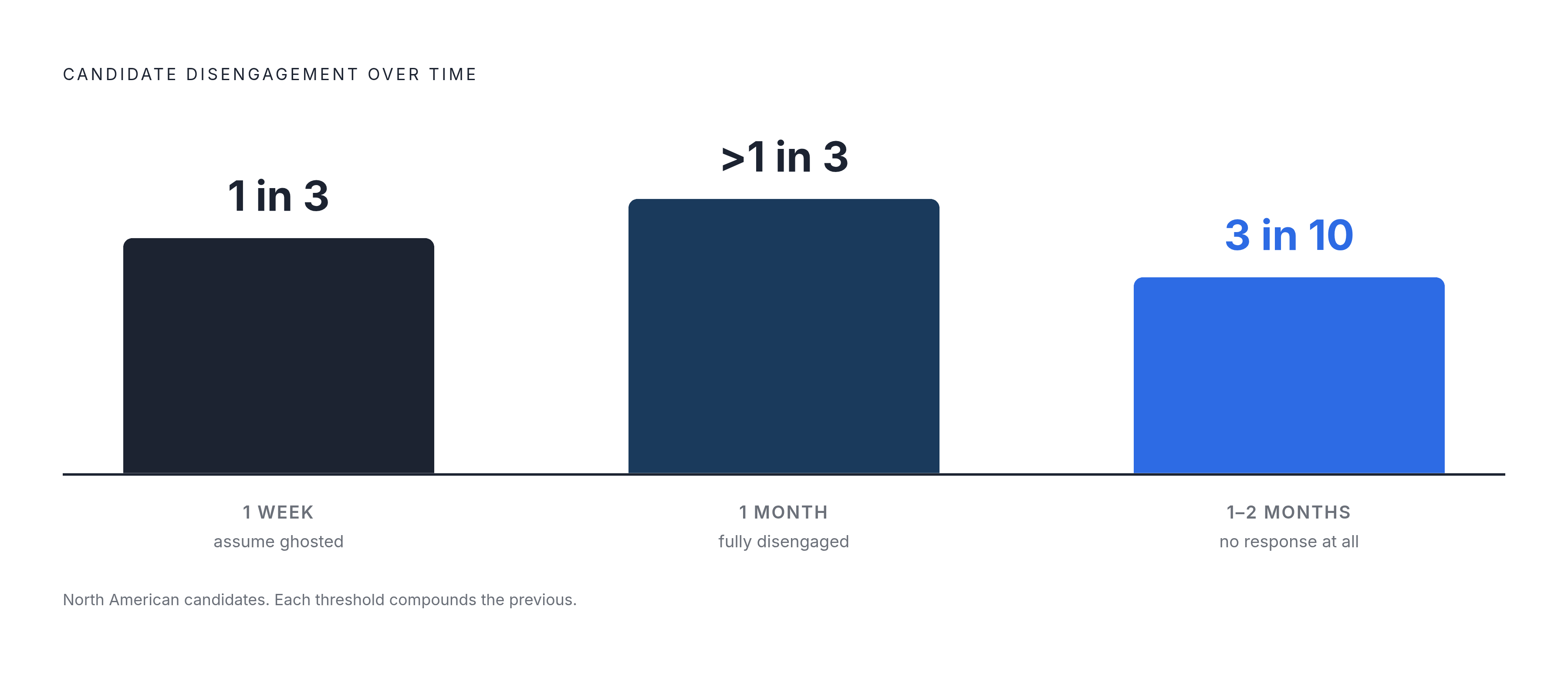
The first data point sets the pace: a third of candidates assume they've been ghosted after just one week of silence. Seven days. Not a follow-up cycle, not a sprint, a single week. From there, disengagement doesn't slow down, it compounds. More than a third of candidates fully disengage by the one-month mark, and that share has climbed noticeably year over year. By the one-to-two-month point, roughly three in ten North American candidates have received no response at all. A meaningful chunk of any given pipeline has already checked out mentally before a recruiter even opens the file to follow up.
Three specific patterns drive most of this decay: no follow-up cadence after the first contact, outreach stuck on a single channel that misses candidates who aren't sitting in their email, and generic messaging that tells the candidate, correctly, that nobody remembers who they are. For technical candidates, there's a fourth wrinkle layered on top. A meaningful share of candidates now trust employers less when they suspect AI touched their evaluation, and candidates who went cold over the past year may have partly disengaged because the process felt mechanical rather than human. Re-engagement copy that ignores this is walking into a conversation the candidate has already had an opinion about.
The same decay curve that destroys a pipeline is also a map. If a third of candidates give up after one week, and disengagement snowballs by week four, then the sequencing of a re-engagement campaign is a strategic necessity. It's a race against a clock that's already running.
Why late-stage engineers are a categorically different target
Not every lapsed candidate deserves the same amount of effort. The engineer who made it to stage two or beyond in a technical loop has already cleared something almost impossible to fake or shortcut: structured assessment of how they actually think through a system under pressure.
That distinction deserves close attention. A strong engineer can pick up a new CI/CD tool in a few weeks. Systems thinking, the instinct for debugging a distributed system mid-incident, the judgment to design infrastructure that scales instead of just running in a demo, takes years to build and can't be crammed into an onboarding sprint. Cold sourcing filtered through resume keywords never captures that. A silver-medalist pool does, because someone already tested it.
The numbers back up treating this group differently. Silver medalists hire at roughly three times the rate of cold candidates, and that conversion gap alone justifies building a separate campaign for them rather than folding them into general re-engagement. The trigger window matters just as much as the targeting: effective silver-medalist campaigns reach out within the first few months after rejection, filtered specifically to candidates who reached stage two or later and opted into a talent community, with messaging that names the original role by title instead of asking a generic "still looking?". Skipping that filter and specificity makes the campaign read like every other piece of recruiting spam the candidate already ignores.
There's a newer wrinkle for 2026 loops specifically. AI coding assistants now require engineers who can validate the output, reason through system trade-offs, and own production quality when something breaks, so deep interview loops increasingly assess AI judgment, not just tool familiarity. A candidate who cleared that bar has a proven skill that's getting harder to source blind, and that alone makes them worth more outreach effort than someone who's never been evaluated.
What structurally breaks most re-engagement attempts before they start
Bad subject lines aren't the problem.
Cold recruiting email reply rates have fallen to five to seven percent, and that's a ceiling built into the channel itself, not something a better opening line fixes. Yet the data on persistence tells a different story than most recruiters act on: a fifth-touch follow-up produces a cumulative reply rate above twenty percent, compared to roughly eight percent off the first touch alone. A third of candidates assume they've been ghosted after just one week of silence, not a month, not two weeks, seven days. It's giving up on most of the pipeline that was still reachable.
Scheduling is the second leak, and it's arguably the most avoidable one in the entire funnel. A substantial share of candidates withdraw from a process purely because getting time on a calendar took too long.
Layered under both of these is something newer: near-universal adoption of AI across business functions has taught candidates, technical ones included, to expect less from the process before it even starts. They disengage faster the moment something feels automated or impersonal. A meaningful share worry AI will misread their application outright, and a significant share say they trust an employer less once they suspect AI touched the evaluation. That's a real cost, but it's also an opening: campaigns that explicitly signal a human reviewed this specific candidate, by name, by role, by history, are working against a backdrop where most competitors haven't bothered to make that signal visible.
Sequencing a re-engagement campaign across channels and time
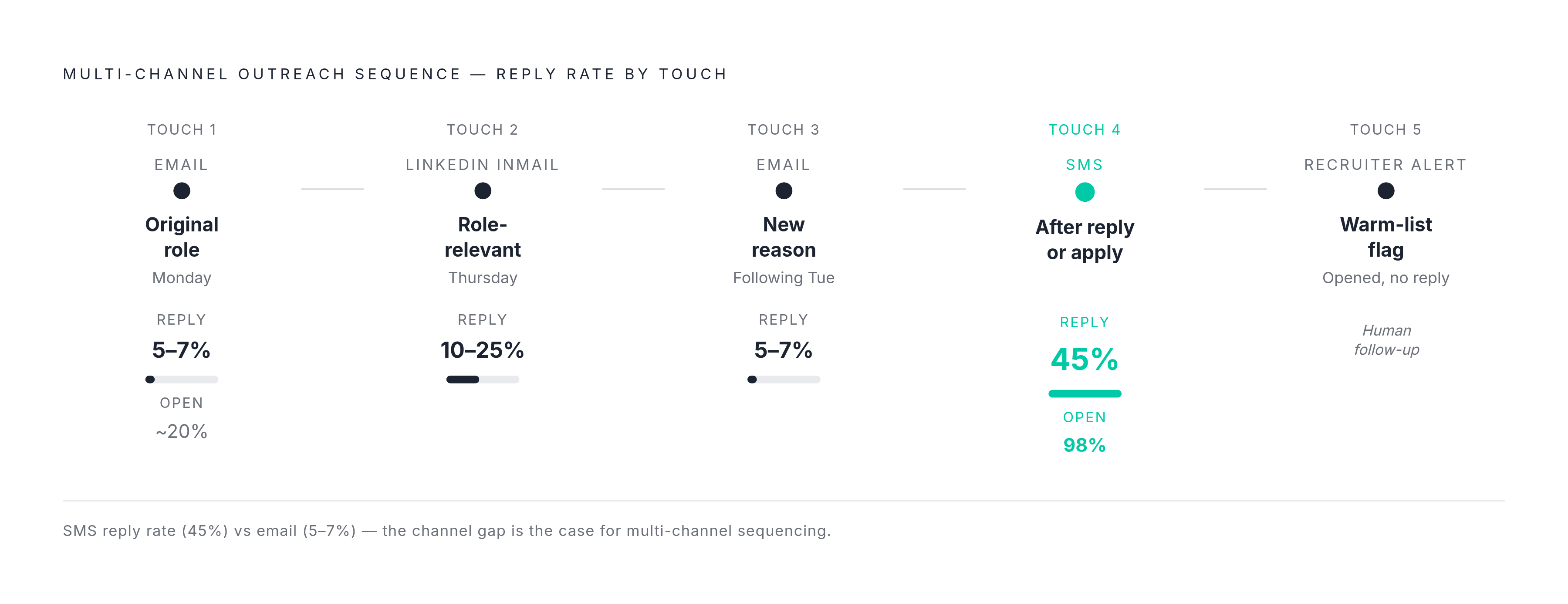
A campaign built to actually recover lapsed technical candidates needs, at minimum, five touches spread across at least three channels over multiple business days. Anything shorter than that structurally leaves reachable pipeline on the table.
The channel math explains why. Cold email alone runs five to seven percent reply, about twenty percent open, with responses typically landing within a couple of hours when they come at all. LinkedIn InMail performs meaningfully better, in the ten to twenty-five percent reply range. SMS outperforms both by a wide margin: forty-five percent reply, ninety-eight percent open, and replies often arrive within minutes.
A workable sequence looks something like this. Monday: an email that names the original role by title, references the candidate's specific background, and includes one concrete update about the team, not a vague "still interested?" note. Thursday: a short LinkedIn message, role-relevant, no attachment, no pitch deck. The following Tuesday, a second email carries a specific reason to reopen the conversation, a new team structure, a different kind of project, or a changed tech stack. SMS comes next, but only once the candidate has already replied or applied somewhere in the sequence, because permission and prior context are what separate a forty-five percent reply rate from a message that reads as a stranger texting out of nowhere. The final touch is a warm-list alert to a human recruiter if the candidate opened messages but never replied. The system flags the signal; a person closes it.
For candidates who went quiet out of friction rather than genuine disinterest, short check-ins built to get a simple yes or no beat a long-form email almost every time, something like: "Hi [name], still open to [role type], or have priorities shifted?". And once a candidate says yes to anything, scheduling has to be instant, a self-booking link sent the moment they reply, because a round of "does Tuesday work" emails undoes the momentum the sequence just built.
The payoff appears in time-to-fill. Teams that keep a consistent cadence with their pipeline fill roles significantly faster than teams that cold-source every open requisition from scratch, and the gap between them runs four to six weeks. That gap is the entire argument for running the system properly instead of improvising it. Multi-channel campaigns combining three or more channels can achieve up to roughly fifteen percent combined reply rate, with studies on a large volume of outreach attempts showing up to two hundred eighty-seven percent more responses than single-channel email alone (Expandi).
Personalization at scale for a technical candidate audience
The usual objection is that real personalization doesn't scale, so recruiters default to generic templates, and that default trains candidates to stop opening recruiter emails.
Personalization for a technical audience was never about inserting a first name into a template. It's about proving the recruiter knows what the candidate actually built, where in the process they stopped, and what's changed since then. Three signals do most of the work: naming the original role by title so the message reads as specific rather than bulk, citing a concrete update about the team or the engineering environment (a new toolchain, a restructured team, a project that lines up with what the candidate said they cared about), and acknowledging that AI-native workflows are now part of daily practice. That last one matters more than it looks. An engineer who applied over a year ago applied to a company that worked differently than it does now, and naming that shift honestly gives them a real reason to look again.
This is where AI tooling actually earns its place in the process, rather than becoming the thing candidates distrust. AI agents can scan historical candidate data and generate outreach that references a candidate's specific background, surfaces a role that actually matches, and starts a real conversation over SMS or email, all before a recruiter has to touch it. The recruiter's time gets spent where it should: at the point a candidate responds, not at the point of drafting the fortieth cold message of the week.
Predictive availability scoring extends that logic further. By reading patterns like average tenure in a given role type, seasonal hiring cycles, and recent profile activity, a system can flag which candidates are likely approaching a transition window, so recruiter attention goes to the highest-probability segment instead of getting spread evenly across a database where most people aren't currently looking. Segmentation into three tiers, warm prospects, passive-interest candidates, and cold re-engagement targets, keeps cadence and message tone matched to how close someone actually is to saying yes. Treating a VP-level finalist the same as a junior applicant to a req that's since closed wastes time on both sides of the conversation.
None of this requires every touchpoint to be a job pitch, either. Sending curated, genuinely useful content, tooling updates, shifts in engineering practice, compensation data, keeps a technical candidate database warm between active hiring cycles without asking anything of the person receiving it. That's a relationship.
ATS automation tasks at each stage of the re-engagement funnel
None of the sequencing or personalization above survives a hiring surge if it depends on a recruiter remembering to send the third touch by hand. Automation is the condition that makes the campaign repeatable, not a convenience layered on top of it.
There's a defined structure for this already: nine automated email campaigns that a modern ATS should run, each mapped to a specific pipeline stage, each with its own trigger, sequence length, and measurable effect on how fast roles get filled and how candidates rate the experience. The first one is the simplest and most revealing. Application acknowledgment fires the moment someone submits, ideally within five minutes, and candidates consistently rank that kind of prompt, timely communication as the single biggest factor in how they judge the whole application experience. A missing or delayed acknowledgment tells a candidate the organization is disorganized before a recruiter has said a single word to them.
The pattern that carries through the rest of the funnel is to automate the predictable, timed, high-volume moments, and reserve human judgment for the moments that actually require it, a candidate who replied, a silver medalist reapproaching a familiar door, a scheduling link sent the second someone says yes. The infrastructure doesn't replace the recruiter. It clears the repetitive work off their desk so the specific, high-value conversations, the ones a lapsed technical candidate actually notices and remembers, get the attention they were always supposed to get.
Sources
- 10 ways to re-engage disengaged candidates | Globus.ai
- Candidate Nurturing: Keep Your Talent Pipeline Warm (2026) - Pin
- 9 Automated Email Campaigns for ATS in 2026
- Candidate Engagement: A Complete Guide - Recruiterflow Blog
- Candidate Reengagement Text Strategies To Revive Your Talent
- Candidate Re-Engagement Campaigns: How to Turn Silver Medalists into Future Hires
- Candidate Engagement Guide: Strategies, Models & Best Practices (2026)