Build-Versus-Buy Talent Decisions for Engineering Teams Scaling Rapidly
Talent strategy requires mixing permanent hires, internal development, and contingent specialists.
Nearly 76% of employers worldwide say they can't find the skilled technical workers they need 5 Ways to Build Engineering Teams Without Traditional Hiring. That single number explains more about the current state of engineering hiring than most strategy decks manage to. The traditional model, post a job, screen for weeks, interview across several rounds, extend an offer, wait for a notice period, runs 30 to 70 days from posting to placement, and often longer before that hire is actually producing at full speed Codebrand Blog. For a company trying to ship a product before a competitor does, that timeline isn't just slow. It's structurally incompatible with how fast markets move now.
The cost side makes the problem worse, not better. Labor costs already eat more than 70% of corporate expenses at most companies, and engineering salaries are typically the largest single line item on that sheet 5 Ways to Build Engineering Teams Without Traditional Hiring. Committing a permanent salary to a skill the roadmap might only need for 18 months isn't a hiring decision anymore. It's a balance-sheet bet, and a compounding one, since severance, benefits, and opportunity cost don't disappear just because the project wound down early 5 Ways to Build Engineering Teams Without Traditional Hiring.
Demand isn't slowing down to make this easier. Gartner's July 2026 forecast puts worldwide IT spending at $6.37 trillion for the year, a 14.2% jump from 2025 IDP Build vs. Buy: The 2026 Calculus for Engineering Teams. If current trends hold, the global talent shortfall could reach 85 million workers by 2030, and 84% of executives already say they're uneasy about their current technical staffing levels IDP Build vs. Buy: The 2026 Calculus for Engineering Teams Codebrand Blog. No domestic pipeline, however well-funded, absorbs that kind of growth on its own IDP Build vs. Buy: The 2026 Calculus for Engineering Teams.
Put those pieces together and the conclusion isn't subtle: the conditions that once made "post a job, interview locally, onboard over a quarter" a viable strategy simply don't exist anymore. This calls for a different way of thinking about where talent comes from, not a tweak to the same playbook.
Why the build-vs-buy binary framing fails for talent
Software organizations already stopped treating build-vs-buy as a two-option question. Zylo's 2026 analysis on software decisions describes a three-path structure, build, buy, or buy-and-extend, and that same structure maps directly onto how engineering leaders should think about talent.
Translated into headcount terms, the three paths look like this: build means developing an internal bench, training existing staff and investing in learning and development for roles tied to proprietary systems and long-term architecture. Buy means direct hire, bringing in permanent employees for senior roles where lasting capability actually matters, think AI/platform leads or architects. The third path, call it embed, means sourcing contingent or augmented engineers for work that's time-bound, evolving, or narrowly specialized.
Artech's June 2026 guide to engineering team design argues that effective AI workforce planning follows exactly this build-buy-embed logic, treating the project roadmap and skills taxonomy as planning inputs rather than a headcount spreadsheet to fill. Forrester's US Tech Labor Market report, cited in that same Artech piece, states it almost bluntly: today's hiring environment rewards a deliberate talent strategy and penalizes reactive hiring decisions.
The build case is real. A Lightcast and Guild webinar found that manufacturers spend more than $10 billion a year hiring talent they could have developed internally instead. But executing on that requires real-time labor market signals and a genuine commitment to development, not a hope that training will happen organically. The same logic holds for software engineering organizations.
The binary framing fails for a simple reason: it forces a false either/or onto a workforce that actually needs all three paths running at once, allocated by the type of work in front of the team. Architecture, governance, and IP-critical systems belong with permanent staff. Feature delivery and sprint-based platform work often fit better with managed delivery pods. Niche AI or cloud skills, and sudden demand spikes, are exactly what contingent specialists exist for. Early-stage proof-of-concept work often does best with a hybrid of onsite staff and specialized remote talent.
McKinsey's State of Organizations 2026 research, drawing on more than 10,000 executives and cited by Artech, found that only around 6% of organizations qualify as genuine AI high performers, and the differentiator wasn't the tools they bought. It was how their teams were designed and led. That's the real argument against the binary: structure beats philosophy, every time.
The four levers that determine which path fits a given scaling moment
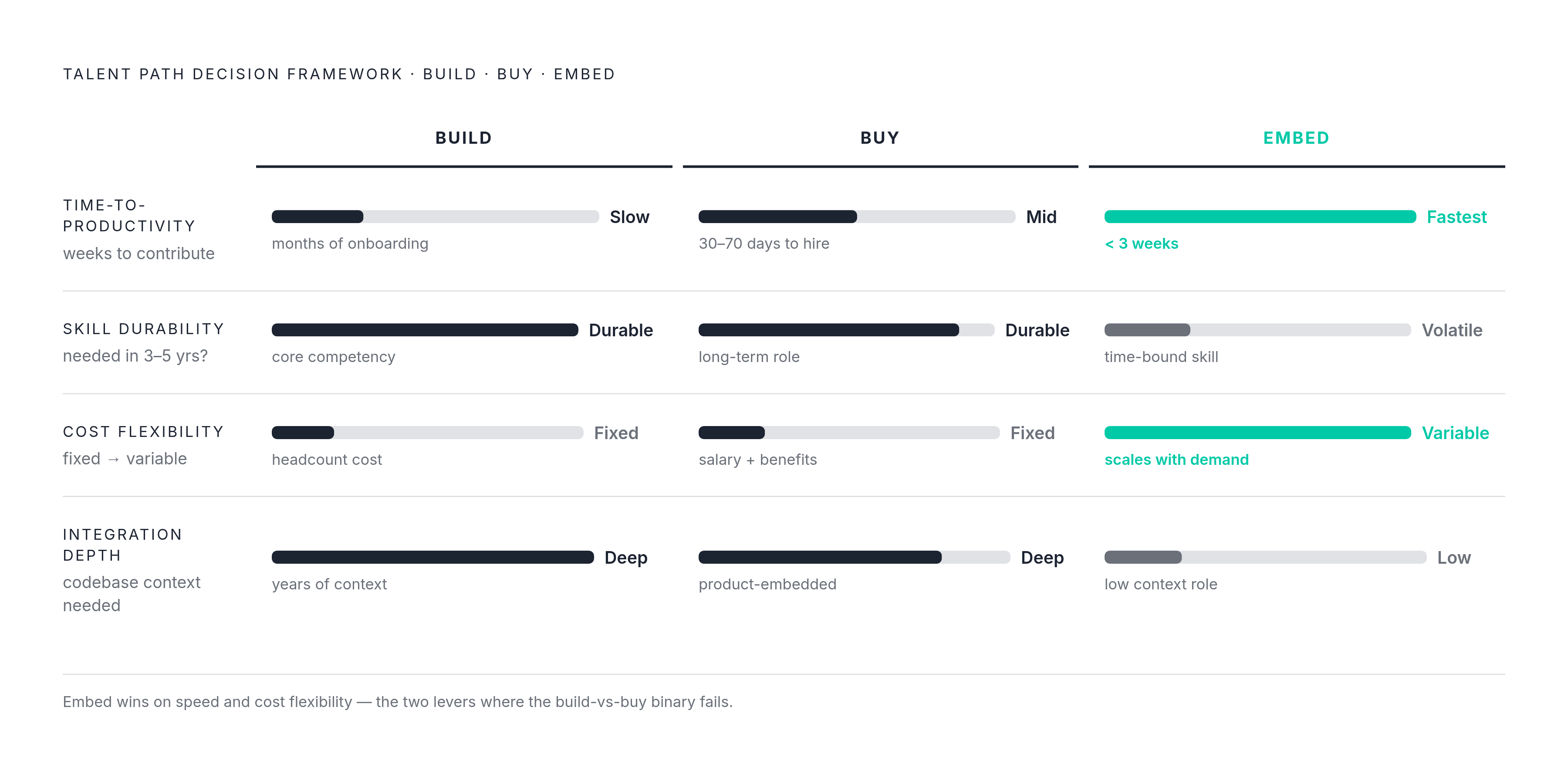
Four variables determine which path actually fits a given moment, and none of them are about ideology.
Time-to-productivity comes first. How fast does the team need output on the board?
McKinsey's organizational research, cited by Artech, found that two-thirds of required engineering skills will look fundamentally different within five years, with durable roles favoring the build or buy path and volatile skills favoring embed. Durable, foundational roles justify the time and expense of build or buy. Volatile ones, the skills likely to be obsolete or transformed by the next tooling shift, favor the embed model instead.
Cost flexibility is the third, and it's mostly an arithmetic problem. With labor costs above 70% of total expenses at most companies, locking permanent headcount against a time-bound need carries real balance-sheet risk. Embedded and augmented models convert that fixed cost into a variable one, which matters enormously when a roadmap can shift in a single planning cycle.
Team integration is the fourth lever, and it's the one leaders underweight most often. How much context does a role actually demand? The longer an engineer sits inside a codebase, working with the same product managers and customers, the more valuable that person becomes, and roles built on that kind of accumulated knowledge are structurally poor fits for rotating augmented talent.
Getting this analysis right pays off in measurable terms. Amplifyit.io's IDP analysis found that applying a deliberate framework enables a CTO to reallocate 20–30% of engineering resources from undifferentiated infrastructure work to core product development within 12 months, the payoff for getting the lever analysis right. Deloitte's 2026 Global Human Capital Trends found that organizations leading in workforce adaptability are 2.4× more likely to report stronger financial results, Artech reports, though only 7% of surveyed organizations are leading in this area.
None of this is about a philosophy of ownership. It's about matching four concrete variables, speed, durability, cost structure, and integration depth, to whatever moment the company is actually in. Staff augmentation can place a senior engineer in under 3 weeks vs. 30–70 days for traditional hiring, with build-from-within running longer still Codebrand Blog 5 Ways to Build Engineering Teams Without Traditional Hiring. Skill durability asks whether this skill will be needed in 3–5 years.
The conditions and requirements for building internal talent
Build is the right call for roles tied to proprietary systems, long-term architecture ownership, and genuinely IP-critical work, the positions where institutional memory compounds year over year rather than depreciating. These are not roles to source opportunistically. They're roles to grow deliberately.
But growing them deliberately is harder than it sounds. The Lightcast and Guild framing is direct: shifting from pure hiring toward building talent internally requires real-time labor market signals and sustained investment in learning and development. It is not the cheap option. It's a different kind of strategic spend, one that appears on a different line of the budget and pays off on a longer timeline.
Safari Solutions, writing in October 2025, frames the fit conditions: build works for organizations with longer time horizons, a tolerance for ramp-up time, and a culture actually capable of developing and retaining people. Strip out any one of those conditions and build stops being an investment. It becomes a sunk cost.
The risk that skills won't stay durable compounds the risk. If two-thirds of the skills an organization needs will look fundamentally different within five years, pouring resources into training programs built around today's skill set is its own quiet form of waste. Amplifyit.io calls out a related failure mode, "Not Invented Here" syndrome, where organizations overestimate their own capacity for long-term maintenance and underrate what's already available externally. That bias applies just as much to talent development programs as it does to software.
Build programs also fail for a more mundane reason: the organization never built a structured capability framework to run them against. Fragmented, inconsistent assessments produce noise, not signal, and noise doesn't tell a manager whether an engineer is actually progressing. Name the conditions where build genuinely works, longer horizons, retention culture, a real framework, and it becomes obvious how often those conditions simply aren't present. That gap is exactly where augmentation earns its place.
The structural fit of staff augmentation
Staff augmentation, defined precisely, means engineers who work under the client's own management, inside the client's own tools and workflows, while an outside provider handles sourcing, vetting, payroll, and compliance. Control stays with the client. That's the detail that separates it from outsourcing, and it's the detail most comparisons skip past.
The market has already made its verdict clear. Numbers moving in that range aren't describing a passing trend. They're describing a structural shift in how engineering capacity gets sourced.
The delivery case is concrete. That's not a marginal efficiency gain. It changes what a team can commit to on a given quarter's roadmap.
2026 changed what augmentation actually delivers, too IDP Build vs. Buy: The 2026 Calculus for Engineering Teams. HatchWorks' staff augmentation guide describes an AI-native shift: the right engagement now hands over not just a skilled engineer, but the AI-native working methods that engineer operates under, habits that transfer to the permanent team once the contract ends. That resets the value calculus. A well-run augmentation engagement leaves something behind after the invoice stops.
None of that erases the model's real limits, and these aren't soft caveats, they're structural facts that determine fit. Rotating developers throw away the compounding value of deep codebase familiarity, so work that depends on years of accumulated customer, data, and product context is a poor match for augmentation by design. Augmentation solves a capacity problem. It cannot fix an unclear product strategy, weak engineering leadership, or a team that genuinely can't absorb new people fast enough to be useful. Gallup's research found that a healthy manager span of control is 5–6 direct reports, with most scaling failures tracing to one lead quietly managing 12 or more.
Scale changes the model's behavior, too. What works cleanly at three augmented engineers tends to break at ten, and breaks again at twenty-five, because the management structure underneath them doesn't keep pace even as the engineers themselves don't change. A dedicated team model fits better than augmentation when the goal is standing up a genuinely new capability without existing internal engineering leadership to guide it. The two approaches aren't mutually exclusive, either: plenty of teams run augmented engineers inside the core team while running a separate dedicated pod for a distinct workstream. One estimate values the global IT staff augmentation market at USD 383.5 billion in 2025, projected to USD 434.1 billion in 2026 at a 13.2% CAGR, while Verified Market Reports projects over $200 billion by 2033 growing at 7.5% annually, signaling a structural shift, not a trend. The core delivery advantage is placement in under 3 weeks vs. 30–70 days for traditional hiring, with companies using augmentation reducing overhead by approximately 40% compared to traditional hiring by cutting benefits, office space, and long-term training costs Offshore Software Development: Enterprise Guide 2025....
Sourcing the augmented talent: how onshore, nearshore, and offshore models compare on total cost of ownership
Rate sheets are the first thing most buyers look at, and also the most misleading.
Rate comparisons alone mislead because the two variables that actually decide whether a sourcing model succeeds are total cost of ownership and hours of real overlap, not the headline hourly number. Total cost of outsourcing also has to account for recruitment, retention, HR, and payroll and benefits administration, which adds another 15 to 20% on top of the base rate when those functions are managed separately Software Dev Cost Guide Engineering Team Design in 2026: How Talent Strategies Are Changing -….
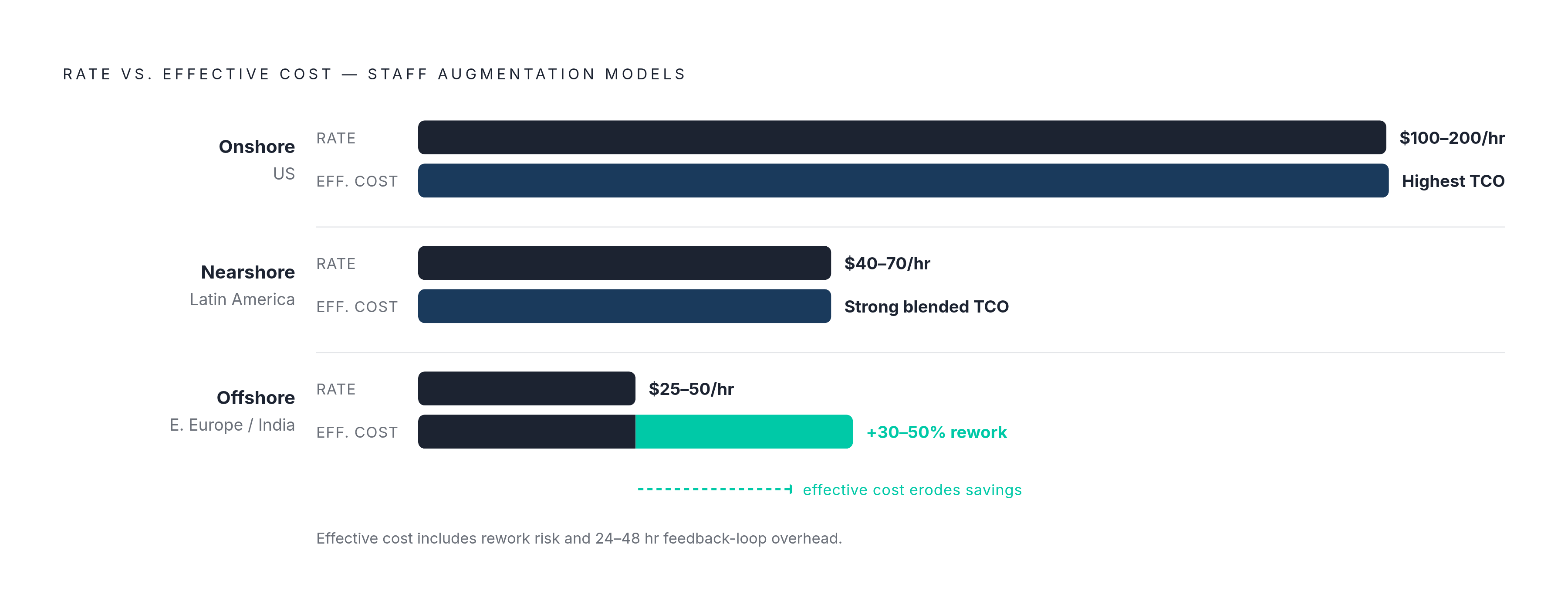
Fit matters more than price. Onshore makes sense for strict compliance environments, sensitive data handling, and constant real-time work with executives or customers, and it carries the highest total cost of ownership as a result. A bayone.com cost-benefit analysis from 2026 found that nearshore fits iterative, customer-facing product development that needs agile collaboration without meaningful lag, and delivers a strong blended total cost of ownership for most US companies building in 2026. Offshore is well-suited to large-scale modernization projects, clearly scoped work, and niche expertise delivered at scale, though its cost advantage narrows, and can reverse, when requirements are genuinely unclear or the work demands unscripted contact with customers or executives. Once you count 30–50% rework, 24–48 hour feedback loops, and the management overhead they generate, the effective cost of deep offshore often approaches nearshore (and sometimes onshore) for anything requiring real collaboration Build vs Buy Software: Pros and Cons, Costs, and How to Decide (2026). Latin America's rapidly maturing engineering education base, English fluency, and timezone alignment have narrowed the cost gap with offshore while preserving the collaboration advantage, making the region an underutilized and genuinely world-class source of technical talent.
The market is already moving toward blending these models rather than picking one. Tholons' 2025 Top 10 GCC/GBS Trends Report projects that half of companies will adopt hybrid sourcing models incorporating nearshoring by the end of 2026, and the Inter-American Development Bank projects nearshore outsourcing will add another $78 billion to Latin American and Caribbean exports beyond 2025 Build vs Buy Software: Pros and Cons, Costs, and How to Decide (2026). It's an underused, genuinely world-class source of technical talent, and the trend data suggests more companies are catching on. Offshore Eastern Europe/India rates run $25–$50/hour, with an average monthly rate of $3,000–$5,500 Software Dev Cost Guide. For context, Glassdoor (May 2026) puts the Senior Software Engineer total pay range in the US at $164,000–$259,000/year, averaging $204,540 Offshore Software Development: Enterprise Guide 2025....
The sourcing decision should be normalized to total cost of ownership before a contract gets signed, not after the first missed deadline. A lower offshore rate paired with meaningful schedule slip and extra project management overhead can end up costing more than a nearshore blended rate looks like on paper. Run that comparison up front. It's cheaper than learning it the hard way. Onshore US rates run $100–$200/hour, with full working-day overlap. Nearshore Latin America rates run $40–$70/hour, with 7–8 hours of real overlap with the US Eastern business day and an average monthly rate of $4,000–$7,000 Software Dev Cost Guide Offshore Software Development: Enterprise Guide 2025....
The governance layer that most scaling teams skip and later regret
Sourcing engineers and governing an engineering workforce are not the same discipline, and conflating them is where a lot of hybrid models quietly fall apart.
Architecture ownership comes first: clear boundaries on exactly what external engineers can and cannot touch, because ambiguity here is precisely where security and IP risk occurs. Performance metrics matter next, measuring delivery throughput, time-to-impact, and defect rates rather than settling for a simpler, weaker signal like fill rate or raw headcount. Spend visibility is the third pillar: a consolidated view across contingent, project-based, and full-time engineering costs, without which a hybrid model's true cost turns opaque fast and stays that way. Compliance and security controls round out the list, applied consistently across onsite and remote teams regardless of geography.
The scaling failure pattern is visible here too. What works at three augmented engineers breaks at ten and breaks again at twenty-five, and the cause traces back to management structure failing to scale, not to any drop in engineer quality.
Vetting matters at the intake point, before governance even becomes an issue. Fragmented, inconsistent screening produces noise rather than signal, while a pre-vetted talent pool evaluated against a documented, rigorous methodology removes a large share of integration risk before an engineer ever joins a sprint. AI-native engineers add a further wrinkle: the productivity habits and workflows they bring need deliberate integration into existing team practices for that value to transfer to the permanent staff, and that's a governance function, not a line item on an HR onboarding checklist.
The skills taxonomy that produces all of this can't be static, either. With two-thirds of required engineering skills expected to look fundamentally different within five years, governance frameworks need a periodic skills audit measured against the actual roadmap, not a job-description library gathering dust in a shared drive. Treating that audit as routine maintenance, not a one-time exercise, keeps the whole build-buy-embed structure honest as the company, and the market underneath it, keeps changing. Sourcing engineers is not the same as governing an engineering workforce, and per Artech's report there are four areas where CIOs and engineering leads must set explicit standards.
Sources
- Build vs Buy: Manufacturing Talent Strategy in the Age of Automation, AI, and Reshoring
- 5 Ways to Build Engineering Teams Without Traditional Hiring
- Engineering Team Design in 2026: How Talent Strategies Are Changing - Artech
- Build vs Buy Software: Pros and Cons, Costs, and How to Decide (2026)
- IDP Build vs. Buy: The 2026 Calculus for Engineering Teams
- Buy or Build Talent: Pros & Cons - Safari Solutions
- Nearshore vs Offshore Rates 2026 | Software Dev Cost Guide
- Offshore Software Development: Enterprise Guide 2025 ...