Audit Frameworks for Detecting Bias in ATS Ranking Algorithms
Employers remain liable for biased hiring algorithms, regardless of who built them.

Bias in applicant tracking system ranking algorithms rarely comes from a bad actor who tampers with the code. It comes from the training data itself, and that data already carries the imprint of decades of hiring decisions made under discriminatory conditions. When a model learns which past applicants were advanced, interviewed, or hired, it learns the preferences embedded in those decisions, including the discriminatory ones, and it reproduces them at scale and with the appearance of objectivity. Bias also enters through the assumptions built into the algorithm itself: which features get weighted, how training labels get annotated, and what design choices a development team makes before a single resume is ever scored. The tools this applies to now extend well past keyword scanners and resume rankers. The World Economic Forum reports that roughly nine in ten companies now use AI somewhere in their hiring process, so the mechanism described above is not a fringe risk confined to a handful of early adopters. It operates at the scale of the entire labor market. That is why a single pre-deployment check cannot be the full answer, and a layered, ongoing audit framework has to be.
Why bias compounds across employers when they share the same algorithmic infrastructure
A bias encoded in one widely used vendor's system does not stay contained to one employer. It propagates across every company that licenses the same platform, which turns what look like independent hiring decisions into correlated outcomes for the candidates affected. The researchers named this effect "algorithmic monoculture." One co-author explained the mechanism directly: if an applicant applies to five different employers, "it could be that the same system is actually screening your resume at all five of those, and so these five supposedly independent chances are no longer independent." That disparity was invisible in aggregate data. It only emerged once outcomes were analyzed position by position, which happens to be the same standard courts apply in disparate impact litigation, a detail that matters for how any audit should be structured from the outset.
A recent audit of fourteen mainstream large language models, using a paired-resume methodology, found something that complicates the picture further: bias direction is not fixed across model generations. One might read that reversal as evidence the problem is correcting itself, but it is not. A reversal in direction is a different form of systematic distortion, not a resolution of the original one, and both directions can coexist simultaneously across the vendor landscape an employer is drawing from. That instability is precisely why auditors cannot assume a single, stable direction of harm going in, and why monitoring has to be built to detect bias in either direction rather than tuned to catch only the pattern seen in prior audits.
What employer liability looks like when an AI vendor's tool produces discriminatory outcomes
If you deploy a third-party AI screening tool, you remain legally accountable for the discriminatory outcomes it produces. Active litigation is already defining what that accountability looks like. In one ongoing class action, plaintiffs allege that a vendor's AI screening tools discriminate based on race, age, and disability. A federal judge expanded the case to include applicants screened by HiredScore AI, a tool Workday acquired, and ruled that the AI vendor can be treated as an "agent" of the employer, a framing with significant implications for how agency liability gets assigned when a third party builds the discriminatory tool but the employer deploys it. The agency found that the hiring software automatically rejected applicants above certain age thresholds, women 55 or older and men 60 or older, so it broke the Age Discrimination in Employment Act. Federal regulators have made clear that "the vendor's tool did it" carries no weight as a Title VII defense. Liability for adverse impact caused by a third-party AI system is non-delegable. The audit obligation sits with the employer regardless of who built the model.
What the current regulatory baseline actually requires auditors to measure
NYC Local Law 144 sets the current measurable floor for what a bias audit must compute, so look at that floor to see what it leaves unaddressed. The law requires audits to calculate selection rates, the proportion of each demographic group selected or advanced; scoring rates, for tools that produce a score; and impact ratios, each group's rate divided by the rate of the most-favored group, calculated separately across sex, race and ethnicity, and intersectional categories. An impact ratio below 0.80, the EEOC's four-fifths rule, generally signals adverse impact, and auditors may supplement that with statistical significance testing. The law also builds in an independence requirement, defining a bias audit as "an impartial evaluation by an independent auditor" and barring auditors from having been involved in developing, distributing, or using the tool under review, or from holding a contractual or financial interest in the organizations that do.
How well that floor functions in practice is a separate question from how it reads on paper. A December 2025 audit by New York State Comptroller Thomas P. Thomas P. DiNapoli found that enforcement of the local bias-audit law by the city agency responsible for it, from July 2023 through June 2025, was "ineffective," and a large share of the 311 calls reporting potential AEDT issues were improperly routed and never reached DCWP. Taken together, these findings show that passing a compliance audit under the current regulatory baseline does not mean a system has been rigorously examined. It means a narrow set of aggregate metrics cleared a threshold, under enforcement that has itself been found wanting.
Layer one: assessing the training data before a model is evaluated
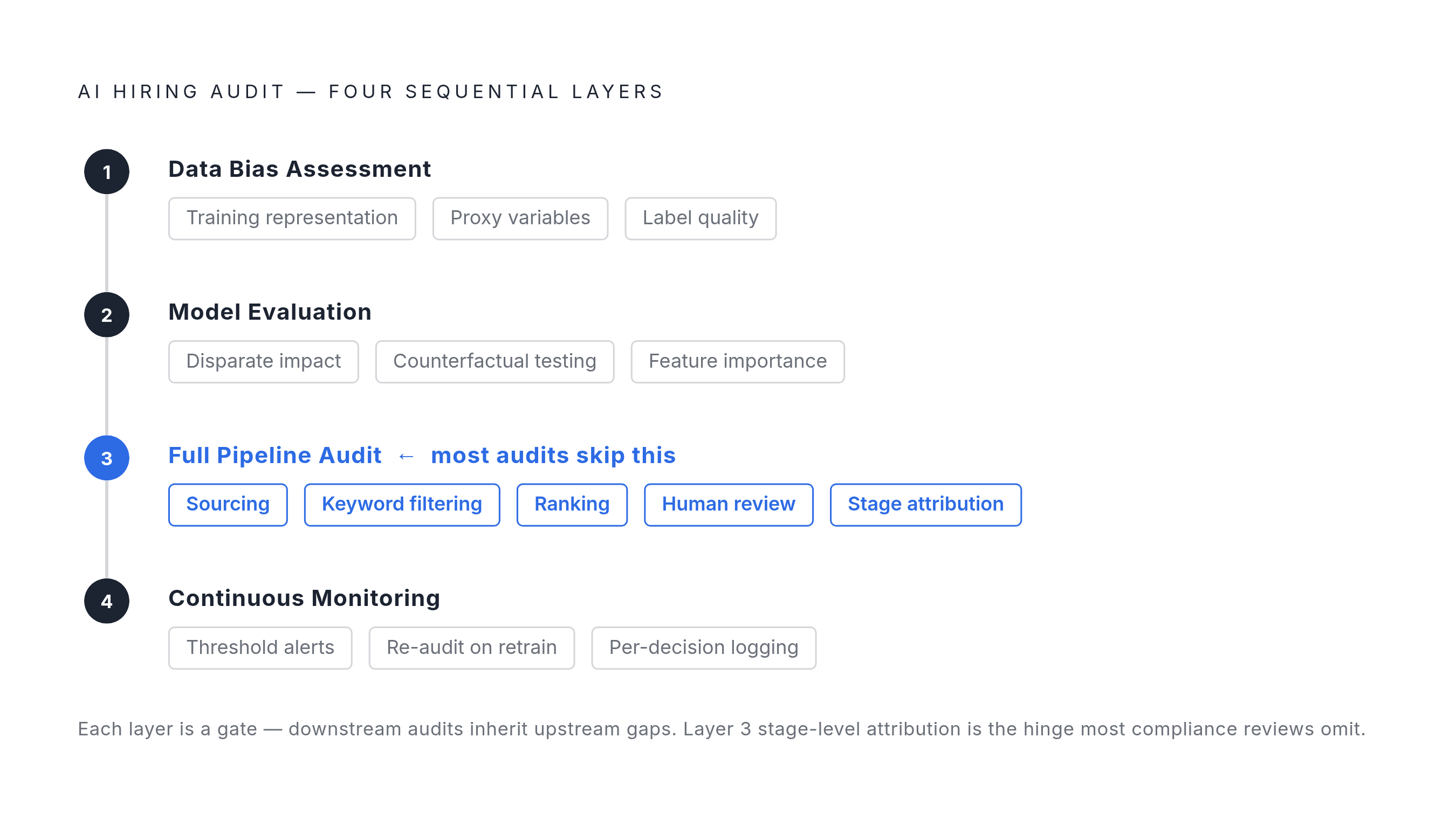
Any rigorous audit framework has to start upstream of the model, with the data it was trained or calibrated on. A 2025 peer-reviewed framework developed by Oveh and Isitor places Data Bias Assessment as the first of four core components, examining whether the training dataset over- or under-represents demographic groups and whether the outcome labels it relies on (who was hired, who advanced to the next round) already encode past discrimination. In practice, this layer involves auditing group representation across protected attributes, examining proxy variables like zip code, school name, or graduation year that correlate with protected class membership without naming it directly, and inspecting the quality of outcome labels themselves. A label of "successful hire" only reflects fairness to the degree the hiring process that generated it was fair.
The case study attached to the Oveh and Isitor framework shows what you miss without this layer. Yet the same model showed a Disparate Impact Ratio of 0.67 and an Equal Opportunity Difference of 0.13, and both reflect gender bias that top-line performance metrics never surfaced. Correcting the data does not, on its own, guarantee the model learns from it equitably. That determination belongs to the next layer of the audit.
Layer two: evaluating the model's decisions for disparate impact across demographic groups
Model-level evaluation requires computing several fairness metrics at once, because different metrics catch different forms of disparate treatment and satisfying one offers no guarantee of satisfying another. This is not a design oversight that better engineering eliminates. No combination of fairness metrics can satisfy all fairness criteria at once, and the fairness literature treats this result as mathematically settled.
Counterfactual, or per-decision, auditing adds a layer of causal precision the aggregate metrics above cannot provide on their own. Holding every job-relevant attribute fixed while varying only the protected attribute under examination isolates how the algorithm treats that attribute specifically. This is the same logic behind the paired-resume methodology used in the Stanford Pymetrics study and in Baldwin's 2025 audit-style evaluation framework for large language models. The same audit task, applied to two model generations, told biased behavior apart from behavior indistinguishable from chance, and that is exactly the discriminating power a model-layer audit needs. Feature-importance analysis belongs at this layer too: identifying which inputs, keywords, school names, tenure patterns, are actually driving a candidate's score reveals whether the model is reasoning from job-relevant signal or from proxies for protected characteristics.
Layer three: auditing the full hiring pipeline, not just the ranking model
A model-level audit, however thorough, only examines one stage of a longer process, and bias frequently enters or compounds at stages the model never touches. A disparity report showing which groups are underrepresented in final rankings does not by itself reveal where in the pipeline that exclusion occurred, and the fix required differs sharply depending on the answer. The gap might originate in sourcing, in keyword filtering applied before the ranker ever runs, in the ranking model itself, or in human review of the ranked output. An audit that begins its analysis at the model misses that entire stage.
This is why an audit report's value depends on attribution, not detection. Identifying that a disparity exists is a necessary first step, and identifying which pipeline stage produced it is what allows a remediation effort to be targeted. A dashboard that reports a disparity in outcomes for a given cohort without attributing it to sourcing, filtering, ranking, or review cannot direct anyone toward a fix. That requirement, that an audit output must name the stage of origin, carries forward directly into what continuous monitoring has to track over time.
Layer four: continuous monitoring because models and labor markets both change over time
A model that passes every check described above at the moment of deployment is not necessarily a model that remains fair a year later. The labor market the model operates in changes too. A one-time or annual audit captures a snapshot that can be obsolete well before anyone acts on its findings.
One proposed response to this problem is the "Fair Game" framework, published in the Cambridge Forum on AI: Law and Governance in 2025, which puts an auditor and a debiasing algorithm into a continuous loop using reinforcement learning. Instead of fixing fairness goals at the point of initial design, the framework allows those goals to update as legal and ethical standards evolve. The gap between an annual compliance requirement and genuine ongoing monitoring is visible in the enforcement record itself: NYC Local Law 144's annual independent audit requirement functions as a legal floor, not a monitoring architecture, and the Comptroller's December 2025 finding, one non-compliance instance identified by DCWP against at least 17 potential issues found in the same 32 disclosures by the Comptroller's own review, shows how much an annual snapshot can miss. A working monitoring architecture needs automated alerts that trigger when impact ratios for any demographic cohort cross predefined thresholds, it needs periodic re-auditing of feature weights after any model retraining event, and it needs a logging architecture that preserves per-decision data at the granularity needed for position-by-position analysis, the same granularity at which the Stanford study found disparities that aggregate data had concealed.
Mitigation techniques that follow from audit findings, and their limitations
Mitigation only works when it is matched to the layer where the audit found the problem. An intervention applied at the wrong stage, or chosen without a clear understanding of where the bias originates, can reduce one disparity while introducing another. Data-layer mitigations, oversampling underrepresented groups, augmenting data to balance label distributions, and reweighting training examples to reduce the influence of historically biased outcome labels, work best when the audit has already confirmed that data composition, rather than model architecture, is the primary driver of the disparity.
Model-layer mitigations address a different source. Calibration in particular carries risk: equalizing pass rates at a single threshold can worsen accuracy for every group involved if the calibration is not grounded in empirical measurement of what the model is actually doing. Pipeline-layer mitigations take yet another form: you restructure default sourcing filters, add human review checkpoints at the specific stages an audit identified as high-disparity, and require that any position-level adverse impact finding trigger a documented human override before an automatic advance.
The strongest limitation applies across all three categories at once. Technical mitigation, no matter how well executed, without transparent deliberation about which fairness criterion is being optimized for, and who made that choice, reproduces a governance gap even when the underlying math checks out. The ethical value choices embedded in how an algorithm gets designed need to be made explicit and subjected to review, not buried inside a calibration parameter.
What a Rigorous Audit Engagement Looks Like in Practice
An organization that understands all four layers described above is in a position to tell a compliance-checkbox engagement apart from one built to actually catch bias, and to specify what a report has to contain before it is useful. A compliance-only audit typically delivers aggregate impact ratios, a pass or fail determination against the four-fifths threshold, and an attestation of independence, with no identification of which pipeline stage produced a given disparity and no guidance on how the model should be retrained. A rigorous engagement delivers considerably more: per-position impact ratio breakdowns rather than aggregate figures alone, intersectional cohort analysis, feature-importance attribution showing which model inputs drive differential outcomes, pipeline-stage attribution for every disparity identified, and a specification for the monitoring architecture that will run after deployment.
Verifying genuine independence matters as much as verifying technical rigor. With three firms, Holistic AI, DCI Consulting, and BABL AI, accounting for over half of all published NYC Local Law 144 audits, buyers have reason to confirm directly that their chosen auditor holds no contractual or financial relationship with the ATS vendor being assessed. Building and maintaining the continuous monitoring layer this framework depends on is fundamentally an engineering undertaking, not only a statistical one. Organizations without that capacity in-house are increasingly augmenting their teams with outside engineering talent built for exactly this kind of work. BairesDev, for instance, maintains a pool of vetted engineers spanning AI, machine learning, data science, and QA disciplines, operating in timezone alignment with North American teams, a detail that matters when a bias alert requires a rapid response. The audit framework only functions if the organization running it can act on what the framework finds, and that capacity has to be engineered, not assumed.